
Self-published authors keep up to 70 percent of each sale under Amazon’s Kindle Direct Publishing, compared with the 10 to 15 percent royalty most traditional publishing contracts pay, and how royalty percentages are actually calculated shows why that gap compounds fast for authors who sell in volume. The ten authors below turned that math into seven and eight figure careers, starting with nothing but a manuscript and a KDP account.
Three of them, Amanda Hocking, Hugh Howey, and Andy Weir, later signed traditional publishing deals after their self-published books took off. What’s easy to miss is that Howey negotiated to keep his digital rights in that deal, a structure now common enough to have its own name: hybrid publishing. The authors who did best here didn’t choose between self-publishing and a traditional deal. They used self-publishing to prove demand first, then negotiated from a position most debut authors never get to stand in.
The Shift from Traditional to Self-Publishing
Self-published authors can go from finished manuscript to published book in weeks. The traditional route usually takes over a year once an agent and a publisher are both attached, and that’s after the manuscript is finished and accepted.
Bowker recorded more than 1.68 million self-published titles released in the U.S. in 2019, up from just over 200,000 in 2011. That growth tracks directly to the two things authors get by skipping the traditional gatekeepers: a bigger cut of each sale and control over when the book actually reaches readers. For most authors, weighing self-publishing against a traditional deal comes down to trading a bigger share of each sale and full control for an advance and an existing distribution network. Authors who publish direct also set their own price, run their own promotions, and can adjust the book itself (cover, blurb, even content) the same week they notice something isn’t working, instead of waiting on a publisher’s schedule.
Self-Publishing Success Stories
E.L. James
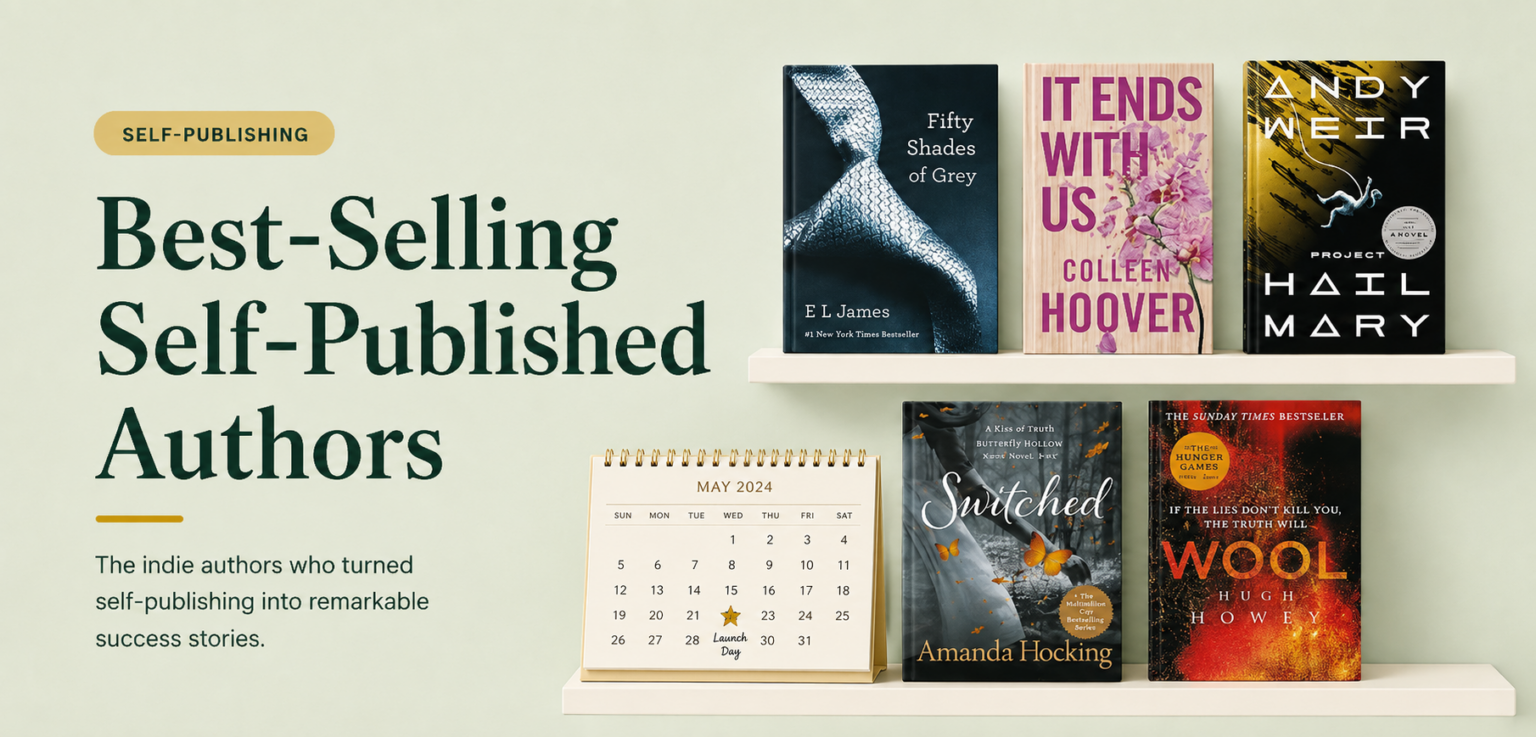
E.L. James has earned an estimated $100 million or more and sold over 150 million copies since self-publishing the first Fifty Shades of Grey installment in 2011.
The book started as Twilight fan fiction before James rewrote it as an original story and released it independently. Its success moved fast: film adaptations, merchandising, and translations into more than 50 languages followed within a few years. James’s trajectory is still the clearest proof point that a self-published book can outsell almost anything a traditional publisher puts out, given the right combination of genre, timing, and word of mouth.
Amanda Hocking
Amanda Hocking sold over 1.5 million copies and earned an estimated $20 million or more after self-publishing her Trylle Trilogy in 2010.
She’d been rejected by traditional publishers before deciding to release the young adult paranormal series herself. The trilogy’s sales numbers led to a multimillion-dollar deal with St. Martin’s Press, but the self-published run that preceded it is the part of her story that matters most for other indie authors: she built the audience and proved the genre demand before a publisher ever got involved.
Hugh Howey
Hugh Howey sold over 3 million copies of his Wool series and earned an estimated $10 million or more after self-publishing the first installment as a short story on Amazon in 2011.
Wool’s success let Howey leave his day job to write full time, and it eventually led to a deal with Simon & Schuster. That deal is the notable part: Howey kept the digital rights, letting the publisher handle print while he continued to control and profit from ebook sales. It’s one of the earliest examples of a hybrid deal structured specifically to protect what the author built independently.
Andy Weir
Andy Weir has earned an estimated $50 million or more from The Martian across book and film deals, after self-publishing the novel as a free serial on his personal blog and later charging $0.99 for the Kindle version.
Reader demand pushed The Martian up the Kindle charts fast enough that Crown Publishing signed Weir for a traditional release, and the book was later adapted into a film directed by Ridley Scott. Weir’s path shows that self-publishing works even for a genre, hard science fiction, that traditional publishers have historically treated as a hard sell.
John Locke
John Locke sold over 3 million copies of his Donovan Creed series and earned an estimated $20 million or more after self-publishing the first book in 2010.
Locke was one of the earliest authors to build real income through Kindle Direct Publishing specifically, using aggressive pricing and marketing tactics at a time when few authors were treating KDP as a serious sales channel rather than a fallback option. His numbers proved that a self-published thriller series could compete directly with traditionally published genre fiction on both sales and visibility.
Notable Mentions: List of Self-Published Authors
- Bella Andre has sold over 7 million copies of her Sullivans series, built entirely through Kindle Direct Publishing. Her sustained sales in the romance genre show that self-publishing success doesn’t have to come from one breakout title. Andre built her readership series by series, using each new release to sell backlist titles to the same audience.
- Colleen Hoover started her career by self-publishing Slammed in 2012, before publishing deals and a run at the top of contemporary fiction and romance charts followed.
- Craig Martelle sold over 1 million books in his self-published Frontiers Saga, establishing himself as a key figure in indie science fiction.
- Rachael Herron sold tens of thousands of copies independently in the Cypress Hollow series, building her following in women’s fiction and romance through direct reader engagement.
- Mark Dawson sold over 1 million books in his self-published John Milton series and has since taught other authors his approach to indie marketing and sales strategy.
Top Self-Published Books That Became Bestsellers
- Fifty Shades of Grey sold over 150 million copies after starting as self-published fan fiction in 2011, making it the best-selling self-published book of all time. Its climb from an independently released ebook to a global franchise, including a film trilogy, is credited with helping bring self-publishing into the mainstream conversation as a legitimate path to a bestseller.
- The Martian by Andy Weir sold over 5 million copies after Weir self-published it as a $0.99 Kindle book, before Crown Publishing and a Ridley Scott film adaptation followed.
- Wool by Hugh Howey sold over 3 million copies after starting as a self-published series of short stories, later becoming a hybrid deal with Simon & Schuster that let Howey keep his digital rights.
- The Trylle Trilogy by Amanda Hocking sold over 1 million copies after its 2010 self-publishing debut, leading to a multimillion-dollar deal with St. Martin’s Press.
- Still Alice by Lisa Genova sold over 2 million copies after Genova self-published the novel in 2007; Simon & Schuster later picked it up, and it was adapted into a film starring Julianne Moore.
- The Shack by William P. Young sold over 20 million copies worldwide after Young self-published it in 2007 following repeated rejections from traditional publishers.
- The Alchemist by Paulo Coelho sold over 65 million copies worldwide, with its independent early release helping the book find the global audience that a traditional first printing had failed to reach.
What These Authors Actually Have in Common
The pattern across every profile above comes down to a specific set of decisions that show up again and again. A niche genre with an underserved but hungry readership, a direct relationship with that readership through email or social platforms, and enough patience to keep publishing while the audience was still small.
Marketing and Reader Relationships
Every author on this list treated their readership as an asset they owned directly, separate from anything a publisher’s marketing team would have controlled. That’s why building an author platform before the book even launches has become one of the clearest predictors of which self-published authors break out and which ones stall after a single release.
It’s the practical difference between self-publishing and traditional publishing that rarely gets stated directly: a traditional publisher owns the relationship with the bookstore and the reviewer, but a self-published author owns the relationship with the reader. An email list or a social following becomes the asset that sells the next book, and the one after that, without needing a new marketing budget each time.
Quality content and professional presentation still matter as much as reader relationships. Investing in professional editing and a genre-appropriate cover design is what lets a self-published book compete visually and editorially with anything from a traditional imprint, and it’s usually the difference between a book that gets a fair read and one that gets dismissed on sight for looking self-published.
Building a Sustainable Career in Self-Publishing
Hugh Howey and Amanda Hocking both built careers, not single hits, by continuing to publish and adapt to reader demand after their first success.
Self-publishing also functions as a proving ground for traditional deals, something authors move through on the way to a bigger contract. Colleen Hoover is the clearest recent example: she self-published Slammed in 2012 and used the readership it built as the foundation for the mainstream career and bestseller status that followed. Authors who treat growing an email list of engaged readers as part of the job, not an afterthought, are the ones who turn one successful book into the kind of career Hoover and Howey built. That flexibility, moving between self-publishing and traditional publishing rather than picking one permanently, is what makes a self-published career durable instead of a one-book story.
Challenges Facing Self-Published Authors
More than 1.68 million new titles entered the U.S. self-publishing market in 2019 alone, which means a new self-published book is competing against millions of already-established ones for the same reader attention. Standing out requires weighing the real tradeoffs of self-publishing honestly, since the same freedom that lets an author publish fast also means absorbing costs and distribution work a traditional publisher would otherwise handle.
That volume is the tradeoff for the low barrier to entry that makes self-publishing possible in the first place. Standing out requires more than a finished manuscript; it requires the same marketing effort the authors above put in before anyone but their initial reader base knew their name.
Self-published authors also face real distribution limits. Traditional publishers have existing relationships with bookstores and physical retailers that most independent authors don’t have access to, which pushes self-published sales toward digital and print-on-demand channels and away from physical shelf space. A stigma around self-published quality still exists among some readers and critics, rooted in the absence of a traditional editorial filter, and the authors who overcome it are consistently the ones who invested in professional editing and design rather than skipping those steps to publish faster.
Impact on the Literary World
Self-published books like The Martian and Still Alice have gone on to win critical acclaim and awards, proving that independently published work can match traditionally published fiction on literary merit.
Literary festivals now regularly include self-published authors, and critics increasingly review independently published books on the same terms as traditionally published ones. The stigma hasn’t disappeared, but it’s no longer the default assumption it was a decade ago.
Future Trends in Self-Publishing
Traditional publishers are increasingly offering hybrid deals that let self-published authors keep more of their rights, the same structure Hugh Howey used with Simon & Schuster back in 2011.
That shift toward hybrid arrangements suggests the two publishing models are converging rather than competing. Improvements in AI-assisted marketing personalization, audiobook production, and reader analytics are also lowering the operational overhead that used to make self-publishing a full-time job on its own, on top of the writing.
Self-Publishing Platforms
Amazon’s Kindle Direct Publishing and Smashwords remain the two platforms most self-published authors use to reach readers, with KDP covering Amazon’s own marketplace and Smashwords extending distribution to retailers like Apple Books, Barnes & Noble, and Kobo.
Both platforms handle formatting, cover upload, and pricing, and both give authors real-time sales data that a traditional publishing contract rarely shares in the same detail. Getting the most out of Kindle Direct Publishing specifically, from pricing tiers to categories and keywords, is often what separates a book that reaches its genre’s readers from one that doesn’t. That data is what let authors like Hugh Howey and Andy Weir notice their books were taking off in time to capitalize on it, rather than finding out from a royalty statement months later.
FAQ: Successful Self-Published Authors
Q: Who is the most successful self-published author?
E.L. James is the most successful self-published author by both earnings and copies sold, having earned an estimated $100 million or more and sold over 150 million copies of the Fifty Shades of Grey series since self-publishing it in 2011. Her jump from independently released fan fiction to a global film franchise remains the clearest example of what a self-published book can achieve at scale.
Q: Can self-published authors be successful?
Yes, self-published authors can be successful, and the examples above, from E.L. James to Andy Weir, show what that success can look like at its highest end. Most self-published authors won’t reach that level, but Kindle Direct Publishing gives every author the same royalty structure and reach that these bestsellers used to get there. The opportunity is real, even if the biggest outcomes are rare.
Q: What is the average income of a self-published author?
The average self-published author earns a modest income, often just a few hundred to a few thousand dollars a year, since most books sell well under 100 copies. Income varies enormously by genre, output, and marketing effort, which is why the handful of authors who reach six or seven figures stand out as exceptions rather than the norm. Looking at how first-time authors typically fare financially puts the outliers profiled above in perspective.
Q: How many copies do you need to sell to make $100,000 self-publishing?
At a $4.99 ebook price and Kindle Direct Publishing’s 70 percent royalty tier, an author nets roughly $3.50 per copy after delivery fees, which means selling around 28,500 to 29,000 copies to reach $100,000 in royalties. That number drops significantly at a higher price point or with a series that keeps the same readers buying multiple books.
Q: What percentage does Amazon take from self-published books?
Amazon takes 30 percent of each ebook sale on Kindle Direct Publishing, leaving self-published authors with a 70 percent royalty on books priced between $2.99 and $9.99. Outside that price range, or for print books through KDP’s paperback and hardcover options, the royalty structure and Amazon’s cut change. That 70 percent rate is still far higher than the 10 to 15 percent most traditional publishing deals pay.
Q: What are the downsides of self-publishing?
The main downsides of self-publishing are the lack of built-in distribution, the absence of an advance, and the amount of marketing work that falls entirely on the author. Traditional publishers place books in physical stores and handle much of the promotion, so self-published authors have to build that reach themselves through email lists, social platforms, and paid ads. Editing and cover design costs also come out of pocket.
Q: Who is the 30-year-old who made $1.8 million self-publishing on Amazon?
Dakota Krout is the author widely cited for earning $1.8 million in a single year self-publishing on Amazon. A former Army veteran, Krout started writing LitRPG fantasy novels as a hobby, and his Divine Dungeon series grew into Mountaindale Press, the publishing company he now runs. His story shows that a specific, underserved genre niche can outperform broader, more crowded categories.
Q: Do bookstores accept self-published books?
Some bookstores accept self-published books, but most require the book to be returnable, which print-on-demand titles typically aren’t, and many independent stores prioritize titles from traditional distributors. Self-published authors have better luck with local, indie-friendly bookstores that allow consignment arrangements and author events than with securing shelf space in major chains. Digital and print-on-demand sales remain the primary channel for most successful self-published authors.
Q: What is “20 Books to 50K”?
20 Books to 50K is a self-publishing strategy and author community built around writing enough books in a single genre to reach $50,000 a year in income. Craig Martelle, one of the authors mentioned above, helped build the movement alongside other indie authors focused on volume, series marketing, and genre-specific reader targeting. It’s become one of the most influential strategies among successful self-published authors today.