
Book Genre Guide

Art Books:
The Complete Genre Guide

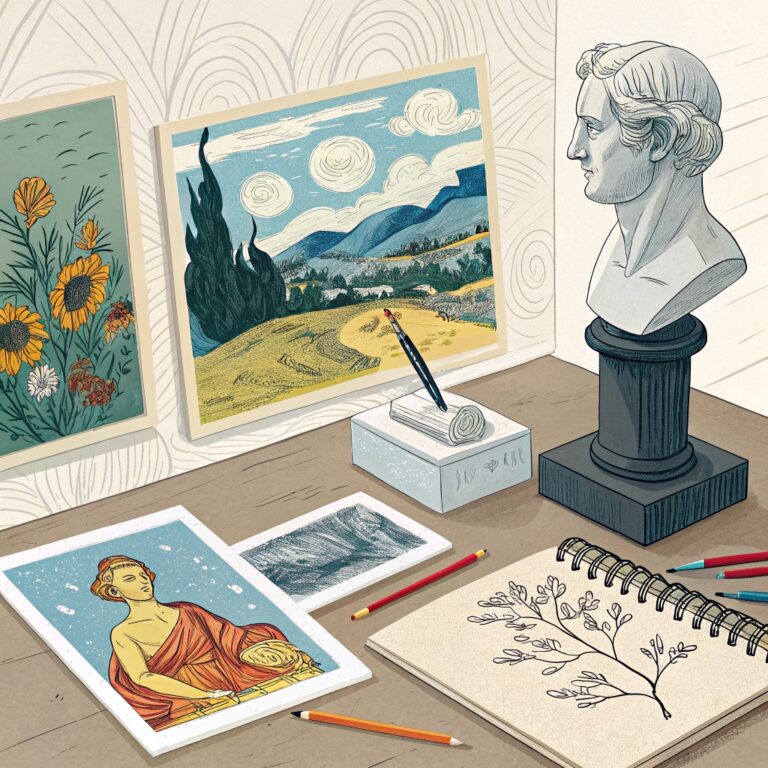
This guide maps the whole art books genre; from art history books that trace movements and masterpieces, to artist monographs, books for artists, the lavish coffee-table and photography books made to be displayed, and the art fiction where a single painting drives the plot.
Typical length

Text can run 20,000 to 80,000 words, but page count is driven by images.

Pacing

N/A

Core Readers

Art lovers, students, collectors, and practising artists.

Heart of It

Art books showcase visual creativity, artistic styles, and inspiring works of art.

Best Formats

Print books.

What Defines the Art Genre

What Makes an Art Book More Than a Beautiful Object?

A great art book doesn’t just show you images, it changes the way you look: at colour, form, history, culture, and the hidden choices behind every finished work. The best books about art carry a specific kind of intelligence: part visual guide, part cultural record, part invitation to slow down.

A New Way of Seeing

A strong art book teaches you how to read a painting: composition, technique, the symbol hiding in plain sight. And sends you back into the world looking harder than before.

Part Guide, Part Cultural Record

Art writing lives between seeing and understanding. The best books connect the work to its moment: what it was responding to, what it broke from, and why people are still arguing about it generations later.

Images With a Reason to Be There

In an art book, visuals are never decoration. Every painting, sculpture, photograph, or sketch should teach, prove, complicate, or deepen something in the text, and guide the reader toward what actually matters.

Beauty Held Together by Structure

Art books are judged by how they look but remembered by how they're organised. Chronology, movement, theme, or artist profile; whatever the path, the reader should always know why they're moving from one section to the next.

How to Write a Art Book

Writing an art book is a different project from writing about something you simply admire. You’re building a guided experience that helps readers move through images, ideas, artists, and historical context without ever feeling lost. Seven moves separate an art book that teaches a new way of seeing from a handsome but hollow one.

Decide what kind of art book you're making.

An art-history survey, a single-artist monograph, a how-to-draw guide, and a coffee-table photography book are four different projects with four different readers. Choose which one you're writing before anything else, because it governs length, structure, and design.

Find the through-line or argument.

The best art books have a clear organising idea; a movement, a thesis about seeing, a single artist's evolution. Decide what yours is really about, so the images and chapters build toward something rather than simply accumulating.

Make the images do the teaching.

In an art book the visuals are the content, not decoration. Choose each image to teach, prove, or deepen a point, and write the text to guide the reader's eye to what actually matters in it.

Sort out image rights early.

This is the art book's biggest hidden hurdle: reproducing artworks and photographs usually requires permissions and licensing fees. Identify what you need, and who holds the rights, before you build the book around images you may not be able to clear.

Design for reproduction quality.

Art books live or die on how the images print: colour accuracy, resolution, paper stock, trim size. Plan for high-resolution files and full-colour printing from the start, because a muddy reproduction undermines the entire book.

Structure so the reader always knows the path.

Chronology, movement, theme, or artist profile; whatever the organising principle, make the journey from section to section clear, so the reader never feels lost among the plates.

Write with authority and accessibility.

Whether it's art history or technique, the text should know its subject deeply but never lecture. Explain without condescending, and invite the reader to slow down and look harder rather than showing off.
Building a Art plot and stuck on structure? A Spines writing coach can help you design your Art, develop your investigator, and make sure every clue lands where it should.

Art Subgenres

Art is the broadest genre there is. Pick the lane closest to your story to see what readers expect and a benchmark title to study.
Subgenre

Art History Books

Art history books explore movements, periods, artists, and cultural shifts across time, showing how art changes alongside politics, religion, technology, money, and taste. Art history books draws 800 monthly searches. The best ones make the past feel visible rather than distant, connecting every masterpiece to the world that produced it, and they remain the intellectual backbone of the whole category.

Example
The Story of Art — E.H. Gombrich
Subgenre

Books About Artists (Monographs)

Focused on individual artists or creative circles, these books combine biography, criticism, and visual analysis. Monographs on painters, sculptors, and photographers are where readers go when they want to understand not just the work but the life that produced it: the struggles, rivalries, and breakthroughs behind the images on the wall.

Example
The Lives of the Artists — Giorgio Vasari
Subgenre

Books for Artists (Technique & Instruction)

Practical, reflective, and motivational, books for artists are made for working and aspiring creatives. They cover drawing, painting, process, discipline, creative blocks, and the business of making art. The best combine clear instruction with genuine inspiration.

Example
Drawing on the Right Side of the Brain — Betty Edwards
Subgenre

Coffee-Table & Photography Books

The most visual strand: large-format, beautifully produced books where the images lead and the text supports. Coffee table books is a huge search term at 19,000 monthly searches, and art and photography titles are its heart. Made to be browsed, displayed, and gifted, these books sell on production values as much as on subject.

Example
Humans of New York — Brandon Stanton
Subgenre

Art Fiction

A growing category where art becomes the emotional or structural centre of the story. Art fiction and novels about artists follow painters, collectors, students, curators, or families shaped by a single artwork, watching creativity collide with ambition, obsession, love, or loss.


Example
The Goldfinch — Donna Tartt

Best Art Books

The novels that built modern Art, shaped reader expectations, and still function as essential comp titles for writers working in the genre today.
The Story of Art E.H. Gombrich
The Story of Art
E.H. Gombrich
Steal Like an Artist Austin Kleon
Steal Like an Artist
Austin Kleon
The Story of Art E.H. Gombrich
The Story of Art
E.H. Gombrich
Just Kids Patti Smith
Just Kids
Patti Smith
The Artist’s Way Julia Cameron
The Artist’s Way
Julia Cameron

Read More About Art

Want to go further? Explore our guides on worldbuilding, magic systems, and publishing your Art series.
A Quick Guide to Self-Publishing: How Book Distribution Services Work

A Quick Guide to Self-Publishing: How Book Distribution Services Work

You may have written a great book, but that doesn't mean people will suddenly be coming out of the woodwork to help you sell it.  A successful book distribution campaign is one of...
Private: A Step-by-Step Guide on How to Publish a Book on Amazon

Private: A Step-by-Step Guide on How to Publish a Book on Amazon

Publishing on Amazon is one of the most underrated ways you can earn money as a writer. Their program, Kindle Direct Publishing (KDP), grants a 70% royalty on sales, is completely free to...

Explore Related Genres

Art shares its DNA with these neighbouring genres. Explore their complete guides.

Art Frequently Asked Questions

Your world is waiting for readers

Bring your manuscript to Spines and we’ll take it from final draft to global distribution — your words, your world, your way.

Talk with us!
Talk with us!