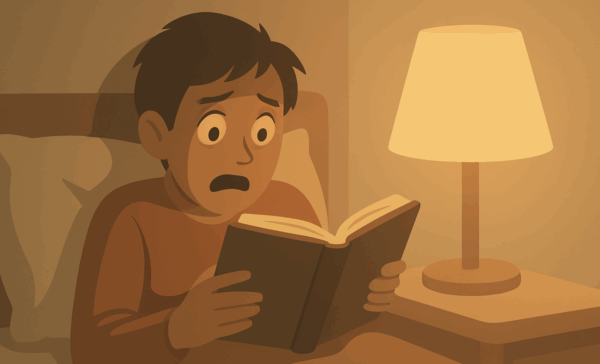


Sometimes “nice” is not wrong. It is just not enough.
If you are describing a friend, writing a character, preparing a recommendation, or trying to say something that actually feels accurate, the right adjective can do a lot of quiet work. It can turn a flat sentence into a vivid one. It can make a person feel recognizable instead of generic. It can help you say, in one word, what would otherwise take a paragraph.
An adjective to describe a person is a word that captures something about their personality, character, mood, behavior, intelligence, values, or appearance. “She was smart” gives the reader a rough idea. “She was perceptive” tells us she notices what others miss.
This list gives you more than 150 adjectives to describe a person, grouped by meaning so you can find the right word faster. Each adjective includes a simple definition and an example sentence, so you can see how it works in context.
If you’re describing a character you’re writing, skim the categories that match their core trait first, then borrow from the rarer words near the end to make the description your own.
Quick Guide: Which Adjective Should You Use?
| If you mean… | Try… |
| Kind in an active, caring way | Compassionate, benevolent, nurturing |
| Smart in a practical way | Astute, shrewd, resourceful |
| Smart in a deep or reflective way | Insightful, discerning, sagacious |
| Hardworking with care | Diligent, conscientious, meticulous |
| Hardworking with grit | Tenacious, persistent, resilient |
| Socially warm | Affable, genial, approachable |
| Charismatic | Magnetic, charming, engaging |
| Honest and morally steady | Principled, ethical, honorable |
| Calm under pressure | Composed, stoic, unflappable |
| Stylish or refined | Elegant, polished, dapper |
| Mysterious | Enigmatic, brooding, taciturn |
| Talkative | Loquacious, garrulous, effusive |
How to Choose the Right Word to Describe Someone
A good adjective is not the fanciest word. It is the most accurate one. So, before choosing a word, ask yourself what you are really trying to show. Is the person warm, or just polite? Confident, or actually arrogant? Quiet because they are shy, thoughtful, guarded, or uninterested?
A strong descriptive adjective usually comes from precision, not quantity. One clear adjective often lands harder than three vague ones.
Here are a few simple filters:
Context matters.
The same person may need different words in different situations.
Example: “Strategic” works well in a resume, while “easygoing” feels more natural in a personal note.
Look for the core trait.
A stronger adjective should describe what is really behind the first impression.
Example: Instead of “Daniel is friendly,” write, “Daniel is approachable. New employees feel comfortable asking him questions.”
Pay attention to tone.
Adjectives change the emotional feeling of a sentence.
Example: “She stayed calm during the argument” feels peaceful, while “she stayed stoic during the argument” feels more serious and restrained.
Choose specificity over generality.
Precise words give the reader a clearer picture.
Example: Instead of “Lena is careful,” write, “Lena is meticulous. She catches small mistakes most people miss.”
Use restraint.
One strong adjective usually works better than several average ones.
Example: Instead of “He is smart, thoughtful, and observant,” write, “He is perceptive. He notices when someone is confused before they say anything.”
If you are writing fiction, the best adjective often points toward behavior. If you are writing about a real person, it should feel fair, not inflated. If you are writing professionally, choose a word that sounds specific without sounding exaggerated.
150+ Adjectives to Describe a Person
Here’s a curated list of adjectives to help you describe a person in more dynamic, specific, and engaging ways.
Positive Adjectives to Describe a Warm, Kind Person
Kindness has many shades. Some people are gentle. Some are generous. Some are emotionally present. Some show care through small, thoughtful actions rather than big declarations.
Use these adjectives when you want to describe someone who makes others feel safe, seen, supported, or welcome.
| Word | Meaning | Example |
|---|---|---|
| 1. Affectionate | Openly showing love and fondness | Her affectionate hello set everyone at ease. |
| 2. Compassionate | Moved to help those who are suffering | A compassionate nurse, she sat with frightened patients. |
| 3. Considerate | Mindful of how actions affect others | He’s considerate enough to text when he’s running late. |
| 4. Empathetic | Able to feel what another person feels | Her empathetic nature made her the one friends confided in. |
| 5. Generous | Quick to give time, money, or praise | He was generous with credit and stingy with blame. |
| 6. Gentle | Mild and tender in manner | She had a gentle way of correcting mistakes. |
| 7. Gracious | Warm and courteous, especially under pressure | A gracious host, she made the latecomers feel expected. |
| 8. Nurturing | Encouraging the growth of others | His nurturing style turned nervous juniors into leaders. |
| 9. Tender | Soft-hearted and caring | A tender goodbye lingered at the door. |
| 10. Thoughtful | Attentive to small, meaningful details | The thoughtful gift showed she’d actually listened. |
| 11. Warm | Friendly and emotionally open | His warm manner filled the room before he said a word. |
| 12. Benevolent | Kind with a wish to do good | The benevolent stranger paid for the family’s groceries. |
| 13. Magnanimous | Generous and forgiving toward rivals | Magnanimous in victory, she praised the team she’d beaten. |
| 14. Altruistic | Selfless in caring for others’ welfare | His altruistic streak kept pulling him toward volunteer work. |
| 15. Amiable | Pleasant and good-natured | The amiable doorman knew every tenant by name. |
| 16. Genial | Cheerfully kind and sociable | A genial uncle, he greeted strangers like old friends |
Adjectives for a Smart, Sharp Person
| Word | Meaning | Example |
|---|---|---|
| 17. Analytical | Skilled at breaking problems apart | Her analytical mind found the flaw nobody else saw. |
| 18. Astute | Quick to grasp what really matters | One astute question exposed the whole scheme. |
| 19. Brilliant | Exceptionally bright or talented | The brilliant young coder rewrote the system overnight. |
| 20. Clever | Quick and inventive in thought | A clever workaround saved the launch. |
| 21. Discerning | Able to judge quality and nuance well | She had a discerning eye for genuine talent. |
| 22. Erudite | Deeply learned and well-read | The erudite professor quoted three languages before noon. |
| 23. Insightful | Seeing beneath the surface of things | His insightful feedback changed how I write. |
| 24. Logical | Reasoning clearly and consistently | A logical thinker, she walked us through it step by step. |
| 25. Perceptive | Quick to notice subtle things | The perceptive editor caught the tone I was hiding. |
| 26. Resourceful | Good at solving problems with what’s at hand | Resourceful as ever, he fixed the leak with a shoelace. |
| 27. Sagacious | Wise and shrewd in judgment | The sagacious elder’s advice proved right for decades. |
| 28. Shrewd | Sharp in practical, self-interested matters | A shrewd negotiator, she never showed her hand. |
| 29. Perspicacious | Unusually quick to understand | His perspicacious read of the room defused the argument. |
| 30. Quick-witted | Fast and sharp in response | Her quick-witted reply turned the heckle into a laugh. |
| 31. Inventive | Full of original ideas | The inventive engineer prototyped it in a weekend. |
| 32. Knowledgeable | Well-informed across a subject | A knowledgeable guide, he answered every odd question. |
Words to Describe a Driven, Hardworking Person
| Word | Meaning | Example |
|---|---|---|
| 33. Ambitious | Strongly set on achieving | The ambitious intern outpaced staff twice her age. |
| 34. Determined | Refusing to give up on a goal | Determined to finish, he wrote at 5 a.m. every day. |
| 35. Diligent | Careful and persistent in effort | Her diligent notes saved the whole project. |
| 36. Disciplined | Consistent and self-controlled | A disciplined runner, he never skipped a training day. |
| 37. Enterprising | Eager to start things and seize chances | The enterprising teen ran three side businesses. |
| 38. Focused | Hard to distract from the task | She stayed focused while the office fell apart around her. |
| 39. Industrious | Steadily and busily productive | The industrious clerk cleared a year’s backlog. |
| 40. Meticulous | Precise about every detail | A meticulous proofreader, she missed nothing. |
| 41. Persistent | Continuing despite setbacks | His persistent follow-ups finally landed the deal. |
| 42. Resilient | Recovering quickly from hardship | Resilient after the rejection, she submitted again that night. |
| 43. Tenacious | Holding on with stubborn grit | The tenacious reporter chased the story for years. |
| 44. Indefatigable | Seemingly tireless | An indefatigable organizer, she planned the whole festival solo. |
| 45. Conscientious | Guided by care and a sense of duty | The conscientious doctor double-checked every dose. |
| 46. Driven | Powered by strong inner motivation | Driven to prove them wrong, he trained all winter. |
Adjectives for a Charismatic, Sociable Person
| Word | Meaning | Example |
|---|---|---|
| 47. Affable | Easy and pleasant to talk to | The affable barista remembered everyone’s order. |
| 48. Charming | Delightfully attractive in manner | His charming grin won over the toughest client. |
| 49. Convivial | Cheerful and fond of good company | A convivial host, she kept the table laughing for hours. |
| 50. Engaging | Holding attention pleasantly | Her engaging style made the lecture fly by. |
| 51. Gregarious | Sociable and crowd-loving | The gregarious manager thrived in a busy office. |
| 52. Magnetic | Drawing people in irresistibly | His magnetic presence filled the stage. |
| 53. Outgoing | Comfortable reaching out to others | An outgoing newcomer, she had friends by lunchtime. |
| 54. Personable | Pleasant and easy to like | The personable rep turned a complaint into a thank-you. |
| 55. Vivacious | Lively and full of spirit | Her vivacious energy lit up the dull meeting. |
| 56. Winsome | Sweetly, innocently appealing | The winsome child charmed the whole waiting room. |
| 57. Debonair | Suave, confident, and stylish | A debonair guest in a sharp grey suit. |
| 58. Effervescent | Bubbly and high-spirited | Her effervescent welcome made the party start early. |
| 59. Approachable | Easy to come up to and talk with | An approachable boss, he kept his door open. |
| 60. Spirited | Full of energy and determination | A spirited debater, she never backed down quietly. |
Creative and Expressive Adjectives
| Word | Meaning | Example |
|---|---|---|
| 61. Artistic | Gifted with creative skill and taste | Her artistic eye reshaped the whole brand. |
| 62. Eloquent | Fluent and moving in expression | The eloquent speaker brought the room to tears. |
| 63. Expressive | Vividly conveying thought and feeling | His expressive face told the story before he spoke. |
| 64. Imaginative | Rich in original ideas and images | The imaginative writer built worlds from a single line. |
| 65. Innovative | Introducing fresh methods and ideas | An innovative teacher, she gamified the whole syllabus. |
| 66. Original | Strikingly new and unlike others | Her original take on the myth won the prize. |
| 67. Visionary | Seeing far ahead of the present | The visionary founder bet on it a decade early. |
| 68. Whimsical | Playfully fanciful and unpredictable | His whimsical doodles filled the margins of every page. |
| 69. Inspired | Touched by sudden creative energy | An inspired solo silenced the whole club. |
| 70. Eclectic | Drawing freely from many styles | Her eclectic taste mixed punk with poetry. |
| 71. Quirky | Charmingly unconventional | His quirky habits made him impossible to forget. |
| 72. Inspiring | Stirring others to feel or act | An inspiring coach, she got more from us than we had. |
Words to Describe an Honest, Principled Person
| Word | Meaning | Example |
|---|---|---|
| 73. Authentic | True to who they really are | Her authentic warmth couldn’t be faked. |
| 74. Candid | Honest and direct, even when it’s hard | A candid friend, he told me what I needed to hear. |
| 75. Dependable | Reliably there when needed | The dependable deputy never dropped a task. |
| 76. Ethical | Guided by strong moral principles | An ethical journalist, she protected her sources. |
| 77. Genuine | Real and without pretense | His genuine apology actually mended things. |
| 78. Honorable | Acting with integrity and respect | The honorable judge recused himself at once. |
| 79. Loyal | Faithful through hard times | A loyal teammate, she stayed when others left. |
| 80. Principled | Firmly committed to what’s right | He made the principled choice, costly as it was. |
| 81. Reliable | Consistently trustworthy in results | The reliable courier had never missed a deadline. |
| 82. Sincere | Heartfelt and free of falseness | Her sincere praise meant more than any award. |
| 83. Steadfast | Unwavering in loyalty or belief | Steadfast to the end, he kept his promise. |
| 84. Trustworthy | Deserving of full confidence | A trustworthy advisor knows when to stay quiet. |
| 85. Upright | Strictly honest and respectable | The upright clerk returned the extra change. |
💡 Did you know adjectives don’t just describe people? They can also describe places, things, or even ideas. For example, in Alice’s Adventures in Wonderland, Lewis Carroll uses adjectives like “curious” and “wonderful” to describe not just Alice, but the entire fantastical world she’s in.
Adjectives for a Brave, Bold Person
| Word | Meaning | Example |
|---|---|---|
| 86. Adventurous | Eager for new and risky experiences | The adventurous traveler said yes to everything. |
| 87. Audacious | Boldly daring, almost reckless | Her audacious plan was too strange to ignore. |
| 88. Courageous | Facing fear or danger head-on | A courageous witness, he testified anyway. |
| 89. Daring | Willing to take bold risks | The daring climber free-soloed the ridge. |
| 90. Fearless | Showing no fear | A fearless reporter walked straight into the protest. |
| 91. Gallant | Brave and nobly courteous | The gallant stranger gave up his seat without a word. |
| 92. Heroic | Showing great bravery for others | Her heroic dash pulled the child from the road. |
| 93. Intrepid | Fearless in the face of hardship | The intrepid explorer mapped the cave alone. |
| 94. Plucky | Bravely spirited despite the odds | The plucky underdog took the title. |
| 95. Valiant | Showing determined courage | A valiant effort kept the team in the game. |
| 96. Undaunted | Not discouraged by difficulty | Undaunted by the loss, she filed again. |
| 97. Bold | Confident and willing to take risks | One bold decision changed the company’s direction. |
Adjectives for Mood and Temperament
| Word | Meaning | Example |
|---|---|---|
| 98. Calm | Untroubled and steady | Her calm voice settled the panicked crew. |
| 99. Cheerful | Visibly happy and upbeat | His cheerful “good morning” was contagious. |
| 100. Composed | Cool and self-controlled | She stayed composed through the hostile questions. |
| 101. Ebullient | Overflowing with enthusiasm | His ebullient reaction made the whole crowd cheer. |
| 102. Easygoing | Relaxed and hard to ruffle | An easygoing roommate, he never sweated the small stuff. |
| 103. Jovial | Cheerfully good-humored | The jovial captain joked through the storm. |
| 104. Melancholic | Quietly, lingeringly sad | A melancholic look crossed her face at the old song. |
| 105. Mercurial | Quick to change moods | His mercurial temper made meetings unpredictable. |
| 106. Optimistic | Expecting good outcomes | Optimistic as always, she saw the delay as a gift. |
| 107. Pensive | Deep in thoughtful reflection | He grew pensive at the mention of home. |
| 108. Placid | Peaceful and even-tempered | Her placid nature calmed the whole household. |
| 109. Serene | Deeply, untroublably peaceful | A serene smile suggested she already knew. |
| 110. Stoic | Enduring hardship without complaint | The stoic veteran never spoke of the pain. |
| 111. Sullen | Silently bad-tempered | A sullen teenager slumped in the back seat. |
| 112. Temperamental | Prone to sudden moods | The temperamental chef ran a tense kitchen. |
| 113. Brooding | Darkly and silently thoughtful | His brooding stare hinted at a long story. |
Adjectives to Describe Appearance and Style
| Word | Meaning | Example |
|---|---|---|
| 114. Athletic | Strong and physically fit | His athletic build came from years on the water. |
| 115. Chiseled | Sharply and strongly defined | A chiseled jaw caught the studio light. |
| 116. Dapper | Neat, trim, and stylishly dressed | The dapper gentleman tipped his hat. |
| 117. Elegant | Gracefully refined and tasteful | She looked elegant in the simplest black dress. |
| 118. Graceful | Smooth and pleasing in movement | The graceful dancer barely seemed to touch the floor. |
| 119. Handsome | Attractive in a strong, clean way | The handsome lead drew every eye on entrance. |
| 120. Lithe | Slim, supple, and easy in motion | A lithe gymnast unfolded into the routine. |
| 121. Polished | Smoothly refined in look and manner | His polished appearance matched his careful speech. |
| 122. Radiant | Glowing with health or joy | Her radiant smile lit the whole photo. |
| 123. Refined | Cultured and free of coarseness | A refined accent softened every sentence. |
| 124. Rugged | Strong and roughly handsome | His rugged features suited the mountain backdrop. |
| 125. Sleek | Smooth, glossy, and streamlined | A sleek silhouette in a tailored coat. |
| 126. Statuesque | Tall and impressively dignified | The statuesque model towered over the set. |
| 127. Striking | Dramatically eye-catching | Her striking looks made strangers turn. |
| 128. Stylish | Fashionably elegant | He was effortlessly stylish, even in a t-shirt. |
| 129. Willowy | Tall, slim, and graceful | A willowy figure crossed the lamplit street. |
Negative Adjectives to Describe a Difficult Person
| Word | Meaning | Example |
|---|---|---|
| 130. Aloof | Cool and emotionally distant | The aloof manager never joined the team lunch. |
| 131. Arrogant | Overrating one’s own importance | His arrogant tone alienated the whole panel. |
| 132. Belligerent | Hostile and eager to fight | A belligerent customer berated the staff. |
| 133. Callous | Coldly indifferent to others’ pain | Her callous reply stunned the grieving family. |
| 134. Cantankerous | Bad-tempered and argumentative | The cantankerous neighbor complained about everything. |
| 135. Deceitful | Habitually dishonest | A deceitful partner hid the losses for months. |
| 136. Dismissive | Treating others as unworthy of attention | His dismissive wave ended the conversation. |
| 137. Egotistical | Excessively self-centered | The egotistical star demanded top billing. |
| 138. Impulsive | Acting without thinking it through | One impulsive comment cost her the contract. |
| 139. Obstinate | Stubbornly refusing to budge | The obstinate official wouldn’t bend the rule. |
| 140. Petty | Fixated on small grievances | A petty rivalry split the otherwise friendly office. |
| 141. Pretentious | Pretending to greater importance | His pretentious vocabulary fooled no one. |
| 142. Sanctimonious | Smugly, self-righteously moral | Her sanctimonious lectures wore everyone down. |
| 143. Spiteful | Driven by a wish to hurt | A spiteful review aimed only to wound. |
| 142. Vindictive | Bent on revenge | The vindictive ex spread the story everywhere. |
| 145. Indifferent | Lacking interest or concern | An indifferent shrug was all the news got. |
Rare and Vivid Adjectives to Make a Description Memorable
These are the words that lift a description out of the ordinary. Use them sparingly and they’ll do a lot of work.
| Word | Meaning | Example |
|---|---|---|
| 146. Beguiling | Charming in a slightly deceptive way | Her beguiling smile hid a sharp agenda. |
| 147. Effusive | Gushingly expressive of feeling | His effusive thanks went on far too long. |
| 148. Enigmatic | Mysterious and hard to read | The enigmatic stranger left no name. |
| 149. Fastidious | Fussily attentive to detail and cleanliness | A fastidious host, he straightened the cushions twice. |
| 150. Garrulous | Excessively talkative | The garrulous passenger narrated the entire flight. |
| 151. Insouciant | Carefree to the point of indifference | She gave an insouciant shrug at the warning. |
| 152. Laconic | Using very few words | His laconic “fine” ended the matter. |
| 153. Loquacious | Fluent and very talkative | The loquacious guide never paused for breath. |
| 154. Nonchalant | Coolly unconcerned | He stayed nonchalant as the alarms blared. |
| 155. Sardonic | Grimly, mockingly humorous | A sardonic grin met the bad news. |
| 156. Taciturn | Reserved and reluctant to speak | The taciturn farmer answered in nods. |
| 157. Unflappable | Impossible to fluster | An unflappable surgeon, she worked through the chaos. |
| 158. Wistful | Gently, longingly sad | A wistful glance at the old playground. |
| 159. Pithy | Brief but full of meaning | His pithy advice fit on a sticky note. |
How to Use Adjectives Without Weakening Your Writing
A list of adjectives is useful, but the real skill is knowing where to place them. The best descriptions do not feel like labels. They feel like recognition. The reader should not just understand the word. They should feel why it fits.
Choose the word that changes the sentence
A weak adjective adds decoration. A strong adjective adds meaning.
Compare these:
She was nice to everyone.
OR
She was gracious to everyone, even the people who interrupted her.
The second sentence tells us more. “Gracious” suggests warmth, restraint, and social intelligence under pressure.
Let behavior prove the adjective
If you call a character “wise,” the reader may believe you for a second. If the character makes a wise choice when everyone else panics, the reader believes it more deeply.
Instead of writing:
He was courageous.
Try:
He signed his name to the complaint, even after everyone else stepped back.
Now the adjective is not doing all the work. The action carries the truth.
Do not stack adjectives just to sound vivid
Too many adjectives can blur the image.
A warm, kind, generous, thoughtful woman sounds positive, but it does not tell us much.
A thoughtful woman who remembered the names of everyone’s children feels more real.
Use one strong adjective, then give the reader one concrete detail.
Match the adjective to the voice
A formal biography may describe someone as “principled,” “disciplined,” or “accomplished.” A novel may call that same person “steadfast,” “restless,” or “quietly stubborn.” A friend might simply say, “She is the kind of person who shows up.”
The right word depends on the setting.
Use rare adjectives only when they feel natural
Words like “perspicacious,” “insouciant,” and “taciturn” can be wonderful. They can also sound forced if the surrounding sentence is plain and conversational. A rare word should feel like the exact key for the lock. If it makes the sentence feel heavier, choose a simpler word.
Show, Don’t Tell: Turn the Adjective Into a Moment
The fastest way to make a description land is to stop naming the trait and start showing the action that proves it. Use the adjective to figure out what you mean, then write the behaviour instead. (Behaviour usually rides on a precise verb, so a strong verbs list pairs well with this.)
| Instead of saying… | Show it with… |
|---|---|
| Kind | She remembered which of us didn’t drink coffee. |
| Meticulous | He read every email twice before sending it. |
| Generous | She tipped in cash so it wouldn’t show on the company card. |
| Patient | She let the toddler tie both shoes, slowly, without reaching in. |
| Brave | She raised her hand when the rest of the room went quiet. |
| Warm | He’d learned the names of everyone’s kids by the second visit. |
| Confident | She walked in ten minutes late and didn’t apologize. |
| Arrogant | He corrected the waiter’s grammar, then ordered for the whole table. |
| Insecure | She apologized for the meal before anyone had tasted it. |
| Controlling | He reorganized the dishwasher she’d just finished loading. |
| Callous | He kept scrolling while she explained why she was crying. |
| Dishonest | His story got a little smoother every time he told it. |
| Lonely | He set out two mugs from habit, then quietly put one back. |
| Vain | He checked his reflection in the dark train window. |
| Nervous | He laughed half a second before the joke actually landed. |
| Exhausted | She read the same sentence four times, then gave up. |
5 Tips for Using Adjectives in Writing
Adjectives are essential for bringing your writing to life, but using them effectively is key. Too many can weigh down your sentences, while too few can leave them feeling flat. Here’s how to make the most out of your adjectives, with examples from classic literature to inspire you.
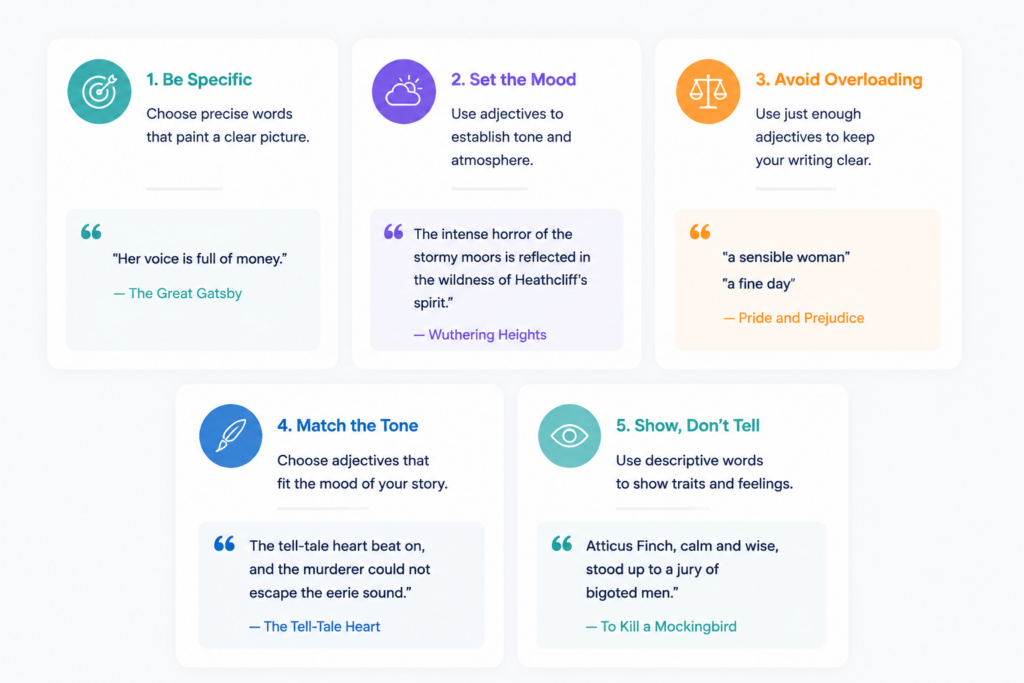
1. Be Specific
Swap vague adjectives like nice or big for words that draw a sharper picture. In The Great Gatsby (Chapter 7), Fitzgerald never calls Daisy “rich.” Gatsby says it in five words:
“Her voice is full of money.”
One precise phrase tells you more about her than a paragraph of wealthy, privileged, spoiled ever could.
2. Use Adjectives to Set the Mood
The right adjective builds atmosphere before anything happens. In Wuthering Heights (Chapter 1), Emily Brontë has Lockwood explain the house’s name:
“‘Wuthering’ being a significant provincial adjective, descriptive of the atmospheric tumult to which its station is exposed in stormy weather.”
A single adjective — wuthering — sets the whole stormy, gothic tone of the novel. Choose adjectives that carry the weather of the scene, not just its facts.
3. Avoid Overloading Your Sentences
More adjectives don’t make a description stronger; distinct ones do. In Pride and Prejudice (Chapter 1), Jane Austen sums up Mrs. Bennet in a single line:
“She was a woman of mean understanding, little information, and uncertain temper.”
Three traits, each doing different work, no padding. Compare that to piling up silly, foolish, anxious, dramatic, which blurs rather than sharpens. Pick the few words that don’t overlap, then stop.
4. Match Tone with Adjectives
Your word choices should match the mood you’re writing in. For something dark or suspenseful, reach for adjectives that unsettle. Edgar Allan Poe opens The Tell-Tale Heart with
“True! – nervous – very, very dreadfully nervous I had been and am,” and later fills the night with a “dreadful silence.”
Words like nervous, dreadful, and hellish keep the horror tone consistent on every page; the adjectives and the atmosphere never pull in different directions.
5. Show, Don’t Just Tell
The strongest move is often to drop the adjective entirely and let behaviour prove it. In To Kill a Mockingbird, Harper Lee almost never calls Atticus Finch “brave” or “wise.” She shows it instead: he takes a case no one else will, and sits alone outside the jail to face the mob. The reader arrives at brave on their own; which is exactly why it sticks. Use the adjective to decide what you want to show, then show it.
“Atticus Finch, calm and wise, stood up to a jury of bigoted men.“
Used well, adjectives do more than decorate; they make writing precise and memorable. Choose specific words, give each one a distinct work to do, and remember that sometimes the strongest description is the one you replace with an action.
Editor’s Advice: Choose the Adjective Last
The writers who capture people in a nutshell rarely start with the adjective; they kick off with what the person actually did.
That’s the habit I think’s worth pinching. If you want to describe someone as ‘kind’, don’t reach for the word ‘kind’. Instead, jot down the smallest true action that made you think it, like she remembered which of us doesn’t drink coffee, and then check whether you really need to slap a label on it at all. Surprisingly, you usually don’t. The little action has already done the job of describing, and the reader gets the pleasure of labelling the trait themselves.
I deal with adjectives just like a personal note to myself – a quick snap diagnosis of what I’m trying to show. He’s a controlling bugger. Useful to me, of course, then I delete it and write down the one thing he did in someone elses kitchen that really showed me.
So use those lists in the way I do, not as words to just chuck into a sentence, but as a way to clearly name a trait in your own head, so you can then go and dig up the one moment that proves it.
— Aziza Redpath, SEO & Content, Spines
FAQ: Niche Adjectives to Describe a Person
Q: What is the nicest word to describe someone?
Kind-hearted is one of the nicest words for someone compassionate and caring; it signals warmth and genuine concern for others.
Example: He’s a kind-hearted person, always the first to help.
Q: What is a fancy word for a good person?
A more elevated word for a good person is virtuous: someone of clear moral excellence who upholds high ethical standards. Principled, honorable, and upright work the same way in formal writing.
Q: How do you describe a brilliant person?
A “visionary” person is someone with exceptional foresight and creativity, often ahead of their time in terms of ideas or inventions. For example, “He was a visionary entrepreneur, always thinking of the future of technology.”
Q: How do you describe a very positive person?
An adjective like “optimistic” is perfect for describing someone with a hopeful outlook on life, always expecting the best outcomes. For example, “Her optimistic attitude made her the most popular person in the office.”
Q: What is the best adjective to describe a person?
The best adjective is the one that matches the person’s core trait and the situation, not the most impressive word. For a warm person, compassionate beats nice; for a sharp one, perceptive beats smart. If you can’t decide, name the single behaviour you’d point to and pick the word that fits it.
Q: What are good positive adjectives to describe someone?
Strong positive adjectives include compassionate, reliable, thoughtful, generous, sincere, resilient, warm, and trustworthy. For something more memorable, reach for magnanimous, vivacious, steadfast, discerning, or gracious. (See our full list of positive character traits for more.)
Q: How do you describe someone in one word?
Pick the one trait that defines them most clearly and choose the most precise word for it. A problem-solver is resourceful; someone socially confident is outgoing or magnetic; someone calm under pressure is composed, stoic, or unflappable.
Q: What adjectives describe a difficult person?
Useful adjectives for a difficult person include arrogant, dismissive, obstinate, callous, petty, vindictive, aloof, impulsive, and belligerent. Use these carefully when writing about real people. (More options in our guide to negative personality traits.)
Q: What are rare adjectives to describe a person?
Rare or vivid adjectives include taciturn, laconic, enigmatic, fastidious, insouciant, beguiling, sardonic, loquacious, garrulous, wistful, and unflappable. These words can make a description more distinctive when used in the right context.
Q: How can I describe a person’s appearance without sounding generic?
Avoid vague words like pretty or good-looking when you need a sharper image. Try adjectives such as striking, radiant, dapper, rugged, statuesque, elegant, sleek, or willowy. The more specific the adjective, the clearer the picture.