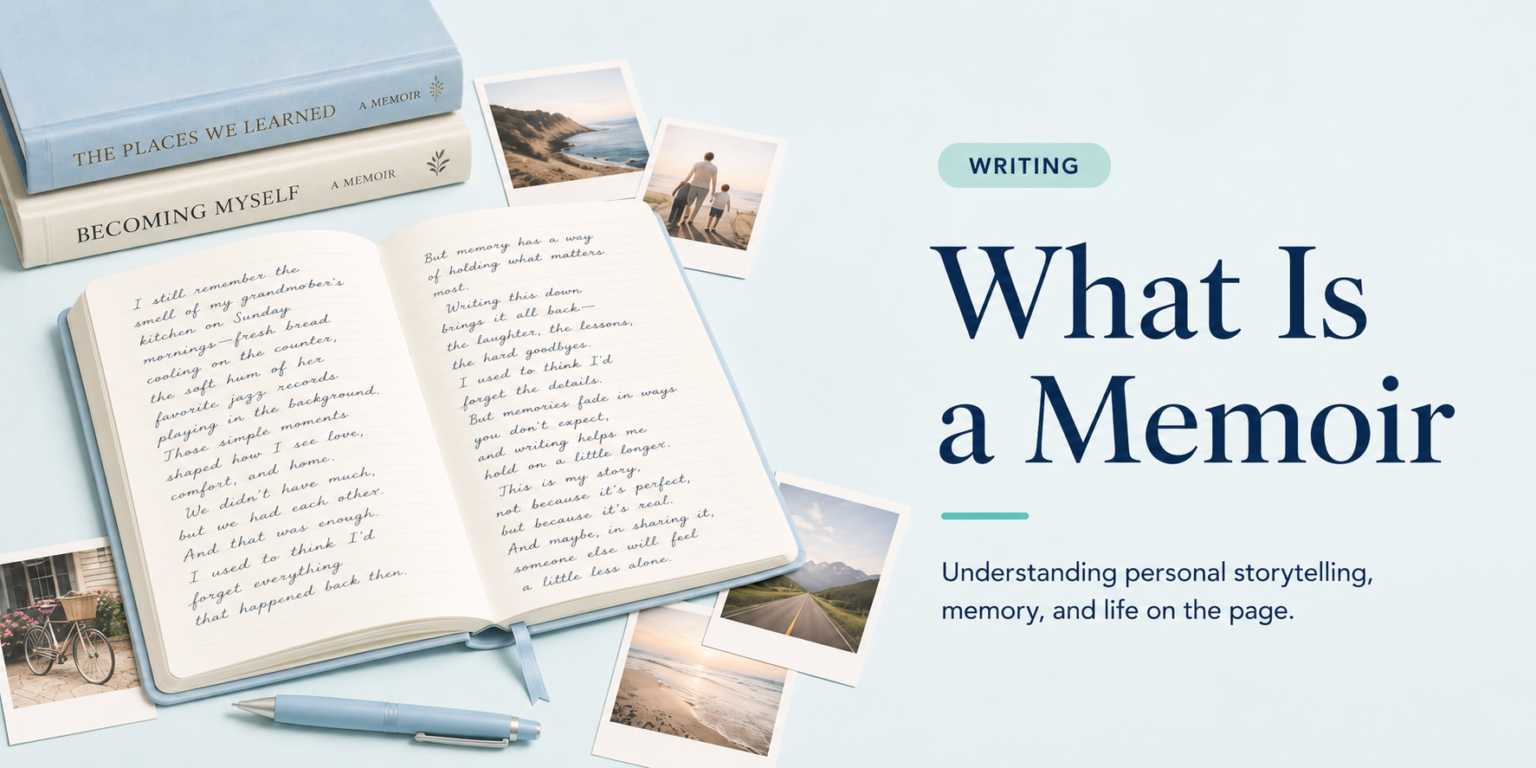
A memoir is a work of creative nonfiction that tells the story of one meaningful chapter of your life, written from your own memory and point of view. Think of it as the highlight reel of the moments that shaped you, the stories with real weight, told close enough that a reader feels them too.
That emotional closeness is the purpose of a memoir. It hands a stranger the truth of what an experience actually felt like. It also points to the difference between a memoir and an autobiography. An autobiography moves through a whole life from start to present. A memoir stays with one thread and follows where it leads.
In this article we cover the memoir definition, what memoirs are for, and how the genre stands apart from an autobiography.
What Is a Memoir?
A memoir is a literary form where a writer captures specific slices of their real life and reflects on the experiences that shaped who they became. An autobiography chronicles an entire life from birth to the present. A memoir zooms in on the moments that carry the most weight and asks what they meant.
That focus is what sets memoir apart from every other form of life writing. Memoir is a type of creative nonfiction, which means it holds itself to the truth while borrowing the tools of fiction: scene, dialogue, pacing, and voice. A memoir thrives on introspection. It cares less about the sequence of events and stays fixed on why those events still matter.
A good memoir feels like sitting across from someone over coffee while they tell you their best and worst stories. Think of Educated by Tara Westover, Becoming by Michelle Obama, or The Glass Castle by Jeannette Walls. Each one turns a private history into something a stranger can recognize as their own.
A memoir turns a life into literature. It is memory joined with meaning, truth told with perspective and a little narrative craft.
What Is the Difference Between a Memoir and an Autobiography?
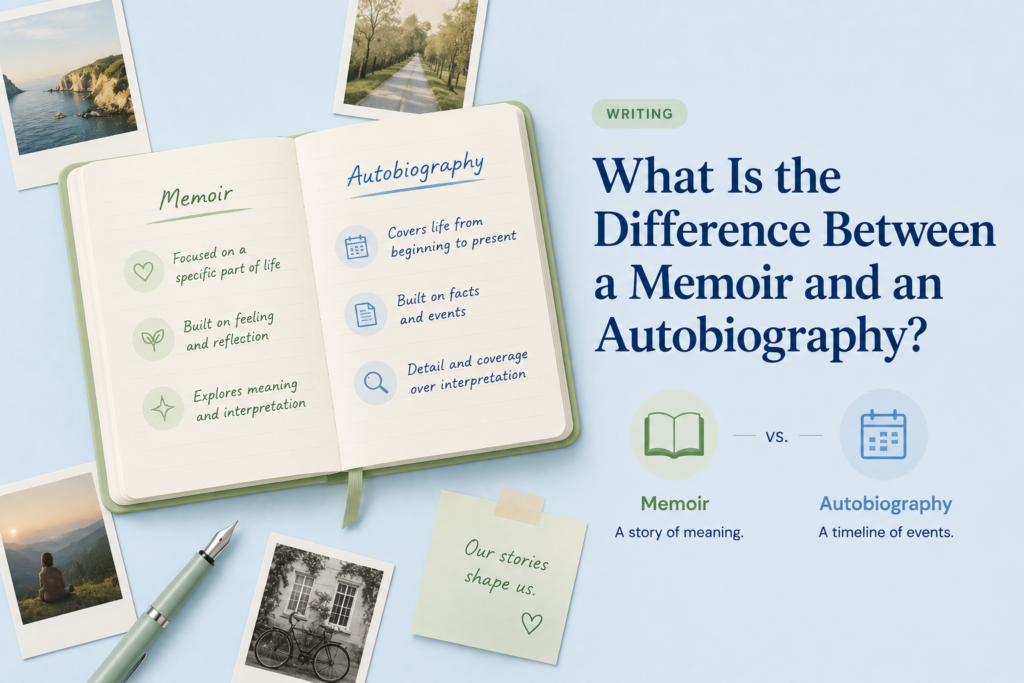
The difference between a memoir and an autobiography trips up even seasoned readers. Both grow out of the author’s real life, yet they approach that life in opposite ways. Here is the clean breakdown:
| Memoir | Autobiography |
|---|---|
| Theme driven, focused on a specific topic or period | Chronological, covering life from beginning to present |
| Built on feeling and reflection | Built on facts and events |
| Explores personal meaning and interpretation | Documents in an informative, factual style |
| Emotional depth over completeness | Detail and coverage over interpretation |
An autobiography reads like a life’s résumé. It covers the bases and ticks off milestones in order, all about the what and the when. A memoir reads like a love letter to a life, including the mistakes, the triumphs, and the small messy moments no résumé would ever list. It lives in the why and the how, reaching the emotional core underneath the events.
Picture an autobiography as the facts laid out in a straight line. A memoir is the soul of the story, told with reflection and a healthy dose of introspection. If the line between fact and invention interests you, autofiction blurs it on purpose, borrowing from real life while inventing freely.
Memoirs are having a moment because readers crave authenticity. They want stories that echo their own experience, told in a way that feels real. Against a feed of polished social media posts, a memoir offers an honest look at life as it actually is, and that honesty is exactly why the genre keeps growing.
What Is a Memoir Book?
A memoir book is what happens when personal memories are shaped into a story that strangers can feel as their own. It takes private experience and makes it recognizable, so a reader sees their own heartbreaks, triumphs, and awkward teenage years reflected on the page.
A journal spills emotion without a filter. A memoir book curates that emotion with intention, giving it structure, voice, and a shape the reader can follow. The author works as both the narrator and the architect of their own chaos, building meaning from the mess and reflection from regret.
Not every family Thanksgiving deserves a book deal, though a few come close. The skill is knowing which stories carry weight, the ones that reveal something larger about being human.
Take When Breath Becomes Air by Paul Kalanithi, written by a neurosurgeon facing his own death. It is deeply personal, yet it reaches something universal: the search for purpose when life rewrites its own script. That is the power of a memoir book. It turns one life into a mirror where readers find themselves.
Start Your Publishing Journey FOR FREEWhat Is the Purpose of a Memoir?
The purpose of a memoir goes past narrating events. A memoir exists for emotional honesty, reflection, and connection. It invites readers into a private space and shows them the complexity of a life through someone else’s eyes. The real power sits in how these stories help readers recognize their own struggles, joys, and regrets on the page.
A memoir often looks like an author working through their own history, and frequently it is. A strong memoir still lands as art that happens to have feelings. It takes raw emotion and intense personal experience and turns them into a story that means something to people who have never met the writer.
A memoir hands the reader a mirror. It shows them how much of a stranger’s life they already share. It works as a bridge from one person to another, and it connects, comforts, and sometimes challenges.
Seen more widely, memoirs reflect our culture, our values, and the experiences we hold in common. They give us a way to process the past while making better sense of the present. When someone shares a personal story honestly, they help other people feel seen, and in a world hungry for connection, that is worth a great deal.
Memoir Examples Worth Reading
The fastest way to understand a memoir is to read a few that do the job well. These titles are grouped by the kind of story they tell, since the subgenre is usually what a reader is really after.
Transformation and escape. Educated by Tara Westover follows a woman raised in a survivalist family who teaches herself enough to reach Cambridge, then learns that leaving home can cost you the self you grew up as. The Glass Castle by Jeannette Walls remembers a childhood of brilliant, negligent parents with a tenderness that never curdles into blame. A Long Way Gone by Ishmael Beah reconstructs how a boy becomes a child soldier and how he slowly finds his way back to being a person.
Grief and mortality. The Year of Magical Thinking by Joan Didion sits inside the year after her husband’s sudden death and watches her own mind try to bargain its way out of loss. When Breath Becomes Air by Paul Kalanithi is written by a neurosurgeon facing his own death, asking what makes a life worth the time it takes to live it. H Is for Hawk by Helen Macdonald turns the training of a goshawk into the only way she can carry the loss of her father.
Coming of age and identity. I Know Why the Caged Bird Sings by Maya Angelou traces the making of a voice back to the years a young girl spent silent. Angela’s Ashes by Frank McCourt tells of poverty in Limerick with a humor that makes the hardship land harder. Becoming by Michelle Obama measures the distance between a girl on the South Side of Chicago and the woman a whole country projected itself onto.
Survival and illness. Night by Elie Wiesel remains one of the essential accounts of the Holocaust, written by someone who survived Auschwitz and Buchenwald as a teenager. Wild by Cheryl Strayed walks the Pacific Crest Trail while grief works itself out through the body. This Is Going to Hurt by Adam Kay reads as a doctor’s diary that stays funny right up until the moment it stops.
Obsession and a single subject. Barbarian Days by William Finnegan tells a whole life through surfing and what it means to give yourself completely to one thing. Eat Pray Love by Elizabeth Gilbert turned the “my year of” memoir into a genre of its own. The Liars’ Club by Mary Karr is widely credited with sparking the modern memoir boom, from the writer who later published The Art of Memoir on how to do it.
Across every one of these, the same pattern holds. A memoir takes a single life and shapes it until a stranger can see their own reflection in it.
Why We Love Memoirs: Relatability, Reflection, and a Dash of Drama
Memoirs are irresistible for three reasons: truth, emotion, and connection. Readers reach for them because they offer what fiction cannot always promise, which is real life. And real life, as it turns out, writes better plot twists than most novels. A memoir gives us a front row seat to someone else’s struggles and triumphs, and we see parts of ourselves in the journey.
In a culture built on highlight reels, memoirs feel refreshingly raw. The rise of personal storytelling across podcasts, confessional essays, and viral videos points to one thing: people want real stories. We are drawn to authenticity and vulnerability, and that is exactly what a memoir delivers.
What makes the genre stand out is the way it blends the personal with the universal. A memoir carries one person’s experience while reaching toward something bigger, tapping into resilience, love, identity, and transformation. Memoir sits alongside biography, personal essay, and literary journalism in the wider family of nonfiction genres, yet it stays the most intimate of them all.
A memoir is a way to tell your story and leave behind a record of who you were, what you learned, and how you lived. It lets an author express themselves while inviting readers to reflect on their own lives. That, in its simplest form, is the power of storytelling.
FAQ: What is a Memoir?
Q: Does a memoir have to be true?
A memoir must be based on real experiences, but it doesn’t necessarily have to be entirely factual in every detail. The essence of a memoir is emotional truth, so while the events might be altered or condensed for storytelling purposes, the core experience should remain genuine. That said, integrity and honesty are crucial to maintaining trust with your readers.
Q: Are memoirs always written in first person?
Yes, memoirs are almost always written in the first person because they are personal reflections on the author’s life. The first-person perspective helps create an intimate connection with the reader, allowing them to see the world through the author’s eyes. However, there are rare instances where memoirs can be written in a more narrative style or even use second-person, though first-person is the most common.
Q: How long should a memoir be?
Memoir length can vary widely, but a typical memoir is between 60,000 to 100,000 words. Shorter memoirs, especially those focusing on a specific event or theme, can be around 40,000-50,000 words. It’s more important that the length serves the story; it should be long enough to capture the emotional depth of the experience without dragging on unnecessarily.
Q: What is the best-selling memoir of all time?
The best-selling memoir of all time is The Diary of a Young Girl by Anne Frank. This poignant and powerful account of Anne Frank’s life while hiding from the Nazis during World War II has touched millions of readers worldwide. While it is technically a diary, it’s often included in the memoir category due to its autobiographical nature and intimate look at Anne’s experiences and emotions.