

Looking for examples of themes in literature? Below you’ll find 250+ themes, from love and revenge to alienation and the American Dream. Each one has a short definition and a real example from a well-known book, organized A–Z so you can find one fast.
In simple terms, a theme is the underlying message or big idea a story explores.
If you’ve ever wanted to decode the deeper meaning behind your favorite books or use themes to craft a compelling story of your own, you’re in the right place. A strong book title can subtly hint at a theme, while a well-structured story summary can highlight its core message.
Jump to the full list of theme examples.
What Is a Theme in Literature?
A theme is the central idea or underlying message of a story. It is the big-picture takeaway about life, people, or society that stays with the reader long after the plot details fade. Unlike the plot (what happens) or the characters (who make it happen), the theme is why it matters.
This page is the complete examples list. For the full breakdown of what a theme is and how to find one in any book, see how to find the theme of a story.
Topic vs Theme: What’s the Difference?
| Topic | Theme | |
|---|---|---|
| What it is | The subject, what the book is about | The message, what the book says about that subject |
| Form | A word or phrase (love, war, power) | A full idea or insight (e.g. power corrupts those who fear losing it) |
| Stated or implied | Usually explicit | Usually implied through events and characters |
| Example | Power | Unchecked ambition destroys the person who chases it |
One topic can carry several themes: a book about power might explore corruption, responsibility, and resistance all at once. Not sure whether you are looking at a topic or a theme? We break that down in what is the theme of a story.
10 Most Common Themes in Literature (With Examples)
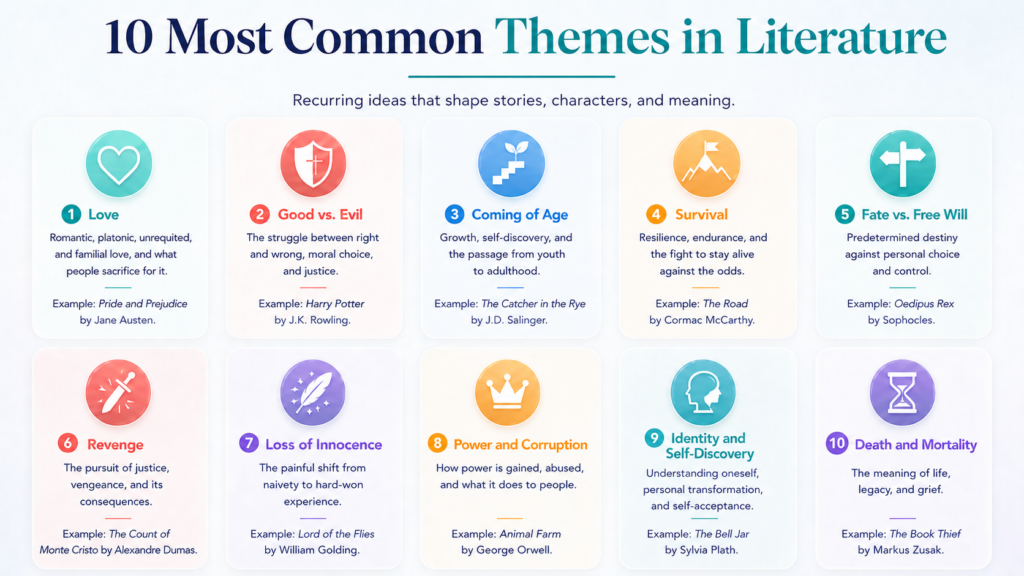
These are the themes that appear most often across literature. The timeless ideas writers return to because they reflect the core of human experience. Each one below includes a short definition and a well-known book that explores it.
- Love – Romantic, platonic, unrequited, and familial love, and what people sacrifice for it.
Example: Pride and Prejudice by Jane Austen. - Good vs. Evil – The struggle between right and wrong, moral choice, and justice.
Example: Harry Potter by J.K. Rowling. - Coming of Age – Growth, self-discovery, and the passage from youth to adulthood.
Example: The Catcher in the Rye by J.D. Salinger. - Survival – Resilience, endurance, and the fight to stay alive against the odds.
Example: The Road by Cormac McCarthy. - Fate vs. Free Will – Predetermined destiny against personal choice and control.
Example: Oedipus Rex by Sophocles. - Revenge – The pursuit of justice, vengeance, and its consequences.
Example: The Count of Monte Cristo by Alexandre Dumas. - Loss of Innocence – The painful shift from naivety to hard-won experience.
Example: Lord of the Flies by William Golding. - Power and Corruption – How power is gained, abused, and what it does to people.
Example: Animal Farm by George Orwell. - Identity and Self-Discovery – Understanding oneself, personal transformation, and self-acceptance.
Example: The Bell Jar by Sylvia Pshlath. - Death and Mortality – The meaning of life, legacy, and grief.
Example: The Book Thief by Markus Zusak.
Looking specifically for themes that cross cultures and eras? See our guide to universal themes, with examples.
250+ List of Themes in Literature (A-Z)
Abandonment
Explores the emotional, psychological, and physical effects of being left behind, loss, rejection, and survival without support.
Example: Great Expectations by Charles Dickens. Pip’s experiences of abandonment shape his view of love and trust.
Accountability
Responsibility for one’s actions and the moral reckoning that follows, guilt, redemption, and justice.
Example: The Scarlet Letter by Nathaniel Hawthorne. Hester Prynne owns her actions publicly while Dimmesdale is destroyed by hidden guilt.
Addiction
The struggle with substance abuse, destructive habits, and obsessive behaviour, dependence, self-destruction, and redemption.
Example: Requiem for a Dream by Hubert Selby Jr.. characters spiral into addiction with devastating consequences.
Adoption
Identity, belonging, and the emotional complexity of being raised by non-biological parents, nature vs. nurture and self-discovery.
Example: Anne of Green Gables by L.M. Montgomery. orphan Anne navigates love, acceptance, and her place in the world.
Adultery
Betrayal, morality, forbidden love, and the consequences of infidelity.
Example: Anna Karenina by Leo Tolstoy. Anna’s affair with Vronsky leads to personal and social downfall.
Aging
The passage of time, mortality, memory, and the physical and emotional changes of growing older.
Example: King Lear by William Shakespeare. Lear’s decline highlights the vulnerability and wisdom of old age.
Altruism
Selflessness, kindness, and sacrifice for others, often weighed against personal desire.
Example: Les Misérables by Victor Hugo. Jean Valjean’s self-sacrificing care for Cosette embodies altruism.
Ambition
Personal goals, the drive for success, and the consequences of unchecked ambition.
Example: Macbeth by William Shakespeare. Macbeth’s insatiable ambition leads to his downfall.
American Dream
The pursuit of success, wealth, and happiness, and whether those ideals are achievable or illusions.
Example: The Great Gatsby by F. Scott Fitzgerald. Gatsby’s chase for wealth and Daisy reveals the dream’s corrupting emptiness.
Anxiety
(parent, includes Social Anxiety) Fear, worry, and the psychological burdens characters carry, existential dread, paranoia, and insecurity.
Example: Crime and Punishment by Fyodor Dostoevsky. Raskolnikov’s guilt-driven anxiety torments him after his crime.
Social Anxiety
The fear of judgment and the struggle to fit social expectations.
Example: Eleanor Oliphant Is Completely Fine by Gail Honeyman. Eleanor navigates deep social anxiety while learning to connect.
Art
Creativity, expression, beauty, and art’s power to inspire, challenge, or disturb.
Example: The Picture of Dorian Gray by Oscar Wilde. Dorian’s portrait ties art to morality, vanity, and self-destruction.
Autonomy
Self-governance, independence, and the struggle for control over one’s life against external pressure.
Example: Jane Eyre by Charlotte Brontë. Jane fights to define her own identity beyond society’s constraints.
Beauty
The power, subjectivity, and impact of beauty, admiration, privilege, deception, or destruction.
Example: Snow White (Brothers Grimm). the Queen’s obsession with beauty turns it into a source of danger.
Beliefs
Deeply held convictions, religious, political, or philosophical, and how they shape people and conflicts.
Example: Life of Pi by Yann Martel. Pi’s spiritual journey explores faith and the power of belief.
Betrayal
Broken trust, deception, and the emotional fallout of being let down by loved ones, allies, or society.
Example: Julius Caesar by William Shakespeare. Brutus’s betrayal of Caesar pits personal loyalty against political duty.
Betrayal and Redemption
The emotional impact of betrayal and the journey toward making amends.
Example: The Kite Runner by Khaled Hosseini. Amir’s betrayal of Hassan drives a lifelong quest for redemption.
Blood vs. Chosen Family
The bonds of biological family weighed against the connections of found family.
Example: Harry Potter series by J.K. Rowling. Harry finds more love in his chosen family than among the Dursleys.
Blue-collar vs. White-collar Struggles
Class divisions and the tension between laborers and professionals in a status-driven society.
Example: Death of a Salesman by Arthur Miller. Willy Loman’s struggles expose the gap between working-class hope and economic reality.
Broken Dreams
Shattered hopes, disillusionment, and the loss of idealism.
Example: Of Mice and Men by John Steinbeck. George and Lennie’s dream of owning land is crushed by reality.
Capitalism
A critique of economic structures, greed, exploitation, and wealth pursued at humanity’s expense.
Example: The Jungle by Upton Sinclair. exposes the brutal conditions and failures of unchecked capitalism.
Catharsis
The emotional release that comes from intense sorrow, fear, or relief.
Example: Oedipus Rex by Sophocles. Oedipus’s tragic realization delivers catharsis for character and audience.
Celebration
Joy, victory, and the value of marking achievements, milestones, or traditions.
Example: A Midsummer Night’s Dream by William Shakespeare. the play closes on celebrations of love and restored harmony.
Chance
Fate, randomness, and the unpredictable twists that shape destiny.
Example: Slaughterhouse-Five by Kurt Vonnegut. the novel’s structure emphasizes the role of chance in life and war.
Change vs. Tradition
(parent, includes Resistance to Change, Preservation of Tradition, Convention and Rebellion) The tension between progress and tradition as people choose to embrace or resist change.
Example: Fiddler on the Roof by Joseph Stein. Tevye balances deep-rooted tradition against a changing world.
Resistance to Change
Reluctance or fear of adapting to new circumstances, ideas, or social progress.
Example: To Kill a Mockingbird by Harper Lee. Maycomb clings to prejudice and resists racial change.
Preservation of Tradition
The struggle to maintain cultural, religious, or societal traditions against modern pressures.
Example: Fiddler on the Roof by Joseph Stein. Tevye fights to preserve Jewish tradition as the world shifts.
Convention and Rebellion
The clash between societal norms and individual defiance.
Example: The Handmaid’s Tale by Margaret Atwood. Offred’s quiet resistance defies the rigid conventions of Gilead.
💡 Pro Tip: Let Your Theme Emerge Naturally – The best themes aren’t forced, they grow from your characters, conflicts, and setting. Instead of deciding on a theme first, let it develop organically through your story. If your characters face moral dilemmas, your theme might be justice vs. corruption. If they struggle with identity, your theme could be self-discovery.
Childhood
The innocence, wonder, and challenges of youth, often contrasted with adulthood.
Example: To Kill a Mockingbird by Harper Lee. Scout’s child’s-eye view illuminates racism, morality, and justice.
Class
Social hierarchy, economic disparity, and the critique of privilege and systemic inequality.
Example: Pride and Prejudice by Jane Austen. class distinctions shape marriage and mobility in Regency England.
Codependency
Relationships where one person’s well-being is overly dependent on another, leading to imbalance and harm.
Example: Wuthering Heights by Emily Brontë. Heathcliff and Catherine’s obsessive bond illustrates destructive codependency.
Colonialism
The impact of colonial rule, exploitation, cultural erasure, and resistance.
Example: Things Fall Apart by Chinua Achebe. the disruption of Igbo society by British colonial forces.
Coming of Age
(parent, includes Growing Up, Maturity, Personal Development) A character’s transition from childhood to adulthood through struggle, self-discovery, and hard lessons.
Example: The Catcher in the Rye by J.D. Salinger. Holden Caulfield’s confusion and alienation capture growing up.
Growing Up
The transition from childhood to adulthood through self-discovery and life lessons.
Example: Anne of Green Gables by L.M. Montgomery. Anne grows through mistakes, friendships, and adolescence.
Maturity
Emotional growth and the shift from innocence to experience.
Example: Jane Eyre by Charlotte Brontë. Jane’s path from orphan to self-assured woman charts her maturity.
Personal Development
Self-improvement and the journey toward becoming more self-aware.
Example: The Catcher in the Rye by J.D. Salinger. Holden’s journey leads to deeper self-understanding.
Communication
The importance of language and understanding, and the conflicts caused by its absence.
Example: The Remains of the Day by Kazuo Ishiguro. repressed emotion and poor communication lead to deep regret.
Companionship
The human need for connection, trust, and loyalty in friendship or alliance.
Example: Of Mice and Men by John Steinbeck. George and Lennie’s bond highlights the need for companionship.
Conspiracy
Secrecy, manipulation, and hidden agendas, often involving powerful or shadowy forces.
Example: 1984 by George Orwell. the Party’s manipulation of truth builds a world of control and deception.
Corporate Greed
The pursuit of profit at the expense of ethics, people, and the environment.
Example: Atlas Shrugged by Ayn Rand. explores capitalism, individualism, and corporate power.
Cultural Identity
(see also: Identity) The relationship between individuals and their heritage, traditions, and sense of belonging.
Example: The Namesake by Jhumpa Lahiri. Gogol struggles between his Indian heritage and American upbringing.
Darkness and Light
A symbolic contrast of ignorance and knowledge, evil and good, despair and hope.
Example: Heart of Darkness by Joseph Conrad. the journey into the Congo exposes literal and moral darkness.
Death & Mortality
(parent, includes Death and Mortality, Immortality) Loss, grief, legacy, and the inevitability of death.
Example: The Book Thief by Markus Zusak. narrated by Death, the novel reframes loss during World War II.
Death and Mortality
The meaning of life, legacy, and the acceptance or fear of death.
Example: The Fault in Our Stars by John Green. two terminally ill teens confront mortality with humor and heartbreak.
Immortality
The desire to live forever and the consequences of eternal life.
Example: Tuck Everlasting by Natalie Babbitt. questions whether living forever is a blessing or a curse.
Dedication
Persistence, loyalty, and the sacrifices made to stay true to a goal or value.
Example: Les Misérables by Victor Hugo. Valjean’s dedication to redemption and to Cosette drives the novel.
Democracy
The values, challenges, and fragility of democratic systems.
Example: Animal Farm by George Orwell. critiques the illusion of democracy when power concentrates in the few.
Desire
Longing, ambition, and the pursuit of love, power, or fulfillment, often into conflict.
Example: A Streetcar Named Desire by Tennessee Williams. Blanche’s desires collide with reality and destroy her.
Despair
Hopelessness and emotional suffering, and the search for meaning within it.
Example: The Road by Cormac McCarthy. a father and son endure bleak despair with a faint thread of hope.
Digital Age and Its Effects
The influence of technology, social media, and the internet on society and identity.
Example: Feed by M.T. Anderson. a future of brain-implanted internet explores consumerism and lost autonomy.
Disappointment
Unmet expectations, personal failure, and the emotional toll of dreams not realized.
Example: Great Expectations by Charles Dickens. Pip’s ambitions for wealth and love end in disappointment and self-knowledge.
Disillusionment with Society
The loss of faith in institutions and ideals, corruption, hypocrisy, broken promises.
Example: The Catcher in the Rye by J.D. Salinger. Holden’s disillusionment with the “phony” adult world.
Displacement
The emotional and physical consequences of being forced from home by war, migration, or upheaval.
Example: Exit West by Mohsin Hamid. refugees travel through magical doors, dramatizing displacement and identity.
Dreams
Ambition, escapism, and the gap between aspiration and reality.
Example: The Great Gatsby by F. Scott Fitzgerald. Gatsby’s dream of recapturing the past embodies the unattainable.
Dystopia vs. Utopia
Imagined societies, idealized or oppressive, used to critique present-day issues.
Example: The Hunger Games by Suzanne Collins. the gulf between the Capitol and the districts paints a dystopia of inequality.
Education
The power of knowledge and learning, and the barriers and biases within formal education.
Example: To Kill a Mockingbird by Harper Lee. Scout’s schooling versus real-world lessons exposes the system’s limits.
Empowerment
Gaining confidence, strength, and control, overcoming oppression, fear, or self-doubt.
Example: The Color Purple by Alice Walker. Celie’s journey from oppression to self-empowerment and voice.
Exploitation of Labor
Economic inequality, poor conditions, and the mistreatment of workers.
Example: The Jungle by Upton Sinclair. the harsh realities faced by immigrant laborers in Chicago.
Faith
Religious devotion, spiritual belief, and the struggle to maintain or question it.
Example: Life of Pi by Yann Martel. Pi survives at sea through his deep, diverse religious faith.
Fame
The pursuit and cost of celebrity, and the illusion of public adoration.
Example: The Picture of Dorian Gray by Oscar Wilde. Dorian’s obsession with reputation and youth ends in ruin.
Family
The complexities of relationships between parents, siblings, and extended family, love, duty, conflict, loyalty.
Example: Little Women by Louisa May Alcott. the March sisters’ bond and struggles show the strength and strain of family.
Family Obligations vs. Personal Desires
The tension between family expectations and individual dreams.
Example: A Doll’s House by Henrik Ibsen. Nora struggles between her role as wife and mother and her need for independence.
Fate vs. Free Will
(parent, includes Fate, Free Will, Free Will vs. Determinism, Destiny, Fate and Prophecy) Whether human actions are predetermined or freely chosen, the central tension between destiny and choice.
Example: Julius Caesar by William Shakespeare. Cassius’s belief in free will and Caesar’s trust in fate drive the plot.
Fate
Whether life’s events are predetermined or shaped by personal choice.
Example: Oedipus Rex by Sophocles. Oedipus fulfills the prophecy despite his efforts to escape it.
Free Will
Whether humans have full autonomy over their choices, or are limited by fate, society, or circumstance.
Example: East of Eden by John Steinbeck. the idea of “timshel,” the freedom to choose one’s own path.
Free Will vs. Determinism
The philosophical debate between independent choice and a preordained world.
Example: Slaughterhouse-Five by Kurt Vonnegut. Billy Pilgrim’s time travel questions whether choices matter at all.
Destiny
Predestination, and whether characters control their future or are bound by larger forces.
Example: Oedipus Rex by Sophocles. despite every effort, Oedipus cannot escape his fate.
Fate and Prophecy
Foretold fate and the tension between prophecy and free will.
Example: Macbeth by William Shakespeare. the witches’ prophecies shape Macbeth’s self-fulfilling choices.
🚀Did You Know? Some Authors Were Watched by the Government – Because of their political and revolutionary themes, writers like George Orwell, Ray Bradbury, and Gabriel García Márquez were monitored by intelligence agencies. Fahrenheit 451 warned about censorship, and the FBI kept files on Bradbury for writing it. Talk about irony!
Fear
Rational and irrational fears, and how they shape behavior, decisions, and societies.
Example: It by Stephen King. Pennywise preys on the deepest anxieties of its victims.
Fear of Technological Advancements
The dangers of unchecked technology and the ethics of human innovation.
Example: Frankenstein by Mary Shelley. Victor’s creation of life warns against scientific overreach.
Feminism
Gender roles, women’s rights, societal expectations, and the fight for equality.
Example: The Handmaid’s Tale by Margaret Atwood. critiques patriarchy and the control of women’s bodies and rights.
Forgiveness
Redemption, growth, and the ability to move past betrayal, pain, or mistakes.
Example: The Kite Runner by Khaled Hosseini. Amir seeks forgiveness for betraying Hassan.
Freedom
Personal liberty and the struggle against oppression, what it truly means to be free.
Example: The Underground Railroad by Colson Whitehead. Cora seeks freedom against systemic oppression.
Friendship
The bonds between people, loyalty, trust, and the depth of non-romantic relationships.
Example: Harry Potter series by J.K. Rowling. the friendship of Harry, Ron, and Hermione anchors their growth.
Fulfillment
The search for happiness, purpose, and self-actualization, inner peace vs. external achievement.
Example: Eat, Pray, Love by Elizabeth Gilbert. the author’s journey in pursuit of fulfillment and self-discovery.
Future
Speculative visions of humanity’s path, progress, technology, and ethics.
Example: The Hunger Games by Suzanne Collins. a grim future where a totalitarian state rules through fear.
Gender
Societal roles, identity, expectations, and the fluidity of gender expression.
Example: Orlando by Virginia Woolf. a protagonist who changes gender across centuries challenges fixed identity.
Ghosts and Hauntings
The supernatural as a symbol of unresolved trauma, guilt, or the lingering past.
Example: Beloved by Toni Morrison. the ghost of Sethe’s daughter embodies the haunting legacy of slavery.
Globalization
The interconnectedness of cultures and economies, and its benefits and costs.
Example: Americanah by Chimamanda Ngozi Adichie. a Nigerian woman’s life across America and England explores race and migration.
God
Faith, divinity, and the human quest to understand the divine.
Example: The Brothers Karamazov by Fyodor Dostoevsky. faith, doubt, and the existence of God in moral debate.
Good vs. Evil
(parent, includes The Nature of Evil, Sin, Vices, Temptation) The moral struggle between righteousness and corruption, from internal conflict to epic battle.
Example: The Lord of the Rings by J.R.R. Tolkien. the quest to destroy the Ring embodies the classic good-vs-evil narrative.
The Nature of Evil
Whether evil is inherent, learned, or born of circumstance.
Example: Lord of the Flies by William Golding. the boys’ descent into savagery suggests evil within human nature.
Sin
Morality, transgression, and the consequences of straying from ethical or religious principles.
Example: Dr. Faustus by Christopher Marlowe. Faustus sells his soul, embodying sin and its consequences.
Vices
Moral weaknesses and destructive habits, and the human flaws behind them.
Example: Dr. Jekyll and Mr. Hyde by Robert Louis Stevenson. Jekyll’s indulgence of his darker side reveals the danger of vice.
Temptation
The lure of power, wealth, love, or forbidden knowledge, and the cost of giving in.
Example: Doctor Faustus by Christopher Marlowe. Faustus succumbs to the temptation of limitless knowledge.
Government
Political power and its impact on individuals, corruption, authoritarianism, and control vs. freedom.
Example: 1984 by George Orwell. a totalitarian state shows the dangers of unchecked government and surveillance.
Gratitude
Appreciation, contentment, and the transformative power of valuing what one has.
Example: A Christmas Carol by Charles Dickens. Scrooge learns to value life, relationships, and generosity.
Guilt & Redemption
(parent, includes Guilt, Guilt and Redemption) The emotional burden of wrongdoing and the path toward atonement.
Example: Crime and Punishment by Fyodor Dostoevsky. Raskolnikov’s guilt torments him toward confession.
Guilt
The weight of wrongdoing, real or perceived, and its effect on the psyche.
Example: Crime and Punishment by Fyodor Dostoevsky. Raskolnikov’s guilt drives his psychological collapse.
Guilt and Redemption
How characters seek atonement, forgiveness, and personal redemption.
Example: The Kite Runner by Khaled Hosseini. Amir’s guilt over Hassan fuels his search for redemption.
Happiness
What it means to be truly happy, joy, contentment, and fulfillment.
Example: The Alchemist by Paulo Coelho. Santiago learns happiness comes from following his personal legend, not wealth.
Hard Work
Perseverance, discipline, and the belief that effort leads to success.
Example: The Grapes of Wrath by John Steinbeck. the Joads’ labor shows the harsh realities of hard work in hardship.
Health
Physical and mental well-being and the impact of illness or disability.
Example: The Fault in Our Stars by John Green. two teens with terminal illness navigate love and mortality.
Heartbreak
Emotional pain, loss, and healing after a deep romantic or personal wound.
Example: Wuthering Heights by Emily Brontë. Heathcliff and Catherine’s love is steeped in heartbreak and longing.
Hedonism
Indulgence, the pursuit of pleasure, and the consequences of living for gratification.
Example: The Picture of Dorian Gray by Oscar Wilde. Dorian’s pursuit of pleasure leads to moral decay.
Heroism
(parent, includes Hero, Journeys and Quests) Bravery, selflessness, and the courage to face danger or injustice.
Example: Harry Potter and the Deathly Hallows by J.K. Rowling. Harry faces death to protect others.
Hero
A protagonist who undertakes a journey, overcomes trials, and shows courage or sacrifice.
Example: The Odyssey by Homer. Odysseus faces countless trials on his journey home.
Journeys and Quests
A physical or emotional journey involving self-discovery, trials, and transformation.
Example: The Hobbit by J.R.R. Tolkien. Bilbo’s adventure tests and ultimately changes him.
💡 Pro Tip: A Strong Theme Makes Your Story Memorable – People forget plots, but they remember themes. Readers might not recall every event in 1984, but they remember its message about surveillance and control. A clear, compelling theme leaves an impact; make yours count.
History
The impact of the past on present and future, memory, narrative, and revisionism.
Example: Beloved by Toni Morrison. the lingering trauma of slavery shapes identity across generations.
Honesty
Truthfulness, integrity, and the consequences of deception.
Example: The Adventures of Huckleberry Finn by Mark Twain. Huck wrestles with honesty in a morally complex world.
Hope & Optimism
(parent, includes Optimism) Resilience and the belief that better days lie ahead, even against adversity.
Example: Rita Hayworth and Shawshank Redemption by Stephen King. Andy’s unwavering hope sustains him through wrongful imprisonment.
Optimism
Hope, perseverance, and belief in a better future, set against despair.
Example: Pollyanna by Eleanor H. Porter. Pollyanna’s relentless optimism transforms those around her.
Humility
Modesty, self-awareness, and the rejection of arrogance.
Example: Pride and Prejudice by Jane Austen. Darcy’s shift from pride to humility drives his growth.
Humor
Comedy, satire, and irony used as both entertainment and social critique.
Example: Catch-22 by Joseph Heller. dark humor exposes the absurdities of war and bureaucracy.
Hypocrisy
The gap between public virtue and private vice, double standards and moral contradiction.
Example: The Crucible by Arthur Miller. the Salem trials reveal the dangers of moral panic and self-righteousness.
Identity
(parent, includes Identity and Self-Discovery, Self-Discovery, Self-awareness, Cultural Identity) Self-perception, belonging, and the struggle to define oneself against society and expectation.
Example: The Namesake by Jhumpa Lahiri. Gogol struggles with identity as the child of Indian immigrants.
Identity and Self-Discovery
Personal growth and coming to understand one’s true self.
Example: The Catcher in the Rye by J.D. Salinger. Holden questions identity in a world he finds inauthentic.
Self-Discovery
The search for identity, meaning, and personal truth through introspection and experience.
Example: Eat, Pray, Love by Elizabeth Gilbert. a journey across three countries in pursuit of self-discovery.
Self-awareness
A character’s journey toward understanding their own emotions, motives, and flaws.
Example: Crime and Punishment by Fyodor Dostoevsky. Raskolnikov gradually grasps the impact of his crime.
Cultural Identity
The bond between individuals and their heritage, especially amid assimilation or displacement.
Example: The Namesake by Jhumpa Lahiri. Gogol navigates the pull between Indian heritage and American life.
Ideology
Systems of belief, political, social, philosophical, and the conflicts between them.
Example: Animal Farm by George Orwell. critiques how political ideologies are manipulated for power.
Imagination
Creativity, fantasy, and the mind’s power to reshape reality.
Example: Alice’s Adventures in Wonderland by Lewis Carroll. Alice’s surreal journey reflects limitless imagination.
Immigration and Displacement
The struggles, identity crises, and cultural clashes faced by immigrants and the displaced.
Example: Exit West by Mohsin Hamid. refugees navigate migration and adaptation through magical doors.
Imperialism
The expansion of empires and exploitation of indigenous peoples, and the ethics of conquest.
Example: Things Fall Apart by Chinua Achebe. the devastating impact of British colonialism on Igbo society.
Impossibility
The limits of reality and the pursuit of the unattainable, dreams against constraints.
Example: Don Quixote by Miguel de Cervantes. Quixote’s quest to be a knight pits delusion against reality.
Individuality
Personal identity and nonconformity in a society that pressures people to fit in.
Example: Fahrenheit 451 by Ray Bradbury. Montag challenges a society that suppresses individuality.
Inequality
Social, economic, racial, or gender disparity, and the systems that uphold it.
Example: To Kill a Mockingbird by Harper Lee. Tom Robinson’s trial exposes racial inequality in the American South.
Inheritance and Legacy
What one generation passes to the next, wealth, values, trauma, tradition.
Example: Hamlet by William Shakespeare. Hamlet wrestles with his father’s legacy and the duty to avenge him.
Innocence
Purity, naivety, and the transition to a more complex understanding of the world.
Example: The Catcher in the Rye by J.D. Salinger. Holden mourns the loss of innocence and resists growing up.
Inspiration
The sources of creativity, motivation, and transformation.
Example: The Secret Life of Bees by Sue Monk Kidd. Lily finds inspiration in the women who teach her love and resilience.
Intergenerational Conflict
Tensions between generations over values, tradition, and expectation.
Example: Fences by August Wilson. Troy and his son Cory clash over dreams, race, and opportunity.
Isolation & Loneliness
(parent, includes Loneliness, Solitude, Alienation) Emotional detachment and the effects of being cut off from others, by choice or circumstance.
Example: Frankenstein by Mary Shelley. both Victor and his creature suffer profound isolation.
Loneliness
Isolation, emotional detachment, and the longing for human connection.
Example: Of Mice and Men by John Steinbeck. Crooks, Candy, and Curley’s wife each ache with loneliness.
Solitude
Isolation and introspection, and the impact of being alone.
Example: Robinson Crusoe by Daniel Defoe. Crusoe’s physical and psychological journey while marooned.
Alienation
The isolation of the individual from society, self, or others.
Example: The Catcher in the Rye by J.D. Salinger. Holden’s alienation reflects his inability to connect with the adult world.
Joy
Happiness, fulfillment, and emotional contentment, often set against hardship.
Example: Anne of Green Gables by L.M. Montgomery. Anne’s joyful outlook brightens the lives around her.
Justice
(parent, includes Justice vs. Revenge, Legal Injustice, Divine Justice vs. Human Justice, Law) Fairness, morality, and the consequences of legal and ethical decisions.
Example: To Kill a Mockingbird by Harper Lee. Tom Robinson’s trial exposes the failure of the system to deliver justice.
Justice vs. Revenge
Fair justice weighed against the desire for personal vengeance.
Example: The Count of Monte Cristo by Alexandre Dumas. Dantès’s revenge questions whether justice can come through vengeance.
Legal Injustice
The flaws of the legal system, corruption, discrimination, and failure for the marginalized.
Example: Just Mercy by Bryan Stevenson. a true account of wrongful convictions and racial bias in the justice system.
Divine Justice vs. Human Justice
Moral or religious justice against flawed human law.
Example: The Brothers Karamazov by Fyodor Dostoevsky. crime, punishment, and whether divine justice outweighs human law.
Law
Legal systems and how they shape individuals and societies, often questioning their fairness.
Example: Les Misérables by Victor Hugo. Valjean’s harsh punishment for stealing bread exposes the law’s rigidity.
Knowledge
(parent, includes The Pursuit of Knowledge, Discovery and Curiosity) Curiosity, wisdom, and the moral dilemmas that come with understanding.
Example: Fahrenheit 451 by Ray Bradbury. Montag’s awakening to the value of books defies an ignorant society.
The Pursuit of Knowledge
The quest for learning and discovery, and its ethical implications.
Example: Frankenstein by Mary Shelley. Victor’s relentless pursuit of knowledge brings unintended consequences.
Discovery and Curiosity
The drive to learn and the thrill or danger of uncovering hidden truths.
Example: The Martian by Andy Weir. Mark Watney’s curiosity and problem-solving keep him alive on Mars.
💡Pro Tip: Show, Don’t Tell – Themes are most powerful when felt, not explained. Instead of writing “power corrupts people,” show a character slowly becoming ruthless after gaining control. Use symbolism, actions, and consequences to make your theme resonate without being heavy-handed.
Legacy
What individuals leave behind, reputation, achievement, and lasting impact.
Example: Hamlet by William Shakespeare. Hamlet bears the weight of his father’s legacy and the duty to avenge it.
LGBTQ
Identity, love, acceptance, and the struggles of LGBTQ individuals, discrimination, resilience, self-acceptance.
Example: The Song of Achilles by Madeline Miller. reimagines Achilles and Patroclus’s bond, exploring love and identity.
Life
The meaning of existence and the philosophical and emotional aspects of life itself.
Example: The Fault in Our Stars by John Green. Hazel and Augustus contemplate life, love, and mortality.
Loss
Grief, mourning, and the emotional fallout of losing a loved one, a dream, or a sense of self.
Example: The Lovely Bones by Alice Sebold. Susie Salmon watches her family cope with her death.
Loss of Humanity Through Technology
A critique of technology’s role in eroding connection, ethics, and individuality.
Example: Do Androids Dream of Electric Sheep? by Philip K. Dick. what it means to be human in a world of artificial intelligence.
Love
(parent, includes Unconditional Love, Forbidden Love, Platonic Love, Unrequited Love) Romantic, familial, and platonic love, and the ways it drives motivation and conflict.
Example: Pride and Prejudice by Jane Austen. love, misunderstanding, and the weight of social expectation.
Unconditional Love
Love without limits or conditions, often tested by hardship or sacrifice.
Example: The Road by Cormac McCarthy. a father’s unwavering love for his son drives his will to survive.
Forbidden Love
Love that is socially, politically, or morally prohibited.
Example: Romeo and Juliet by William Shakespeare. star-crossed lovers from feuding families.
Platonic Love
Deep, non-romantic bonds built on loyalty and friendship.
Example: Sherlock Holmes by Arthur Conan Doyle. the friendship of Holmes and Watson exemplifies platonic love.
Unrequited Love
One-sided love, longing, heartbreak, and the pain of affection unreturned.
Example: The Phantom of the Opera by Gaston Leroux. the Phantom’s obsessive, unreturned love for Christine ends in tragedy.
Loyalty
Faithfulness to people, ideals, or causes, and the sacrifices devotion demands.
Example: The Lord of the Rings by J.R.R. Tolkien. Sam’s loyalty to Frodo defines their journey.
Madness
The line between sanity and insanity, and the mind’s fragility.
Example: One Flew Over the Cuckoo’s Nest by Ken Kesey. a critique of institutional care and the idea of madness.
Magic and Supernatural Forces
Mystical elements and magical systems that shape a story’s world and conflicts.
Example: Harry Potter series by J.K. Rowling. magic drives the narrative through spells, prophecies, and legend.
Manipulation
Deception, persuasion, and control used to gain power or advantage.
Example: Othello by William Shakespeare. Iago manipulates Othello into jealousy and tragedy.
Materialism
The pursuit of wealth and possessions, and whether it brings happiness or decay.
Example: The Great Gatsby by F. Scott Fitzgerald. Gatsby’s lifestyle symbolizes the emptiness of materialism.
Media Influence
The power of media to shape opinion, culture, and reality, propaganda and mass control.
Example: The Hunger Games by Suzanne Collins. the Capitol controls perception through televised propaganda.
Mercy
Compassion, forgiveness, and the moral dilemmas around justice and retribution.
Example: Les Misérables by Victor Hugo. the bishop’s mercy transforms Valjean’s life.
Metamorphosis
Physical, emotional, or symbolic transformation reflecting deep change.
Example: The Metamorphosis by Franz Kafka. Gregor’s change into an insect is a metaphor for alienation.
Money
The impact of wealth and financial status on relationships, morality, and fulfillment.
Example: A Christmas Carol by Charles Dickens. Scrooge learns money alone cannot bring happiness.
Multiculturalism
The blending and clashing of cultures, identity, and the immigrant experience.
Example: Americanah by Chimamanda Ngozi Adichie. examines race and identity across Nigeria, the U.S., and the U.K.
Music
The emotional and cultural power of music as self-expression, healing, or rebellion.
Example: High Fidelity by Nick Hornby. music shapes the protagonist’s identity and relationships.
Mythology and Folklore
Ancient myths and legends used to explore universal truths and cultural heritage.
Example: Circe by Madeline Miller. a modern retelling that gives voice to the witch of The Odyssey.
Nationalism
Patriotism and national identity, and the line between pride and xenophobia or propaganda.
Example: Homage to Catalonia by George Orwell. a firsthand account of nationalism and allegiance in the Spanish Civil War.
Nature & Environment
(parent, includes Environmentalism, Conservation, Climate Change) The beauty and power of the natural world, and humanity’s relationship with it.
Example: Walden by Henry David Thoreau. reflects on self-sufficiency and the bond between humans and nature.
Environmentalism
Humanity’s relationship with nature and the consequences of environmental destruction.
Example: The Overstory by Richard Powers. interwoven lives advocate for environmental consciousness.
Conservation
Environmental preservation and humanity’s responsibility to protect nature.
Example: Silent Spring by Rachel Carson. exposes the dangers of pesticides and champions conservation.
Climate Change
Environmental concern and the consequences of ecological neglect, often as warning.
Example: The Overstory by Richard Powers. connects human lives to trees to spotlight environmental destruction.
Necessity
(see also: Survival) Survival, resourcefulness, and the hard choices forced by scarcity.
Example: The Hunger Games by Suzanne Collins. Katniss makes life-or-death choices out of necessity.
Neglect
Abandonment, lack of care, and the consequences of being ignored or mistreated.
Example: Oliver Twist by Charles Dickens. Oliver endures neglect from workhouses to criminal exploitation.
New Year
Fresh beginnings, renewal, and the hope of transformation.
Example: The Great Gatsby by F. Scott Fitzgerald. Gatsby’s parties symbolize reinvention and new opportunity.
Normality
What counts as “normal”, societal expectation, conformity, and the outsider.
Example: The Perks of Being a Wallflower by Stephen Chbosky. Charlie grapples with trauma and feeling like an outsider.
Nostalgia
Longing for the past, memories that are both comforting and painful.
Example: Never Let Me Go by Kazuo Ishiguro. characters reflect on childhood while uncovering a tragic truth.
Obsession
Fixation and compulsion, and how intense focus can lead to self-destruction.
Example: Moby-Dick by Herman Melville. Ahab’s obsessive pursuit of the whale leads to his downfall.
Omens and Symbols
Supernatural signs and prophecies that foreshadow events and guide decisions.
Example: Macbeth by William Shakespeare. the witches’ prophecies and omens drive Macbeth’s ambition.
Oneness
Unity and interconnectedness, the idea that all beings are part of a greater whole.
Example: Siddhartha by Hermann Hesse. Siddhartha’s journey leads to an understanding of oneness with the universe.
Opportunity
Chances for success, growth, or change, and how circumstance and choice shape destiny.
Example: Ragtime by E.L. Doctorow. characters navigate the opportunities of early-20th-century America.
Oppression
Systemic injustice and the suppression of individuals or groups by those in power.
Example: The Handmaid’s Tale by Margaret Atwood. women in Gilead are stripped of rights and autonomy.
Order vs. Chaos
(parent, includes Chaos and Order, Anarchy vs. Order) The balance between structure and disorder, and the fragility of civilization.
Example: Lord of the Flies by William Golding. the breakdown of order shows how quickly chaos overtakes civilization.
Chaos and Order
The tension between structure and disorder and the consequences of losing control.
Example: Lord of the Flies by William Golding. order collapses into savagery on the island.
Anarchy vs. Order
Societies in collapse, rebellion against authority, and the struggle between control and freedom.
Example: Lord of the Flies by William Golding. the boys’ descent highlights the fragility of civilization.
Parent-child Relationships
Familial bonds, generational conflict, and parental influence.
Example: To Kill a Mockingbird by Harper Lee. Atticus’s parenting shapes Scout and Jem’s moral development.
Passion
Intense emotion, for love, art, ambition, or revenge, driving characters to great or tragic ends.
Example: Wuthering Heights by Emily Brontë. Heathcliff and Catherine’s passion turns to obsession and ruin.
Peace
The pursuit of peace set against war and conflict, personal, societal, or global.
Example: War and Peace by Leo Tolstoy. examines war’s toll and the human desire for peace amid chaos.
Peer Pressure
The influence of others on personal choices, identity, conformity, and morality.
Example: Lord of the Flies by William Golding. the boys succumb to peer pressure, sliding into violence.
Politics
Governance, power structures, ideology, and the effects of political decisions.
Example: 1984 by George Orwell. critiques authoritarian rule and the dangers of political control.
Poverty
Economic struggle, class disparity, and the hardships of impoverished life.
Example: Les Misérables by Victor Hugo. Valjean and Fantine reveal the brutal realities of poverty.
Power & Corruption
(parent, includes Abuse of Power, Corruption) The use and abuse of power, and how authority leads to moral decay and oppression.
Example: Animal Farm by George Orwell. Napoleon’s rise shows how unchecked leadership becomes corrupt.
Abuse of Power
The corrupting nature of power and how individuals or institutions exploit others.
Example: Animal Farm by George Orwell. Napoleon’s exploitation of power leads to oppression and betrayal.
Corruption
Moral decay and the abuse of power, where self-interest overrides justice.
Example: Macbeth by William Shakespeare. Macbeth’s thirst for power leads to deception, murder, and downfall.
Privacy and Technology
How technology affects privacy, surveillance, and control over personal information.
Example: The Circle by Dave Eggers. critiques a society that trades privacy for digital connectivity.
Progress
(parent, includes The Double-Edged Sword of Progress, Fear of Progress) Advancement in society, technology, or morality, and whether change truly improves things.
Example: Brave New World by Aldous Huxley. a future where progress strips humanity of individuality and depth.
The Double-Edged Sword of Progress
How advancement brings both benefit and unintended harm.
Example: Jurassic Park by Michael Crichton. cloning dinosaurs yields both wonder and catastrophe.
Fear of Progress
Skepticism toward change and modernization, and the clash of tradition and innovation.
Example: Brave New World by Aldous Huxley. questions the human cost of scientific and social progress.
Propaganda
Biased or misleading information used to manipulate public perception.
Example: Fahrenheit 451 by Ray Bradbury. the state uses propaganda to suppress knowledge and keep people complacent.
Race
Racial identity, discrimination, heritage, and the impact of racial divides.
Example: The Hate U Give by Angie Thomas. systemic racism and the fight for justice through a Black teenager’s eyes.
Realism
Depicting life and society as it truly is, everyday struggle and moral complexity.
Example: Madame Bovary by Gustave Flaubert. an unromanticized portrait of middle-class dissatisfaction.
Reality & Perception
(parent, includes The Nature of Reality, Subjectivity) The nature of reality, perception, illusion, and the line between truth and fiction.
Example: Don Quixote by Miguel de Cervantes. Quixote’s delusions blur the line between reality and illusion.
The Nature of Reality
What is real, how reality is perceived, and whether truth is subjective or absolute.
Example: Alice’s Adventures in Wonderland by Lewis Carroll. a surreal world challenges Alice’s sense of reality.
Subjectivity
Personal perception and bias, and how individual viewpoints shape reality.
Example: The Turn of the Screw by Henry James. an unreliable narrator forces readers to question what is real.
Rebellion
Resistance against authority, oppression, or norms, the fight for freedom or change.
Example: The Hunger Games by Suzanne Collins. Katniss’s defiance ignites rebellion against the Capitol.
Rebirth
Renewal and transformation, often after profound personal or spiritual change.
Example: A Christmas Carol by Charles Dickens. Scrooge’s moral and emotional rebirth after the three ghosts.
Regaining Trust
Rebuilding relationships and restoring faith after betrayal or broken bonds.
Example: The Kite Runner by Khaled Hosseini. Amir seeks to regain trust after betraying Hassan.
Regret
The emotional weight of past mistakes, lost chances, and the wish to undo one’s choices.
Example: The Remains of the Day by Kazuo Ishiguro. Stevens reflects on a life of duty over happiness.
Repression
The suppression of emotions, desires, or freedoms, and its psychological cost.
Example: The Awakening by Kate Chopin. Edna struggles against the repression of her desires and identity.
Resilience & Perseverance
(parent, includes Psychological Resilience, Overcoming, Overcoming Trauma, Perseverance, Adversity) The ability to withstand hardship and emerge stronger.
Example: The Book Thief by Markus Zusak. Liesel’s resilience growing up in Nazi Germany.
Psychological Resilience
The capacity to recover from adversity, trauma, or hardship.
Example: Room by Emma Donoghue. a mother and son show immense resilience in captivity and after.
Overcoming
Triumphing over obstacles, physical, emotional, or societal.
Example: Unbroken by Laura Hillenbrand. Louis Zamperini’s perseverance and survival against the odds.
Overcoming Trauma
Healing and resilience after traumatic experience.
Example: The Nightingale by Kristin Hannah. two sisters overcome the trauma of World War II.
Perseverance
Determination and the will to persist despite failure or hardship.
Example: The Old Man and the Sea by Ernest Hemingway. Santiago’s struggle with the marlin embodies perseverance.
Adversity
The struggles characters face and the resilience and growth that follow.
Example: The Grapes of Wrath by John Steinbeck. the Joads face poverty, displacement, and survival in the Depression.
🚀Did You Know? Some Books Predicted the Future – Dystopian novels like Brave New World and 1984 eerily predicted mass surveillance, media manipulation, and political control, long before they became real-world concerns. Sometimes, fiction is just a few steps ahead of reality.
Resistance
The struggle against oppression, injustice, or personal limitation through defiance.
Example: One Day in the Life of Ivan Denisovich by Aleksandr Solzhenitsyn. a prisoner resists dehumanization by keeping his dignity.
Revenge
The moral and psychological consequences of vengeance, justice or self-destruction.
Example: The Count of Monte Cristo by Alexandre Dumas. Dantès executes his revenge, then questions its worth.
Sacrifice
Giving up something valuable, love, freedom, or life, for a greater cause or others.
Example: A Tale of Two Cities by Charles Dickens. Sydney Carton’s ultimate sacrifice for Lucie and her family.
Sadness
Grief, sorrow, and emotional pain, and how characters cope with loss.
Example: The Fault in Our Stars by John Green. Hazel and Augustus face love and loss amid terminal illness.
Satire
Humor, irony, and exaggeration used to expose hypocrisy and critique society.
Example: Gulliver’s Travels by Jonathan Swift. satirizes politics, human nature, and government.
Science
The role of scientific discovery and technology, and its ethical or existential implications.
Example: The War of the Worlds by H.G. Wells. humanity’s vulnerability against superior alien technology.
Scientific Ethics
The moral boundaries of science, genetic engineering, AI, and experimentation.
Example: Frankenstein by Mary Shelley. Victor’s reckless discovery raises the ethics of “playing God.”
Secrets and Lies
Deception, hidden truths, and the consequences of keeping or revealing them.
Example: Big Little Lies by Liane Moriarty. hidden truths and lies told to keep up appearances.
Self-Discipline
Restraint, perseverance, and control of one’s impulses toward a greater goal.
Example: Meditations by Marcus Aurelius. reflections that prize self-discipline, virtue, and emotional control.
Shame
Guilt, societal judgment, and the struggle with perceived or real disgrace.
Example: The Scarlet Letter by Nathaniel Hawthorne. Hester’s public shaming and private resilience.
Sibling Rivalry
Competition, jealousy, and conflict between siblings, and the family dynamics behind it.
Example: East of Eden by John Steinbeck. the Trask brothers echo the rivalry of Cain and Abel.
Social Mobility
The ability, or inability, to move between social classes, and the barriers that block it.
Example: The Great Gatsby by F. Scott Fitzgerald. Gatsby’s rise reveals the illusion of social mobility.
Society
The structure, values, and behaviors of a community, often questioning norms and roles.
Example: Brave New World by Aldous Huxley. a society that sacrifices individuality for stability.
Stoicism
Emotional resilience, self-control, and enduring hardship without complaint.
Example: Meditations by Marcus Aurelius. advocates inner peace and rational thought against adversity.
Suffering
Physical, emotional, or existential pain, and the endurance and empathy it tests.
Example: Night by Elie Wiesel. a memoir of survival and suffering during the Holocaust.
Suicide
Despair, mental health, and the pressures that lead to self-destruction.
Example: The Bell Jar by Sylvia Plath. Esther Greenwood’s descent into depression. (Sensitive topic. see note below.)
Superstition vs. Logic
Belief in the supernatural set against reason, science, and empirical thinking.
Example: Dracula by Bram Stoker. modern science meets ancient superstition about vampires.
Surveillance
State control, invasion of privacy, and the dangers of constant monitoring.
Example: 1984 by George Orwell. “Big Brother” embodies the total loss of privacy and autonomy.
Survival
(parent, includes Survival Against the Elements, Self-Preservation, Necessity) The instinct to endure in extreme conditions, resourcefulness, resilience, and perseverance.
Example: The Hunger Games by Suzanne Collins. Katniss uses intelligence and grit to survive.
Survival Against the Elements
Human resilience against extreme natural conditions.
Example: Into the Wild by Jon Krakauer. Christopher McCandless’s attempt to survive alone in the Alaskan wild.
Self-Preservation
The instinct to survive, through endurance, moral compromise, or isolation.
Example: The Road by Cormac McCarthy. a father and son make hard choices to stay alive.
Necessity
Survival and the difficult choices forced by scarcity.
Example: The Hunger Games by Suzanne Collins. Katniss’s choices, from hunting to the Games, are driven by necessity.
The American Work Ethic
The belief that success is earned through hard work and self-reliance, and its limits.
Example: Death of a Salesman by Arthur Miller. Willy Loman’s fall critiques the promise of the American Dream.
The Human Condition
Fundamental human experiences, love, loss, ambition, suffering, mortality.
Example: Of Mice and Men by John Steinbeck. loneliness, dreams, and the struggle of existence.
The Unknown
(parent, includes Thrill of the Unknown, Fear of the Unknown) Fear, curiosity, and mystery surrounding what lies beyond human understanding.
Example: The Call of Cthulhu by H.P. Lovecraft. cosmic horror beyond human comprehension.
Thrill of the Unknown
The excitement and danger of venturing into uncharted territory.
Example: Journey to the Center of the Earth by Jules Verne. an expedition into an unknown subterranean world.
Fear of the Unknown
Humanity’s anxiety about the unexplored, mysterious, or supernatural.
Example: The Call of Cthulhu by H.P. Lovecraft. dread of the dark cosmic secrets the characters uncover.
Time
The passage of time and its effects on people, memory, history, and destiny.
Example: The Time Traveler’s Wife by Audrey Niffenegger. love and fate across a non-linear relationship.
Totalitarianism
Oppressive government, extreme control, and the consequences of absolute power.
Example: 1984 by George Orwell. an authoritarian regime illustrates the dangers of totalitarian rule.
Toxic Relationships
Destructive relationships marked by manipulation, power imbalance, or abuse.
Example: Wuthering Heights by Emily Brontë. Heathcliff and Catherine’s toxic bond leads to suffering and revenge.
Tragedy
Downfall, loss, and the inevitability of fate, often resolving in catharsis.
Example: Hamlet by William Shakespeare. indecision and revenge lead to tragic ruin.
Travel
The physical and metaphorical journey, self-discovery, adventure, or escape.
Example: On the Road by Jack Kerouac. a restless journey across America in search of freedom and meaning.
Trust
Faith in others, the fragility of relationships, and the cost of betrayal or loyalty.
Example: The Kite Runner by Khaled Hosseini. broken trust between childhood friends shapes the central conflict.
Truth
The nature of truth, its subjectivity, and the impact of deception and perception.
Example: Life of Pi by Yann Martel. ambiguous storytelling questions what truth really means.
Unfulfilled Desires
Longing, missed opportunity, and the weight of desires left unmet.
Example: The Great Gatsby by F. Scott Fitzgerald. Gatsby’s pursuit of Daisy embodies the unattainable.
Universe
The vastness of existence and humanity’s place in the cosmos.
Example: The Hitchhiker’s Guide to the Galaxy by Douglas Adams. a comic take on existence and human insignificance.
Unselfishness
Selflessness and putting others’ needs first, often at personal cost.
Example: Les Misérables by Victor Hugo. Valjean repeatedly sacrifices his own well-being for others.
Urban vs. Rural Life
The contrast between fast-paced urban life and the tradition and simplicity of rural living.
Example: My Ántonia by Willa Cather. the rural Midwest set against a changing urban America.
Value
What is truly valuable, wealth, love, integrity, or fulfillment.
Example: The Pearl by John Steinbeck. a valuable pearl raises questions about greed and the meaning of wealth.
Violence
Aggression, war, crime, and brutality, and questions of cause, consequence, and morality.
Example: A Clockwork Orange by Anthony Burgess. the psychology of violence and society’s attempt to control it.
Willpower
Determination, inner strength, and perseverance against obstacles or temptation.
Example: The Hunger Games by Suzanne Collins. Katniss’s endurance demonstrates immense willpower.
Winning and Losing
Competition, success, failure, and what it truly means to win or lose.
Example: The Most Dangerous Game by Richard Connell. a deadly hunt blurs victory and survival.
Wisdom
The pursuit of knowledge and experience, and the difference between intelligence and true wisdom.
Example: The Alchemist by Paulo Coelho. Santiago learns that wisdom comes from experience, not books alone.
Work
Labor, ambition, and how work shapes identity and fulfillment.
Example: Hard Times by Charles Dickens. critiques industrialization and a work-obsessed society.
Xenophobia
Fear, prejudice, and discrimination against outsiders or those perceived as different.
Example: The Underground Railroad by Colson Whitehead. the brutal, fear-driven oppression of African Americans.
How to Identify Themes in Literature
In order to find the theme in literature, it requires that you look beyond the surface of a story and analyze its deeper meaning. While themes may not always be explicitly stated, they can be uncovered through careful reading, critical thinking, and pattern recognition. Use the following strategies to identify themes in any literary work:
1. Pay Attention to Repeated Ideas and Motifs
Themes often emerge through repetition. Whether in recurring symbols, emotions, conflicts, or character experiences. If a concept appears multiple times, it is likely central to the overall message.
📖 Example: In The Great Gatsby, the green light at the end of Daisy’s dock symbolizes Gatsby’s unattainable dreams and the broader theme of unfulfilled desires.
2. Analyze the Main Conflict
The central struggle in a story often reveals its key themes. Ask yourself:
- Is the conflict internal or external?
- Does it involve individuals, society, or moral dilemmas?
- How does the resolution (or lack of one) reinforce the story’s message?
📖 Example: In To Kill a Mockingbird, the conflict surrounding Tom Robinson’s trial highlights themes of racial injustice and morality.
3. Examine Character Arcs and Transformations
Character growth often reflects deeper themes. Consider how the protagonist’s struggles, decisions, and personal changes contribute to the story’s central message.
📖 Example: In A Christmas Carol, Scrooge’s transformation from a greedy miser to a generous man reinforces the theme of redemption and the power of kindness.
4. Consider the Story’s Setting and Context
The time period, location, and societal backdrop can shape a story’s themes. Certain themes, such as oppression, class struggle, or technological advancements, are often tied to historical and social contexts.
📖 Example: 1984 by George Orwell, set in a dystopian society ruled by surveillance and propaganda, reinforces themes of totalitarianism and loss of personal freedom.
5. Look for Symbolism and Allegory
Authors use symbols and allegories to represent broader ideas. Identifying these elements can help reveal underlying themes.
📖 Example: In Lord of the Flies, the conch shell symbolizes order and civilization, reinforcing the theme of the fragile nature of human society.
6. Pay Attention to the Title and Opening/Closing Lines
Authors often hint at their story’s themes through the title, introduction, or final moments of the narrative.
📖 Example: Of Mice and Men, inspired by a Robert Burns poem about failed plans, immediately signals the theme of shattered dreams.
7. Ask, “What Message is the Author Conveying?”
At its core, a theme answers the question: What is this story really about beyond the plot? Try summarizing the book’s main message in one sentence.
📖 Example: The Hunger Games is about survival, but at its core, it examines themes of power, oppression, and resistance.
How to Use Themes in Your Writing
Themes are the backbone of compelling storytelling. Whether you’re writing a novel, short story, or screenplay, a well-developed theme gives your story depth, emotional resonance, and a lasting impact on readers. Instead of being a checklist item, themes should naturally emerge from your characters, conflicts, and worldbuilding.
Here’s how to effectively use themes in your writing:
Start with a Big Idea
Think about the core message or question you want your story to explore. It can be broad (love, power, identity) or more specific (“What is the cost of revenge?”). Let this idea guide your storytelling.
Let Themes Emerge Naturally
Themes should unfold organically through the story’s events, character choices, and conflicts rather than being explicitly stated. Readers should feel the theme rather than being told what it is.
Use Characters to Reflect the Theme
Your protagonist’s journey, struggles, and choices should align with the theme. Opposing characters can also highlight different perspectives on the same theme, adding depth and contrast.
Show, Don’t Tell
Themes resonate best when revealed through action and emotion rather than direct statements.
Avoid: “The world is unfair to the poor.”
Better: Show a struggling character working hard but still facing injustice, like Fantine in Les Misérables.
Use Symbolism and Motifs
Reinforce themes through recurring symbols, objects, or imagery that gain significance throughout the story. These subtle cues help reinforce meaning without overt explanations. To explore how motifs enhance storytelling, check out this Guide on Motif Examples in Literature.
Weave Themes into Conflict
Put your themes to the test by creating challenges that force characters to confront them. If your theme is “the cost of ambition,” show a character making tough choices that reveal its consequences.
Leave Room for Interpretation
The best themes spark thought rather than dictate meaning. Instead of presenting one-sided arguments, explore multiple perspectives and let readers form their own conclusions.
Make It Personal
Themes that come from authentic experiences, beliefs, or questions will feel more genuine and impactful. Stories that reflect personal truths often resonate the most with readers.
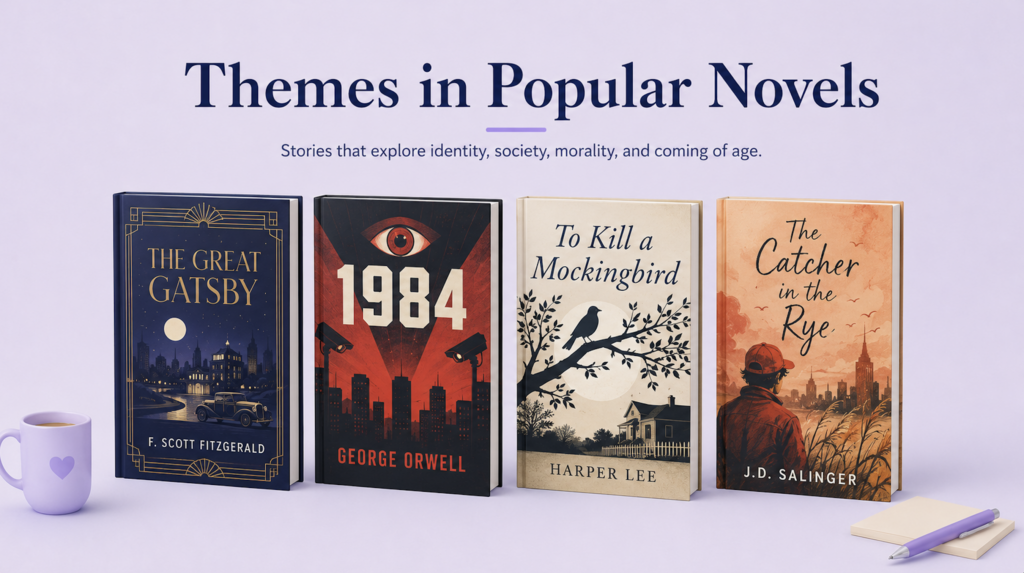
Themes in Literature Examples: Themes in Popular Novels
Themes are what make stories and characters memorable and impactful. Let’s take a look at three popular novels and how their themes shape their narratives.
The Great Gatsby by F. Scott Fitzgerald
📖 Main Themes:
- The American Dream and its corruption
- Wealth and materialism
- Unfulfilled desires
💡 How the Themes Appear
Jay Gatsby’s relentless pursuit of Daisy symbolizes the illusion of the American Dream, where wealth and status fail to bring true happiness. The novel critiques materialism and the moral decay of the Roaring Twenties.
1984 by George Orwell
📖 Main Themes:
- Totalitarianism and government control
- Surveillance and loss of privacy
- The power of propaganda
💡 How the Themes Appear
Winston Smith’s struggle against Big Brother highlights the dangers of authoritarian rule. Orwell warns about state surveillance and how propaganda manipulates truth, making individual thought a crime in a dystopian world.
To Kill a Mockingbird by Harper Lee
📖 Main Themes:
- Racial injustice and morality
- Empathy and understanding
- Loss of innocence
💡 How the Themes Appear
The trial of Tom Robinson exposes the deep racial prejudices of society. Through Atticus Finch’s moral integrity and Scout’s coming-of-age journey, the novel explores justice, compassion, and the power of seeing the world through others’ perspectives.
The Catcher in the Rye by J.D. Salinger
📖 Main Themes:
- Alienation and loneliness
- Coming of age and identity
- The loss of innocence
💡 How the Themes Appear
Holden Caulfield, disillusioned with the “phoniness” of the adult world, isolates himself emotionally and physically. His journey explores the struggles of growing up, finding identity, and the inevitable loss of childhood innocence. Through his experiences, the novel captures the alienation and confusion of adolescence.
8 Common Themes in Children’s Literature
Children’s literature plays a crucial role in shaping young minds, teaching valuable life lessons, and sparking imagination.
Research from the National Library of Medicine shows that children absorb multiple layers of information during shared book reading, learning new words, moral lessons, and story details simultaneously, reinforcing the impact of these recurring themes in their development.
1. Friendship & Kindness
Many children’s stories emphasize the importance of building friendships, showing empathy, and treating others with kindness. These themes help kids learn social skills and the value of compassion.
2. Courage & Bravery
From facing fears to standing up for what’s right, courage is a recurring theme in children’s books. Whether it’s a small character overcoming a big challenge or a hero embarking on a daunting journey, these stories inspire kids to be brave in their own lives.
3. Family & Love
Family bonds and unconditional love are central to many children’s books. These stories highlight the strength of relationships between parents, siblings, and caregivers, reinforcing the idea that love and support are always present.
4. Growing Up & Self-Discovery
Many children’s books follow characters as they learn, grow, and discover their place in the world. Themes of identity, independence, and personal growth help young readers navigate their own journeys.
5. Good vs. Evil
Classic fairy tales and modern adventures often explore the battle between good and evil. These stories teach children about morality, decision-making, and the importance of choosing kindness over selfishness.
6. Imagination & Creativity
Encouraging curiosity and creative thinking, many books celebrate the power of imagination. Whether through magical worlds or inventive problem-solving, these stories inspire children to dream big and think outside the box.
7. Perseverance & Resilience
Overcoming obstacles and never giving up are powerful themes that show children the importance of determination. Stories with this theme encourage kids to keep trying, even when things get tough.
8. Respect for Nature & the Environment
Many children’s books highlight the beauty of the natural world and the importance of taking care of it. These stories teach young readers about environmental responsibility and the impact of their actions on the planet.
From timeless fairy tales to modern classics, children’s literature uses these universal themes to entertain, educate, and inspire. No matter the story, a meaningful theme helps young readers connect, learn, and grow.
Themes make these stories timeless—they resonate across generations because they reflect real-world struggles, dreams, and fears. When reading or writing, identifying themes can deepen the experience and add layers of meaning to any story.
FAQ: Themes in Literature
Q: What Is the Best Definition of Theme?
A theme is the central idea or underlying message of a story. It represents a universal truth, moral, or insight that the author conveys through characters, plot, and conflict.
Q: How Many Themes Should a Story Have?
A story can have one or multiple themes, depending on its depth and complexity. While some stories focus on a single, dominant theme, others explore several interwoven themes that add layers to the plot and narrative.
Q: What Are the 5 Types of Theme?
Themes can be categorized in various ways, but five common types include:
Moral themes (e.g., good vs. evil, justice)
Social themes (e.g., class struggles, oppression)
Psychological themes (e.g., identity, coming of age)
Philosophical themes (e.g., fate vs. free will, existentialism)
Romantic themes (e.g., love, unrequited love)
Read more about on the Breakdown of Popular Narratives.
Q: How Do You Identify a Theme?
To identify a theme, look at the main conflicts, character arcs, and recurring symbols in the story. Ask yourself: What lesson or message is the author trying to convey? Themes are often implied rather than directly stated.
Q: What Are the Major Themes?
Some of the most common literary themes include love, power, identity, good vs. evil, survival, justice, fate vs. free will, and coming of age. These themes appear across genres and time periods, making them timeless and relatable.Themes often overlap with motifs, recurring elements that reinforce a story’s deeper meaning. If you’d like to explore how motifs enhance themes, check out our guide on Motif Examples in Literature.
Q: Does Every Story Need a Theme?
While not every story explicitly states a theme, all great stories have an underlying message or central idea. Even simple narratives reflect some kind of universal truth or emotional experience that resonates with readers.
Q: What Is the Difference Between a Topic and a Theme?
A topic is the subject of a story, such as love, war, or friendship, while a theme is the deeper meaning or insight related to that topic. Themes explore how and why the topic matters, making them more complex and thought-provoking.
Q: What Are Topics in Themes?
Topics are the broad subjects that a theme is built around. For example, the topic of power could lead to themes such as “absolute power leads to corruption” or “true leadership requires humility”. Topics provide the foundation, while themes give them depth.