

Sometimes, finding the deeper meaning of a story can feel like trying to read a message written in invisible ink.
So, what is the theme of a story? Simply put, it’s the deeper message woven through the narrative, the insight about life, human nature, or the world that gives a story its lasting meaning. It’s easy to confuse theme with plot, subject, or moral, but theme goes deeper than all three.
In this guide, we’ll define the theme of a story, show you how to tell it apart from plot, topic, and moral, and walk through a simple method for finding the theme in any narrative, from classic literature to your own writing. If you want ready-made inspiration, you can also browse our list of 250+ theme examples.
What Does Theme Mean in a Story?
The theme of a story is the central idea or underlying message the author wants readers to take away. Unlike the plot (what happens) or the topic (what the story is about), the theme is the deeper truth about life, humanity, or the world, revealed through the characters and the choices they make.
Themes can be explicit (the author states the message directly) or implicit (the meaning is woven into the story for readers to interpret). Some are broad, like love, power, or survival, while others are specific, like the cost of unchecked ambition or the clash between tradition and progress.
Many people mistakenly equate theme with plot or moral, but there are important differences:
- Plot answers, What happens in the story?
- Moral answers, What lesson should the reader take away?
- Theme answers the deeper question, What does this story say about human nature or life?
For example, the plot of Romeo and Juliet follows two star-crossed lovers whose tragic romance ends in death. The moral might be that impulsive actions have consequences, but the theme digs deeper: how destructive inherited hatred can be, or how love can transcend the boundaries society sets.
Theme vs Topic vs Moral: What’s the Difference?
| Theme | Topic | Moral | |
|---|---|---|---|
| What it is | The deeper message about life | The subject the story is about | A direct lesson to take away |
| Form | A full idea (power corrupts those who fear losing it) | A word or phrase (love, war, power) | An instruction (honesty is the best policy) |
| Stated or implied | Usually implied through events and characters | Usually explicit | Usually explicit |
| Example | Unchecked ambition destroys the person who chases it | Power | Don’t let ambition blind you |
Why Is the Theme of a Story Important?
The theme of a story isn’t just a literary buzzword. It’s the heartbeat beneath every memorable narrative. Understanding it transforms reading from mere entertainment into something more profound, offering insights that resonate on a deeper, often personal level.
When authors carefully develop a strong theme, they’re doing more than telling a good story. They’re giving readers something relatable and meaningful. Themes help stories stay timeless, connecting readers across eras and cultures through the kind of universal themes that reflect shared human experience.
For example, the theme of resilience in Harry Potter has helped readers of all ages find courage in hard times. Similarly, the theme of ambition and moral corruption in Shakespeare’s Macbeth still sparks reflection on power and its consequences centuries later.
In short, themes elevate stories beyond plot twists and engaging characters. They invite readers to reflect, question, and even reconsider how they see life, society, and themselves.
How to Write a Theme Statement
A theme statement, also called a thematic statement, is a single sentence that expresses a story’s theme as a complete idea about life, not just a one-word topic. If the theme is the message, the theme statement is that message written out in one clear line.
A simple formula makes it easier:
[topic] + [what the story reveals about it] = your theme statement
- Topic: ambition. Theme statement: Unchecked ambition destroys the person who chases it.
- Topic: love. Theme statement: Love can endure even when it demands sacrifice.
Three rules for a strong theme statement:
- Write a full sentence, not a word. “Love” is a topic. “Love can both heal and destroy” is a theme statement.
- Keep it universal. Leave out character names and specific plot points so the idea applies beyond the one story.
- Avoid clichés and absolutes. “Crime never pays” is a moral. Aim for something the story actually proves.
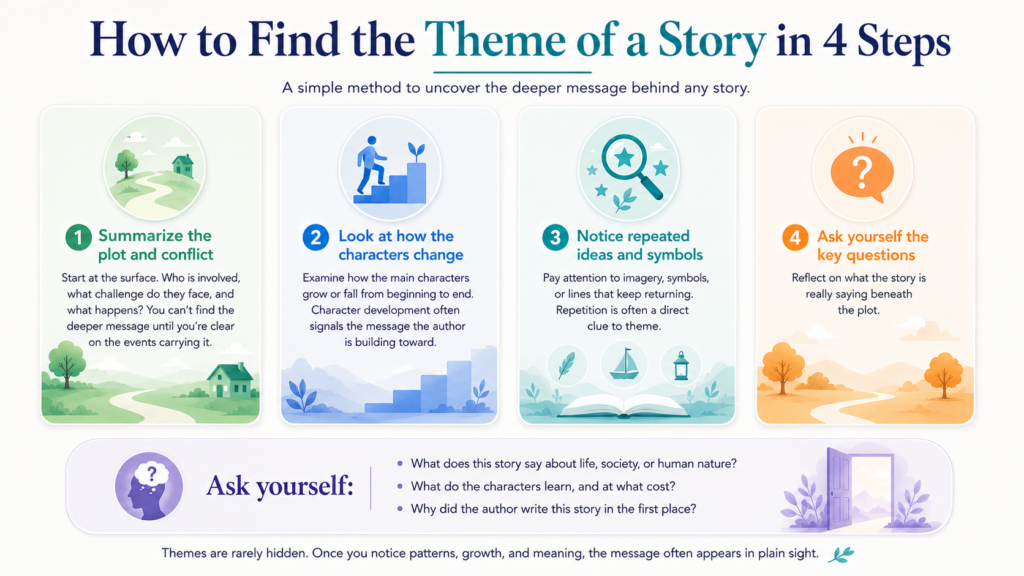
How to Find the Theme of a Story in 4 Steps
Finding the theme of a story can feel like hunting for hidden treasure without a map. But with the right approach, the theme is usually hiding in plain sight. Here’s a simple method to identify it.
Step 1: Summarize the plot and conflict
Start at the surface. Who is involved, what challenge do they face, and what happens? You can’t find the deeper message until you’re clear on the events carrying it.
Step 2: Look at how the characters change
Examine how the main characters grow or fall from beginning to end. Character development often signals the message the author is building toward.
Step 3: Notice repeated ideas and symbols
Pay attention to imagery, symbols, or lines that keep returning. Authors reinforce a theme through repetition, so a recurring symbol or motif is often a direct clue.
Step 4: Ask yourself the key questions
Reflect on what the story is really saying:
- What does this story say about life, society, or human nature?
- What do the characters learn, and at what cost?
- Why did the author write this story in the first place?
Then turn your answer into a theme statement: one sentence that states the message as a complete idea.
For example, in George Orwell’s Animal Farm, the recurring motif of corruption and power points to a theme about the dangers of unchecked authority. In The Hunger Games, repeated images of hope and defiance emphasize themes of survival and resilience.
A Worked Example: Finding the Theme of Of Mice and Men
Theory is easier to trust when you watch it work. Here is the four-step method applied to John Steinbeck’s Of Mice and Men.
Step 1: Summarize the plot and conflict. George and Lennie are migrant workers in Depression-era California, chasing a shared dream of owning a small farm. Lennie’s strength and innocence keep landing them in trouble, and the story ends with George forced to kill Lennie to spare him a worse fate.
Step 2: Look at how the characters change. George spends the novel guarding a dream he only half believes in. By the end he gives it up entirely, choosing mercy over the future the two of them had imagined.
Step 3: Notice repeated ideas and symbols. Loneliness is everywhere: Candy and his dying dog, Crooks alone in the barn, Curley’s wife with no one to talk to. Against all of it sits one repeated line, that George and Lennie have each other when other men have no one.
Step 4: Ask the key questions. What is Steinbeck saying about life? That companionship is rare and precious in a world built on isolation, and that the vulnerable are rarely allowed to keep it.
The theme statement: Companionship is what makes a hard life bearable, but in a world built on isolation, holding onto it comes at a devastating cost.
Notice the statement is a full idea, not a word, and it would still ring true in a story with a completely different plot. That is the test of a strong theme.
Common Themes to Recognize in a Story
Across cultures and eras, stories return to the same big ideas, the universal themes that reflect shared human experience. Learning to recognize these recurring themes makes it much easier to spot the theme when you read or write.
A few of the most common:
- Love and friendship: the bonds between characters and what they sacrifice for them (Jane Austen’s Pride and Prejudice, J.R.R. Tolkien’s The Lord of the Rings).
- Good vs. evil: the moral struggle between opposing forces, and the courage or redemption it demands (J.K. Rowling’s Harry Potter).
- Coming of age: a character’s journey toward maturity, identity, and self-awareness (J.D. Salinger’s The Catcher in the Rye, Louisa May Alcott’s Little Women).
- Survival and resilience: the strength to endure hardship, physical or emotional (Suzanne Collins’s The Hunger Games, Yann Martel’s Life of Pi).
- Prejudice and injustice: societal discrimination confronted to provoke thought and change (Harper Lee’s To Kill a Mockingbird, Khaled Hosseini’s The Kite Runner).
This is only a starting point. For a full, sortable reference, see our list of 250+ theme examples in literature, each with a definition and a book example.
What a Theme Is Not
Theme gets confused with a few things that look similar but do a different job. Clearing these up is often the fastest way to find the real theme.
- Not the plot. The plot is the sequence of events. The theme is what those events add up to. A farmer’s animals overthrow him is plot; power corrupts those who seize it is theme.
- Not the topic. The topic is the subject in a word or two (war, love, power). The theme is the point the story makes about that subject.
- Not the moral. A moral is a direct instruction, like “honesty is the best policy.” A theme is an open observation the reader interprets, not a rule they are handed.
- Not a single symbol or word. A recurring symbol can point toward the theme, but it is not the theme itself, and neither is a one-word label like “betrayal.”
Seeing all three side by side makes it click. In Harper Lee’s To Kill a Mockingbird:
- Topic: racism in the American South.
- Moral: do not judge people before you understand their circumstances.
- Theme: prejudice and ignorance perpetuate social injustice.
The topic tells you what the book is about, the moral hands you a takeaway, and the theme reveals what the story is really saying about how people and society work.
How to Write a Story With a Strong Theme
Crafting a story with a clear, resonant theme is what makes a narrative stay with readers. Here is how to build one in on purpose, with a note at each step on where authors most often go wrong.
Step 1: Start with a central idea. Decide early what you actually want to explore (friendship, courage, redemption, the price of ambition). It does not have to be original, but it should be something you genuinely care about.
Editor’s note: The manuscripts that struggle here usually have no idea at all, or five at once. One clear central idea beats a pile of half-explored ones every time.
Step 2: Align your characters with the theme. Build characters whose wants and struggles naturally test the idea. If your theme is resilience, your protagonist’s motivation should keep dragging them back into situations that demand it.
Editor’s note: The most common fix we suggest is connecting the theme to the main character’s flaw. When the thing they need to learn is the thing the story is about, theme and character stop feeling like separate jobs.
Step 3: Weave the theme into plot and conflict. Your central conflicts and their outcomes should illustrate the theme, not run parallel to it. A story about power corrupting works best when the plot itself shows a character trading their integrity for control, scene by scene.
Editor’s note: If you could delete your theme and the plot would not change, the theme is not load-bearing yet. Tie it to a decision the protagonist cannot avoid.
Step 4: Use symbolism and motifs. Repeated images and objects reinforce a theme quietly. In Lord of the Flies, the conch shell stands for order, and its slow destruction tracks the boys’ descent into savagery.
Editor’s note: One well-placed motif does more than ten. Authors tend to over-explain their symbols; trust the reader to feel the pattern before they can name it.
Step 5: Resist the urge to spell it out. Themes land hardest when readers arrive at them, not when a character announces them. Let actions and consequences do the work, using show, don’t tell rather than a closing monologue.
Editor’s note: This is the single most common theme problem we see. The moment a character explains the lesson, readers feel managed. Cut the speech and let the ending prove the point.
From the Spines Editing Desk…
Across the manuscripts our team works on, a weak theme almost never means a missing one. The theme is usually already there, buried under a plot that does not test it or a character who states it out loud. The strongest revisions rarely add a theme. They sharpen the conflict until the theme you already had becomes impossible to miss.
Avoid These Mistakes: Tips For Writers
Working with first-time authors, we see the same theme problems again and again. The good news: each has a fast fix, and most come down to rewriting a single sentence. Run your own theme through these.
1. You wrote a moral, not a theme.
A moral hands the reader a rule. A theme makes an observation and lets them reach their own conclusion.
- Before: Always tell the truth.
- After: The truth can set a person free or cost them everything, and they rarely get to choose which.
Fix: if your sentence sounds like advice, rewrite it as something the story reveals, not something it instructs.
2. Your theme is a single word.
“Love,” “power,” and “loss” are topics. A theme needs a full idea attached, or it gives you nothing to write toward.
- Before: Betrayal.
- After: Betrayal cuts deepest when it comes from the person you trusted to protect you.
Fix: turn the word into a theme statement using the topic-plus-insight formula.
3. You spelled it out.
If a character pauses to explain the lesson, the theme is sitting in the dialogue instead of living in the story, and readers feel lectured.
- Before: A character announces, “I guess this proves that greed destroys everything.”
- After: The greedy character quietly loses the people who mattered, scene by scene, and never names why.
Fix: let actions and consequences carry the message. This is where showing rather than telling does the real work.
4. The plot never proves your theme.
A theme has to be earned by what happens. If your story claims “trust is always rewarded” but no character is ever truly tested, the theme is a label on the cover, not the engine inside.
Fix: name your theme, then check that at least three turning points put it under pressure. If they don’t, either the scenes or the theme needs to change.
The 30-second theme test: Can you state your theme in one sentence, point to three moments that prove it, and confirm no character ever says it out loud? Three yeses means it’s working.
FAQ: What Is The Theme Of a Story
Q: What is the theme of a story?
The theme is the central idea or underlying message an author explores through characters, plot, and setting. It is the deeper point about life, people, or society that the story makes, beyond the surface events. For example, the theme of Animal Farm is that power corrupts those who seize it.
Q: What is the difference between a theme and a moral?
A moral is a direct instruction, like “honesty is the best policy.” A theme is an open observation the reader interprets for themselves, like “the truth can free a person or destroy them.” A moral tells you what to do; a theme reveals something true and lets you draw your own conclusion.
Q: Can a theme be one word?
Not really. A single word like “love,” “betrayal,” or “freedom” is a topic. A theme needs a full idea attached to it, such as “love can endure even when it demands sacrifice.” If you can only name a word, you have your topic, not your theme yet.
Q: How do I find the theme of a story I’m reading?
Summarize the plot, watch how the main characters change, note any images or ideas that keep repeating, then ask what the story is saying about life or human nature. The answer, written as one full sentence, is your theme. There is a full step-by-step method, with a worked example, earlier in this guide.
Q: What is the difference between a topic and a theme?
A topic is the subject matter of a story (e.g., war, friendship, or family). The theme, however, is the deeper message or lesson the author conveys about that subject matter, such as the impact of war or the strength of friendship.
Q: How do I find the theme of my own story?
Look at what your protagonist learns by the end and what it costs them. The lesson the story puts them through, not the one you intended, is usually your real theme. If you are not sure yet, draft a quick theme statement and check whether your turning points actually prove it.
Q: Why can’t I find my story’s theme?
This is normal, and it usually does not mean the theme is missing. More often, it is buried under a plot that does not test it, or split across too many competing ideas. Try naming the one decision your protagonist cannot avoid; the theme is almost always attached to it.
Q: Does every story need a theme?
Not every story states one openly, but a strong theme is what gives a story depth and staying power. Readers remember how a story made them think long after they forget the plot, and that lasting resonance comes from theme.