
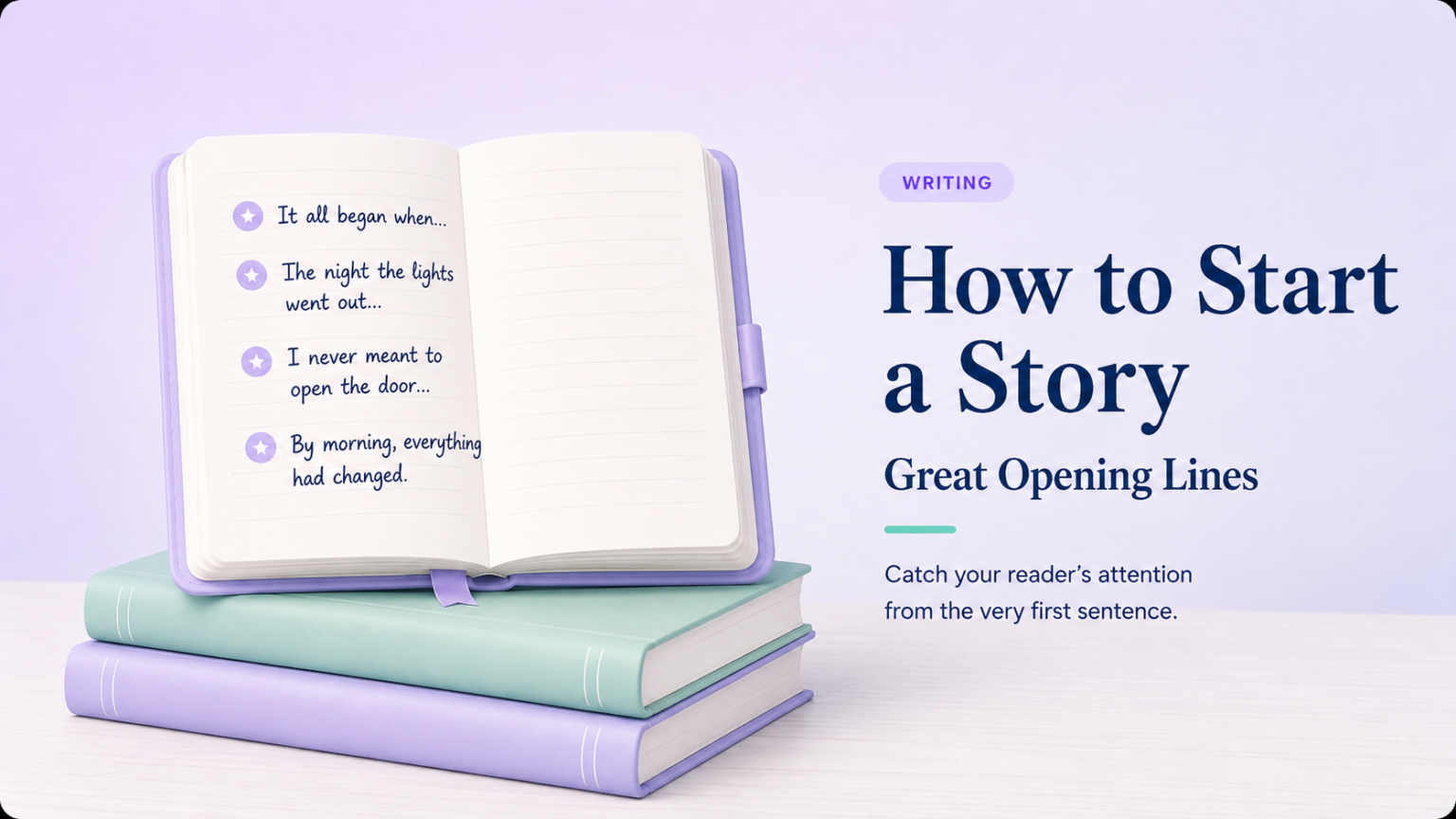
Most writers rewrite their opening more than any other part of their story. The gap between knowing what a great opening does and being able to write one is where most writers get stuck.
The best way to start a story is to drop the reader into a moment already in motion, create a question they need answered, and establish a voice they want to spend time with. Every memorable opening does all three, regardless of genre, length, or style.
This guide breaks down exactly how to start a story. You’ll find the techniques behind memorable story openings, real examples from published fiction you can study and apply immediately, and specific advice for first-person narratives, short stories, fictional worlds, and fantasy.
If you’re working on the broader writing process rather than just the opening, how to start writing a book covers the full journey from idea to finished draft.
What Makes a Great Story Opening
Every great story opening does three things regardless of genre, length, or style.
It starts in motion. It creates a question. It earns trust in the voice.
Get all three right and the reader is yours.
Here’s how those three principles apply across the genres writers ask about most:
| Genre | What in motion looks like | The question it creates | The voice it needs |
|---|---|---|---|
| Literary fiction | A relationship already under pressure | What broke between these two people? | Precise, interior, observational |
| Thriller | A threat already present or approaching | Who is in danger and why? | Taut, propulsive, controlled |
| Fantasy | A world already functioning by its own rules | What are the rules and who controls them? | Confident, specific, immersive |
| Romance | Two people already in each other’s orbit | Will they or won’t they? | Warm, emotionally intelligent, charged |
| Horror | Something already wrong that nobody has named yet | What is it and how bad will it get? | Dread beneath the ordinary |
| Short story | The moment closest to the point of no return | What happens in the next few minutes? | Economical, every word load-bearing |
| Memoir | A specific memory that contains the whole story | Why does this moment matter so much? | Honest, reflective, specific |
| Young Adult | A character already chafing against their world | What are they going to do about it? | Direct, emotionally urgent, unsentimental |
Before you write your opening, answer this question for your own story:
What is already happening when my reader arrives, what do they immediately need to know, and whose voice are they hearing it in?
For more on how story openings connect to the larger shape of a narrative, the story structure guide and story elements guide are worth reading before you start drafting.
Ways to Start a Story
There is no single correct way to begin. But there are proven techniques that work across genres, lengths, and styles. Here are the most effective ones, each with a real example from published fiction.
In Medias Res: Start Mid-Action
Drop the reader into a scene already in progress. No setup, no backstory. The story is happening when they arrive.
Cormac McCarthy opens The Road with a man and a boy already moving through a destroyed landscape. We don’t know how the world ended. We don’t need to yet. The forward motion is enough.
Read more about the In-Media Res meaning and how it can be a good option to start a story.
A Striking Opening Line
A single sentence that creates immediate curiosity without explaining itself.
“It was a bright cold day in April, and the clocks were striking thirteen.”
Orwell’s opening to 1984 sounds almost normal until the last two words make it impossible to ignore. For more on what makes opening lines land, the guide to the best opening lines in books breaks down the most celebrated examples from published fiction.
Opening With Dialogue
A line of speech that raises an immediate question: who is speaking, to whom, and why does it matter?
Dialogue openings create instant forward momentum without requiring scene-setting. The reader is dropped into a conversation already happening and has to keep reading to understand its stakes.
A Declarative Statement That Surprises
State something unexpected as plain fact and let the reader sit with it.
“All happy families are alike; each unhappy family is unhappy in its own way.”
Tolstoy’s opening to Anna Karenina works because it states something that feels both true and arguable. The reader has to keep going to find out which it is.
A Revelation
Tell the reader something significant they didn’t expect to know this early.
Gillian Flynn opens Gone Girl by revealing, within the first pages, that the narrator is capable of coldly calculated deception. Everything that follows is reframed by that knowledge. The reader is already unsettled before the story has properly begun.
A Specific Image
A single precise visual detail that carries more weight than description.
Gabriel García Márquez opens One Hundred Years of Solitude with a man remembering the afternoon his father took him to see ice for the first time. A small, specific image that contains an entire world without explaining it.
Character Voice
Let the narrator’s personality dominate the opening paragraph. The story begins because this particular person is telling it.
Holden Caulfield’s opening in The Catcher in the Rye works entirely on voice. Nothing dramatic happens. But the voice is so specific and so immediately distinctive that readers follow it without needing to know where it’s going.
A Moment of Tension
Not necessarily action, but pressure. A decision that needs making, a confrontation about to happen, a silence that means something.
Tension doesn’t require violence or drama. It requires that something is at stake in the opening scene. For more on building and sustaining that pressure, the guide on how to create suspense in writing covers the mechanics in detail.
How to Start a Story Examples
The fastest way to understand what a great opening does is to read one closely. Here are eight examples from published fiction, each using a different technique, each creating a different effect.
“It was the best of times, it was the worst of times.” A Tale of Two Cities, Charles Dickens
Opens with contradiction. The reader immediately wants to understand how both things can be true at once. The tension between the two halves of the sentence is the tension of the entire novel in miniature. Dickens earns the reader’s attention not with action but with a paradox that demands resolution.
“The man in black fled across the desert, and the gunslinger followed.” The Gunslinger, Stephen King
Pure forward motion. Two unnamed figures. A pursuit already underway. No context, no backstory, no explanation of the world. Just momentum. The reader has no choice but to follow because the story is already moving.
“In a hole in the ground there lived a hobbit.” The Hobbit, J.R.R. Tolkien
Grounds the reader in a specific, unusual place immediately. The word “hobbit” is unexplained. The sentence is so matter-of-fact about something so strange that the reader continues simply to find out what a hobbit is. Confidence in the unusual is itself a hook.
“It is a truth universally acknowledged, that a single man in possession of a good fortune, must be in want of a wife.” Pride and Prejudice, Jane Austen
The irony is immediate. “Universally acknowledged” signals that what follows is anything but universal. The wit establishes the novel’s entire tone in a single sentence. The reader knows exactly what kind of book this is before meeting a single character.
“Someone must have slandered Josef K., for one morning, without having done anything wrong, he was arrested.” The Trial, Franz Kafka
The injustice is established in the first sentence. The mystery is total. The premise is both absurd and immediately recognisable as a kind of truth most readers have felt at some point. That combination of the surreal and the familiar is what makes it impossible to stop.
“Last night I dreamt I went to Manderley again.” Rebecca, Daphne du Maurier
The past tense and the word “again” do enormous work. Something has already happened. The narrator has already left. The reader wants to know what Manderley is, why she left, and why she’s still dreaming of it. Three questions in ten words. That density of implication is what great openings achieve.
For more analysis, the guide to the best opening lines in books goes deeper on the most celebrated first lines in literary history.
How to Start a Story in First Person
First person openings live or die on voice. The narrator isn’t just telling the story. They are the story. Here’s what separates a first person opening that works from one that doesn’t.
Lead with personality, not biography
The most common first person opening mistake is starting with information. “My name is X and I grew up in Y” tells the reader facts. It gives them nothing to hold onto.
What works instead: an opinion stated too confidently, a thought the narrator probably shouldn’t be having, a confession that reveals more than it intends to. Holden Caulfield opens The Catcher in the Rye with defensiveness and irritation present from the first sentence. We don’t know where he is. The voice is so specific we follow it anyway.
First person opening prompts by genre:
| Genre | Opening prompt |
|---|---|
| Literary fiction | Start with something the narrator notices that nobody else would |
| Thriller | Start with something the narrator knows that puts them in danger |
| Romance | Start with the narrator’s first impression of someone they’re trying not to like |
| Horror | Start with something the narrator dismisses that the reader recognises as a warning |
| Memoir | Start with the moment the narrator realised something had permanently changed |
| Young Adult | Start with the narrator’s clearest statement of what they want and can’t have |
How to write an unreliable first person opening
If your narrator is hiding something, misremembering, or deceiving themselves, the opening is where you plant that seed without the reader knowing it’s there.
They shouldn’t suspect anything yet. But looking back after finishing the book, the signal should have been there from the first line. That retrospective clarity is one of the most powerful effects in fiction and it starts in the opening paragraph.
The one test your first person opening must pass
Read the first paragraph aloud and ask: could any other narrator have written this exact paragraph?
If yes, the voice isn’t specific enough. A great first person opening could only have been written by this narrator, in this state of mind, at this exact moment.
For a deeper look at how first person narration works across an entire story, the guide to writing a first person narrative covers point of view, voice, and reliability in depth.
How to Start a Short Story
Starting a short story is a different craft problem than starting a novel. You have less space, less time, and a reader who decides faster. Here are seven things every strong short story opening does.
1. Start closer to the end than feels comfortable The interesting moment is rarely at the beginning of the chronology. It’s somewhere in the middle. Raymond Carver opens stories mid-situation, mid-tension, mid-consequence. The reader arrives late by design. Start where the pressure already exists.
2. Make every sentence do two things at once There is no room for a sentence that only establishes place, or only describes character, or only sets atmosphere. Every sentence in a short story opening must earn its place by doing at least two things simultaneously: character and conflict, tone and place, voice and situation.
3. Skip the introduction The reader doesn’t need to be introduced to the narrator. They need to be dropped into the narrator’s reality. Cut every sentence that explains who someone is before showing what they’re doing.
4. Use one specific detail instead of a full description One precise, concrete detail does more work than a paragraph of scene-setting. It implies everything around it without stating any of it. The reader’s imagination fills in the rest and a reader who has filled in details is a reader who is invested.
5. Let the conflict arrive in the first paragraph In a novel the conflict can build across the first chapter. In a short story it needs to be present, or at minimum implied, before the first page ends. Not dramatically announced. Present. The way a smell is present in a room before anyone mentions it.
6. Trust the reader to catch up Short story readers are experienced readers. They don’t need context delivered before the story begins. Drop them into the situation and let the context arrive through action, dialogue, and implication. Readers who have to piece something together are readers who are paying attention.
7. Choose the tone and commit to it immediately Short stories don’t have room to find their tone halfway through. The opening sentence establishes the register the whole story will live in. Carver’s plainness, Flannery O’Connor’s gothic unease, Lorrie Moore’s dark comedy. Each is present from the first line. Know what tone your story needs and put it in the first sentence.
For more on how openings function within the specific architecture of the short form, read our blogs about short story structure and short story elements.
How to Start a Fictional Story
Starting a fictional story means solving a problem that doesn’t exist in memoir or journalism: you need the reader to believe in a world that never existed. The opening has to earn that belief before it’s been established, which means every fictional story opening is doing two jobs at once. Telling a story and building a world, simultaneously, from the first sentence.
Most fictional story openings fail because the writer tries to do the world-building job first. The story job has to come first. Always.
The core principle: emotion before invention
Readers will accept almost any fictional world if they care about the person living in it. They will abandon a brilliantly constructed world if they don’t. This is the single most important principle in starting a fictional story and the one most writers violate in their first draft.
Ground the reader in something recognisably human before you ask them to accept anything invented. A character wanting something. A relationship under strain. A decision with consequences. Give the reader an emotional foothold and they will follow you into any world, no matter how strange or distant from their own experience.
Suzanne Collins opens The Hunger Games not with the Capitol, not with the arena, not with an explanation of the dystopian political system. She opens with Katniss checking on her sister before dawn. The world is extraordinary. The feeling, a sibling trying to protect someone younger from something frightening, is completely ordinary. That combination is what makes the opening work.
Three techniques specific to fictional story openings
Show the world through the character’s relationship to it. Don’t describe your fictional world. Show how your character experiences it. There is a significant difference. Description tells the reader what a world is. A character’s relationship to that world tells them what it means. A character who finds their world suffocating tells us more about that world in one paragraph than three pages of description ever could. The story setting guide covers how to use place as an active element of character rather than a backdrop.
Introduce the rules by breaking them. One of the most effective techniques for opening a fictional story is to establish a rule of your world in the act of someone breaking it, or being affected by its breaking. The reader learns what is normal and what is abnormal simultaneously, without a single line of exposition. This technique does in one scene what a prologue attempts to do in three pages, and it does it without stopping the story to explain itself.
Use the ordinary to make the extraordinary believable. The more invented your world, the more ordinary your anchor needs to be. Kafka states the impossible as plain fact. García Márquez describes the magical with the same tone he uses to describe the mundane. Ursula K. Le Guin grounds the strange in the specific. In each case the technique is the same: treat the invention as if it requires no special pleading, and the reader will accept it on those terms.
What fictional story openings must never do
Start with a prologue that explains the world before the story begins. Start with a map, a glossary, or an epigraph that tells the reader what to think before they’ve experienced anything. Start with a character who exists only to receive an explanation of the world they already live in. These are the three most reliable ways to signal to a reader that the story hasn’t started yet, and readers who sense that a story hasn’t started will stop reading until it does.
The fictional world exists to serve the story. The opening exists to start the story. Keep those two things in their correct order and the world will reveal itself naturally through everything that follows. The story elements guide and what makes a good story guide cover how world, character and conflict work together across the full arc of a fictional narrative.
How to Start a Fantasy Story
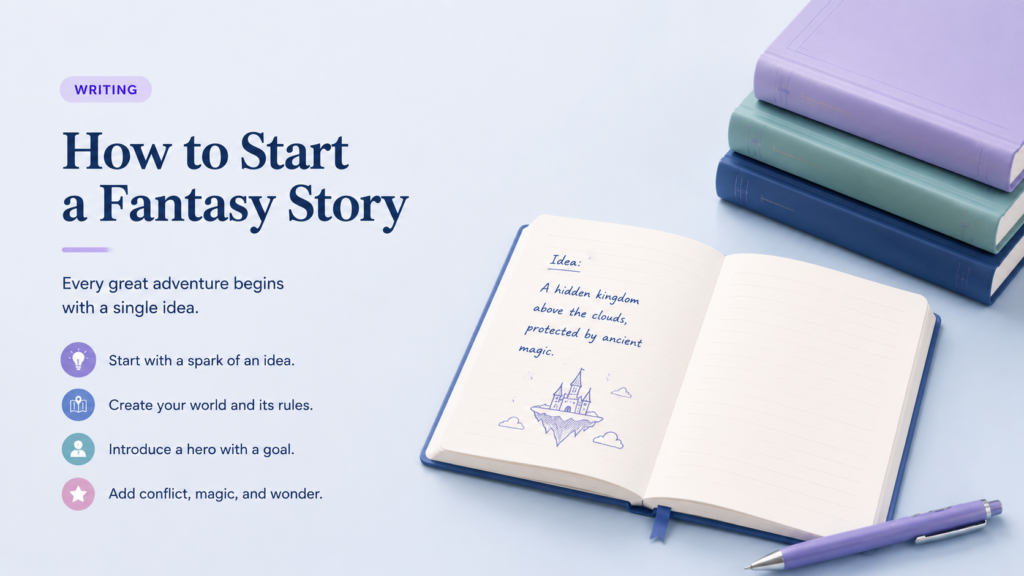
Fantasy carries a specific burden that no other genre shares: the reader has never been to this world before and you have approximately one page to make them want to stay in it. The instinct is to explain the world before the story begins. That instinct is almost always wrong.
The worldbuilding trap and how to avoid it
Every fantasy writer has built something extraordinary. Seven moons, a magic system with internal logic, a political history spanning three centuries, a language with its own grammar. None of it belongs in the opening.
Readers don’t need to understand your world before they care about your characters. They need a reason to care about your characters first. The world reveals itself through what the characters do, want, fear, and lose. It doesn’t need to be explained before any of that has happened.
Patrick Rothfuss opens The Name of the Wind in a village inn with a man who is clearly more than he appears. The magic system, the history, the mythology: none of it is explained. What’s established is that this particular man is worth listening to. The world arrives later, earned rather than given.
Micro-worldbuilding: the single detail that implies everything
The most effective fantasy opening technique is introducing one specific, concrete detail that implies the rules of your world without stating them.
Not: “In this world, magic was drawn from the emotional energy of living creatures, channelled through specially trained practitioners known as Weavers.”
Instead: “She locked the door not with a key but with a whispered word, and even then she checked it twice.”
The second version tells the reader that magic exists, that it’s ordinary enough to be used for mundane tasks, that it’s unreliable enough to require checking, and that this character is cautious by nature. Five pieces of information. Zero exposition. The reader’s imagination fills in everything else, and a reader whose imagination is engaged is a reader who is invested.
The tonal contract
Fantasy covers an enormous range. The pastoral warmth of Tolkien. The brutal political realism of George R.R. Martin. The literary surrealism of Susanna Clarke. The YA urgency of Leigh Bardugo. Each is a completely different reading experience and each establishes what it is in the first page.
Your opening is a promise about what kind of fantasy story this will be. A reader who expects Tolkien and gets Martin will feel misled regardless of how good the writing is. Establish the tone before you establish anything else because tone is what tells the reader whether this is a book for them.
Fantasy Opening by Subgenre
| Subgenre | What the opening needs to establish | What to avoid |
|---|---|---|
| Epic fantasy | A world worth saving and a character with a reason to save it | Front-loading political history or maps |
| Dark fantasy | Dread beneath the surface of something ordinary | Explicit horror before the reader is invested |
| High fantasy | The rules and stakes of the world through action not explanation | Prologues that explain the world before the story begins |
| Urban fantasy | The collision between the magical and the mundane | Over-explaining how the two worlds coexist |
| Romantic fantasy | A character’s emotional landscape before their physical one | Prioritising world detail over character feeling |
| YA fantasy | A character chafing against the limits of their world | Starting too slowly or too far from the central conflict |
If you’re still developing the premise your opening needs to introduce, fantasy story ideas and the guide on what is high fantasy are useful starting points.
How to Write a Story Opening: A Practical Framework
You’ve read the techniques. Here’s how to actually use them.
Step 1: Identify your entry point Write down three possible moments where your story could begin. Not where you’ve been starting it. Three different entry points across the timeline of your story. The earliest possible moment, the most dramatic moment, and the moment closest to the point of no return. Now ask: which one creates the most immediate question?
Step 2: Write the worst possible version first Give yourself explicit permission to write the opening badly. Set a timer for ten minutes and write the opening without stopping, without editing, without reading back what you’ve written. The goal is not a good opening. The goal is a draft opening that exists and can be worked with. You cannot edit a blank page. For more on this approach, the how to start writing a book guide covers the first draft mindset in detail.
Step 3: Apply the three-question diagnostic Once you have a draft opening, run it through these three questions:
- Does it start in motion?
- Does it create a question the reader needs answered?
- Does it establish a voice the reader wants to spend time with?
If any answer is no, you know exactly what to fix.
Step 4: Cut the first paragraph This is counterintuitive but reliable. Most writers warm up into their story in the first paragraph. The actual opening, the moment where the story genuinely begins, is usually the second or third paragraph. Delete the first paragraph and read from what remains. More often than not, the story is stronger without it.
Step 5: Read it aloud The ear catches what the eye misses. A rhythm that feels right when writing often reveals itself as clunky when spoken. An opening that reads well aloud is almost always an opening that works on the page. Read it to yourself, slowly, before you decide it’s finished.
Step 6: Test it against your genre Go back to the genre table in the opening section of this article. Does your opening do what your genre requires? Does it establish the right tone, the right stakes, the right kind of question? An opening that works brilliantly for literary fiction may be completely wrong for a thriller. Genre isn’t a constraint. It’s a contract with your reader.
Once your opening is working, the next step is understanding how it connects to the larger structure of your story. The story structure guide covers how to build everything that comes after the first page, and if you’re ready to take your story from opening to finished manuscript, the how to start writing a book guide walks through the complete process.
Story Opening Mistakes: What Separates Strong From Weak
Most weak openings share the same problems. Not because writers don’t know better, but because the instinct when starting is to over-explain, over-establish, and over-prepare the reader for what’s coming. Here’s how to diagnose exactly what’s wrong with an opening that isn’t working.
| The weak version | Why it fails | The strong alternative |
|---|---|---|
| Starting with weather | Atmosphere without purpose stalls momentum before it builds | Weather that carries conflict, mirrors character, or signals what’s coming |
| Starting with a character waking up | Signals the writer began at the start of a day not the start of a story | Start at the moment something changes, not the moment before it |
| Opening dialogue with no context | The reader has no way to understand why what’s being said matters | Anchor dialogue in action or situation before trusting it to carry the opening |
| Backstory in paragraph one | Front-loads information before the reader has a reason to care about it | Let backstory arrive through action and consequence, never through explanation |
| Purple prose | Ornate language that calls attention to itself rather than the story | Specificity over decoration. One precise detail beats three beautiful sentences |
| The prologue that explains everything | Tells the reader what to think before they’ve experienced anything | Trust the story to explain itself through what happens |
| A character described in a mirror | The most overused device in unpublished fiction | Reveal character through action, decision, and voice |
The one question that diagnoses every weak opening
Read your first paragraph and ask: is anything at stake yet?
Not dramatically. Not obviously. But is there pressure, tension, implication, or a question the reader needs answered? If the answer is no, the opening hasn’t started yet. Keep writing until the answer is yes, then cut everything before that point.
FAQ: How to Start a Story
Q: What is the best way to start a story?
Start in motion. Drop the reader into a moment already happening rather than building toward one. The most effective story openings begin mid-situation with conflict or tension already present, and let the reader piece together context as they go. The opening line should create a question the reader needs answered before they’ve had time to decide whether they’re interested.
Q: How do you start a story with a hook?
A hook creates a gap between what the reader knows and what they need to know. It can be a striking statement, an unusual situation described as plain fact, a moment of tension, or a voice so specific it demands attention. It doesn’t need to be dramatic. It needs to be specific enough to feel real and open enough to feel unresolved.
Q: What are some good ways to start a story?
The most effective techniques are starting in medias res, opening with a striking first line, using a declarative statement that surprises, revealing something significant early, grounding the reader in a specific image, or leading with a distinctive character voice. Each technique creates a different effect. The right one depends on your genre, your story, and the kind of question you want the reader to be asking by the end of the first paragraph.
Q: How do you start a story in first person?
Lead with personality rather than biography. The reader needs to feel what it’s like to be inside the narrator’s head before they need to know the facts of their situation. Avoid the résumé opening and instead reveal character through the specific texture of how the narrator thinks, speaks, and notices the world around them.
Q: How do you start a short story?
Start closer to the end of the chronology than feels comfortable. The interesting moment is rarely at the beginning of the timeline. Every sentence in a short story opening needs to do at least two things simultaneously, and the conflict needs to be present, or at minimum implied, before the first page ends.
Q: What should you not do at the beginning of a story?
Avoid starting with weather description that carries no narrative purpose, a character waking up unless the act of waking is itself significant, backstory that front-loads information before the reader has a reason to care, opening dialogue with no context to anchor it, or a prologue that explains the world before the story begins. The most reliable diagnostic is asking whether anything is at stake in the first paragraph. If nothing is at stake, the story hasn’t started yet.
Q: How do you start a fantasy story?
Resist the urge to explain your world before the story begins. Introduce one specific detail that implies the rules of your world without stating them. Ground the reader in a character’s desire or fear before introducing anything that requires suspension of disbelief. Establish the tone of your specific subgenre immediately because tone is the first promise you make to your reader.
Q: How do you start a fictional story?
Ground the reader in something recognisably human before you ask them to accept anything invented. Emotion before invention, always. Show the world through the character’s relationship to it rather than describing it directly. Introduce the rules of your world through action rather than explanation. The reader will accept almost any fictional world if they care about the person living in it.