
A strong short story structure gives a piece of fiction a clear, compelling shape, guiding the reader through one central conflict from beginning to end. Short stories are challenging because there’s little room for unnecessary scenes. Every character choice, line of dialogue, and plot beat must earn its place.
That tight focus is also what makes short fiction powerful. A well-structured story moves quickly, builds tension, and leaves a lasting emotional impact. Poor structure can lead to common issues: starting too early, cramming too many plot points, or ending without a satisfying payoff.
In this guide, we will break down the core structure of a short story, including the opening hook, inciting incident, rising action, climax, and resolution. We will also look at how short story structure differs from a novel, how published stories use structure effectively, and how structure changes across genres like flash fiction, literary fiction, horror, and romance.
| Structural Element | Purpose in a Short Story |
|---|---|
| Opening Hook | Pulls the reader into the story’s central tension |
| Inciting Incident | Introduces the disruption, problem, or desire driving the story |
| Rising Action | Builds pressure, emotional stakes, and reader curiosity |
| Climax | Forces a decision, realization, confrontation, or irreversible shift |
| Resolution | Provides closure, meaning, or a final emotional effect |
What Is the Structure of a Short Story?
Short story structure is the way a story is organized from the first meaningful moment to its final effect. It gives readers a clear path through the conflict, making the story feel intentional rather than like a random scene.
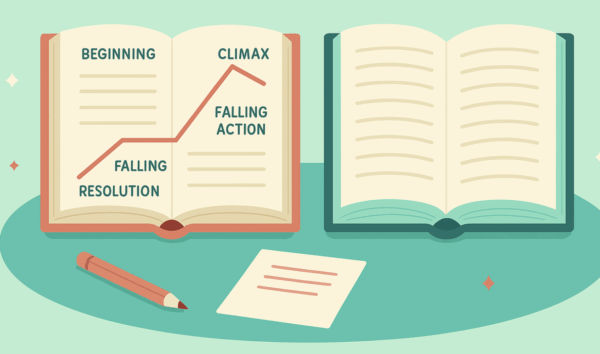
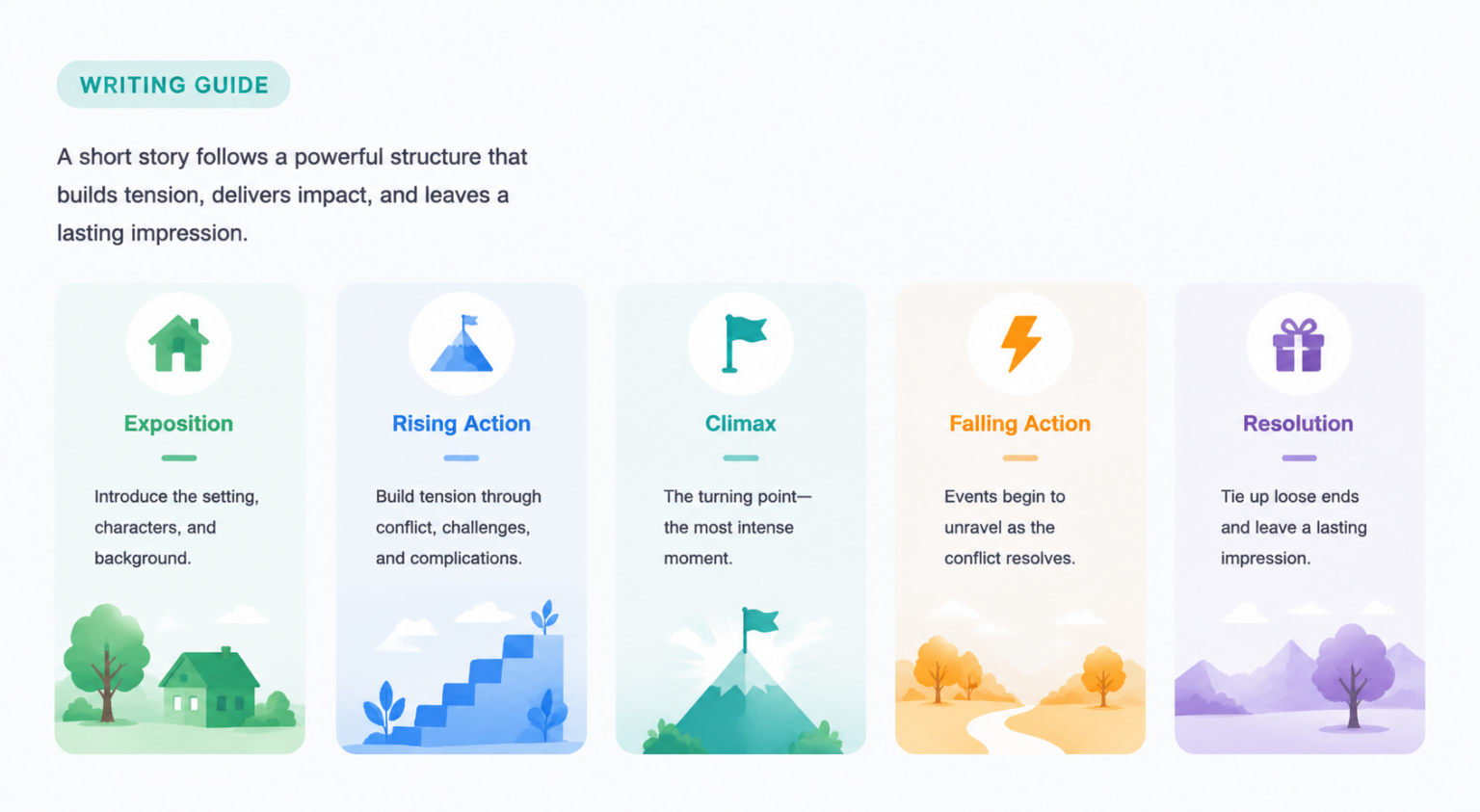
Most short stories follow a classic narrative arc, often referred to as Freytag’s Pyramid, which includes:
- Exposition – Introduce the setting, characters, and main conflict. Think of it as the opening scene that sets the stage—no need to overstay your welcome.
- Rising Action – Develop tension and build stakes. This is where complications unfold, and readers lean in.
- Climax – The turning point. Something big happens that changes everything.
- Falling Action – Tensions ease, and consequences start to play out.
- Resolution – The conflict wraps up—whether happily ever after or a delicious gut punch.
Good structure doesn’t mean following the same formula every time. Some stories move chronologically; others circle a memory, repeat a pattern, or withhold information until the reader uncovers the truth. What matters is that the structure serves the story’s purpose. Some tales start mid-action or experiment with structure, others drop the resolution entirely. But even when it’s subtle, some form of this arc is usually present.
Think of structure as a framework, not a rulebook. It helps writers determine which details carry emotional weight, which scenes are purely explanatory, and where readers should feel curiosity, tension, or surprise. A few precise moments can reveal a character’s emotional history without halting the story with backstory. Having a clear structure helps to write compelling short stories.
Why Structure Matters in Short Fiction
Structure is essential because readers need orientation before they feel moved. The central conflict should be clear early, even if the deeper meaning unfolds gradually.
A strong short story structure creates momentum: every glance, lie, rejected apology, or unfinished sentence should shift the reader’s understanding of the conflict or characters. Without focus, the story can feel scattered, overexplained, or incomplete.
The ending is just as important as the opening. It doesn’t have to resolve every detail but should shift the reader’s perspective, sharpen the emotion, or leave a final, resonant image.
How to Structure a Short Story: Step-by-Step Guide
A strong short story structure ensures your story is focused, builds tension, and leaves the reader with a lasting impact.
Short stories are different from novels. You have limited space, so every line, scene, and character choice must serve the story’s central conflict. Follow these five practical steps to structuring your narrative for impact.
Step 1: Hook Them in the First Paragraph (Opening Hook)
The opening hook is your story’s first impression; it decides whether readers keep going. You don’t have time for a slow burn. In a short story, the hook isn’t optional. Start close to the central tension. Introduce the protagonist, hint at the conflict, or present a surprising image, bold statement, or action that demands explanation. Writing an unforgettable opening line can be the key to pulling readers in fast.
Pro tips for opening hooks:
- A strange or shocking event
- A tense conversation
- A character facing a difficult choice
- A line that raises curiosity
Example: A character deletes a long-awaited acceptance email, fearing that believing it is real would reveal just how badly they wanted it. This small action creates curiosity, conflict, and tension immediately.
Step 2: Introduce the Inciting Incident
The inciting incident interrupts the character’s ordinary life and makes avoidance impossible. It’s the moment that sets the story in motion, introducing a problem, loss, desire, opportunity, or discovery.
In short stories, this usually occurs early, within the first few paragraphs, so readers understand what’s at stake. It can be dramatic, like a sudden betrayal, or subtle, like a single line that changes the character’s perspective. What matters is that life is no longer the same after it happens.
Step 3: Build Momentum with Rising Action
Rising action is where the story gains energy. The character wants something, but obstacles appear, another person, a secret, fear, or misunderstanding. Each beat should change what the reader understands about the conflict, character, or emotional stakes.
In short stories, focus is key. One strong obstacle is often more effective than multiple underdeveloped ones. For example, a story about a character trying to apologize may need only one conversation where pride, shame, and fear create tension.
Step 4: Deliver the Climax
The climax is the emotional or narrative high point. It’s where the story’s central tension can no longer be avoided. It may involve a decision, revelation, confrontation, or internal shift.
- Connect it directly to the main conflict
- Make it feel earned, not random
- It doesn’t need to be loud or action-heavy; even internal realization works in literary fiction
Example: A character confronts their jealousy, finally admits the truth, or chooses silence because honesty would come at too high a cost.
Step 5: Land the Ending (Resolution)
The resolution shows what has changed because of the story. It can be external, emotional, symbolic, or psychological. Give your reader a satisfying close. That could mean resolution, irony, ambiguity, or even leaving your story open-ended for dramatic effect. As long as it feels intentional and complete, you’re golden.
A strong resolution leaves readers with:
- A sense of recognition, discomfort, or relief
- A deeper understanding of the story’s emotional core
- A final image that lingers
Tip: Even a small, quiet ending can feel complete if it resolves the central tension and reinforces the story’s emotional purpose.
Quick Short Story Structure Checklist
- Does the story start close to the main conflict?
- Is the protagonist’s goal clear?
- Is there one central tension?
- Does each scene move the story forward?
- Is the climax tied to the main conflict?
- Does the ending feel intentional and satisfying?
5 Common Short Story Plot Structures
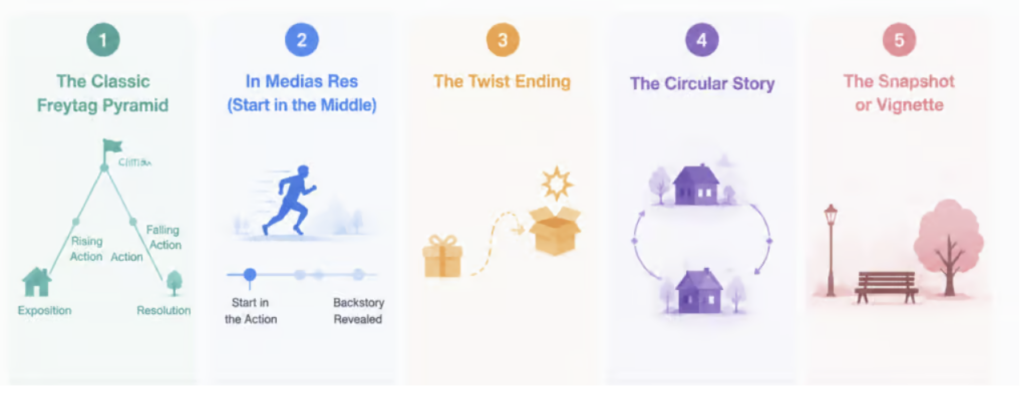
While all good stories need structure, not all structures are created equal. Depending on your style, genre, and message, the short story plot structure you choose can drastically change how your story feels.
Let’s explore a few popular plot structures that work especially well for short fiction:
1. The Classic Freytag Pyramid
We covered this earlier: exposition, rising action, climax, falling action, resolution. It’s simple, timeless, and works for almost any genre, just like the Hero’s Journey, another timeless structure.
📚 Best for: Traditional storytelling with a clear arc and satisfying payoff.
2. In Medias Res (Start in the Middle)
This structure drops the reader straight into the action. Backstory and context are revealed as the plot moves forward.
📚 Best for: Flash fiction, thrillers, or emotionally charged scenes where immediacy is key.
3. The Twist Ending
The story builds toward a seemingly predictable outcome, only to pivot dramatically in the final moments, plot twists that keep your story engaging can create a lasting impact in short fiction.
📚 Best for: Psychological drama, horror, or satire. Think O. Henry or Black Mirror vibes.
4. The Circular Story
The ending mirrors the beginning, often showing how everything has changed, or stayed hauntingly the same. It’s compact, poetic, and perfect for themes like inevitability or personal growth.
📚 Best for: Character-driven fiction and introspective narratives.
5. The Snapshot or Vignette
Rather than a full arc, this structure captures a moment in time, often centered around mood, theme, or character insight. It’s like a literary photograph.
📚 Best for: Literary fiction, coming-of-age stories, and experimental prose.
How Is Short Story Structure Different from a Novel?
Short story structure is different from novel structure because a short story has less room to expand and more pressure to concentrate. A novel can build a world slowly, follow subplots, and let characters change across many scenes. A short story usually has to create meaning through one focused emotional or narrative movement.
That does not make short stories simpler. In many ways, they ask for more precision because there is less space to hide a weak scene, a vague desire, or an ending that has not earned its effect. A novel often lets meaning accumulate. A short story asks the reader to infer more from fewer signals.
| Short Story | Novel |
| One central conflict | Multiple conflicts or subplots |
| Limited cast | Larger cast |
| Minimal backstory | Expanded backstory |
| Fast pacing | More gradual pacing |
| One major emotional shift | Multiple arcs and developments |
Short Story Structure Examples from Published Stories
Published stories make short story structure easier to understand because they show how form works under pressure: where the story begins, what it withholds, how tension gathers, and why the ending lands. The best examples show that structure is not only about what happens. It is about timing: when the reader receives information, when unease begins, and when the conflict finally becomes emotionally legible.
These short story structure examples show that even in wildly different genres and tones, structure is what helps keep your story engaging and coherent, even across genres and tones. Whether you follow the rules or flip them on their head, having structure as your base gives your story the strength to stand.
The Lottery by Shirley Jackson
The Lottery begins with an ordinary village scene: people gathering, children playing, neighbors talking. At first, the structure feels almost casual. That ordinary surface lowers the reader’s guard before the story reveals what the ritual really means.
The tension builds because the reader keeps noticing details that feel slightly wrong before there is enough information to name the danger. The story’s shocking climax works because the structure slowly turns a familiar community ritual into something horrifying. Jackson’s control of pacing shows how a short story can create suspense by letting the reader feel the truth approaching before the story fully names it.
Hills Like White Elephants by Ernest Hemingway
Hills Like White Elephants is structured around one conversation between a man and a woman at a train station. Very little is explained directly. Hemingway lets dialogue, silence, setting, and subtext carry the emotional conflict, so the reader has to listen for what the characters are trying not to say.
The story works because the structure keeps the reader inside the tension of what is not being said. Each exchange shifts the pressure slightly, showing how short fiction can build drama through implication rather than exposition, even when the characters barely move.
The Tell-Tale Heart by Edgar Allan Poe
The Tell-Tale Heart is structured like a psychological tightening: obsession narrows the narrator’s vision, violence follows, guilt intensifies, and confession becomes almost unavoidable. The narrator’s unstable mind drives the momentum from the first line.
The structure works because the real suspense is not only about the narrator being exposed, but about how long he can keep misreading himself. He tries to prove his sanity while revealing the opposite. As guilt intensifies, the story becomes less about someone else catching him and more about his own mind forcing the truth into the open.
Cat Person by Kristen Roupenian
Cat Person builds its structure through social discomfort, romantic expectation, and internal realization. Much of the tension comes from the gap between what the main character experiences, what she tells herself about it, and what social pressure makes it difficult to stop.
The story is not structured around action in the traditional sense. Its movement happens through perception: attraction shifts into discomfort, expectation turns into obligation, and the character’s interpretation of events keeps changing. This makes the story a strong example of how modern short fiction can use structure to explore ambiguity, desire, embarrassment, self-persuasion, and power.
Short Story Structure by Genre
Short story structure changes by genre because each genre teaches the reader to look for a different kind of movement. Flash fiction compresses meaning into a single charged moment, literary fiction often turns on recognition, horror builds dread before the danger is fully visible, and romance depends on emotional risk as much as plot resolution.
| Genre | Structural Priority | Common Mistake to Avoid |
| Flash fiction | One compressed moment | Too much setup |
| Literary fiction | Internal shift | No clear emotional movement |
| Horror | Rising dread | Revealing the threat too early |
| Romance | Emotional conflict and resolution | Solving the external plot without emotional payoff |
Flash Fiction Structure
Flash fiction is usually under 1,000 words, so the structure has almost no room to warm up. It often begins where a longer story might arrive after several scenes.
There is rarely room for long exposition, multiple scenes, or detailed backstory. The reader should feel that they have entered the most revealing slice of the story, not the preface to it.
Flash fiction often focuses on:
- One moment
- One image or situation
- One emotional shift
- A sharp or resonant ending
The power of flash fiction often comes from omission. What is left unsaid is not empty space; it is where the reader begins to infer the larger wound, choice, or consequence.
Example: Girl by Jamaica Kincaid
Literary Fiction Structure
Literary short stories often build their structure around internal change: a shift in perception, a memory that changes meaning, or a private truth the character can no longer avoid.
Literary fiction often focuses on:
- Character interiority
- Subtext
- Emotional tension
- Meaningful ambiguity
In this kind of story, the main question is often not “What happens next?” but “What does this moment reveal about the character’s desire, shame, fear, or self-deception?”
Example: Araby by James Joyce
Horror Structure
Horror short stories often build dread by making safety feel smaller before the threat is fully explained. The rising action should create unease before the climax arrives, giving the reader the feeling that something is wrong long before the danger is fully revealed.
Horror often focuses on:
- Atmosphere
- Foreshadowing
- Escalating dread
- Delayed reveal
- Psychological or physical threat
Good horror structure does not always show the monster early. Sometimes it is more frightening to watch the rules of ordinary life stop working one by one.
Example: The Monkey’s Paw by W. W. Jacobs
Romance Structure
Romance short stories usually work best when the external obstacle presses on a private fear: rejection, grief, pride, shame, or the risk of being truly known. The emotional resolution matters as much as the plot resolution because readers want to feel a change in trust, vulnerability, honesty, or desire, not only a change in circumstance.
Romance often focuses on:
- Meeting or reconnecting
- Establishing attraction and conflict
- Revealing the emotional obstacle
- Forcing a choice or moment of vulnerability
- Resolving the romantic tension
In short romance, the structure should not spend too much time on setup. The central tension needs to appear quickly: two people want each other but fear the cost, misunderstand each other’s intentions, or protect themselves from rejection.
Example: A Temporary Matter by Jhumpa Lahiri
FAQ: Short Story Structure
Q: What is the structure of a short story?
A short story structure is the organized path from the opening moment to the ending. Most short stories include a hook, inciting incident, rising action, climax, and resolution. Because short fiction has limited space, the structure usually focuses on one central conflict, one main character, and one meaningful emotional or narrative shift. It ensures your story flows smoothly and helps you outline your story effectively while staying focused on the core narrative arc.
Q: How do you structure a short story for beginners?
Start with a simple five-part structure: introduce the character and conflict early, build tension, hit a strong climax, and end with a resolution. Beginners benefit from keeping the story tight and focused on one central idea.
Q: What’s the difference between short story structure and novel structure?
Short stories rely on brevity and focus, usually centering around a single plot and emotional arc. Novels, in contrast, can have multiple subplots, characters, and slower pacing, making structure even more essential in short fiction.
Q: How many paragraphs is a short story?
There’s no fixed number, but most short stories fall between 3–8 pages, Depending on your style and narrative choices, the short story plot structure you choose can drastically change how your story feels. Focus more on the story’s structure and emotional beats than paragraph count.
Q: What is the 7-point story structure?
The 7-point structure is a plotting method that includes: Hook, First Plot Point, First Pinch Point, Midpoint, Second Pinch Point, Second Plot Point, and Resolution. It’s commonly used in both short stories and novels for tighter storytelling.
Q: How long should a short story be?
A short story is usually between 1,000 and 7,500 words, though flash fiction is often under 1,000 words. The right length depends on the story’s scope. A simple emotional turn may need only a few pages, while a more developed conflict may need more room for rising action and resolution
Q: What are the 5 parts of a short story?
The five common parts of a short story are the opening hook, inciting incident, rising action, climax, and resolution. The hook captures attention, the inciting incident introduces the problem, rising action builds pressure, the climax creates the strongest moment of tension, and the resolution shows what has changed by the end.
Q: What makes a good short story?
A good short story has focus, tension, emotional movement, and a satisfying sense of change. It does not need a complicated plot, but it should make the reader care about what happens. Strong short stories often use precise details, purposeful scenes, and an ending that changes how the reader understands the character or conflict.
Q: What is a short story outline?
A short story outline is a simple plan that maps the story’s main beats before drafting. It usually includes the opening situation, main character, central conflict, turning point, climax, and ending. An outline helps writers keep the short story structure focused, avoid unnecessary subplots, and make sure the ending feels earned.