

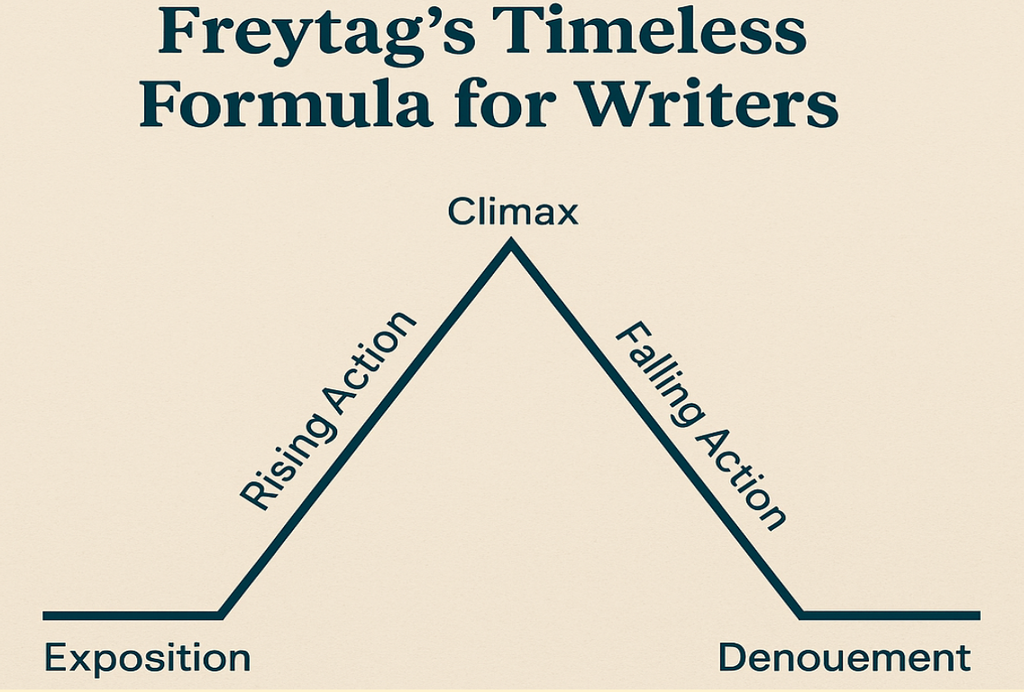
Freytag’s Pyramid is a five-stage model of story structure: exposition, rising action, climax, falling action, and denouement. The German playwright Gustav Freytag introduced it in his 1863 book Die Technik des Dramas, after studying Greek tragedy and Shakespeare closely enough to notice they all rose and fell the same way. It’s also called the plot pyramid, the story pyramid, or Freytag’s Triangle, and it’s the reason a Marvel finale and a Sophocles play can feel structurally identical centuries apart.
Most writers already sense this shape before they have a name for it. A draft that feels flat is usually a proportion problem: too many pages spent introducing a world nobody’s tested yet, or a climax that arrives on schedule but hasn’t been earned. Working through debut manuscripts at Spines, the pyramid itself is rarely the problem writers think it is. Before you commit to a single structural model, it helps to see how Freytag’s Pyramid compares to other approaches to story structure. Misjudging how much space each stage deserves is, and that’s the part this article spends the most time on.
Here’s how the five stages break down, what a working template looks like in word count, and the specific place drafts tend to collapse.
Who Was Freytag, and Why Did His Pyramid Outlast Everything Else From His Era?
Gustav Freytag was a 19th-century German novelist and playwright who noticed that classical and Shakespearean drama shared a rhythm no one had formally mapped. He was documenting a rhythm that already existed: storytellers from Homer onward had been building tension and releasing it in roughly the same order, and Freytag was the first to draw a line under it and label the parts. That analysis became Die Technik des Dramas, published in 1863, and the five-part shape inside it is still the one screenwriting software, MFA workshops, and Reddit’s r/writing argue about today.
What makes the model durable is that Freytag was describing something readers do involuntarily, building expectation and needing it paid off, rather than prescribing a rule writers are supposed to follow. That’s why the pyramid survives genre shifts a 19th-century playwright never saw coming: it was never really about 19th-century plays.
The Five Stages of Freytag’s Pyramid
Freytag’s Pyramid arranges a story into five stages that rise toward a single peak and then release: exposition, rising action, climax, falling action, and denouement. Each stage has a specific job, and most structural problems in a draft trace back to one stage doing another stage’s work.
Exposition
Exposition is the opening stage, where a story establishes its characters, setting, and central stakes before any real conflict begins. The job here is narrow: give readers enough to orient themselves and enough reason to keep going, without explaining the whole world before it’s earned that explanation. A common failure mode is treating exposition as a place to deposit backstory; readers tolerate far more mystery in the opening pages than most writers assume. If you’re still working out the basics of plot before applying any structure to it, that’s worth sorting out first, since exposition only works once there’s a plot to set up.
Rising Action
Rising action is the stage where conflict escalates through a connected chain of complications, and it typically makes up more than half a story’s total length. Each beat should raise the stakes set up in the exposition rather than introduce new, unrelated problems, since rising action that wanders tends to read as filler even when every individual scene is well written. Varying the types of conflict driving each complication keeps a long rising action from feeling repetitive, even when every scene is technically raising the stakes. This is the stage readers describe as “unputdownable” when it works, because every complication closes off an easier way out.
Climax
The climax is the single scene where the story’s central tension peaks and the outcome tips irreversibly in one direction. If a climax scene isn’t landing yet, it’s worth studying what actually makes a climax work in isolation from the rest of the pyramid. It’s the smallest section of the pyramid by word count but the one carrying the most structural weight, since everything before it has been building toward this moment and everything after it has to answer for it. A climax that resolves the plot’s central question quietly, rather than at the pitch the rising action promised, is what writers usually mean when they call a book’s ending “flat.”
Falling Action
Falling action is the stage immediately after the climax, where a story shows the consequences of what just happened and starts resolving whatever conflicts remain. It moves faster than the rising action but shouldn’t be rushed. This is the stage that most often gets shortchanged in early drafts, closing three or four open threads in a single chapter because the writer is eager to reach the ending, and it’s covered in more detail below.
Denouement
The denouement is the final stage of Freytag’s Pyramid, where loose ends close and the story settles into whatever counts as its new normal. Done well, it gives the reader a moment to feel the distance between where the characters started and where they landed, beyond simply wrapping up plot mechanics. A denouement that skips this and simply lists outcomes tends to read as an epilogue rather than an ending.
Why Freytag’s Pyramid Still Explains a Marvel Movie
Freytag’s Pyramid still works because tension and release are how human attention behaves, in a 15-second video as much as a three-hour epic. The Iliad and Avengers: Endgame share the same underlying DNA: a setup, an escalating buildup, one point where everything breaks open, a cooldown, and a landing. The scale changes; the shape doesn’t.
That’s also why the pyramid shows up in formats nobody designed with Freytag in mind. A meme has an exposition (the setup image), a rising action (the caption building toward something), and a climax (the punchline). A viral video has the same rhythm compressed into fifteen seconds. Readers and viewers don’t consciously check a story against Freytag’s stages, but they notice immediately when a stage is missing, which is exactly why an anti-climax or a rushed ending gets called out in reviews more often than a slow opening does.
Freytag’s Pyramid Template: A Word Count Guide
A working template turns Freytag’s five stages into word count targets a writer can actually plan a draft against, rather than five abstract labels.
| Stage | Share of the Story | What Happens |
|---|---|---|
| Exposition | 10 to 15% | Introduce the world, characters, and the spark that starts the conflict |
| Rising Action | 55 to 60% | Escalate conflict through connected, stakes-raising complications |
| Climax | Roughly 5% | Deliver the single scene the rising action has been building toward |
| Falling Action | 15% | Show consequences and resolve the remaining open conflicts |
| Denouement | 10 to 15% | Close loose ends and land the story’s new normal |
These proportions shift by genre more than most templates admit. Thrillers often compress the climax into a single explosive chapter but stretch falling action across two or three, since the plot mechanics of a thriller ending need more room to make sense than a literary novel’s do. Middle-grade and picture books collapse falling action and denouement into a page or two, because young readers want the emotional payoff fast. Short fiction compresses this even further, and structuring a short story often means cutting rising action down to a handful of scenes rather than several chapters. The pyramid works as a shape to plan a draft around; treat the ratios above as a starting point rather than a rule to hit exactly.
Where Story Structure Actually Breaks
Working through debut manuscripts at Spines, the structural failure that shows up most often is a rushed falling action: three or four subplots forced closed inside a single chapter, right after a climax that took forty pages to build. Writers spend the most editorial attention on the stage readers will remember least (the climax) and the least attention on the stage that determines whether the ending feels earned (the falling action). The fix is almost always the same: redistribute pacing that already exists elsewhere in the draft, rather than add new content.
Exposition overload is the second most common issue: world building takes over the opening pages before the conflict has a reason to exist yet, and readers are asked to memorize a map before they’ve been given a reason to care where anyone is standing. The fix is to let the world arrive in pieces, seeded into scenes that are already doing narrative work, rather than delivered up front as a briefing. If rising action starts to sag in the middle third, a few concrete plot development strategies can restart the escalation without needing a new subplot.
An anti-climax is a climax that arrives without cashing in on the tension the rising action built, and it’s usually a pacing problem rather than an idea problem: the actual event is often strong enough on its own, it just needed three more chapters of escalation to arrive at full pitch.
Freytag’s Pyramid in Practice
Romeo and Juliet follows the pyramid almost exactly. Two feuding families and two star-crossed teenagers open the exposition, secret meetings and mounting family conflict build the rising action, Romeo killing Tybalt is the climax that makes the ending inevitable, and the double death in the tomb is the denouement that seals the play’s tragedy.
Harry Potter and the Sorcerer’s Stone maps just as cleanly onto a novel. The exposition introduces Harry’s life in the cupboard under the stairs, the rising action builds through lessons, Quidditch, and the mystery of the third floor corridor, the climax lands underground with Harry facing Voldemort, and the falling action and denouement resolve with the House Cup and Harry heading home changed.
Avengers: Endgame proves the pyramid scales to a franchise. The exposition shows a broken world after the Snap, the rising action builds through time travel and team conflict, the climax is the final battle against Thanos, the falling action includes Tony Stark’s funeral, and the denouement closes with Captain America passing on the shield.
Building With the Pyramid
Freytag’s Pyramid works as the scaffolding most successful stories turn out to share, whether or not the writer planned for it. The stages don’t dictate what happens in a story. They dictate how much room each part of what happens is allowed to take up, and that’s usually the difference between a draft that feels complete and one that just feels long.
Sketch the five stages against your own word count before the next revision pass. If one stage is eating space that belongs to another, that’s usually the fastest structural fix available, faster than a new plot idea and more likely to be the actual problem.
FAQ: Freytag’s Pyramid
Q: What is the reversal in Freytag’s Pyramid?
The reversal, also called peripeteia, is the turning point inside the climax where the protagonist’s fortune flips, often from apparent triumph into looming defeat. It sits at the very peak of Freytag’s Pyramid, marking the moment a story’s outcome becomes locked in. In Oedipus Rex, the reversal is Oedipus discovering the truth about his own identity, the instant his fate tips irreversibly.
Q: How do you write a story using Freytag’s Pyramid?
Start by sketching your five stages against your target word count before drafting: roughly 10 to 15 percent for exposition, 60 percent for rising action, a short climax, then falling action and denouement. Use Freytag’s Pyramid as a planning tool during outlining and a diagnostic tool during revision, checking whether any stage is taking up more or less room than its share of the story allows.
Q: Is Freytag’s Pyramid outdated?
No. Freytag’s Pyramid still holds up because it describes how tension and release work in a reader’s mind, a pattern that outlasts any single era’s storytelling conventions. The five stages show up in modern novels, films, and even memes at roughly the same rhythm Freytag mapped in 1863. What has changed over time is how fast each stage moves, from a fifteen second video to a three book series.
Q: What is an alternative to Freytag’s Pyramid?
The three act structure and the Hero’s Journey are the two most common alternatives, and both map onto Freytag’s Pyramid more closely than writers expect. Three act structure compresses rising action, climax, and falling action into a single act two, while the Hero’s Journey adds specific beats, like the call to adventure and the return, inside that same overall rise and fall. Most writers pick whichever vocabulary fits their genre.
Q: What are some famous examples of Freytag’s Pyramid?
Shakespeare’s Romeo and Juliet, J.K. Rowling’s Harry Potter and the Sorcerer’s Stone, and Avengers: Endgame are three of the clearest examples, each following exposition, rising action, climax, falling action, and denouement almost beat for beat. Freytag’s Pyramid also shows up outside fiction, in memes, ad campaigns, and TED talks, anywhere a story needs to build tension and pay it off in order.
Q: What is Freytag’s Pyramid tragedy?
Freytag’s Pyramid tragedy refers to the model’s original use case: Freytag built the five stages by studying Greek and Shakespearean tragedies, where the climax marks the hero’s fatal turning point rather than a moment of triumph. In a tragedy, the falling action tracks the character’s downfall, and the denouement usually ends in loss rather than resolution. Romeo and Juliet remains the clearest working example of the pattern.
Q: Why is it called Freytag’s Pyramid?
It’s named after Gustav Freytag, the German playwright who mapped the shape in his 1863 book Die Technik des Dramas, and called a pyramid because the five stages climb to a single peak, the climax, before descending again. That climbing and falling shape is why the model is drawn and taught as a triangle rather than a list or a timeline.