

A universal theme is a core human conflict or truth that shows up across stories, cultures, and eras, because it keeps showing up in real life. It is a specific kind of literary theme, built on a tension so familiar that it survives translation, changing fashions, politics, slang, and whatever else dates a book. That is why universal themes still get under your skin today, even in a book written centuries ago.
Some stories hit even when the world around them is totally unfamiliar. Different country, different century, different customs. It doesn’t matter. You still understand what’s at stake, because the story is built around something deeply human.
What Are Universal Themes?
A universal theme is a core human conflict or truth that appears across stories, cultures, and time periods because it keeps appearing in real life. It is not about the setting. It is about the pressure underneath the setting. The names and costumes change; the problem stays familiar.
The simplest way to understand it is to separate a theme from a topic. A topic is a subject. A theme is what the story is saying about that subject:
- Topic: war. Theme: war turns ordinary people into strangers to themselves.
- Topic: love. Theme: love can make you brave and foolish in the same week.
- Topic: family. Theme: loyalty feels noble until it starts asking you to lie.
That distinction matters. If your theme is a single word, it is probably still a topic. Grief, power, and identity are ingredients, not themes. A theme is the recipe: a complete thought, a viewpoint, an argument the story keeps proving through what characters do and what it costs them.
What makes a familiar theme feel universal is recognition. Most people know the emotional shape of wanting to belong, being tempted, or choosing between comfort and truth, even if they have never lived the same story. That is why universal themes in literature can still get under your skin in a book written decades ago.
What Makes a Theme Universal, and Not Just Common?
A theme is universal when it taps something recognizably human, not just because it appears a lot. That is the difference between universal and common, and it is worth being precise about. A common theme is one that shows up frequently across books. A universal theme is one that readers anywhere, in any era, recognize emotionally, even if they have never lived the same story. Many common themes in literature are also universal, but “common” is about frequency while “universal” is about reach.
Here is the test in practice. “Everyone has felt lonely” is true, but it is too soft to write or analyze with. “Loneliness makes people accept the wrong kind of love” is a theme. It has a point of view. It has teeth. Two qualities separate the two.
It is emotional, not demographic
Universal is about the feeling, not the details. A story about a prince can still be about insecurity. A story about a cashier can still be about pride. A story about a parent can still be about the fear of being replaced. You do not need the same life to recognize the pressure.
Quick litmus test: if you can swap the setting, time period, and character background and the core conflict still works, you are probably looking at a universal theme.
It is specific, not cloudy
Love, hope, and friendship are too broad to carry a story on their own. They are topics, not themes. The universal themes that actually land are built around tension:
- love vs self-respect
- belonging vs honesty
- ambition vs integrity
Tension is what makes a theme move. It creates choices, choices create consequences, and consequences create meaning.
One honest caveat, since it comes up often: some critics argue that no theme is truly universal, that what feels universal is shaped by culture and era. There is real truth in that. But a theme does not have to be read identically by every person to be universal. It only has to be recognizable across differences. For a writer, that is the bar that matters, and it is what keeps a story working long after its world stops looking like ours.
How Universal Themes Show Up in Literature
If you go looking for a theme in the obvious places, you will miss it. Most good books do not announce their themes like a TED talk. They build them into the story’s machinery, then let you feel the pattern before you can name it.
A universal theme usually surfaces when a character wants two things that cannot peacefully coexist. Freedom and approval. Love and control. Safety and dignity. The plot keeps tightening the screws until the character has to choose, and then live with what that choice costs.
To spot a universal theme as a reader, do not start with “what is this book about?” Start here:
- What decision keeps coming back in different forms?
- What does the character keep avoiding?
- What truth would ruin their life if they admitted it?
That is usually where the theme is waiting.
Universal themes repeat, but never copy
A theme shows up as variation. The book puts the same emotional problem in new outfits. A character lies to protect someone early on, then later lies to protect themselves, then later lies because they cannot stop. Same behavior, rising stakes, deeper consequences. The story is making an argument about truth and self-image without ever saying the words out loud.
They live in consequences, not commentary
A lot of writers think a theme means a character learns a lesson. The sharper version is consequence. If the theme is that power corrupts, the story has to show how, not in a speech, but in the cost: relationships thinning out, small compromises becoming normal, moral lines moving without permission. Universal themes in literature stick because the story keeps asking “what happens if you keep doing this?” and then answers, patiently, in painful detail.
They often hide in contrasts
Writers lean on contrast because it does a lot of work quietly. Two siblings raised the same way who make opposite choices. A public self versus a private one. A place that feels safe until it isn’t. A promise that sounded romantic until it becomes a trap. If the same contrast keeps returning, the book is probably pointing at its theme.
Quick reader trick: look at what the story rewards and punishes. Ask who thrives and why, who suffers and for what, and which behaviors the story treats as expensive. The answers lead you straight to the theme, even when the plot is busy doing plot things.
20 Universal Themes Examples (With Story Angles)
Here is a quick-reference list of common universal themes, followed by a deeper breakdown of twelve, each with story angles you can actually build scenes around.
Universal Themes List
- Love and sacrifice
- Identity and belonging
- Power and corruption
- Freedom vs security
- Grief and loss
- Justice vs revenge
- Fear and courage
- Truth vs deception
- Survival and resilience
- Fate vs choice
- Family, loyalty, and betrayal
- Ambition and the cost of success
- Good vs evil
- Coming of age
- Tradition vs change
- Innocence and its loss
- Isolation and connection
- Hope and despair
- Revenge and forgiveness
- The search for meaning
A theme on its own is rarely the problem. “Love,” “identity,” “power,” fine. The problem is writing them so broadly that the story could belong to anyone, which usually means it belongs to no one. So the twelve below each come with angles. Think of them as levers: pull one and you get instant conflict.
1. Love and Sacrifice
What it looks like: people give up comfort, safety, reputation, or their future for someone else.
Angles: sacrifice that quietly curdles into resentment; love that demands proof, not trust; “I did it for you” used as a weapon, not a gift.
2. Identity and Belonging
What it looks like: a character works out who they are, and who they are allowed to be.
Angles: belonging that comes with conditions; reinvention that costs you your past; being accepted, but for the wrong version of you.
3. Power and Corruption
What it looks like: someone gains authority and it changes what they think they are entitled to.
Angles: corruption by tiny compromises, not dramatic evil; power as addiction; the person who claims they don’t want power but keeps grabbing it.
4. Freedom vs Security
What it looks like: characters choose between safety and autonomy, and rarely get both.
Angles: comfort as a cage; risk as self-respect; security that requires obedience.
5. Grief and Loss
What it looks like: someone loses a person, a home, or a version of themselves, and can’t go back.
Angles: grief disguised as anger; grief that arrives late and ruins everything at the worst time; trying to replace what can’t be replaced.
6. Justice vs Revenge
What it looks like: characters want payback or closure, but the line between them is messy.
Angles: revenge that feels like purpose; justice that becomes performative; winning, but feeling emptier afterward.
7. Fear and Courage
What it looks like: someone is scared and has to act anyway, or fails to and pays for it.
Angles: courage as honesty, not heroics; fear that looks like control; bravery that ruins your life socially, not physically.
8. Truth vs Deception
What it looks like: secrets, lies, and the damage of protecting a version of reality.
Angles: lies told out of love; self-deception as survival; truth that hurts but clears the air like a storm.
9. Survival and Resilience
What it looks like: characters endure and adapt, sometimes at a cost they don’t notice until later.
Angles: survival that turns into numbness; resilience that hardens into cruelty; getting through it, then not knowing how to live afterward.
10. Fate vs Choice
What it looks like: a character wonders how much control they really have.
Angles: “destiny” as an excuse to avoid responsibility; choice as a burden, not a gift; the illusion of control breaking at the worst moment.
11. Family, Loyalty, and Betrayal
What it looks like: people protect the group even when the group is the problem.
Angles: loyalty that demands silence; betrayal that is actually self-respect; family love tangled with obligation, shame, and fear.
12. Ambition and the Cost of Success
What it looks like: a character wants more, and the climb changes them.
Angles: becoming the thing you used to hate; winning but losing your relationships; success that feels like a costume you can’t take off.
If you want a theme that actually drives the plot, pick one theme and one angle. That is the difference between a story that feels deep in theory and one that feels sharp on the page. For the full reference, see our list of 250+ theme examples in literature.
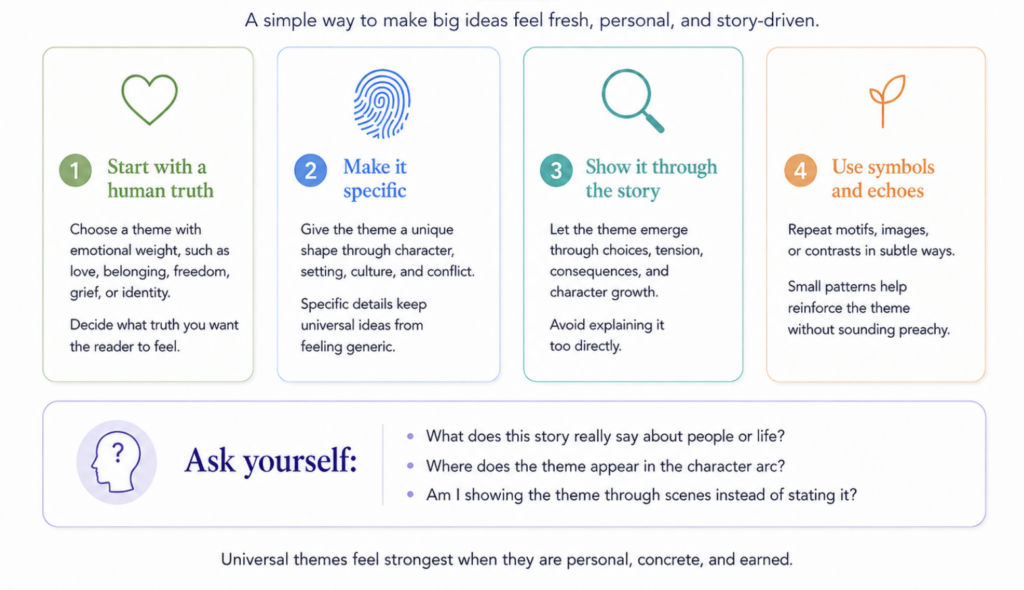
How to Use Universal Themes in Your Writing (Without Sounding Generic)
Universal themes work when they are built into the story, not announced like a lesson. Here is the clean way to do it.
Pick one main theme. One theme should drive the story’s emotional spine. A second can support it, but do not stack five and call it depth. Quick check: can you state it in one line? If you can, you have a workable theme statement to write toward.
Start with the character’s want and fear. A theme becomes real when it is attached to a person, specifically to a character’s motivation. Ask:
- What do they want badly?
- What are they afraid of losing?
- What are they willing to do to avoid that loss?
That is your theme in action.
Turn the theme into a tension. Avoid single-word themes. Use a push-pull that forces decisions. If your theme does not create hard choices, it will not drive the plot.
- honesty vs loyalty
- freedom vs security
- ambition vs integrity
- love vs self-respect
Give the theme an opponent. Something in the story should argue against it. This is where conflict does the work: a character with the opposite belief, a culture that rewards the wrong thing, or the protagonist’s own bad logic.
Show it through consequences, not speeches. If a character has to explain the theme, it is not on the page yet. Let outcomes carry the meaning, using show, don’t tell rather than a closing monologue.
How to Find Your Story’s Theme in 10 Minutes
You only need a few blunt sentences. Set a timer if it helps. This works best when you do not overthink it.
Step 1: Finish this sentence
Write one line: “This story is saying that __________.”
If you cannot answer yet, start messier:
- “I keep circling around __________.”
- “My character keeps getting punished for __________.”
- “The real problem is __________.”
Then rewrite it into a clear theme statement.
Step 2: List three turning-point choices
Pick three moments where your main character chooses something, even a bad choice. For each one, write the choice and what it costs them.
Example: lies to protect a friend costs them the trust of the person they actually need. Do this three times, and do not make the costs polite. Make them hurt.
Step 3: Name the recurring tug-of-war
Look at your three costs and circle the tension that repeats. Most stories fight the same fight in different forms:
- truth vs loyalty
- belonging vs honesty
- safety vs freedom
- love vs control
- ambition vs integrity
Whatever keeps showing up is likely your theme. If two tensions appear, choose the one present in all three choices.
Step 4: Sharpen it with one “because”
Add a “because” clause to force specificity: “This story is saying that __________ because __________.”
- Weak: love matters because people need love.
- Strong: love can turn into control because fear hates uncertainty.
Step 5: Stress-test it with one scene
Pick one important scene and adjust it so the theme is louder without adding dialogue. Make the choice harder, the consequence more direct, or the loss more personal. If the scene gets clearer and more tense, you’ve found the right theme. If it feels forced, your theme sentence is still too general. Tighten it and try again.
FAQ: Universal Themes
Q: What Are Universal Themes?
Universal themes are recurring human conflicts or truths that make stories resonate across cultures and eras. They are universal because the emotion is familiar even when the setting isn’t. A universal theme is a clear idea, not a single vague word.
Q: What Are Universal Themes in Literature?
In literature, universal themes are the big human tensions authors return to again and again, like belonging, power, grief, and freedom. They surface through character choices and consequences, not speeches. When the same emotional conflict keeps repeating in different scenes, that is usually the theme at work.
Q: What is the difference between a universal theme and a common theme?
A common theme is one that appears frequently across books. A universal theme is one readers recognize emotionally anywhere, in any era. Many common themes are also universal, but “common” describes how often a theme appears, while “universal” describes how widely it is understood.
Q: How do you identify a universal theme?
Look for the central conflict the story keeps pressing, especially the hard choices the main character can’t avoid, then ask what the story rewards or punishes. If you can sum it up as “this story is saying that…,” you are close. Here is the full method for identifying the theme of a story.
Q: How do I choose a universal theme for my own story?
Start with your main character’s deepest want and fear, then find the tension between them. Pick one theme, turn it into a push-pull like “freedom vs security,” and let your turning points test it. One theme explored deeply beats five mentioned in passing.
Q: What Are Some Examples of Universal Themes?
Common examples include love and sacrifice, identity and belonging, power and corruption, truth and deception, grief and loss, justice vs revenge, and fate vs choice. The strongest are phrased as tensions, not labels: “loyalty vs honesty” is more usable than “friendship.”
Q: Can a Universal Theme Be One Word?
Usually not. One word is almost always a topic, not a theme (love, death, power). A theme works best as a statement or tension, like “power corrupts” or “fear makes people choose safety over truth.”
Q: Is Death a Universal Theme?
Death is usually a topic, because it is a subject that can appear in many ways. The theme is what a story says about death, like “loss changes how people live” or “fear of death can shrink a life.” That is what makes it meaningful.
Q: Why Are Universal Themes Important?
They’re what make a story feel meaningful instead of just eventful. They help readers connect quickly, even across unfamiliar settings. For writers, they give the plot a backbone so scenes feel like they’re building toward something.
Q: What Is an Example of a Topic and Theme?
Topic is the subject, theme is the idea about that subject. Topic: war. Theme: war reshapes people in ways they can’t undo. Topic: love. Theme: love can demand courage, but it can also demand sacrifice.