
Figurative language basically has two modes. One expresses things dead on. The other sort of stretches towards something words alone can’t quite capture.
When Sylvia Plath wrote that death is an art, she wasn’t doing a clinical analysis. She was tapping into figurative language to say something profound about the darker side of creativity, about how our sense of self gets shredded, about how pain gets performed, all in a way a direct sentence just can’t come close to.
You know, the figurative version packs a punch in a way the literal version wouldn’t, even though it’s technically less accurate.
That’s what figurative language is all about. It’s less about jazzing up the words and more about precision of a different kind, the kind that manages to convey emotion and all the stuff going on beneath the surface in a way that a straight-up statement just can’t touch.
What is Figurative Language, in a Nutshell
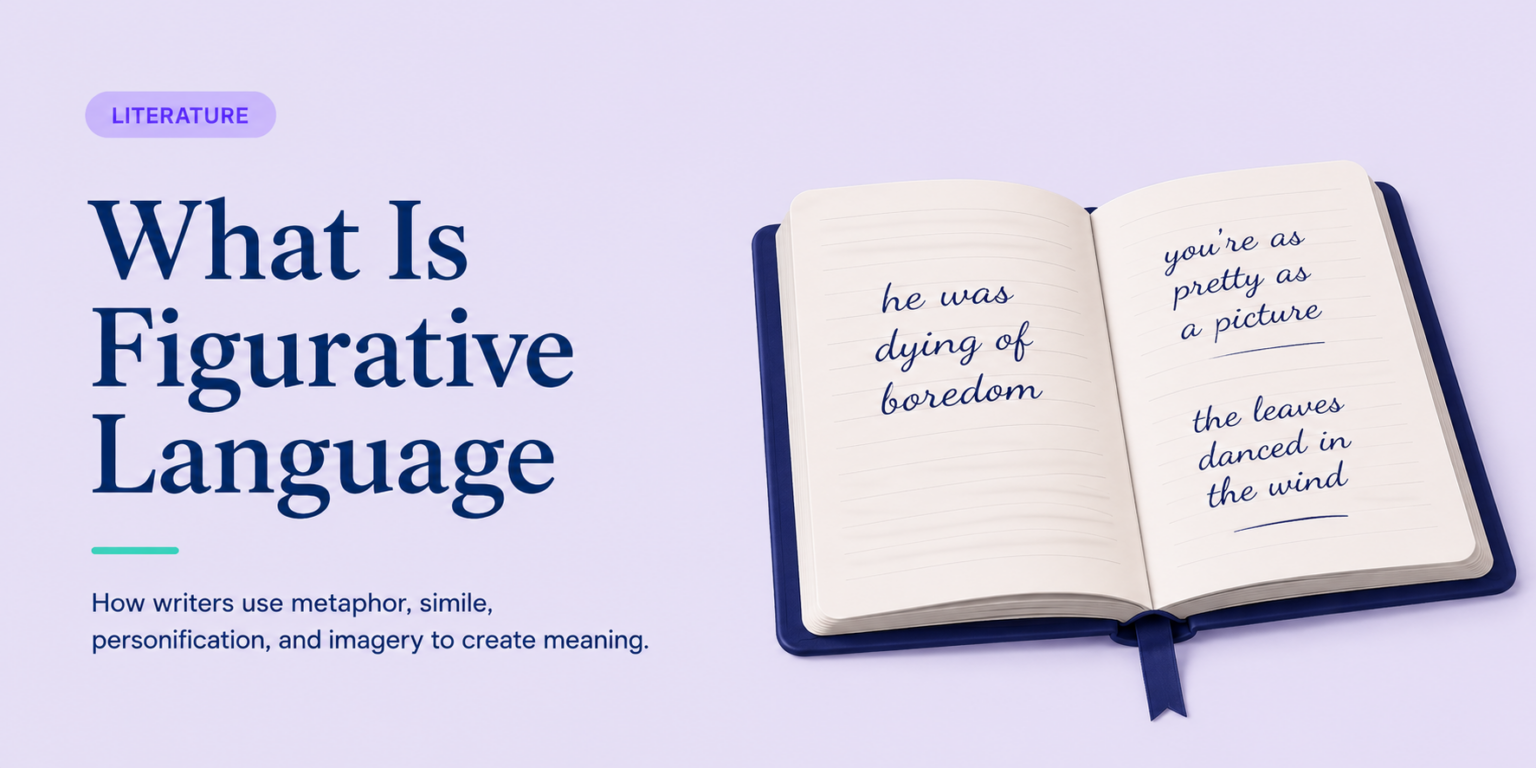
Figurative language is any language that uses words in a way that goes beyond their dictionary meaning to create a certain effect, express an idea, or evoke a particular emotion in a way that a straightforward statement just can’t match.
Understanding the meaning of figurative language is what separates writers who describe things from writers who make readers feel them.
On the flip side, literal language just says what it means. “The fire was hot” is an example of literal language. “The fire ate through the walls” is figurative, because fire doesn’t actually eat, but the verb used gives the sentence a whole different kind of energy.
It makes the reader feel the fire in a way they wouldn’t if it was just a straightforward statement.
Writers use figurative language in all sorts of writing: poetry, fiction, essays, advertising, songwriting, and even everyday conversation. Most of the time, people use it without even thinking about it.
“I’m drowning in work”, “she has a heart of gold”, “the world is your oyster”, these are all figurative expressions that are so ingrained in our everyday speech that we’ve lost track of where they came from.
It’s all about using figurative language in a way that’s fresh and new, so the impact still lands.
Figurative Language vs. Literal Meaning: Understanding the Difference
It’s important to understand how figurative language differs from literal meaning.
Literal language states facts directly: The snow is cold.
Figurative language paints a picture or adds deeper meaning: The snow kissed my skin. Snow doesn’t actually kiss, but this phrase makes it sound gentle and soft.
While figurative language is great for storytelling and poetry, literal language is essential in areas like legal documents, instructions, and academic writing, where clarity is key.
12 Types of Figurative Language (With Some Examples From Literature)
Figurative language plays a crucial role in storytelling, helping to enhance emotional depth and engagement. A study analyzing figurative language in English storytelling found 15 instances across various sentences, with personification being the most frequently used, followed by metaphors, hyperboles, and similes.
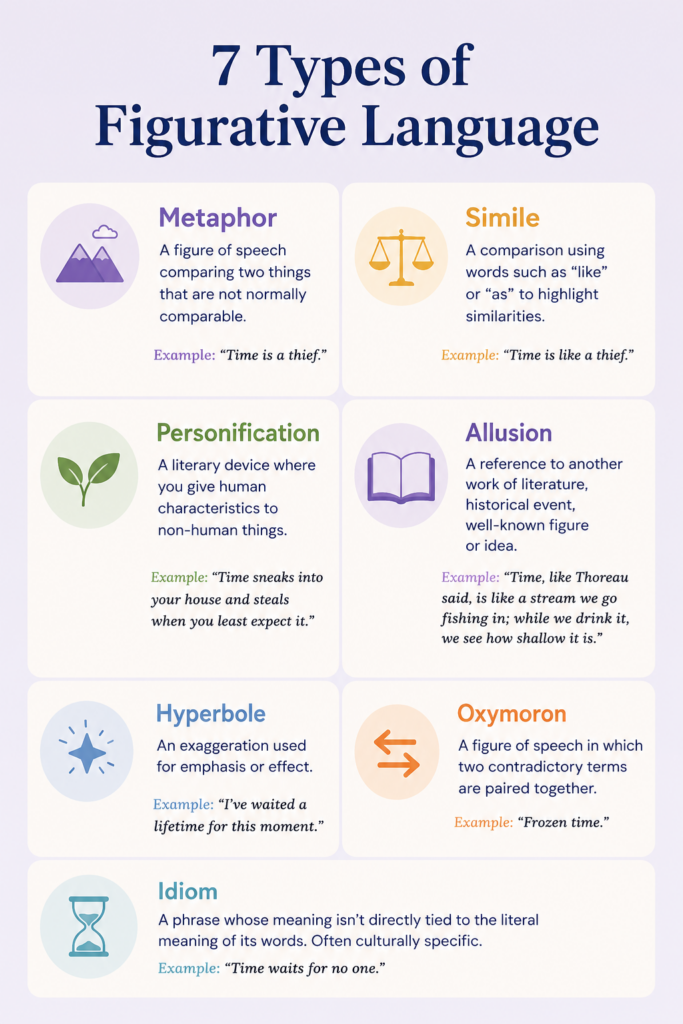
There are many types of figurative language, but here are the most common types with examples:
Metaphor
A metaphor is basically saying one thing is another, without using any of that like/ as business. It creates a kind of direct fusion between two things that aren’t alike, to produce a new meaning that neither word alone can tap into.
“All the world’s a stage, and all the men and women merely players.”
Shakespeare isn’t saying the world is like a stage. He’s saying it is one. And because he refuses to qualify it, the full weight of what he’s saying, that life is a performance, scripted, temporary, observed land like a ton of bricks.
Simile
A simile does the same kind of thing as a metaphor, but with “like” or “as”, which keeps a bit of distance between the two things being compared.
“My love is like a red, red rose”
Robert Burns compares the speaker’s love to a rose in bloom, with all the beauty and brevity that comes with that. The “like” preserves the comparison as a comparison, rather than trying to blur the lines and say that love and a rose are one and the same.
Personification
Personification gives human qualities, emotions, or behaviors to things that aren’t human: objects, animals, abstract concepts, forces of nature.
“Because I could not stop for Death, he kindly stopped for me”
Emily Dickinson turns Death into a patient, almost courteous companion. Personification changes how you relate to the poem’s subject entirely. Death becomes something you might go for a ride with, rather than just something that shows up out of nowhere.
Hyperbole
Hyperbole is when you exaggerate something to the point where it becomes absurd usually for emphasis or to get a laugh.
“I’ve told you a million times”
is an example of hyperbole in everyday speech. Fitzgerald uses it in Gatsby to build the whole world of the book: the parties, the shirts, the impossible green light. The exaggeration is the point. Gatsby’s life is hyperbole made of architecture.
Idiom
Idioms are these fixed expressions that you just can’t decode from the individual words. “Break a leg”, “spill the beans”, “bite the bullet”, each one has a meaning that has completely detached from its literal origin.
Idioms are culturally embedded, which means they don’t translate well and can leave out readers who aren’t familiar with a particular cultural context. Used deliberately, that exclusion can itself be a literary effect.
Alliteration
Alliteration is when you repeat the same consonant sound at the beginning of closely connected words.
“So we beat on, boats against the current”
(F. Scott Fitzgerald, The Great Gatsby).
The repeated “b” sound creates a rhythm and a forward momentum that is exactly the right texture for a sentence about keeping going against the odds.
Onomatopoeia
Onomatopoeia is when you use words that phonetically imitate the thing they’re describing: buzz, crash, hiss, murmur, sizzle.
Poe uses onomatopoeia all through “The Bells” to mirror the sounds of different kinds of bells across different emotional registers, from the silver tinkling of sleigh bells to the mournful tolling of iron ones. The words become the sounds they’re naming.
Oxymoron
An oxymoron is when you pair two contradictory terms in a single expression to create a compound meaning that neither word can hold alone.
“Deafening silence” “bittersweet” “living death”
These words don’t cancel each other out; they create a third meaning in the tension between them. Shakespeare’s “parting is such sweet sorrow” is the most quoted example in English and it still holds up because the contradiction hits emotionally.
Irony
Irony occurs when what is said versus what is meant or really happens. It comes in three main forms.
Verbal irony is when you say the opposite of what you mean, usually for a laugh or to really hurt. Situational irony is when what happens is the opposite of what anyone would expect.
Dramatic irony is when the reader knows something that the characters don’t, and that creates tension because of the gap between those two levels of knowledge.
Synecdoche
Synecdoche is when you use a part of something to refer to the whole, or the whole to refer to a part, so it’s a bit like a linguistic shorthand.
“All hands on deck” means the whole crew. “The White House announced” doesn’t mean the building itself is talking. We use these kinds of substitutions all the time in English, and that’s why they can be so easy to overlook, which is worth remembering if you want to make one stand out.
Allusion
An allusion is a nod to something else outside the text you’re reading, a person, place, event, or work that the reader is expected to know and whose associations are meant to add depth to the text’s meaning.
Calling a character a ‘modern Sisyphus’ brings the whole Greek myth into play, the endless struggle, the futility, the strange dignity of carrying on anyway, without having to explain any of it.
The allusion does all the heavy lifting in just two words.
Extended Metaphor
An extended metaphor stretches a single comparison across a poem, a few stanzas, or even the entire piece, building meaning as it goes.
Emily Dickinson’s “Hope is the thing with feathers” extends the bird metaphor right across the poem, giving hope a song, a perch, a resilience in storms, a gale-tested persistence.
By the end, hope has become something way more complex than the abstract noun it was to start with.
Telling the Types of Figurative Language Apart
The most commonly mixed up pairs are:
| Type | What sets it apart | Example |
| Metaphor | Says one thing IS another | Life is a journey |
| Simile | Compares using “like” or “as” | Life is like a journey |
| Personification | Gives human traits to a non-human thing | The wind argued with the trees |
| Hyperbole | Extreme exaggeration for effect | I’ve been waiting forever |
| Irony | Says the opposite of what is meant | Oh great, another Monday |
| Oxymoron | Two contradictory words mashed together | Bittersweet |
| Idiom | Fixed phrase with a non-literal meaning | Under the weather |
| Synecdoche | A part stands in for the whole | New wheels (meaning a new car) |
Why Figurative Language Works on the Reader
Literal language just reports the facts. Figurative language makes the reader feel as well as think.
When you read “he was sad” your brain just processes the information. When you read “he moved through the days like a person reading a book in a language they used to know” something different happens.
It makes the reader work out the feeling from the inside out, and that’s a more memorable, more emotionally accurate, and more likely to stick experience.
That’s why the most overused figurative expressions lose their impact. “Time flies” “Heart of gold” “Life is a journey”, these were once genuine metaphors with real bite. Repetition has made them transparent. The reader just glides past them without giving them a second thought.
The writer’s job is to find the figurative expression that still has a bit of spark, the one that makes the reader pause, work out what’s going on, and feel something as they’re trying to understand.
The Role of Descriptive Language: Using Descriptive Language Effectively
Descriptive language is a type of language that uses vivid and sensory details to describe people, places, objects, and experiences. It is a powerful tool in writing and speech, as it helps to create a mental image or atmosphere, engaging the reader or listener and making the message more memorable.
Descriptive language can be used in various forms, including figurative language, such as metaphors, similes, and personification. These literary devices help to create a rich and evocative description, drawing the reader or listener into the world of the text.
To use descriptive language effectively, it’s essential to choose words and phrases that are precise and evocative. For example, instead of saying “The sunset was beautiful,” you could say “The sunset was a kaleidoscope of colors, with hues of orange, pink, and purple dancing across the sky.”
This descriptive language helps to create a vivid image in the reader’s mind, making the experience more engaging and memorable.
In addition, descriptive language can be used to convey complex ideas and emotions, making it a valuable tool in creative writing and everyday communication. By using descriptive language effectively, you can add depth, nuance, and emotion to your writing and speech, making it more engaging and impactful.
Figurative Language Examples in Literature
These examples are worth revisiting because each one shows a different aspect of what figurative language can do.
George Orwell, 1984
“The Ministry of Peace is concerned with war, the Ministry of Truth with lies, the Ministry of Love with torture.”
Is irony on a massive scale, built into the very foundations of the world the novel describes.
Cormac McCarthy, The Road
“The world will be more lovely and more terrible.”
McCarthy’s prose is sparse but at the same time full of figurative language, using elemental comparisons that feel ancient rather than crafted.
Toni Morrison, Beloved
“124 was spiteful. Full of a baby’s venom.”
The house has a personality and a history even before any character has been introduced. Personification as a way of getting straight to the point.
F. Scott Fitzgerald, The Great Gatsby
“So we beat on, boats against the current, borne back ceaselessly into the past.”
Alliteration, metaphor, and thematic closure all wrapped up in one sentence.
Sylvia Plath, Lady Lazarus
“Dying is an art, like everything else. I do it exceptionally well.”
Simile, hyperbole, and irony all rolled into thirteen words.## Figurative Language in Writing: Three Passports to Creativity
Three Guiding Principles to Help You Unlock Your Most Vivid Writing
The best figurative language stems from the specific. “She was lonely” is a straightforward claim. “She’d taken to reading the food labels on cans every night, just for the company” is where the magic happens, it says a lot more.
The more precise the detail, the more the figurative language adds a layer of depth that finds a way to emerge naturally.
Effective figurative language requires noticing, and observing in a fresh way. Most writers draw from a stock of phrases they’ve picked up from reading, but using those expressions,rephrasing what’s already been said, just feels a bit tiring.
The real deal comes from writers who pay close attention to what’s going on around them, and find language to describe it in their own words.
FAQ: What is Figurative Language?
Q: What’s the difference between figurative and literal language?
Literal language states facts directly. Figurative language is an phrase that expresses more than it literally means. For example, “She was angry” is a literal phrase, and “She was a storm looking for a place to unleash” is a figurative language.
Q: What kind of figurative language is this sentence using?
The easiest way to spot figurative language is to ask: does this mean exactly what it says, or is something being stretched, amplified, or given human qualities? If two things are being compared with “like” or “as”, it’s a simile. No such words, and it’s a metaphor. If a non-human thing is behaving like a person, it’s personification. If the statement is completely over the top, it’s hyperbole. And if it means the opposite of what it says, it’s irony.
Q: What are the 12 most common types of figurative language?
Metaphor, simile, personification, hyperbole, idiom, alliteration, onomatopoeia, oxymoron, irony, synecdoche, allusion, and extended metaphor. These 12 cover about 90% of the figurative language you’ll encounter in writing and everyday conversation, though there’s a whole lot more where that came from.
Q: Why do writers use figurative language?
Because certain ideas and emotions are just too slippery to pin down with literal language. Figurative language lets a writer pack a lot of emotional heft into a single image, make abstract concepts tangible, produce a real emotional response in the reader, and it’s also way more memorable. People remember images longer than they remember statements.
Q: Where do you find figurative language in everyday speech?
Most idioms are so deeply ingrained that people don’t even notice them: “under the weather”, “bite the bullet”, “the ball is in your court”, or “it cost an arm and a leg”. Hyperbole is everywhere too: “I’m starving”, “I’ve told you a million times”, or “this bag weighs a ton”. And let’s not forget metaphors: “the heart of the problem”, “a sea of faces”, or “she’s got a sharp mind”.
Q: What’s the difference between a metaphor and a simile?
Both compare two things, but a simile uses “like” or “as” to flag that it’s a comparison, while a metaphor just states it straight out – one thing is another. “Her voice was like music” is a simile. “Her voice was music” is a metaphor. The metaphor goes all in and usually carries more weight in the process.
Q: How do you spot figurative language in a poem?
Look for language that would be just plain absurd if read literally – if the sun is smiling, the sea is angry, or death is taking you for a joyride, you’ve got personification. If two things are being compared, check for “like” or “as” to tell the simile from metaphor. And listen for repeated sounds (alliteration, assonance), or words that make a specific sound (onomatopoeia). In poetry, figurative language often gets layered – a single image can be a metaphor and an allusion and a symbol all rolled into one.
Q: Can figurative language be misused?
Yes, in two fairly obvious ways. First, there’s the problem of the cliché: going for a figurative expression that has been trotted out so many times it loses all impact with the reader. Like ‘the world is your oyster’, for instance – what’s left of that one? Second, there’s mixed metaphors – where you take two contrasting figurative expressions and mash them together in a way that ends up destroying the logic of both. “We need to grab the bull by the horns and nip this in the bud” does that – and what it ends up doing is plopping the reader in two completely different mental scenes at once – and neither of them sticks.