
Think about the last character who changed you. Not just entertained you. Changed you.
The ones who do that are almost always characters who changed themselves first. A dynamic character going through something painful or clarifying gives the reader a safe place to try on that experience before life forces it on them, and that is why character arcs feel personal even when they’re about wizards, orphans, or Victorian misers. The story is a borrowed cover for something the reader is quietly working through.
But then think about Sherlock Holmes: he ends exactly as he began: brilliant, cold, oblivious to the feelings of everyone around him. And yet he remains one of the most beloved characters in literary history. His consistency is not a flaw. That is the entire point.
Understanding the difference between a static and dynamic character is not about memorizing a definition. It is about understanding what each type costs and gives in a story, and why the choice between them is one of the most consequential a writer makes.
Static vs Dynamic Characters: A Quick Reference
| _ | Static Character | Dynamic Character |
| Changes internally? | No | Yes |
| Core purpose | Anchor, foil, contrast, or thematic mirror | Drive emotional and narrative transformation |
| Can be complex? | Yes | Yes |
| Common mistake | Treating them as undeveloped or lazy | Making the arc feel unearned or mechanical |
| Famous examples | Atticus Finch, Sherlock Holmes, The Joker | Scrooge, Elizabeth Bennet, Katniss Everdeen |
What Is a Dynamic Character?
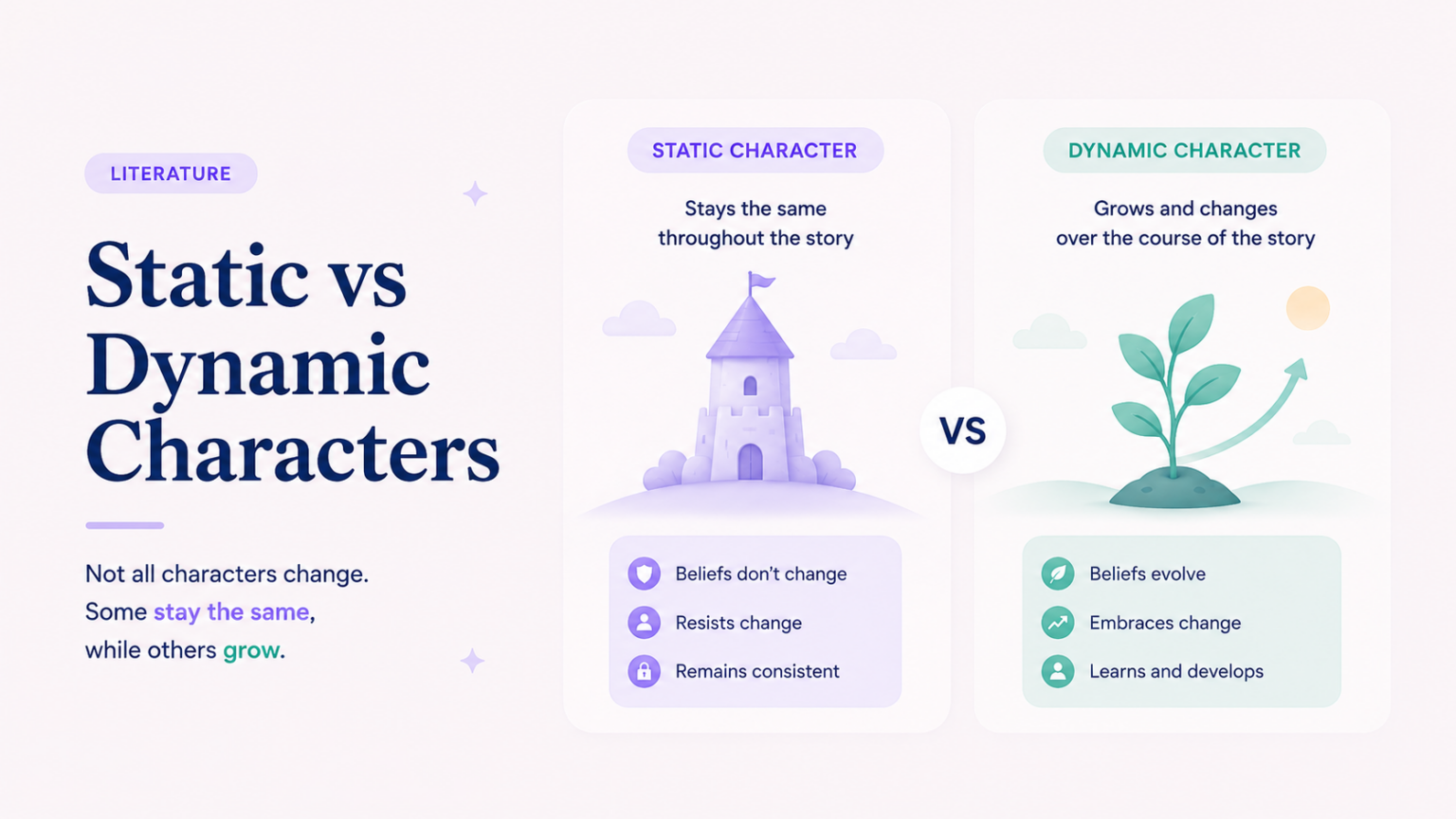
A dynamic character changes in a meaningful way over the course of a story. The change is more internal. It is not enough for circumstances to shift around them but something has to shift: a belief they held, a fear they carried, a version of themselves they were protecting.
The transformation can move in either direction. Ebenezer Scrooge moves from cruelty to generosity, while Walter White moves from decency to corruption. What makes each of them dynamic is not the direction of the change but the fact that by the final scene, they cannot return to who they were. The story has made that impossible.
Dynamic characters work because readers trust transformation more than description, you can tell a reader a character is brave and you can also put that character in a situation where bravery costs them something real, and watch them find it anyway. The second approach convinces the reader.
Dynamic Character Examples Worth Studying
Ebenezer Scrooge in A Christmas Carol is the clearest arc in English literature: a man so sealed against warmth that it takes three supernatural interventions to crack him open. The speed of the transformation is almost absurd, and yet it works because Dickens makes the reader understand exactly what Scrooge is protecting himself from before he takes it away.
Elizabeth Bennet in Pride and Prejudice is subtler because her transformation is not from bad to good but from certain to humble. She realizes she was wrong about nearly everyone she judged, including herself and that kind of arc is more uncomfortable for readers, because it implicates them too.
Katniss Everdeen in The Hunger Games starts as a survivor and ends as a symbol, and the tragedy is that the second role costs her everything that made the first one possible.
What Is a Static Character?
A static character does not undergo significant internal change. Their beliefs, their personality, their fundamental way of moving through the world remain consistent from the first page to the last.
This is widely misunderstood. Writers often treat “static” as a flaw, as if a character without an arc is a character without a purpose. That is not how the best stories use them.
Static characters are not failed dynamic characters. They are a different instrument playing a different function. Their consistency creates the conditions for transformation around them. They are the fixed point the story measures change against.
Static Character Examples Worth Studying
Atticus Finch in To Kill a Mockingbird holds the same moral code at the end of the novel that he held at the beginning. The world around him changes, Scout changes, the trial and its outcome change, but Atticus does not. His steadiness is not passive. It is the thing that makes Scout’s own moral awakening possible. Without a fixed reference point, her growth would have nothing to anchor to.
Sherlock Holmes remains brilliant, arrogant, and socially indifferent across every case. What makes him static also makes him safe: readers return to Holmes precisely because he will never disappoint them by becoming someone else. His consistency is comforting.
The Joker in The Dark Knight is perhaps the most strategically static character in modern storytelling. A villain who could be reformed would be a villain with a weakness by ensuring the Joker learns nothing and changes nothing. In this adaptation, Christopher Nolan creates a genuine philosophical threat rather than a plot obstacle.
Note what all three have in common: they are not flat. Static does not mean simple. Atticus is quietly complex. Holmes is contradictory and strange. The Joker operates on a worldview that, however disturbing, has internal coherence. You can be static and fully realized at the same time.
Flat vs Round vs Static vs Dynamic: The Distinction That Actually Matters
These four terms get collapsed together constantly, and the confusion costs writers real clarity.
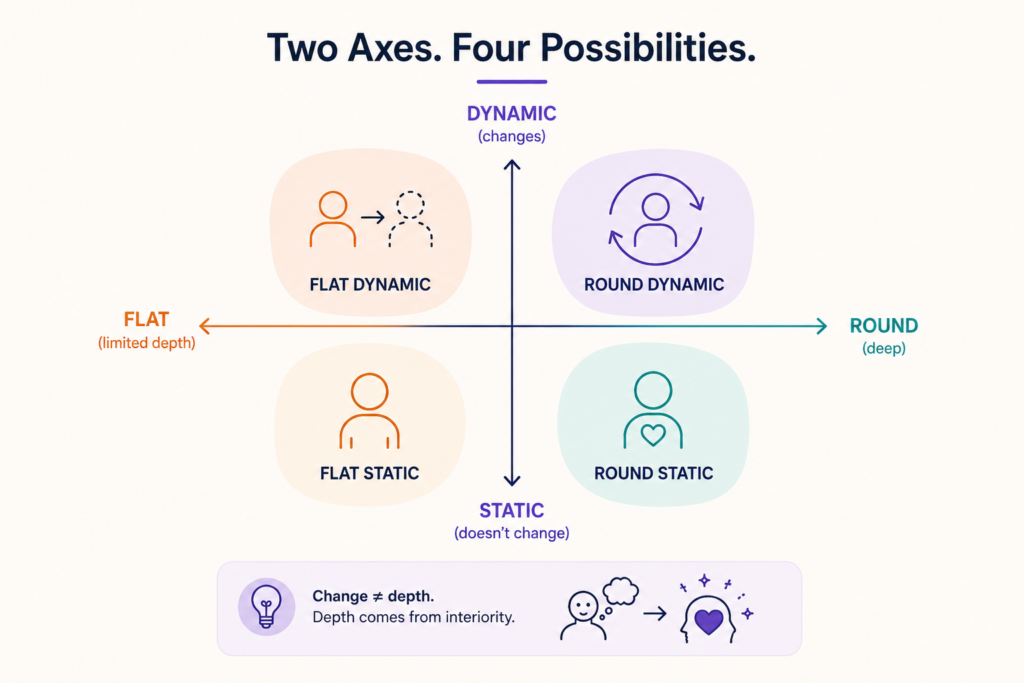
Static and dynamic describe whether a character changes, and flat and round describe how much depth they have. They are separate axes, and a character can occupy any combination of them.
A round static character has complexity and history but does not change. Atticus Finch and Sherlock Holmes are fine examples. A round dynamic character is what most great protagonists are: fully realized and transformed by the story. Elizabeth Bennet, Frodo Baggins, Scrooge and the list goes on.
A flat dynamic character is the one to watch out for. Someone whose transformation the writer announces but never builds, so it feels mechanical rather than felt. The character shifts, the reader doesn’t believe it.
The distinction matters because writers sometimes give a character an arc under the mistaken belief that change automatically signals depth. It does not. An arc has to be earned, and earning it requires the kind of psychological interiority that makes a character round in the first place. Change without interiority is just a plot happening to a person.
Static and Dynamic Characters in Literature: The Decision a Writer Actually Has to Make
Here is the question most articles about this topic never answer: how do you decide which one a character should be?
The instinct, especially for newer writers, is to make every significant character dynamic, because If they matter, they should grow. But this collapses stories under the weight of too many arcs, and it misunderstands what static characters do for a narrative.
A useful frame: ask what function this character serves in relation to the protagonist’s journey. If this character is the protagonist, or a character whose transformation is itself the story’s subject, they probably need an arc. If this character exists to reflect, challenge, enable, or resist the protagonist’s transformation, they may serve the story better by staying exactly who they are.
Gatsby stays the same, and his tragedy is precisely that he cannot change: he is so committed to the version of himself he invented that he cannot adapt when reality refuses to cooperate. His static nature is the story. And ultimately, Nick, who observes and slowly understands, is the dynamic one. Remove the contrast between them and the novel loses its whole moral architecture.
James Bond stays the same across fifty years of films because the fantasy depends on it. The audience wants to visit a version of competence and composure that never falters, never learns a hard lesson, never has to reassemble itself after a loss. Giving Bond a meaningful character arc would mean giving the audience something they did not come for.
The wrong answer is defaulting to dynamic because it feels more literary. The right answer is asking what the story requires, and trusting that a well-written static character can do just as much work as one who changes.
Final Thoughts
Most writing advice treats static and dynamic as a hierarchy: dynamic characters are the serious ones, the literary ones, the ones that prove a writer knows what they are doing, static characters are what you settle for when you run out of ideas.
That framing is wrong, and it produces weaker stories.
The writers who use both types well are not thinking about categories. While they are thinking about function, the question is what does this character owe the story? What does the story owe this character? Sometimes the answer is an arc. Sometimes the answer is an anchor. Both are legitimate, and both require a good craft.
The real skill is knowing which one your story is asking for, and then delivering it fully rather than halfway.
FAQ: Static vs Dynamic Characters
Q: Can a static character be the protagonist?
Yes, and when it works, it works for a specific reason. Sherlock Holmes is one of literature’s most famous static protagonists. The key is that something else in the story must generate movement: the cases, the moral questions they raise, the secondary characters who respond to Holmes in ways that reveal their own humanity. A static protagonist can carry a narrative if the world around them does the transforming.
Q: What makes a dynamic character arc feel earned rather than forced?
An arc feels earned when the reader understands, before the change happens, both what the character is protecting and what it is costing them. Scrooge’s transformation works because Dickens shows the reader the warmth Scrooge buried long before it resurfaces. Elizabeth Bennet’s arc works because Austen makes her intelligence complicit in her blindness. When writers skip that groundwork and jump to the change, readers sense the absence. The character shifts, but nobody believes it.
Q: Why does my character’s change feel unconvincing?
Usually, because the change is announced rather than built. A character who shifts their worldview in response to a single event, without sufficient prior establishment of what they believed and why, reads as a plot convenience rather than a human being. The fix is almost always to go earlier in the draft and lay more ground: more scenes showing the original worldview, more moments where it is tested before it finally breaks.
Q: Is Shrek a static or dynamic character?
Dynamic. Shrek begins the story aggressively alone and ends it choosing connection. The arc is played for comedy but it is structurally sincere: his worldview shifts, and by the film’s end he is genuinely incapable of returning to the isolated creature he was at the start.
Q: What is the difference between a flat and a static character?
Static refers to change over time: a static character’s core self does not shift. Flat refers to depth: a flat character has few distinguishing traits and little interiority. A character can be static without being flat. Atticus Finch does not change, but he is unmistakably complex. And a character can change while remaining flat if the arc is mechanical and the writer never gave them interior life to begin with.
Q: What are examples of static characters?
Static characters can be main characters, secondary characters, or antagonists who do not undergo significant internal change. Some great examples include:
Alice (Alice’s Adventures in Wonderland): Curious and adventurous, but remains unchanged despite her bizarre journey.
Sherlock Holmes: His intelligence and arrogance are consistent throughout his stories.
The Joker (The Dark Knight): Represents chaos and never experiences personal growth or change.
James Bond: Always remains the cool, capable spy, no matter the mission.
Even though they don’t change, static characters serve an important purpose in keeping the story balanced and supporting the arcs of other characters.
Q: What is a dynamic character example?
A dynamic character changes due to the events of the story. Some great examples include:
Ebenezer Scrooge (A Christmas Carol): A greedy miser who learns the value of kindness and generosity.
Simba (The Lion King): Runs from responsibility but grows into a true king.
Elizabeth Bennet (Pride and Prejudice): Overcomes her initial prejudices and matures emotionally.
Katniss Everdeen (The Hunger Games): Starts as a reluctant hero and evolves into a revolutionary leader.
These characters do not stay the same, they learn, struggle, and grow, making them relatable and compelling.