
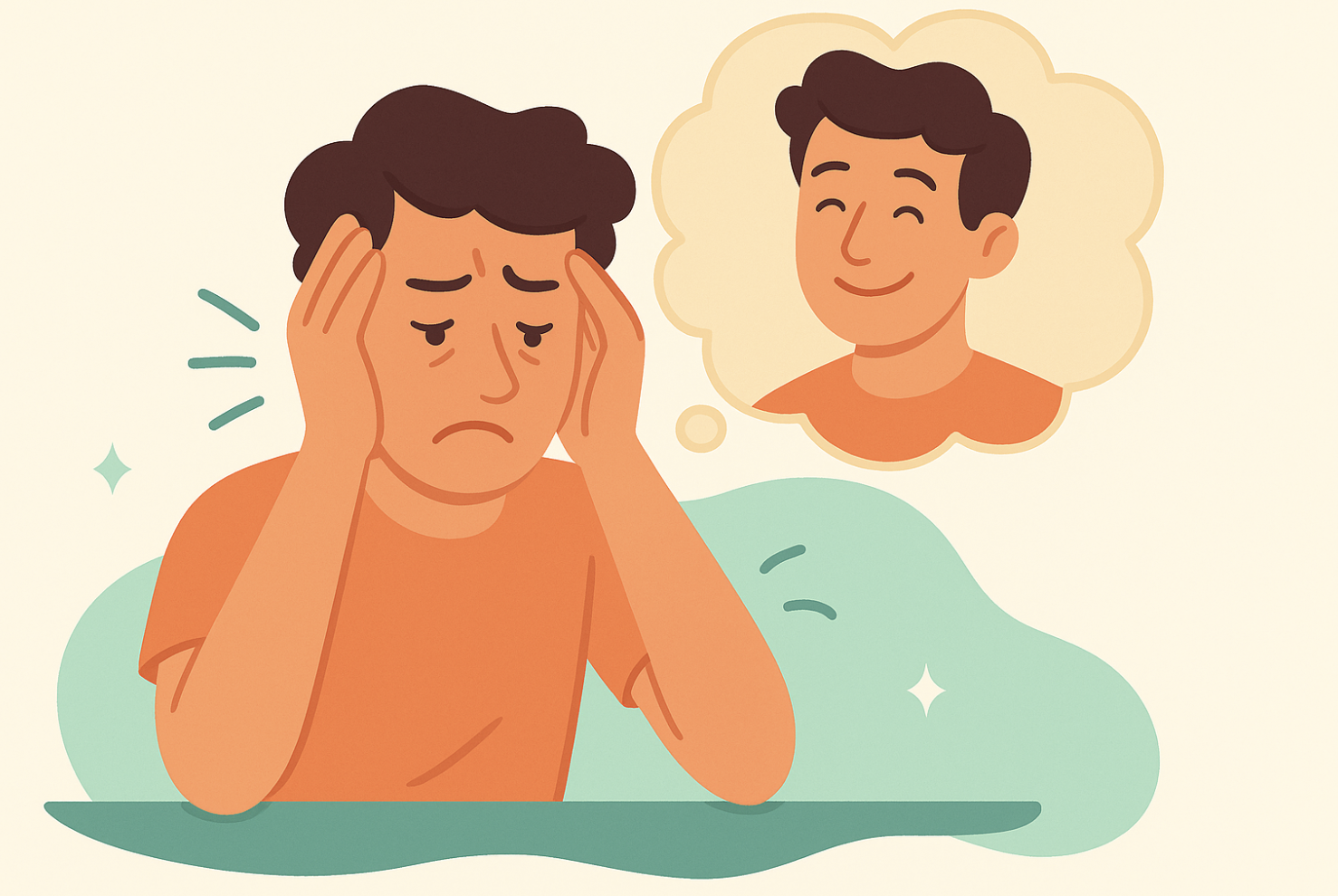
Character vs self is the internal conflict a character has with their own mind: a battle against fear, guilt, desire, or belief rather than against another person or force. Writers also call it man vs self or person vs self, and all three names describe the same thing. The reason it works on readers is simple. Every person alive is already fighting one of these battles in some form, so a character who’s fighting one too becomes instantly recognizable, even before the plot explains why.
Most conflict in fiction is external. A villain, a storm, a rival, a deadline. Character vs self is one of several types of conflict in literature that break that pattern entirely. That’s what makes it the hardest kind of conflict to write badly and the easiest kind to write forgettably, because it lives entirely in interiority, in the gap between what a character does and what they actually want.
What Is Character vs Self? (And Is It the Same as Man vs Self or Person vs Self?)
Character vs self, man vs self, and person vs self are the same literary device under three different names. All three describe a character in conflict with their own emotions, values, or desires rather than with an external force. The terminology shifted over decades of writing pedagogy (older textbooks favored “man vs self,” modern ones tend toward “character vs self” or “person vs self” for gender neutrality), but the definition never changed underneath it.
What separates this from every other conflict type is where the battle takes place. Character vs nature puts a person against the elements. Character vs society puts them against a system or culture. It’s easy to confuse this with character vs character, which pits a person against another individual instead of against themselves. Character vs self puts them against their own contradictions: the fear that stops them from acting, the guilt that follows an action they can’t undo, the desire that conflicts with what they know is right. There’s no external opponent to defeat. The resolution has to come from inside the character, which is exactly why it tends to produce the most memorable arcs in fiction. A character who survives a storm has proven something about the world. A character who survives their own self-doubt has proven something about themselves, and readers remember that distinction even when they can’t name it. Character vs self flips the usual internal and external conflict split, because the opponent lives inside the protagonist instead of outside them.
This is also the conflict most likely to sit underneath every other conflict in a story without announcing itself. A character fighting a villain is often, underneath the swordplay, fighting their own fear of failure. A character surviving a natural disaster is often, underneath the survival plot, confronting what they actually value. Character vs self rarely stands alone in strong fiction. It’s usually the engine running quietly under whatever external conflict is driving the plot on the surface.
Character vs Self Examples: Three Kinds of Internal Battle
The clearest way to spot character vs self in a story is to ask what the character is afraid to admit to themselves, not just what obstacle stands in front of them. Three patterns show up again and again across literature and film: the moral dilemma, the identity crisis, and the reckoning with the past.
The moral dilemma. Hamlet is the sharpest example in the canon. His internal conflict isn’t whether he can kill his uncle, it’s whether he should, and that question paralyzes him for the length of the entire play. His endless deliberation isn’t a flaw in the pacing. It’s the point. Shakespeare built an entire tragedy out of a man arguing with his own conscience.
The identity crisis. Holden Caulfield in The Catcher in the Rye never fights anyone directly. His war is with the adult world he’s terrified of becoming part of, and with the grief over his brother’s death that he can’t bring himself to name out loud. Inside Out gives this same crisis a literal shape: Riley’s emotions personified and arguing with each other is character vs self staged as an actual physical conflict, which is part of why the film reads as emotionally accurate to anyone who’s ever felt torn between how they’re supposed to feel and how they actually feel.
The reckoning with the past. Raskolnikov in Crime and Punishment spends the entire novel arguing with himself about a murder he’s already committed, and that argument, not the murder itself, is the actual story. Scout Finch in To Kill a Mockingbird faces a quieter version of the same thing: the gap between the moral world her father taught her and the uglier world she watches play out around her. Both characters are less interesting for what happens to them than for what they’re forced to admit to themselves.
The pattern underneath all three: character vs self conflict works because the reader already knows the answer to the character’s internal question, and the tension comes from watching the character catch up to something the reader saw coming three chapters earlier. This is also why character vs self tends to sit at the center of the hero’s journey, since the internal change is usually the real transformation the external plot is tracking.
How to Write Character vs Self Conflict Without It Feeling Generic
The fastest way to write a flat character vs self conflict is to state it directly instead of dramatizing it. If a sentence in your manuscript says “she was scared of failure,” the conflict is being reported, not experienced, and readers can feel the difference immediately.
Here’s what separates a character vs self conflict that lands from one that reads like a writing exercise:
- Name the actual fear, not the situation. “Afraid of failure” is a situation. “Afraid that success will prove she never deserved the easy years” is a fear. The second version gives you a character, the first gives you a trope. That fear is rarely separate from your character’s motivation, since what a character wants is usually just the flip side of what they’re afraid of.
- Raise what the character loses if they don’t face it. Internal conflict without a real cost attached reads as mood, not stakes. What relationship, identity, or self-image is actually at risk.
- Show the conflict through behavior, not narration. A character hesitating before a decision, deflecting a direct question, or over-explaining something nobody asked about does more work than a paragraph of internal monologue naming the emotion outright.
- Let the conflict shape the plot, not just the character’s mood. The internal battle should be the reason the character makes the choice that drives the next scene, not a separate emotional subplot running alongside the real story.
- Earn the resolution instead of resolving it cleanly. A character vs self conflict that gets solved in one scene of realization usually wasn’t a real conflict to begin with. The best resolutions leave a mark, a way the character is visibly different afterward rather than simply informed.
This is the conflict type we see collapse most often in early drafts from self-published authors specifically, more than in traditionally published manuscripts. Traditional publishing has an editor whose job is to catch a flat internal arc before it reaches a reader. Self-published authors are often making that catch alone, which means the internal conflict either gets skipped entirely in favor of plot, or it gets stated outright instead of dramatized, because there’s no second set of eyes flagging the difference. If there’s one craft note worth taking from this article and applying immediately, it’s this: reread your protagonist’s internal conflict and ask whether a reader could delete every sentence that explains the emotion and still feel it from the behavior alone. If the answer is no, the conflict isn’t on the page yet. It’s only in your head.
FAQ: Character vs Self
Q: What is an example of character vs self?
Hamlet is the clearest example in literature. His internal conflict, whether to avenge his father’s murder despite the moral weight of killing his uncle, drives the entire play through his indecision rather than through external obstacles. The conflict never resolves cleanly, which is part of why the play still holds up centuries later.
Q: What’s the difference between character vs self and man vs self?
There is no difference. Man vs self is the older, more traditional term for the same literary device that’s now more commonly called character vs self or person vs self. Writing curricula shifted toward gender neutral language over the past few decades, but all three names describe a character in conflict with their own mind rather than an external force.
Q: What is the difference between character and self?
Character is how a person acts and is perceived by others, while self is how that person privately understands their own identity. Character is observable through choices and behavior. Self is internal and often hidden even from the character themselves, which is exactly the gap character vs self conflict is built to expose.
Q: What is an example of character vs self in Fahrenheit 451?
Guy Montag’s entire arc is character vs self. He begins the novel enforcing a society that burns books, then spends the rest of it arguing internally with the beliefs he was raised to hold, long before he ever acts on that doubt. The internal conflict precedes and causes every external choice he makes afterward.
Q: Is character vs self the same as character vs character?
No. Character vs self is an internal conflict against one’s own mind, while character vs character is an external conflict between two people. They can appear in the same story, and often do, but they describe different sources of tension. For a full breakdown of the external version, see our character vs character conflict guide.
Q: How do you know your character has a real internal conflict, not just a stated one?
A real internal conflict changes how a character behaves under pressure, not just what they say about themselves. If you can delete every line where the character explains their feelings and a reader can still infer the conflict from their choices and hesitations, it’s real. If the conflict disappears the moment you cut the explanation, it was only ever stated.
Q: Is character vs self a common conflict type, or a theme?
It’s both. As a conflict type, it describes the structural tension driving a scene or plot. As a theme, it describes the larger idea a story returns to across its length, identity, guilt, or self-acceptance. Coming-of-age stories and psychological fiction tend to use it as both simultaneously.
Q: What is the character’s internal conflict in The Giver?
Jonas’s internal conflict is between the comfortable, controlled life his society gave him and the harder, truer life he discovers once he starts receiving real memories. His choice to embrace the second one, despite everything it costs him, is the entire resolution of the book’s character vs self arc.