
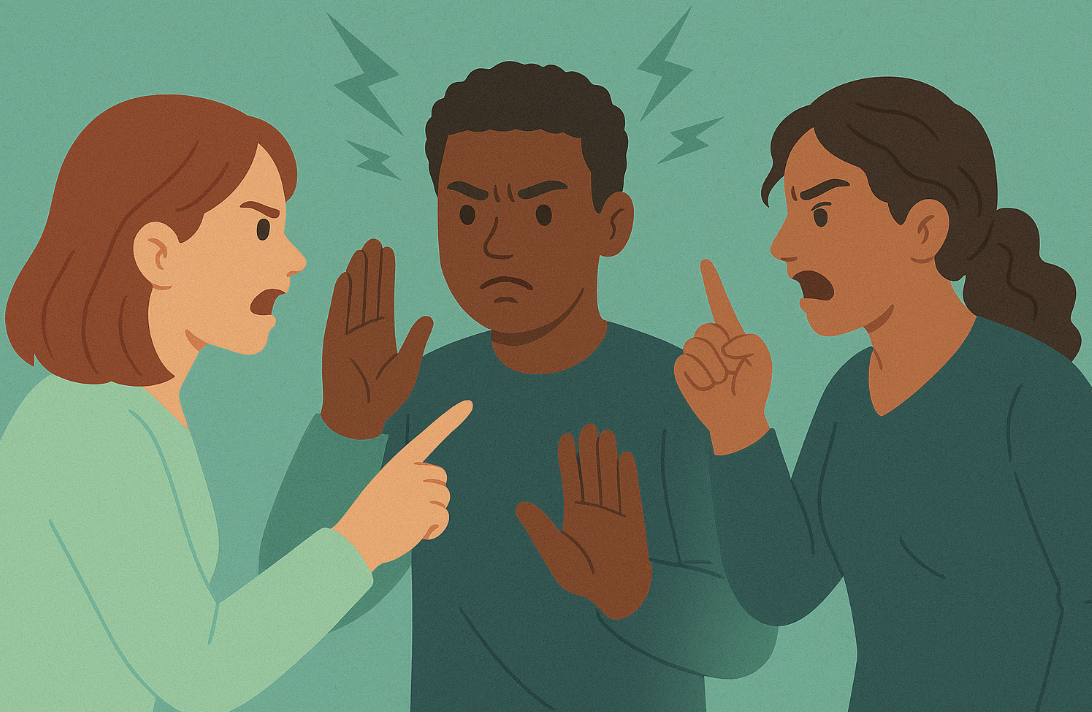
Character vs. character conflict happens when two people want incompatible things badly enough that one of them has to lose. Sherlock Holmes can’t out-think Moriarty and let him walk free. Katniss can’t win the Games and leave President Snow’s regime standing. The two characters aren’t just disagreeing. They’re structurally in each other’s way, and the story can’t resolve until one of them gives ground.
This is one of the seven types of literary conflict, and it’s the most common one in fiction because it does something the other six can’t: it puts a face on the obstacle. A character fighting nature or fate is fighting something abstract. A character fighting another character is fighting someone who wants, plans, and pushes back, which is exactly what makes the conflict feel personal to a reader instead of theoretical.
This guide breaks down what character vs. character conflict actually is, walks through the examples that get cited most often and why they work, and covers what tends to go wrong when writers try to build one from scratch. If you’re deciding whether this conflict type fits your story, it’s also worth knowing when it doesn’t: stories built around survival, internal doubt, or an unbeatable system usually need a different type of conflict, like character vs. self, to carry the weight.
What Is Character vs. Character Conflict?
Character vs. character conflict is a story structure where the protagonist’s goal directly blocks another character’s goal, and neither can fully succeed while the other is still standing in the way. It’s not a disagreement that could be resolved with a conversation. It’s a collision of two people who each need something the other one is actively preventing.
That distinction matters more than it sounds like it should. A lot of scenes that look like character vs. character conflict are actually just tension, two characters arguing, competing, or annoyed with each other without a real structural stake underneath it. The test is simple: if both characters could get what they want at the same time, it isn’t this type of conflict. Sherlock Holmes and Moriarty can’t both win. Harry and Voldemort can’t both survive the war they’re fighting. Katniss can’t free Panem while Snow still rules it. In each case, one character’s success requires the other’s defeat, which is what gives the conflict its pull.
Iconic Examples of Character vs. Character Conflict
The examples that get cited most often for this conflict type share one thing in common: the two characters don’t just want different outcomes, they represent different answers to the same question, which is what makes the conflict feel inevitable instead of arbitrary.
Harry Potter vs. Voldemort. The question underneath their fight is what love and loyalty are worth against fear and control. Harry survives repeatedly because people choose to protect him. Voldemort loses repeatedly because he can’t understand why anyone would.
Batman vs. Joker. Batman believes order can be rebuilt. Joker’s entire philosophy depends on proving that it can’t. Every confrontation between them is really an argument about whether the city is worth saving, staged as violence.
Sherlock Holmes vs. Moriarty. Two minds operating at the same level, aimed at opposite outcomesmakes them each other’s perfect foil characters. Neither one is more intelligent than the other, which is exactly why the conflict has to be resolved through a mistake rather than a knockout.
Katniss Everdeen vs. President Snow. Katniss represents the possibility that the system can be refused. Snow’s entire authority depends on nobody testing that possibility publicly. Once she does, one of them has to lose control of the story the Capitol has been telling.
Why This Conflict Type Carries a Story
Character vs. character conflict works because it forces every choice a character makes to cost something. A character fighting a storm can wait it out. A character fighting another person who wants them to fail cannot wait, guess wrong, or hesitate without consequences that another character will immediately exploit.
It makes the stakes personal. When the obstacle is a person, every setback reads as something the antagonist did to the protagonist, not something that happened to them. Readers track that as an injury, not an event.
It forces a side. A well-built character vs. character conflict doesn’t just ask readers to root for someone, it asks them to notice which values they’re rooting for. Readers who understand exactly why Joker sees chaos as honest are still hoping Batman wins anyway, and that gap is where the tension lives.
It exposes character under pressure. Nobody’s real priorities show up in comfortable moments. Sherlock’s contempt for people who can’t keep up with him becomes a liability the moment Moriarty uses it against him. The conflict reveals what the character was hiding, including from themselves.
It keeps the plot moving. A story without an opposing will has to manufacture tension from coincidence or bad luck. A story with two characters actively working against each other generates its own momentum, because every move one of them makes forces a response from the other.
How to Write Character vs. Character Conflict
The single biggest thing that separates a working character vs. character conflict from a flat one is whether the antagonist has a reason to act that has nothing to do with the protagonist. If the antagonist exists only to oppose the hero, the conflict will read as manufactured no matter how high the stakes get.
Give both characters an independent motivation. Editors reading self-published manuscripts flag this constantly: an antagonist whose only trait is “wants to stop the hero” collapses the moment a reader asks what they’d be doing if the hero weren’t there. Moriarty’s real obsession is being unbeatable. Sherlock just happens to be the only person who might prove him wrong.
Keep the power roughly even, at least at the start. If one character can clearly win at any point, there’s no conflict, just an outcome that hasn’t happened yet. Give both sides something real to hold over the other before the story lets either one pull ahead.
Let the stakes hit both characters, not just the protagonist. If losing costs the antagonist nothing, readers stop believing the fight matters to them, and a fight that doesn’t matter to one side reads as a formality instead of a conflict.
Build the conflict in stages instead of dropping readers into the final confrontation. The strongest version of this conflict escalates: a disagreement becomes a rivalry, a rivalry becomes sabotage, sabotage becomes a confrontation neither character can walk away from. Skipping straight to the climax is the fastest way to make a high-stakes fight feel weightless.
Let the resolution cost something. A character vs. character conflict that resolves cleanly, with the antagonist defeated and no lingering damage, tends to read as unearned. The protagonist should win something and lose something in the same scene.
Common Mistakes Writers Make With Character vs. Character Conflict
Most character vs. character conflicts that fall flat share one of the same handful of problems, and all of them are fixable at the outline stage before they cost a full draft.
Making one character too strong. If the antagonist is clearly outmatched, the conflict reads as a formality. If the protagonist is clearly outmatched with no visible path to close the gap, readers disengage instead of worrying.
Skipping the internal cost. External conflict without an internal one flattens the fight into choreography. Katniss’s fight with Snow lands because it runs alongside her own guilt over what the rebellion is asking her to become, and that second layer is what makes the external conflict feel earned.
Reducing the fight to “I want this, you want that.” A conflict built only on competing goals, with no underlying values attached, feels shallow no matter how high the stakes are. The goal is the surface. The values underneath it are what make readers care who wins.
Letting the antagonist dominate the story. A compelling antagonist is an asset until they start upstaging the protagonist’s own arc. The conflict belongs to both characters equally, and the protagonist’s growth needs just as much page space as the antagonist’s menace.
Resolving everything too neatly. Real conflict leaves damage. A tidy ending where the antagonist is defeated and nothing else has changed usually means the conflict wasn’t doing enough work in the first place.
Skipping too much of the build. A confrontation that hasn’t been earned through escalation reads as sudden rather than inevitable. The tension needs room to accumulate before the climax spends it.
Exercise: Which of These Is Character vs. Character Conflict?
Read each pairing below and decide whether it’s a character vs. character conflict or a different type of conflict entirely. The rule to apply: if both characters could get what they want at the same time, it isn’t character vs. character.
Simba vs. Scar (The Lion King). Simba wants to reclaim the throne Scar stole and refuses to give up. This is character vs. character conflict: neither can hold the throne while the other is alive to contest it.
Chuck Noland vs. the island (Cast Away). Chuck is stranded after a plane crash and has to survive alone with no one actively working against him. This is character vs. nature conflict, not character vs. character, because the obstacle isn’t a person with a competing goal.
Katniss Everdeen vs. President Snow (The Hunger Games). Katniss represents the rebellion Snow is trying to crush before it spreads. This is character vs. character conflict: Snow’s authority and Katniss’s survival cannot both remain intact.
Winston Smith vs. the Party (1984). Winston wants freedom of thought inside a system built to eliminate it. The scenes where Winston faces O’Brien directly can look like character vs. character conflict. The real obstacle is the Party’s structure itself, which makes this character vs. society.
FAQ: Character vs Character
Q: What does character vs character mean?
Character vs. character means two people in a story want things that directly block each other, so only one of them can fully get what they want. It’s the most common type of literary conflict because the obstacle has a face and a motive instead of being weather, luck, or fate. Sherlock Holmes and Moriarty are the reference example most writing guides use for this term.
Q: What is an example of character vs. character conflict?
Dr. Jekyll and Mr. Hyde is one of the clearest examples, because the conflict happens inside a single person split into two competing identities. Jekyll’s need for control and Hyde’s need for freedom can’t both win, which makes it character vs. character conflict even without two separate bodies.
Q: What are the 7 types of literary conflict?
The seven types are character vs. character, character vs. self, character vs. nature, character vs. society, character vs. technology, character vs. fate, and character vs. god or the supernatural. Character vs. character covers direct opposition between two people, like Hamlet and Claudius. Character vs. self covers internal struggle, like Macbeth’s ambition eating away at him from the inside.
Q: What are the four main types of conflict?
Some writing guides simplify literary conflict into four main types instead of seven: character vs. character, character vs. self, character vs. society, and character vs. nature. This shorter model folds character vs. fate, character vs. technology, and character vs. god into whichever of the four categories fits best. Character vs. character stays its own category in every version, since it never gets absorbed into a broader type.
Q: Is character vs character a theme?
Character vs. character is a conflict type, the structural obstacle that drives the plot forward when two characters want incompatible things. Themes work differently: they are the underlying idea a story explores through that conflict, like power, loyalty, or the cost of ambition. Harry Potter and Voldemort create character vs. character conflict, and the theme that conflict serves is what someone will sacrifice for love versus for control.
Q: What’s the difference between character vs. character and character vs. self conflict?
Character vs. character conflict is about two people opposing each other. Character vs. self conflict is about one person opposing their own instincts, fears, or ambitions. Many stories run both at once, which is why Katniss’s fight with Snow lands alongside her own guilt over what the rebellion is asking her to become. If your story is built around one character’s internal struggle rather than an external opponent, character vs. self is the type of conflict you’re actually describing.
Q: Which correctly reflects a conflict of character vs. character?
A pairing reflects character vs. character conflict when both characters have active, opposing goals that cannot both succeed. Two characters who simply dislike each other or disagree don’t meet that bar on their own. Katniss against President Snow qualifies, since her survival and his authority can’t both remain intact. A character surviving a plane crash alone does not, since there’s no second person with a competing goal to resolve against.