
You know what you want to say. You just can’t get the first line down. The cursor blinks, the page stays white, and every sentence you try feels wrong the second you type it.
That’s what a good sentence starter fixes. It’s not a trick or a shortcut. It’s a small, practical tool that gives you somewhere to plant your feet so the rest of the sentence has something to build on.
This guide covers what makes a sentence starter work, the different types you’ll actually use (topic sentences, hooks, essay openers, body paragraph transitions), and more than 120 examples organized by purpose. Borrow them, adjust them, make them yours. By the end, you’ll have a real answer to “what are good sentence starters,” and a list you can keep coming back to.
What Is a Good Sentence Starter?
A sentence starter is a word or phrase that opens a sentence with a clear sense of direction. Instead of stalling on “um” or “so basically,” it gives your reader an immediate signal about where the sentence is headed.
Think of it as a small piece of orientation. A strong starter tells the reader that a new idea is coming, or that the paragraph is about to shift, or that the conclusion is close. Without that signal, writing can feel disjointed, like the reader has to guess what each sentence is doing there. A weak starter can sometimes tip a sentence into an incomplete thought, so it helps to know what turns a sentence into a fragment before you build a paragraph around one.”
Good sentence starters matter for three reasons:
Structure. They organize your thoughts so a paragraph reads like it was planned, not assembled on the fly.
Flow. They connect ideas so the reader moves from one point to the next without friction.
Attention. A well placed hook or topic sentence can hold a reader’s focus through a paragraph they might have otherwise skimmed.
None of this is about sounding impressive. A good starter isn’t decoration. It’s there to carry the reader’s attention from one sentence to the next without making them work for it.
The right starter depends entirely on what you’re doing in that sentence. Opening an argument calls for something direct. Explaining evidence calls for a phrase that signals support. Wrapping up calls for a natural, conclusive close. You adjust your openers the same way you adjust your tone when you’re talking to a friend versus a colleague. Different moment, different phrase.
Why Sentence Starters Are Worth Using
They bring clarity. A good starter tells the reader what’s coming before it arrives, instead of dropping them into the middle of a thought with no warning.
They create flow. Without transitions, an essay can read like a list of disconnected observations. Starters link each sentence to the one before it, so the reader stays with you.
They build engagement. A strong hook at the start of a paragraph can spark curiosity or make a claim worth reading on for. It’s often the difference between a reader who finishes the paragraph and one who skims past it.
They add authority. Opening with “Research shows” or “It is widely acknowledged” signals that you know your subject, even on the days you’re writing on no sleep and a deadline. Confident openers make the whole piece read as more credible.
Good sentence starters aren’t ornamental. They’re functional. Used well, they help your ideas land clearly, connect naturally, and hold a reader’s attention from the first line to the last.
Types of Good Sentence Starters
The best starter depends on what the sentence needs to do. Here are the main categories and how each one works.
1. Topic Sentence Starters
Topic sentences introduce the main idea of a paragraph and set up what follows.
- “One important reason is…”
- “A key factor to consider is…”
- “Another perspective worth exploring is…”
- “This highlights the importance of…”
2. Sentence Starters for Essays
Every essay has three parts, and each one needs a different kind of opener.
Introduction:
- “Many people believe that…”
- “The question of whether…”
- “Public opinion on this issue is…”
Body:
- “For example…”
- “In addition…”
- “On the other hand…”
Conclusion:
- “In summary…”
- “Therefore…”
- “Ultimately…”
3. Hook Sentence Starters
Hooks are built to catch attention immediately. They can surprise, provoke a question, or make a bold claim.
- “Imagine a world where…”
- “What if I told you that…”
- “Recent research points to…”
- “Few people realize that…”
4. Sentence Starters for Body Paragraphs
Body paragraphs need strong connective tissue so the essay reads as one argument, not a set of separate points.
- “Building on this idea…”
- “This clearly demonstrates that…”
- “As a result…”
- “In contrast…”
- “This evidence suggests that…”
Each type carries its own job. Used with intention, they guide a reader from point to point without ever making the structure obvious.
120+ Good Sentence Starters, Organized by Use
Good Sentence Starters for Essays
(Academic writing, reports, assignments)
Introductions
- Many people believe that…
- Throughout history…
- It is often said that…
- The purpose of this essay is to…
- A common question is…
- At first glance, it may seem…
- The topic of… has long been debated.
- One of the main issues is…
- Public interest in… has grown steadily.
- Recent studies show that…
Body paragraphs
- For example…
- Furthermore…
- In addition…
- On the other hand…
- This evidence suggests that…
- As a result…
- This clearly demonstrates…
- Similarly…
- In contrast…
- Building on this idea…
Conclusions
- In summary…
- Therefore…
- Ultimately…
- Taking everything into account…
- To sum up…
- On the whole…
- It is clear that…
- From this, we can see that…
- In light of the evidence…
- All things considered…
If “In summary” and “Therefore” are starting to feel repetitive, this list of the best conclusion words and alternatives offers plenty of ways to close a paragraph without repeating yourself.
Good Sentence Starters for Books
(Storytelling, novels, creative writing)
General story hooks
- Once upon a time…
- Imagine a world where…
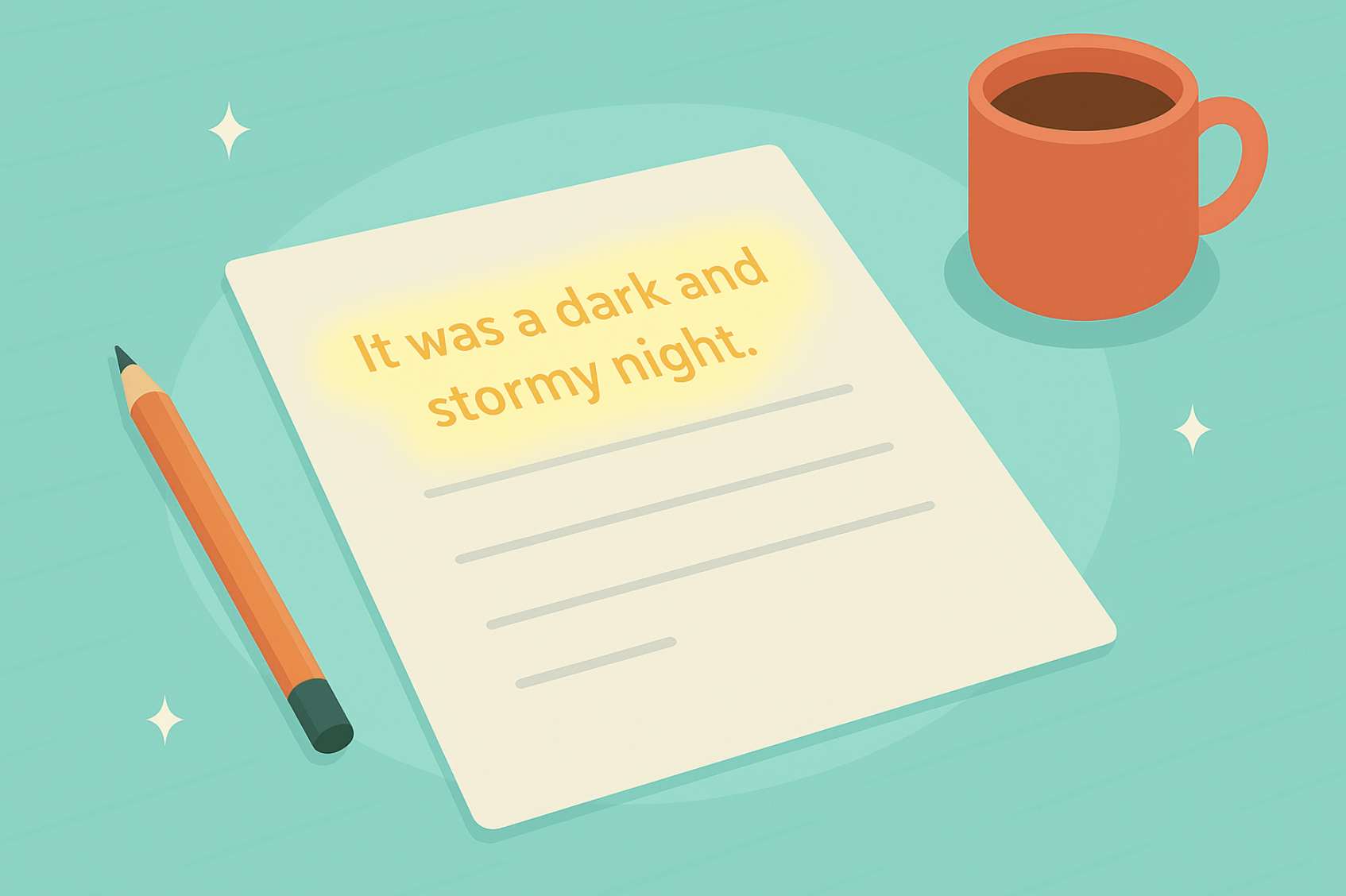
- It all began on a stormy night…
- Few people realized that…
- Most assumed it was impossible, until…
- The story starts with…
- Everything changed when…
- The moment no one expected finally arrived…
- Nobody could have guessed that…
- It seemed like just another ordinary day…
Character introductions
- She had always believed that…
- He never thought this day would come…
- They were the kind of friends who…
- At just twelve years old, she already knew…
- Nobody ever expected him to…
- Her secret was something no one else knew…
- From the moment he walked in…
- She had a habit of…
- He was the kind of person who…
- What defined her most was…
Setting the scene
- The city was alive with…
- Deep in the forest…
- The room smelled of…
- Dawn broke over the horizon…
- Silence filled the air as…
- The night sky shimmered with…
- Across the fields, you could hear…
- The village rested quietly in…
- The sea stretched endlessly before…
- A storm gathered above…
Good Sentence Starters for New Chapters
(To reset, shift perspective, or build suspense)
Time transitions
- The next morning…
- Hours later…
- By the time night fell…
- Weeks passed before…
- At that exact moment…
- The following day brought…
- After a long silence…
- Later that evening…
- In the days that followed…
- By sunrise…
Shifting perspective
- Meanwhile, across town…
- Back in the village…
- From his point of view…
- What she didn’t know was…
- Far away, another story was unfolding…
- In another part of the city…
- At the same time, elsewhere…
- From her perspective…
- Unknown to them…
- While this was happening…
Building suspense
- Little did they know…
- The truth was about to be revealed…
- It started as an ordinary day, but…
- No one could have predicted…
- Just as everything seemed calm…
- Beneath the surface, danger waited…
- What happened next would change everything…
- The silence was broken by…
- Then, out of nowhere…
- Something felt different that day…
Good Sentence Starters for Hooks & Attention Grabbers
(Essays, speeches, blogs, creative pieces)
- Did you know that…?
- Believe it or not…
- What if I told you that…
- Here’s a surprising fact:
- Consider this scenario:
- Most people don’t realize that…
- It may come as a surprise that…
- Let me start with a story…
- What would happen if…?
- Picture this:
Good Sentence Starters for Persuasive Writing
(Arguing a point, making a case)
- I strongly believe that…
- Without a doubt…
- One cannot ignore the fact that…
- Some may argue otherwise, but the evidence points to…
- It is essential to recognize that…
- From my perspective…
- The truth is…
- Evidence clearly shows…
- I am convinced that…
- This proves that…
Good Sentence Starters for Analytical & Critical Writing
(Research essays, reports, literary analysis)
- The data indicates that…
- This suggests that…
- Researchers agree that…
- The evidence points to…
- This raises the question of…
- One possible explanation is…
- A closer analysis shows…
- Scholars have long debated whether…
- The findings highlight that…
- This demonstrates that…
5 Tips for Using Sentence Starters Well
1. Don’t overuse them. If every sentence opens with “Furthermore,” the reader starts to notice the pattern instead of the argument. Vary your openers so the writing feels natural.
2. Match the starter to the job. Opening a new argument calls for something direct, like “One important reason is…” Wrapping up calls for a closer like “In summary…” Pick the tool that fits the task in front of you.
3. Keep the tone consistent. A line like “It all began on a stormy night…” belongs in a short story, not a lab report. Match your starting tone to your audience: formal for essays, conversational for blogs, expressive for fiction.
4. Use them as bridges, not crutches. A starter should move the reader from one idea to the next. If a paragraph feels thin, check whether the starter is doing the work your ideas should be doing.
5. Practice variety. Mix short openers with longer ones. “For instance…” reads differently than “This evidence suggests that…” Both have a place, and switching between them keeps a reader engaged.
FAQ: Good Sentence Starters
Q: What are the 7 ways to start a sentence?
There are several reliable ways to open a sentence: with a subject, a transition word, a prepositional phrase, a question, a quote, an ing phrase, or a dependent clause. Good sentence starters usually pull from one of these patterns, since each creates a different rhythm and level of emphasis. Mixing them across a paragraph keeps writing from feeling repetitive and helps ideas connect naturally from one sentence to the next.
Q: What is a strong sentence starter?
A strong sentence starter gives the reader immediate direction, often through a specific noun, an active verb, or a clear claim rather than a vague transition. Phrases like “Research shows” or “The real problem is” work because they commit to something right away. Weak starters, like “There is” or “It is,” delay the point. Choosing precise, active language at the start of a sentence makes the whole line hit harder.
Q: How do you start a sentence without using “I”?
Shift the focus from yourself to the subject, action, or evidence you’re describing. Instead of “I believe the data shows,” try “The data shows” or “Evidence suggests.” Starting with the topic, a transition word, or a strong verb keeps the sentence objective and confident. This is especially useful in academic or persuasive writing, where too many “I” statements can make an argument sound like opinion rather than analysis.
Q: What’s a good hook to start an essay?
A good essay hook creates curiosity in the first sentence, often through a surprising fact, a pointed question, or a short scenario the reader can picture. Lines like “Consider this scenario” or “Few people realize that” work because they promise something worth reading on for. The strongest hooks connect directly to the essay’s main argument, rather than opening with something unrelated just to grab attention.
Q: What are the different types of essay introductions?
Essay introductions generally fall into a few categories: a hook opener, a question opener, a background opener, a quote opener, and a thesis first opener. Each works differently depending on the essay’s tone and audience. A narrative essay might open with a scene, while an academic paper often leads with context and a clear thesis. Matching the introduction style to the essay type makes the opening feel intentional rather than random.
Q: What is a simple sentence?
A simple sentence contains one independent clause: a single subject and verb expressing a complete thought, like “She finished the manuscript.” It doesn’t rely on conjunctions or dependent clauses to make sense. Simple sentences make useful sentence starters because they’re direct and easy to follow, and mixing them with longer, more complex sentences creates better rhythm and keeps the reader engaged.