Grammar mistakes are like spinach in your teeth: you don’t notice them, but everyone else does. And the worst part? They show up at the exact moment you’re trying to sound smart, polished, and totally in control of your life. (Spoiler: none of us are.)
Here’s the truth: everyone makes them, even great writers. The problem isn’t that you slipped up. It’s that those tiny errors can quietly chip away at your credibility, distract readers, and make your message feel less trustworthy than it actually is. And if you’re writing for an audience—clients, readers, followers, or future book buyers, clarity matters.
This guide isn’t about grammar shame or memorizing dusty rules. It’s about fast fixes for the most common grammar mistakes, so your writing feels clean, confident, and easier to read. We’ll cover quick corrections, easy examples, and simple tricks you can use immediately. Bookmark this, you’ll want it the next time you hit “publish.”
Why Grammar Mistakes Matter (Even When Your Idea Is Brilliant)
Readers are forgiving… until they aren’t. You can have a brilliant idea, a strong story, or a killer argument, but if your writing is sprinkled with grammar mistakes, it can start to feel less polished and less trustworthy. Even small errors interrupt the flow, pull readers out of the moment, and make them reread a sentence when they should be nodding along.
Clean grammar isn’t about sounding fancy. It’s about making your message easy to follow and hard to misunderstand. When your writing feels smooth, you sound more confident, more credible, and yes, more convincing. Good grammar sharpens your voice. It doesn’t stiffen it.
Your Publishing Journey Awaits – Start NowThe Most Common Grammar Mistakes (With Quick Fixes)
Think of this section as your grammar “spot-the-difference” game except the prize is writing that looks smarter, reads smoother, and doesn’t accidentally scream I wrote this at 2 a.m. with one eye open.
These are the common grammar mistakes that show up in everything: emails, captions, essays, book manuscripts, even polished marketing copy. The good news? Most of them aren’t complicated. They’re just sneaky. And once you know what to look for, they’re ridiculously fast to fix.
In each of the mistakes below, you’ll get:
- a quick explanation (no grammar lecture, promise)
- common English grammar mistakes examples (the kind you’ve definitely seen before)
- a simple correction tip you can apply instantly
- a memory trick to help it stick
- and a quick “spot-it” moment to sharpen your editing eye
Ready? Let’s clean up the grammar gremlins before they start biting your credibility.
Your vs. You’re: The Most Popular Mix-Up on the Internet
Your vs. you’re is basically the internet’s favorite grammar tripwire, and one of the most common English grammar mistakes examples you’ll see everywhere, from comments to captions to professional emails. Here’s the rule: your shows ownership, while you’re is a contraction for you are.
So: “Your amazing” technically means your amazing thing belongs to you. Nice, but probably not what you meant. The correct version is: “You’re amazing.”
Fast fix: swap you’re with you are. If the sentence still makes sense (“You are amazing”), you need the apostrophe. If it doesn’t (“You are phone is ringing”), go with your.
Memory trick: apostrophes are tiny time-savers. Use them when you’re shortening words, not when you’re handing out ownership.
Its vs. It’s: The Apostrophe That Betrays Everyone
If grammar had a “most wanted” list, its vs. it’s would be on the cover. This tiny apostrophe causes chaos because it looks like it should show possession… but it doesn’t.
Here’s the rule: it’s is a contraction for it is or it has. Meanwhile, its is possessive, meaning something belongs to it.
So: “It’s raining again” = “It is raining again.”
But: “The dog wagged its tail” = the tail belongs to the dog.
Fast fix: swap it’s with it is. If the sentence still works, keep the apostrophe. If it sounds weird (“The dog wagged it is tail”), it should be its.
Memory trick: possessive pronouns don’t wear apostrophes: his, hers, its.
Then vs. Than: One Is Time, One Is Comparison
Then and than are proof that two tiny words can cause very big confusion, especially in casual writing, ads, and social posts where speed wins and grammar loses.
Here’s the difference: then relates to time or sequence (first this, then that). Than is used for comparisons (bigger than, better than, more than).
So: “Finish your draft, then edit.”
But: “This version is better than the last.”
Fast fix: if you can replace the word with next, it should be then.
Memory trick: ThAn = compArison: both have an A. And yes, then and than will keep trying to trick you. Don’t let them.
Subject-Verb Agreement: When Your Sentence Has Commitment Issues
Subject-verb agreement is basically your sentence deciding whether it’s going solo or showing up with a group. The rule is simple: a singular subject needs a singular verb, and a plural subject needs a plural verb. Easy… until English throws a decoy noun into the mix and watches you panic.
Example: “A list of items is on the table.”
Not are. Why? Because the subject is list (singular), not items (plural). Those items are just along for the ride.
Fast fix: find the true subject, usually the main noun doing the action, not the noun sitting closest to the verb.
Memory trick: ignore the extras in the middle of the sentence. Prepositional phrases like “of the items,” “with the team,” or “along with my friends” love to distract you. Your verb should stay loyal to the real subject.
Run-On Sentences: The Olympic Marathon of Grammar Mistakes
Run-on sentences happen when two (or three… or seven) complete thoughts decide to hold hands and refuse to let go. Usually it’s not laziness, it’s enthusiasm. You’re excited, your brain is moving fast, and suddenly your sentence becomes a sprint that turns into a marathon with no water breaks.
Humorous example: “I started writing my book last night and I had one great idea and then another and I thought I should outline it but then I opened social media and now it’s somehow three hours later.”
Yep. That’s a run-on.
Fast fix: break it up with a period, use a semicolon, or add a conjunction like and, but, or so to connect ideas correctly.
Memory trick: if you’re out of breath reading it… so is the reader. Give your sentences a chance to breathe.
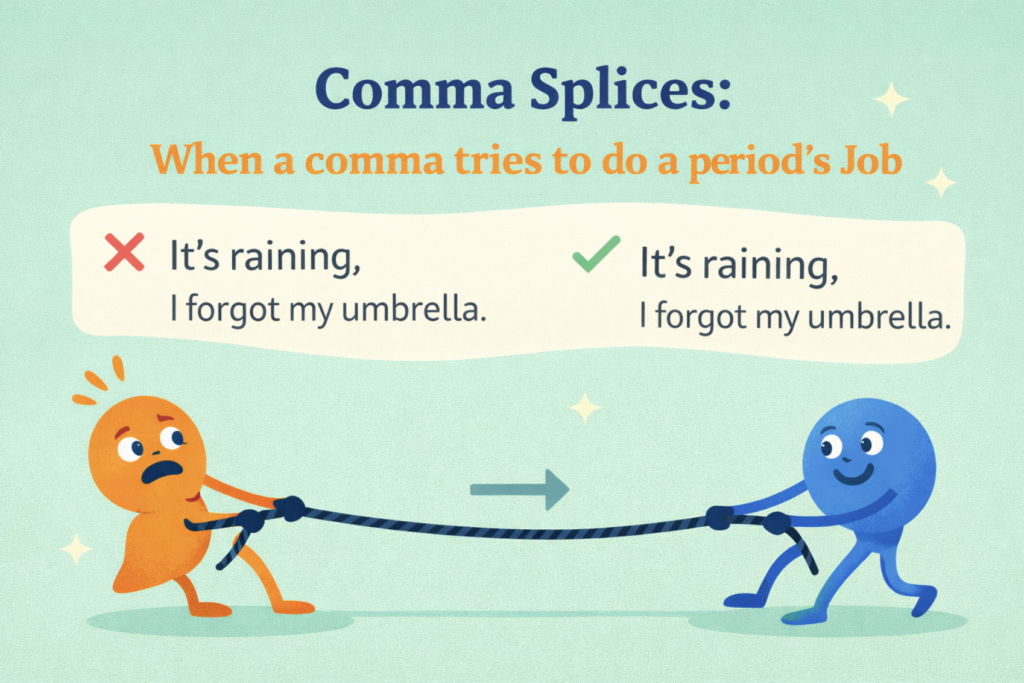
Comma Splices: When a Comma Tries to Do a Period’s Job
A comma splice is what happens when a comma gets overconfident and tries to glue two full sentences together. It almost works (which is why it’s so common) but it’s still incorrect.
Example: “I wrote the book, it was long.”
That’s two complete sentences pretending to be one.
Fast fix: you have two easy options:
- Split it into two sentences: “I wrote the book. It was long.”
- Add a conjunction: “I wrote the book, and it was long.”
Both fixes take about two seconds and instantly make your writing clearer.
Memory trick: commas connect, periods separate. If your comma is trying to do a period’s job, it’s time for a promotion (or a replacement).
Misplaced Apostrophes: The ‘90s Called… They Want Their Plural Back
Misplaced apostrophes are everywhere: on store signs, Instagram captions, even brand copy that should know better. And once you see them, you can’t unsee them. The classic mistake? Using an apostrophe to make a word plural: “apple’s,” “book’s,” “sale’s.” (Somewhere, an English teacher just sighed.)
Here’s the rule: apostrophes are only for possession (the author’s book) or contractions (it’s, you’re, don’t). That’s it. No apostrophe required just because there’s more than one apple.
Fast fix: if you’re just making something plural, add s (or es), nothing else.
Memory trick: if it’s more than one, skip the apostrophe. Your plurals will thank you.
Affect vs. Effect: The Confusing Cousins of English
Even professionals argue about this one, usually right before quietly opening a new tab to double-check. Affect and effect are the confusing cousins of English: related, constantly around each other, and easy to mix up at family gatherings.
Here’s the simple rule: affect is usually a verb meaning to influence. Effect is usually a noun meaning the result.
Example: “The weather can affect your mood.”
“The effect was immediate.”
Fast fix: if you can put the in front of it (“the effect”), you want effect.
Memory trick: RAVEN – Remember: Affect = Verb, Effect = Noun.
Once you memorize that, you’ll look like a grammar wizard… and no one has to know it took you two minutes.
Who vs. Whom: The Grammar Mistake That Feels Fancy
Who vs. whom is the grammar mistake that makes everyone feel like they should be wearing a monocle. But the rule is actually simple: who is a subject (doing the action), and whom is an object (receiving the action).
Fast fix: replace the word with he or him.
If he fits, use who. If him fits, use whom.
Example: “Whom should I email?” → “I should email him.” ✔
So, whom is correct.
Memory trick: whom ends with M, like him.
If it feels fancy, you’re probably doing it right.
Sentence Fragments: When Your Sentence Ghosts You
A sentence fragment is what happens when your sentence starts strong… and then disappears. It’s an incomplete thought pretending to be a full sentence, usually because it begins with words like Because, Although, Which, or While, and never finishes the idea.
Example: “Because I was exhausted.”
Okay… because you were exhausted what? Slept? Quit? Ordered takeout? We need closure.
Fast fix: attach the fragment to the sentence before it or complete the thought.
Correct: “I went to bed early because I was exhausted.”
Memory trick: if it can’t stand alone, it’s not a sentence.
Fragments can be used for style sometimes, but when they’re accidental, they just leave the reader hanging like a cliffhanger with no sequel.
Quick Grammar Fix Checklist: The 60-Second Proofread
No time to proofread properly? Fair. Here’s a quick checklist that catches the most common grammar issues in under a minute, perfect for a last-second sanity check before you hit send or publish.
- Search for “your” and “you’re” → make sure ownership and you are aren’t playing dress-up
- Search for “its” and “it’s” → swap in it is to confirm the apostrophe belongs
- Check subject-verb agreement → the verb should match the true subject, not the distractor noun nearby
- Hunt down long sentences → split run-ons and fix comma splices (commas aren’t superheroes)
- Scan for apostrophes in plurals → “books” is plural; “book’s” is possession
- Read it out loud once → if you stumble, your reader will too
Bookmark this. Future-you will thank you.
Good Grammar Isn’t About Rules, It’s About Respecting the Reader
Good grammar isn’t about sounding perfect; it’s about making your writing clear, smooth, and easy for someone else to enjoy. Fixing common grammar mistakes doesn’t mean turning into a grammar robot. It just means your ideas don’t get tripped up by avoidable distractions. And the truth is, a few small tweaks can instantly make your writing feel more polished, more professional, and more confident, without changing your voice.
Use this guide like a repeatable tool: skim it before you publish, run through the checklist, and move on with your day like the capable writer you are. And if it helped, bookmark it (or share it with someone who still writes “your welcome”).
FAQ: Common Grammar Mistakes
Q: What are the 11 rules of grammar?
There isn’t one official, universal list called “the 11 rules of grammar” (grammar isn’t that neatly packaged, unfortunately). But most guides agree on these 11 core grammar rules that cover the basics of clear English:
Use complete sentences (subject + verb).
Match subjects and verbs (singular/plural agreement).
Keep verb tense consistent (don’t time-travel mid-sentence).
Use pronouns correctly (who/whom, I/me, etc.).
Place modifiers near what they describe (avoid confusion).
Use punctuation properly (commas, periods, apostrophes).
Avoid sentence fragments unless you’re doing it intentionally for style.
Avoid run-ons and comma splices.
Use parallel structure (keep lists consistent).
Use articles correctly (a, an, the).
Use proper capitalization (especially in names and titles).
Think of these as the grammar rules that keep your writing from wobbling.
Q: What is the hardest grammar rule in English?
For most people, the hardest rule is subject-verb agreement in complex sentences, especially when there are phrases in between.
Example:
Correct: “A bouquet of roses smells wonderful.”
Incorrect: “A bouquet of roses smell wonderful.”
Why it’s tricky: your brain wants to match the verb to the closest noun (roses), not the real subject (bouquet).
Other contenders for “hardest” include:
who vs. whom
affect vs. effect
But subject-verb agreement is the one that trips people most consistently.
Q: What are dangling modifiers?
A dangling modifier is a descriptive phrase that doesn’t clearly attach to the right subject, so the sentence accidentally suggests something unintended (and often hilarious).
Example:
Incorrect: “Walking down the street, the trees were beautiful.”
This makes it sound like the trees were walking.
Correct: Fix: “Walking down the street, I noticed the trees were beautiful.”
Quick rule: the noun doing the action should come right after the modifier.
Dangling modifiers are like bad GPS instructions: they technically point somewhere, but not where you meant.
Q: What are the most common writing mistakes?
Here are the most common writing mistakes (and yes, even good writers make them):
Grammar mix-ups (your/you’re, its/it’s, then/than)
Run-on sentences and comma splices
Vague or wordy writing (too many filler phrases)
Weak verbs and overuse of “was/were”
Overusing passive voice
Inconsistent tone (formal → casual → formal again)
Lack of structure (no clear flow or transitions)
Repetition (same words or phrases too often)
Punctuation errors (especially commas and apostrophes)
Not proofreading aloud (the fastest way to catch awkward phrasing)
A good rule: clarity wins. If it feels confusing to write, it’s probably confusing to read.
Q: What are the 8 grammatical categories in English?
This usually refers to the eight parts of speech, which are the main grammatical categories:
Noun (person/place/thing/idea)
Pronoun (he, she, it, they)
Verb (action or state of being)
Adjective (describes a noun)
Adverb (describes a verb/adjective/adverb)
Preposition (in, on, under, by)
Conjunction (and, but, because)
Interjection (wow!, hey!, ouch!)
They’re the building blocks of sentences like Lego pieces, but with fewer foot injuries.
Q: Which is correct, Sally and Me or Sally and I?
Both can be correct, it depends on whether the phrase is a subject or an object in the sentence.
Use Sally and I when it’s the subject (doing the action):
“Sally and I went to the store.”
(You would say: “I went to the store.”)
Use Sally and me when it’s the object (receiving the action):
“The teacher gave the homework to Sally and me.”
(You would say: “The teacher gave the homework to me.”)
Fast trick: remove “Sally and” and see what sounds right.
If “I” sounds right → use Sally and I
If “me” sounds right → use Sally and me
And yes, people overcorrect this constantly, because “Sally and I” sounds more formal, even when it’s incorrect.