You’ve met them before. The fierce protector who turns “no” into a full-time personality. The wise woman who somehow knows everyone’s secrets before they’re even secrets. The chaos queen who shows up late, says something unhinged, and accidentally changes your life. They’re in ancient myths, blockbuster movies, and yes, your group chat (you know exactly who the Rebel is).
That’s the magic of female archetypes: they’re familiar, instantly recognizable patterns that help us understand characters fast. But here’s the twist. Archetypes aren’t personality prisons or outdated “types of women.” They’re story blueprints, and modern storytelling has gotten really good at remixing them.
In this article, we’ll break down what these archetypes actually are, how many people say exist (and why the numbers keep changing), and how they evolve across cultures, genres, and eras, from classic icons to complicated, modern favorites.
The Big Question: What Are the Female Archetypes, Exactly?
Female archetypes are recurring character patterns that show up across stories, cultures, and centuries. Think of them as a character’s default settings: the values she protects, the fears that push her buttons, the motivation that drives her forward, and the moves she tends to make when life gets messy. Some characters lead with love, some with power, some with wisdom, some with pure chaos energy, and archetypes help us name those patterns without over-explaining them.
Here’s an important distinction: an archetype is a blueprint, not a box. It’s a starting structure that gives a character shape and direction. A stereotype, on the other hand, is the bargain-bin version: flat, predictable, and usually stuck repeating the same tired traits with zero growth.
So, what are the female archetypes really useful for? They create instant emotional recognition. Readers feel like they “get” a character within seconds. Writers get a strong foundation to build on. And marketers love them because archetypes tap into identity, aspiration, and story-driven branding. Basically, archetypes are narrative shortcuts when they’re used smart, not lazy.
Your Publishing Journey Awaits – Start NowHow Many Female Archetypes Are There? (Spoiler: Depends Who’s Counting)
If you’ve ever Googled this, you’ve probably noticed something hilarious (and mildly annoying): every list swears it’s the list. One says six. Another says seven. Then someone shows up with twelve, thirteen, or “actually it’s infinite,” and suddenly you’re questioning everything.
That’s because archetypes aren’t a fixed scientific inventory. They shift depending on culture, era, and the framework you’re using. Mythology tends to focus on roles and symbols. Psychology leans into inner drives and transformation. Storytelling frameworks care about character function and conflict. Branding archetypes translate the same patterns into identity and vibe. Same concept, different angle.
So, how many female archetypes are there? The honest answer is: it depends on the lens. Think of these systems like maps. A subway map and a road map show different details, but both can get you where you need to go.
The best move is simple: pick the framework that serves your goal, whether you’re crafting a novel, outlining a screenplay, or shaping a brand voice.
The Greatest Hits: What Are the Different Female Archetypes You’ll See Everywhere?
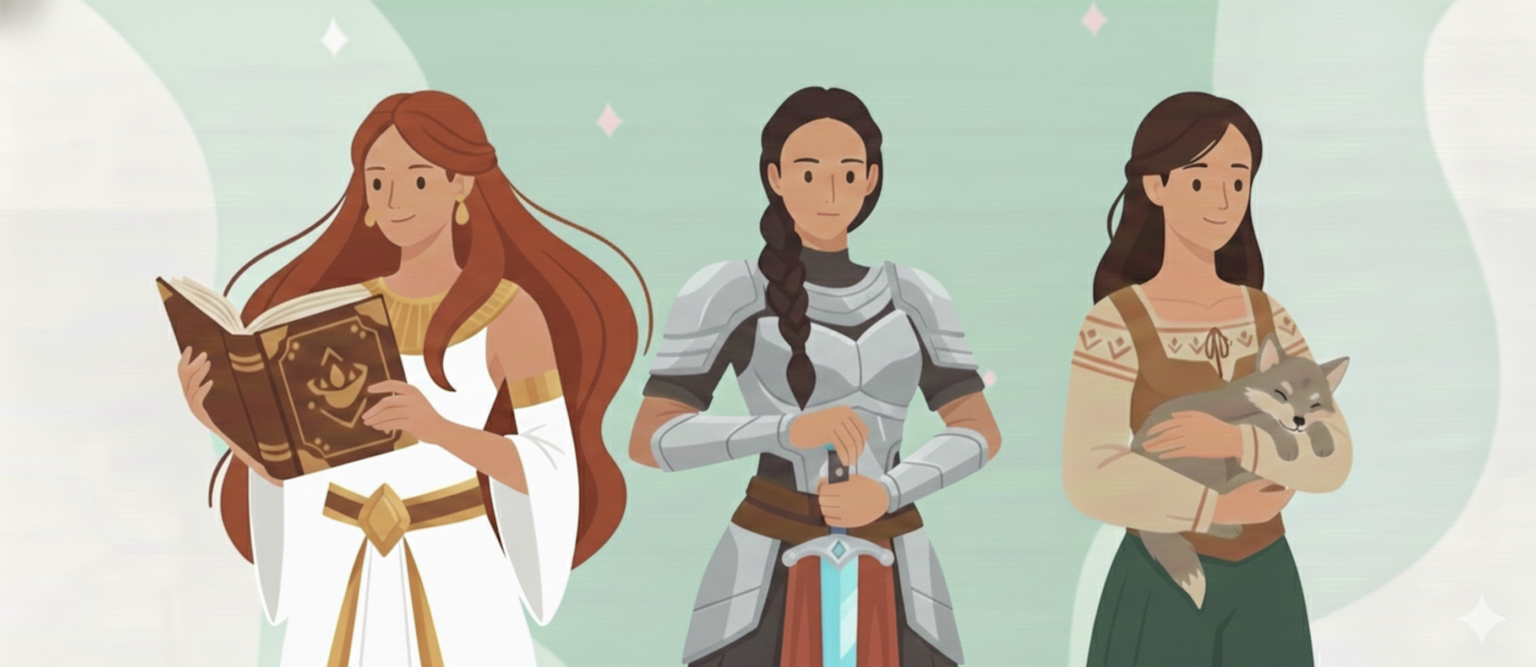
If you’re wondering what are the different female archetypes, here’s a starter set you’ll spot in myths, novels, rom-coms, prestige TV, and the “about me” section of half the internet. Consider this the greatest-hits album, not the complete discography.
The Maiden / Ingénue
- Desire: discovery, belonging, first-times energy (wide eyes, open heart).
- Shadow: naïveté, dependency, outsourcing her choices to louder people.
- Modern evolution: the curious beginner with agency. She learns fast, asks better questions, and chooses her own coming-of-age.
The Mother / Caregiver
- Desire: protect, nourish, build home, hold the world together with snacks and emotional intelligence.
- Shadow: martyrdom, control, “I’m fine” said through gritted teeth.
- Modern evolution: boundaries, chosen family, community care. She helps without disappearing.
The Queen / Ruler
- Desire: lead, create order, raise the standard, make the hard call.
- Shadow: rigidity, image obsession, mistaking perfection for safety.
- Modern evolution: values-driven leadership and earned authority. She’s not “bossy”, she’s effective, and she knows what she stands for.
The Lover / Muse
- Desire: connection, beauty, pleasure, inspiration, aliveness.
- Shadow: people-pleasing, validation hunger, confusing attention with intimacy.
- Modern evolution: desire with self-respect. She’s a creative force, not just someone else’s sparkly side quest.
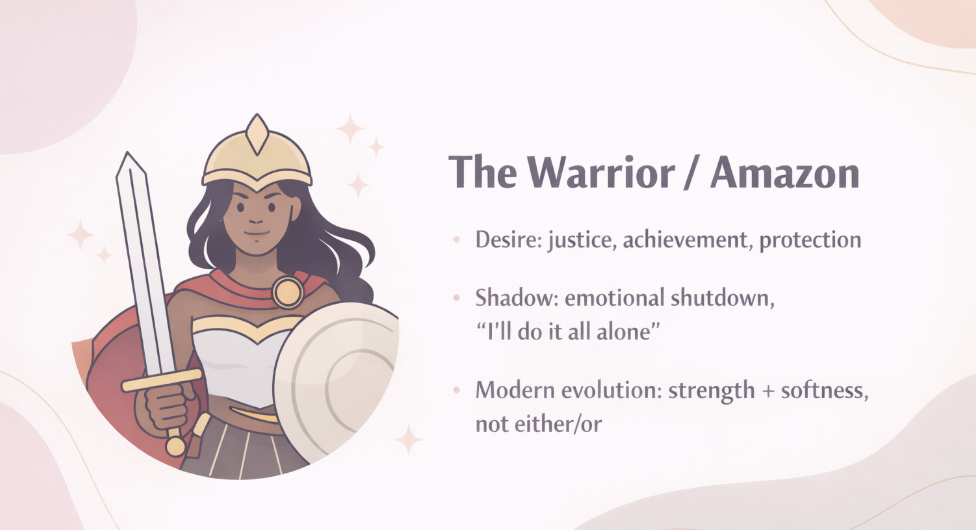
The Warrior / Amazon
- Desire: justice, achievement, protection, the kind of courage that shows up even when she’s scared.
- Shadow: emotional shutdown, “I’ll do it all alone,” treating vulnerability like a suspicious package.
- Modern evolution: strength and softness. She can fight, and she can feel. Two hands, two skills.
The Sage / Mystic
- Desire: truth, insight, transformation, meaning beneath the mess.
- Shadow: detachment, superiority, disappearing into “wisdom” to avoid real-life chaos.
- Modern evolution: grounded insight and practical magic (also known as lived experience). She’s spiritual and useful.
The Trickster / Rebel
- Desire: freedom, disruption, truth via chaos, exposing the fake rules.
- Shadow: self-sabotage, cynicism, burning bridges before checking if there’s a door.
- Modern evolution: playful rule-breaker with a cause. She doesn’t just stir the pot, she’s trying to make a better soup.
Quick note: these aren’t “types of women.” They’re story energies, and any character (or real human) can embody more than one, shift between them, or mash them together into something new.
Evolution Time: How Female Archetypes Are Changing (And Why That’s Good News)
The old-school version of female archetypes often treated women like symbols on legs. She was pure or tempting, nurturing or wicked, the prize, the warning sign, the emotional support animal for the male hero’s journey. Clean labels. Simple functions. Minimal interior life.
Modern storytelling is (finally) letting women be full humans. Contradictory. Powerful. Funny. Ambitious. Occasionally a disaster in sweatpants at 2 a.m. In other words, believable. And that shift has changed how archetypes work. They’re no longer roles women must perform. They’re energy patterns women can move through.
Three big evolution trends are driving the upgrade:
- Agency upgrade: the plot doesn’t just happen to her. Things happen because of her choices, even when she chooses badly, because growth needs consequences.
- Shadow integration: flaws aren’t a moral punishment. They’re part of the arc, the friction that makes change possible, the crack where the light gets in (yes, we went there).
- Role remixing: characters blend archetypes like playlists. Warrior-Mother. Rebel-Queen. Sage-Lover. The mashups are where the magic lives.
And yes, we’re retiring the “strong female character” who is strong mainly at scowling. Strength can also look like tenderness, humor, or saying “I need help” without combusting.
The Secret Sauce: How to Use Female Archetypes Without Writing a Cardboard Cutout
Archetypes are most useful when you treat them like a jumping-off point, not a character generator. The goal isn’t to build “The Queen™” or “The Rebel™.” The goal is to build a person who happens to carry that energy at the start of the story. Here’s a quick checklist that keeps female archetypes sharp, human, and instantly more interesting:
- Start with desire + fear: What does she want more than anything, and what is she terrified it will cost her? (This beats “leather jacket + sarcasm” every time.)
- Add a contradiction: What doesn’t fit the expected mold? A Warrior who loves romance novels. A Caregiver who hates being needed. A Sage who’s petty in group chats.
- Define her relationship to power, love, and belonging: Does she chase power, avoid it, misuse it, share it? Does love feel safe, suspicious, or sacred? Where does she feel “at home”, and why?
- Give her a personal code: What won’t she do, even under pressure? This is where integrity lives and drama is born.
- Let her evolve: The archetype on page one shouldn’t be the same person at the ending. Growth is the whole point.
One final note: if your character’s vibe is “Boss Babe robot mode”, add mess, add softness, add specificity, and for the love of narrative tension, let her be wrong sometimes.
Pick an Archetype, Then Break It Beautifully
Female archetypes aren’t labels you stick on characters like name tags at a networking event. They’re tools, a way to understand what drives a character before you get to the finer details of voice, backstory, and choices. Start with an archetype, then make it yours. Blend two together. Flip the expectation. Modernize the “classic.” Give the Queen a soft spot. Let the Maiden be ruthless. Turn the Rebel into the protector.If you’re writing, revising, or even analyzing your favorite stories, use this as a lens: not to limit your characters, but to deepen them. The best archetypes don’t stay tidy. They evolve.
FAQ: Female Archetypes
Q1: What is the rarest female archetype?
Usually, The Sage / Mystic is the rarest to see as a true main character, especially in mainstream stories. Not because she isn’t powerful, but because wisdom-driven characters are harder to write without turning them into “the therapist friend” or the mysterious side character who speaks in riddles and disappears. A well-written Sage has depth, flaws, and a real inner conflict, which takes more craft (and more courage).
Q2: What is the most popular female archetype?
The most common is The Lover / Muse, especially in romance, drama, and pop storytelling. She’s everywhere because connection, desire, beauty, and emotional intensity are instantly engaging on the page. The modern version is way better though: she’s not just “the love interest,” she’s a character with her own hunger, agency, and creative force.
Q3: What archetype was Marilyn Monroe?
Marilyn Monroe is most often framed as a blend of The Maiden / Ingénue and The Lover / Muse. Publicly, she was marketed as the glamorous, desirable icon, but she also embodied the “sweet, vulnerable” persona that created a huge emotional pull. The reason she’s still so fascinating is that you can also see traces of The Rebel underneath it all, someone fighting to be taken seriously and control her own story.
Q4: What is a dark feminine archetype?
A “dark feminine archetype” is basically the shadow side of feminine power. It’s the version that isn’t soft, pleasing, or easy to digest. Think: seductive and dangerous, nurturing and controlling, wise and ruthless. The dark feminine often shows up as the Femme Fatale, the Witch, the Destroyer, the Vengeful Queen, or the Cold Strategist. It’s not “evil woman energy,” it’s power without approval, and that can feel intimidating.
Q5: Which is the badass woman archetype?
The classic “badass” is The Warrior / Amazon. She’s driven by justice, protection, achievement, and survival. She gets things done, doesn’t fold under pressure, and often becomes the shield for everyone else. The most compelling Warrior isn’t invincible, though. She has something to lose, something she’s hiding, and a soft spot she’d rather die than admit exists.
Q6: Can a character be more than one female archetype?
Absolutely, and that’s where the best characters live. Most memorable women in fiction are blends: a Warrior-Mother, a Rebel-Queen, a Lover-Sage, a Maiden who becomes a Ruler. Archetypes aren’t fixed personalities, they’re story energies that can shift depending on the stakes. Want a character to feel real? Let her evolve and contradict herself. That’s not inconsistency, that’s humanity.