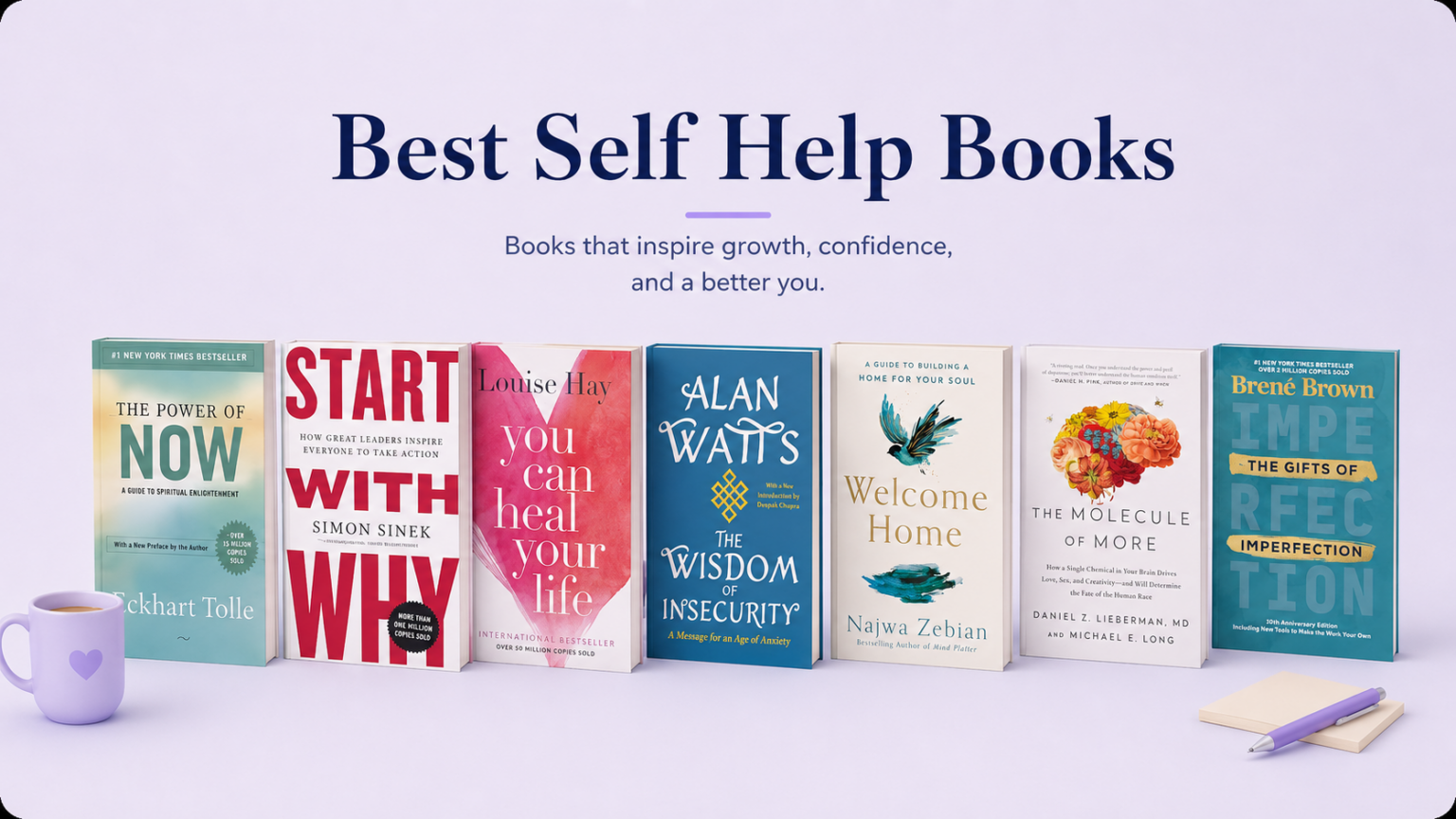
The best self help books rewire the way you think. The problem is finding the ones that actually do.
With thousands of titles promising transformation, and reading habits shifting significantly across age groups, how do you know which ones are worth reading?
I’ve read all 15 books on this list, so these are not random recommendations pulled from a bestseller page. Some changed how I make decisions. Some I still think about years later. A few I’d press into the hands of anyone going through something hard.
This list cuts through the noise. It brings together books that actually deliver, spanning mindfulness, habit formation, Stoic philosophy, emotional healing, and the neuroscience of motivation. Many of them also follow something you might recognize as the hero’s journey: the idea that real personal transformation follows a recognisable arc, not a straight line.
The Best Self Help Books
Every book on this list earned its place. Each one stayed with me long after I finished reading it, and judging by how many of them became bestsellers, I’m definitely not alone. The best self-improvement books do more than offer advice. They change the way you make decisions, the way you talk to yourself, and the way you understand what’s actually driving you. These are the books that did that for me. If you’re new to the self-help genre, this list is a good place to start.
Best for Building Habits and Self-Discipline
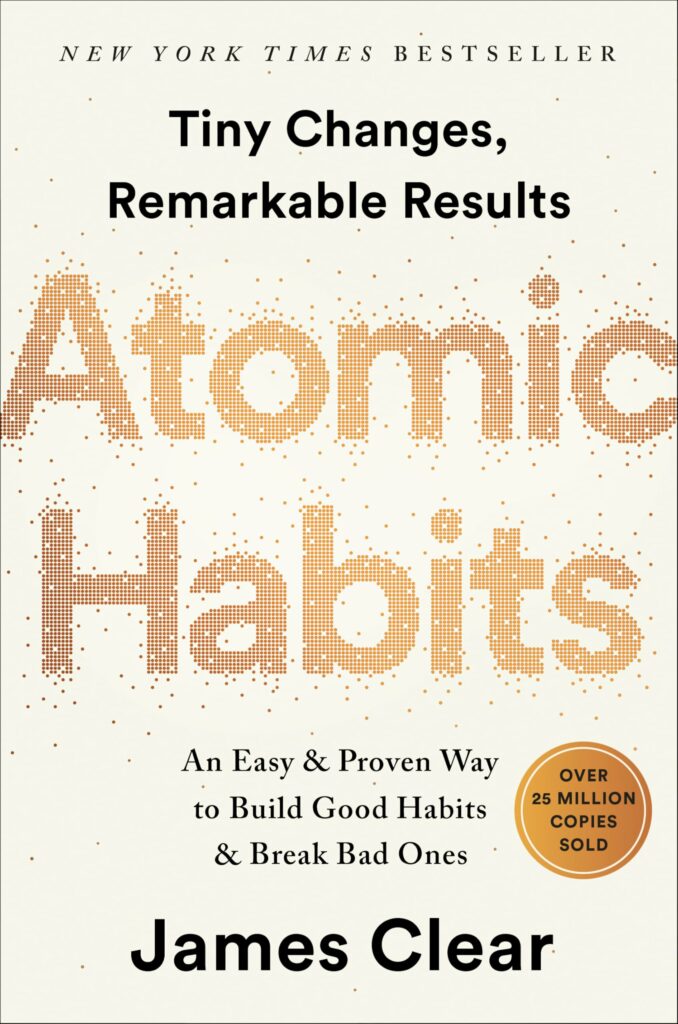
Atomic Habits by James Clear
Best for: Someone who wants to build better habits, become more consistent, and stop relying on motivation to magically appear.
“You do not rise to the level of your goals. You fall to the level of your systems.”
Atomic Habits is about how small daily actions shape who we become. James Clear explains how habits are built through cues, routines, rewards, identity, and environment. Instead of focusing only on big goals, the book teaches readers how to create systems that make good habits easier and bad habits harder.
Why you should read it: This book is popular because it is painfully practical. It does not ask you to become a completely new person by Monday morning. It understands that humans are not machines of discipline. We are creatures of friction, comfort, mood, reward, and convenience. Atomic Habits makes change feel less dramatic and more possible.
Can’t Hurt Me by David Goggins
Best for: If you need mental toughness, discipline, resilience, and a serious push out of their comfort zone.
“You are in danger of living a life so comfortable and soft, that you will die without ever realizing your true potential.”
Can’t Hurt Me is David Goggins’ story of transforming pain, trauma, poverty, racism, and self-doubt into extreme mental endurance. The book combines memoir with personal challenges, showing how Goggins trained himself to push beyond the limits he once believed were fixed.
Why you should read it: This book is not gentle. It is not here to softly suggest that maybe you could try a little harder someday. Goggins writes with the energy of someone who has dragged himself through every excuse and come out the other side allergic to comfort. It can feel intense, even brutal, but that is also the point. It reminds you that the mind often quits long before the body has actually reached its limit. Reading it can make your excuses feel very exposed, and that’s beautifully powerful.
The Daily Stoic by Ryan Holiday and Stephen Hanselman
Best for: People who want a daily practice for resilience, perspective, emotional control, and clearer thinking.
“The single most important practice in Stoic philosophy is differentiating between what we can change and what we can’t.”
The Daily Stoic offers one Stoic reflection for each day of the year, drawing from philosophers like Marcus Aurelius, Seneca, and Epictetus. Each entry gives readers a short idea to sit with, often focused on discipline, acceptance, character, courage, and separating what we can control from what we cannot
Why you should read it: This is a book for people who do not necessarily want to “transform their life” in one dramatic weekend. It works slowly, one small philosophical reminder at a time. There is something grounding about starting the day with a thought that cuts through noise and ego. It does not promise that life will become easy. It just keeps handing you a better posture toward difficulty. Less panic. Less performance. More spine.
Best for Mindfulness and Quieting Your Mind
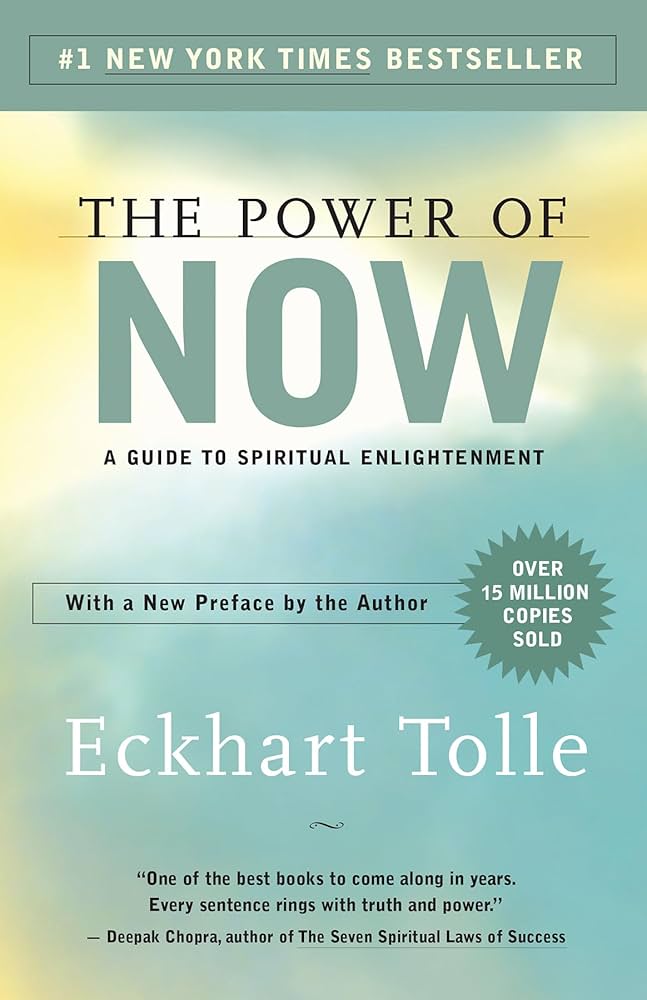
The Power of Now by Eckhart Tolle
Best for: If you are feeling trapped in overthinking, anxiety, emotional noise, or an endless mental loop.
“Realize deeply that the present moment is all you ever have.”
The Power of Now is about learning to live in the present moment instead of identifying with every thought the mind produces. Eckhart Tolle explains how much suffering comes from mental time travel, replaying the past, fearing the future, and resisting what is happening now.
Why you should read it: Tolle feels like someone gently interrupting your inner monologue. It can be strange at first because most of us treat our thoughts like urgent official documents. Tolle makes you realize that the mind is often just narrating, worrying, performing, and rehearsing. Reading it feels like stepping out of a loud room you did not know you were standing in.
Be Here Now by Ram Dass
Best for: People looking for spiritual grounding, presence, self-discovery, and a looser relationship with the ego.
“The quieter you become, the more you can hear.”
Be Here Now blends memoir, spirituality, Eastern philosophy, and reflections on consciousness. Ram Dass explores what it means to move beyond ego, control, identity, and the constant need to define life intellectually.
Why you should read it: This book feels like a door opening in a wall you thought was solid. It does not explain life in a neat, linear way, which is part of its charm. It asks you to loosen your grip, laugh at your ego a little, and stop treating your identity like a legal contract. There is something beautifully unpolished about it. Like, someone went looking for answers and came back with fewer answers, but a much better relationship with the questions.
Your Head Is a Houseboat by Campbell Walker
Best for: People who want a simple, creative, and visual way to understand thoughts, emotions, habits, and mental clutter.
“We can’t command the ocean, but we can command our houseboat.”
Your Head Is a Houseboat uses the metaphor of the mind as a houseboat to explain the inner world. Campbell Walker turns thoughts, feelings, and patterns into accessible characters and images, making self-awareness feel less intimidating and more playful.
Why you should read it: This book makes your mind feel less like a battlefield and more like a strange little floating home that needs some sorting. It has a gentle humor to it, like yes, your thoughts are dramatic, your emotions are wandering around unsupervised, and the whole crew could use a meeting. It does not shame the mess. It just helps you see it. And sometimes seeing the mess without panicking is already a kind of healing.
Best for Emotional Healing and Self-Acceptance
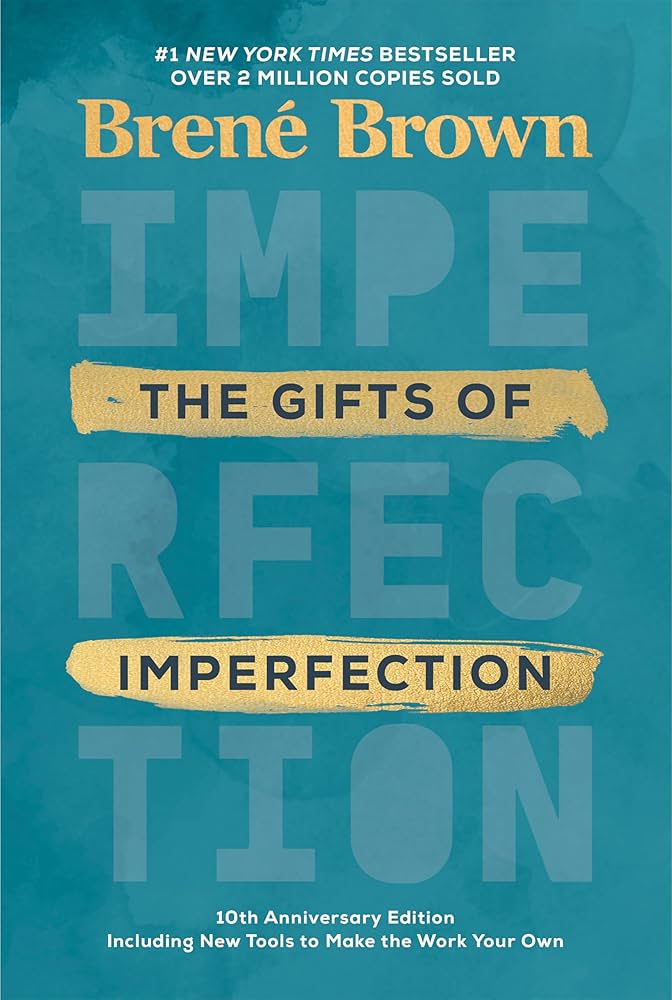
The Gifts of Imperfection by Brené Brown
Best for: If you’re struggling with shame, perfectionism, self-worth, vulnerability, and the exhausting pressure to always be enough.
“Owning our story can be hard but not nearly as difficult as spending our lives running from it.”
The Gifts of Imperfection is about letting go of who we think we are supposed to be and learning to live with more courage, compassion, and connection. Brené Brown explores shame, vulnerability, authenticity, belonging, and the emotional cost of perfectionism.
Why you should read it: Reading Brown’s work feels like a warm but honest conversation with someone who knows exactly how tiring it is to perform being okay. Brown does not treat imperfection like a cute slogan. She treats it like a real human struggle, the kind that shows up in relationships, work, parenting, creativity, and the private ways we compare ourselves to everyone else. It reminds you that being whole is not the same as being polished. It’s truly comforting, and one of my go-to recommendations.
The Mountain Is You by Brianna Wiest
Best for: Anyone dealing with self-sabotage, emotional patterns, fear of change, and the feeling of being stuck in their own way.
“Your new life is going to cost you your old one.”
The Mountain Is You is about self-sabotage and the inner barriers that keep people from becoming who they want to be. Brianna Wiest explores emotional avoidance, fear, trauma responses, resistance, and the process of turning inner conflict into growth.
Why you should read it: This book is for the uncomfortable moment when you realize the obstacle is not only outside you. Sometimes the mountain is your fear, your coping mechanisms, your old identity, your attachment to familiar pain. Wiest writes in a way that feels direct but not cruel. She makes self-sabotage feel less like a character flaw and more like a survival strategy that has overstayed its welcome. That distinction matters. It gives you room to change without hating yourself first.
The Mastery of Love by Don Miguel Ruiz
Best for: People who want to keep healthier relationships, stronger boundaries, and a deeper understanding of love, fear, attachment, and self-worth.
“Don’t take anything personally.”
The Mastery of Love explores how fear, emotional wounds, expectations, and self-rejection affect relationships. Don Miguel Ruiz argues that love becomes painful when we expect other people to complete us, heal us, or carry responsibility for our happiness.
Why you should read it: This book is gentle, but it does not let you hide. Ruiz has a way of making relationship pain feel both sacred and very human. He points out how often we call something love when it is actually fear wearing perfume. Fear of abandonment. Fear of being alone. Fear of not being enough. The book does not make love smaller by removing dependency from it. It makes love cleaner and more spacious.
Welcome Home by Najwa Zebian
Best for: People healing from heartbreak, trauma, self-abandonment, emotional pain, or the feeling of not belonging to themselves.
“These mountains that you are carrying, you were only supposed to climb.”
Welcome Home is about creating inner safety and learning to return to yourself. Najwa Zebian uses the metaphor of the self as a home, guiding readers through healing, boundaries, self-worth, forgiveness, and emotional rebuilding.
Why you should read it: This book feels like sitting with someone who understands that healing is not always inspiring. Sometimes it is awkward, slow, repetitive, and deeply private. Zebian writes for the part of you that kept leaving yourself to be loved, approved of, chosen, or understood. The central idea is simple and painful: you cannot keep decorating other people’s houses and call yourself home. That one stays with you.
Best for Purpose, Motivation & Personal Growth
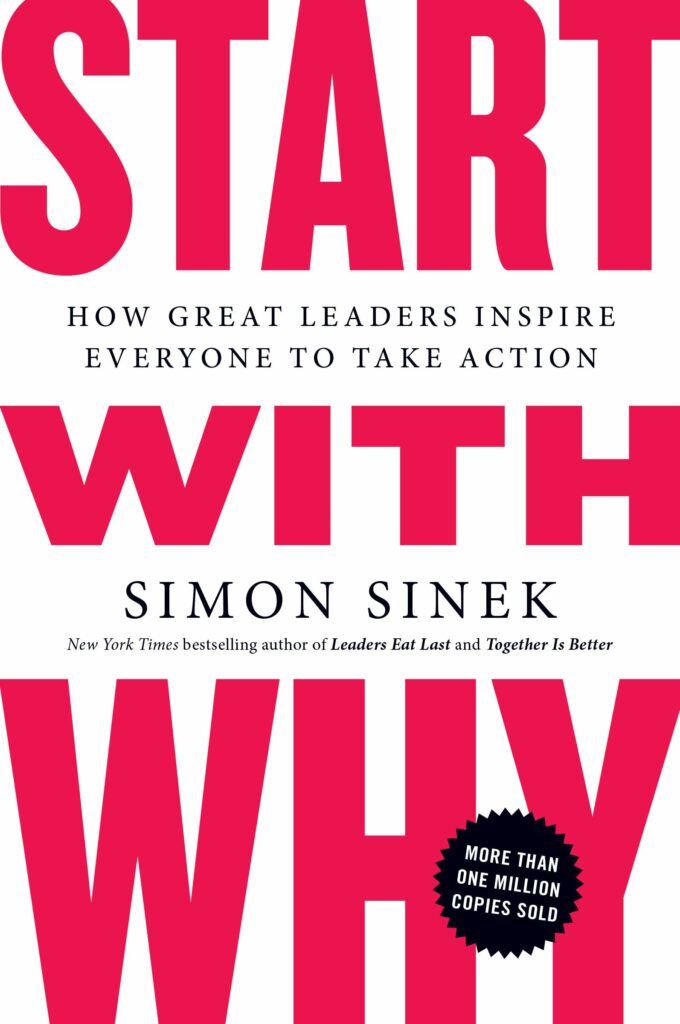
Start With Why by Simon Sinek
Best for: If you are looking for more clarity in leadership, business, creativity, communication, branding, or personal purpose.
“People don’t buy what you do; they buy why you do it.”
Start With Why explains why some people and organizations inspire more loyalty and action than others. Simon Sinek argues that the strongest leaders and brands do not begin with what they do, but with why they do it. The book introduces the Golden Circle framework: Why, How, and What.
Why you should read it: Sinek reminds you that people are not moved by information alone. They are moved by meaning. This book takes something that can sound corporate and makes it surprisingly emotional: the need to know why anything matters. It is a strong read for anyone building a company, a brand, a creative project, or even a personal direction. Because when the why is missing, everything starts to feel like noise wearing a strategy deck.
The Molecule of More by Daniel Z. Lieberman and Michael E. Long
Best for: People who want to understand motivation, ambition, craving, addiction, creativity, and why satisfaction can feel so temporary.
“Dopamine is the molecule of more.”
The Molecule of More explains dopamine and its role in human behavior. The book explores how dopamine drives wanting, pursuit, imagination, ambition, risk-taking, addiction, and future-focused thinking. It helps readers understand why we chase what we do, and why getting what we want does not always bring lasting satisfaction.
Why you should read it: This book makes human wanting feel a little less personal and a lot more fascinating. It explains why the thing ahead of us can glow so brightly, while the thing we already have somehow becomes background furniture. It is both comforting and mildly insulting to realize your brain may be less of a wise philosopher and more of a very enthusiastic treasure hunter. Suddenly, “I’ll be happy when…” starts to look suspicious.
Breaking the Habit of Being Yourself by Joe Dispenza
Best for: Anyone who is interested in mindset, identity change, meditation, neuroplasticity, and breaking repeated emotional or behavioral patterns.
“If you want a new outcome, you will have to break the habit of being yourself.”
Breaking the Habit of Being Yourself explores how thoughts, emotions, and familiar behaviors shape identity. Joe Dispenza argues that people often recreate the same life because they keep thinking the same thoughts, feeling the same emotions, and reinforcing the same internal patterns. Understanding how your personality traits interact with your habits is a big part of why this book lands differently for different people.
Why you should read it: This book is for the moment when you realize the problem is not only what happened to you, but what your nervous system keeps rehearsing afterward. Dispenza makes identity feel less fixed, which can be both exciting and uncomfortable. It asks: what if this is just who I am is sometimes just a very well-practiced emotional routine? That idea can hit hard. It permits you to imagine yourself differently, not in a cheesy way, but in a maybe my brain has been living in an old room kind of way.
Best for Philosophy, Perspective & Inner Clarity
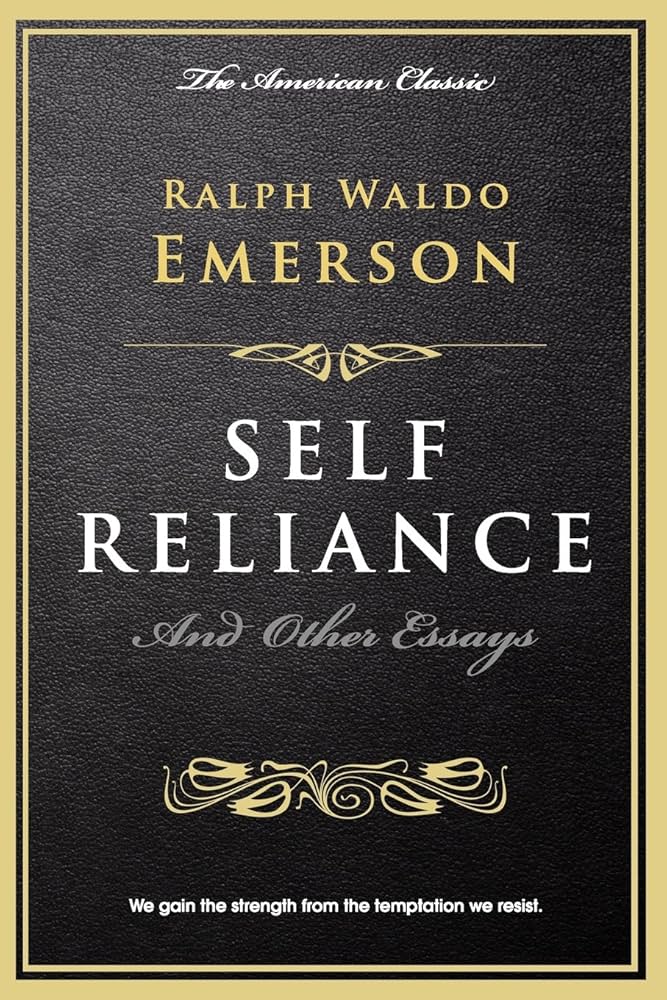
Self-Reliance by Ralph Waldo Emerson
Best for: People who struggle with approval-seeking, conformity, self-doubt, or trusting their own voice.
“Trust thyself: every heart vibrates to that iron string.”
Self-Reliance is an essay about individuality, inner trust, and the courage to think independently. Emerson argues that people often betray their instincts because they are too focused on social approval, tradition, or fear of judgment.
Why you should read it: This is the kind of text that makes you sit up a little straighter. Emerson has this fierce, almost electric belief in the individual soul. He is not asking you to be selfish or arrogant. He is asking why you keep outsourcing your own judgment to the crowd. It can feel like being caught mid-apology for your own existence. The book reminds you that your inner voice may be quieter than public opinion, but it is no less important.
Meditations by Marcus Aurelius
Best for: People who want resilience, emotional discipline, perspective, and a calmer way to handle pressure, disappointment, and uncertainty.
“You have power over your mind, not outside events. Realize this, and you will find strength.”
Meditations is a collection of private reflections by Roman emperor Marcus Aurelius. It focuses on Stoic principles like self-control, humility, duty, mortality, and inner steadiness. The book reminds readers that while we cannot control everything that happens, we can work on how we respond.
Why you should read it: There is something almost absurdly grounding about reading the private notes of an emperor who is basically telling himself to stop complaining, stay humble, and get on with it. Marcus Aurelius does not offer comfort in a soft, decorative way. His comfort is sturdier than that. It is the comfort of perspective. The world is messy. People are difficult. Your body will age. Plans will fail. And still, you can choose your response. Not always perfectly, but enough to remain human with some dignity intact.
Prefer to listen rather than read? Every book on this list is available in audio format – and yes, audiobooks absolutely count as reading.
Start Your Publishing Journey FOR FREEBonus: My Personal Favourites
The 15 books above are my recommendations for almost anyone. These next few are harder to categorise.
Some books don’t feel like books. They feel like someone quietly rewiring the way you metabolize existence. These are the ones I keep orbiting because they have that capability to dissolve into you a little and change the texture of your inner voice.
The Wisdom of Insecurity by Allan Watts
Feels like learning how to stop gripping life by the throat. Alan Watts writes like someone standing barefoot in the middle of chaos, telling you that maybe the panic comes from trying to freeze a river. There’s something deeply sensual about the way he talks about uncertainty: as movement itself. Reading him during an existential spiral feels less like being fixed and more like being invited to dance with your own instability instead of pathologizing it. Extremely quotable book, you spend days thinking about it!
Letters from a Stoic by Seneca
It is strangely comforting because it cuts through mental dramatization with almost surgical precision. Seneca has this energy of someone looking directly at human anxiety and going: most of this suffering is rehearsal. Not cold. Just devastatingly clear. It’s one of those books that makes your catastrophizing feel suddenly visible, almost theatrical. Like, your mind is a very convincing screenwriter. We’re all artists somehow.
Tao Te Ching by Lao Tzu
This book feels ancient, like water remembering something humans forgot. Every passage reads like a paradox whispered by nature itself. It doesn’t try to dominate life or optimize it into productivity language, but just keeps returning to softness, stillness, slowness, and non-force. Reading it too fast almost ruins it. It’s the kind of text that expands in silence after you close it.
Ask, and It’s Given by Esther Hicks
This was my initiation into the Law of Attraction. This book is fascinating because it sits at the intersection of psychology, manifestation, emotional self-regulation, and belief. Even if you approach it skeptically, it forces you to confront how much attention shapes emotional reality. The core of it isn’t really magic; it’s focus. Repetition. Emotional momentum. The realization that people unconsciously rehearse their own suffering every day without noticing they’re practicing it.
You Can Heal Your Life by Louise Hay
The way Louise Hay writes feels like being spoken to by someone who believes the body remembers every unloved version of you. There’s something almost painfully gentle about it. Louise Hay approaches healing less like punishment and more like reconciliation with your past, your self-image, and your inner language. The book sits in this strange place between affirmation, psychology, and emotional spirituality, where you start noticing how casually cruel people are to themselves all day long.
The Astonishing Power of Emotions by Esther Hicks
Hicks changed the way I think about emotions entirely because it treats feelings like internal navigation instead of irrational interruptions. Not good or bad, only directional. The book keeps returning to the idea that emotional states are constantly revealing your relationship with your own resistance, attention, and alignment. It’s less about being positive all the time and more about understanding the energetic consequences of what you repeatedly feed your thoughts.
If you’ve worked through most of these and want to keep going, our wider list of 100 best books to read covers every mood and genre.
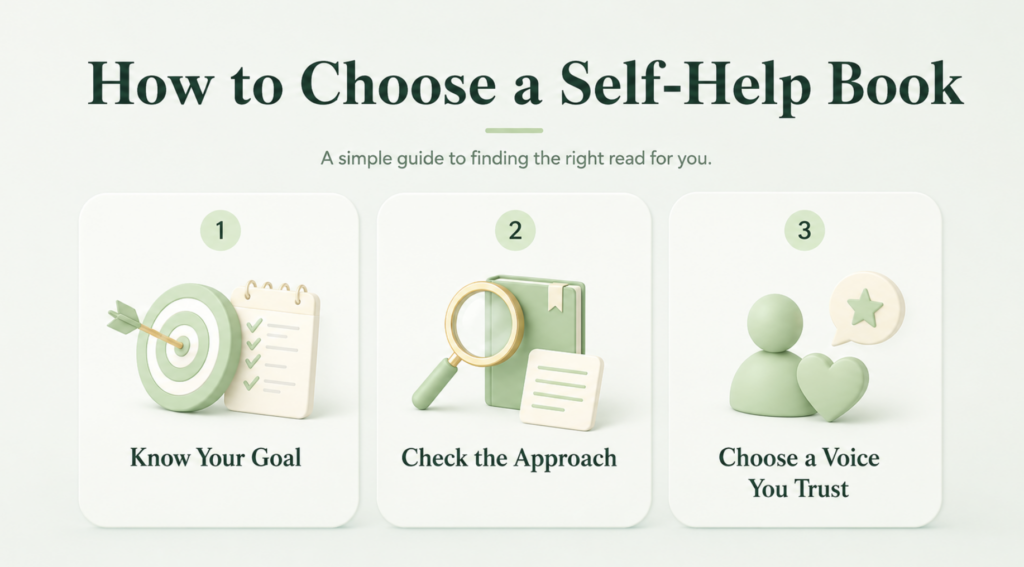
How to Choose the Right Self-Help Book to Start With
The biggest mistake a lot of people make when picking a self-help book is to choose based on what’s popular rather than what’s relevant to where they actually are right now. A book that changes someone’s life in their thirties might land completely flat in their twenties, not because it’s a bad book, but because the timing was wrong.
Start with your current challenge, not your ideal self. Ask yourself what’s actually bothering you right now. Is it that you can’t seem to build habits that stick? Do you overthink everything? Do you keep repeating patterns in relationships you don’t understand? The answer to these questions will point you to the right book more reliably than any bestseller list.
A rough guide:
If you can’t quiet your mind – start with The Power of Now. It’s the most direct path from overthinking to presence, without requiring any prior knowledge of mindfulness or meditation.
If you want to change your behaviour but motivation keeps failing you – start with Atomic Habits. Motivation is unreliable. Systems aren’t. This book will show you the difference.
If you’re going through something emotionally difficult – start with Welcome Home or The Mastery of Love. Both meet you where you are rather than asking you to be somewhere else first.
If you feel directionless or question your values – start with Meditations. It’s shorter than people expect, and nothing cuts through noise quite like a Roman emperor writing to himself at midnight.
If you feel like you understand yourself intellectually but nothing changes – start with Existential Kink. It goes where most self-help books won’t.
One last thing: don’t read self-help books passively. The ones that actually change something are the ones you underline, talk about with your friends, or sit thinking about long after you’ve put the book down.
FAQ: Best Self-Help Books
Q: How do I choose a self-help book?
Start by identifying the area you want to improve, whether it is habits, mindfulness, emotional well-being, or personal growth. Look for books with actionable advice, credible authors, and clear psychological insights. Checking reviews and sample chapters can also help you find self-help books that match your learning style and goals.
Q: What is the best self-help book to change life?
The best self-help book depends on your personal goals, but works like Atomic Habits for behavior change, The Power of Now for mindfulness, and Existential Kink for shadow work offer actionable insights. Choose books that combine practical exercises with reflective depth for meaningful transformation.
Q: Are self-help books good for mental health?
Yes, self-help books can support mental health when chosen wisely. They provide frameworks for managing stress, building resilience, and improving self-awareness. Look for titles that offer evidence-based strategies and psychological guidance, and consider pairing reading with journaling or mindfulness practice for maximum benefit.
Q: Does reading self-help books really help?
Reading self-help books can help by offering perspective, actionable strategies, and motivation. The effectiveness increases when readers actively apply techniques, reflect on personal habits, and integrate lessons into daily life. Using a combination of books on habits, mindset, and emotional intelligence often produces the best results.
Q: What is the number one self-help book of all time?
While opinions vary, classics like The Power of Now by Eckhart Tolle, Meditations by Marcus Aurelius, and Self-Reliance by Ralph Waldo Emerson are often cited as the most influential. These books combine timeless philosophy with practical insights that remain relevant for personal growth across decades.
Q: How to choose the right books for personal growth?
Focus on books that match your current goals and challenges. Check for credibility, readability, and the balance of actionable advice with reflective insight. Combining modern psychology with classic philosophy often creates a well-rounded reading list for meaningful personal development.
Q: What is the book that helps you grow mentally?
Books that promote mental growth often challenge your thinking, encourage reflection, and teach new skills. Examples include Atomic Habits for habit formation, The Molecule of More for understanding motivation, and Wisdom of Insecurity for mindfulness. Choose books that push you to think critically and apply lessons in daily life.
Q: What are the best self-help books in 2026?
The best self-help books in 2026 include a mix of practical, psychological, philosophical, and emotional-growth titles. Atomic Habits is one of the strongest choices for behavior change. The Power of Now remains a leading book for mindfulness, Meditations offers timeless Stoic wisdom, and Welcome Home is a strong pick for self-compassion and emotional healing. The best book for you might include some trial and error until you find one that truly resonates with you, and that will be the one that sets you on your path to success!