
Creating audiobooks have taken the publishing world by storm, and it’s no surprise why: audiobooks let people devour your book while on the go , driving to work, pumping iron, or just getting through their daily chores without having to physically flip a page.
For self-published authors, turning a book into an audiobook is a must-do, not a nice-to-have, and it really is a way to tap into an entirely new audience of readers who just happen to prefer listening to reading when they’re on the move.
This guide will give you a step-by-step run through the real process of creating an audiobook: from planning it out, to laying down the tracks yourself (or hiring a pro to do it for you), editing the final product, getting it out to the world, and then selling it (plus a bonus section on AI narration) which is rapidly becoming a surprise favourite for many self-published authors that most other guides still leave out.
Planning Your Audiobook Creation Project
Before recording anything, decide who the audiobook is for and what you want it to do for your book, whether that’s reaching commuters and multitaskers who don’t read print, or adding a professional audiobook publishing layer to your existing catalog.
Knowing the goal shapes every choice that follows, from narration style to which platforms you prioritize.
The other early decision is narration. There are now three real paths: narrate it yourself, hire a professional narrator, or use an AI narration tool. Each has trade-offs in cost, turnaround time, and how much control you keep, covered in detail below.
Preparing Your Manuscript for Audiobook Production
A well-prepared manuscript is the foundation of a good audiobook, human-narrated or AI-narrated alike.
Start by editing and proofreading thoroughly. Small errors that are easy to skim past on the page become obvious the moment they’re read aloud.
Next, adapt the formatting for audio. Visual elements like tables, footnotes, and complex layouts don’t translate to sound, so simplify anything that assumes a reader is looking at a page rather than listening.
Read through your dialogue and descriptions with an ear for how they sound spoken, not just how they read. Some phrasing that works on the page feels clunky out loud, and it’s worth revising before recording rather than after.
Finally, a second set of eyes helps here too. A professional editor can catch issues you’ve stopped noticing after months with the same manuscript.
Choosing How to Narrate: Human, DIY, or AI
This is the decision that shapes everything else about cost and timeline, so it’s worth laying out clearly.
Self-narration
If you’re comfortable with your own voice and have the time, narrating your own book keeps costs low and control high.
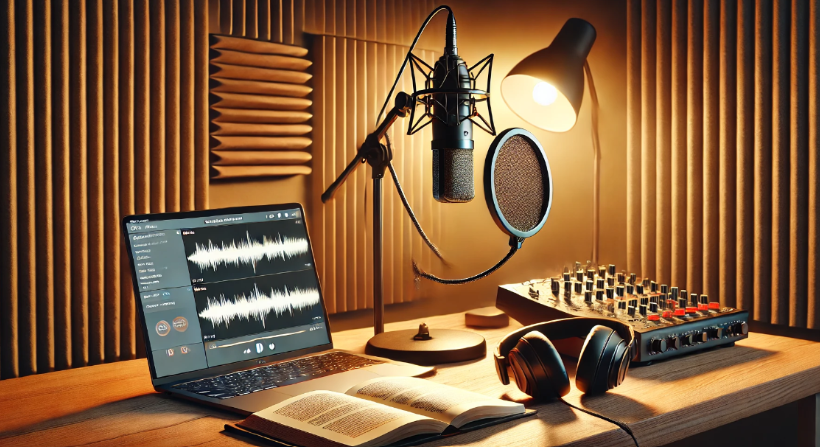
You’ll need decent recording equipment (a quality microphone, headphones, and a quiet, soundproofed space) and recording software.
Audacity is a solid free option for beginners; Adobe Audition offers more advanced editing tools if you’re ready to invest.
Hiring a professional narrator
A skilled narrator brings pacing, character voices, and emotional range that’s hard to replicate yourself, especially for fiction with multiple characters.
Platforms like ACX (Audiobook Creation Exchange) connect authors with narrators, and most projects take 2 to 6 weeks from hire to finished audio.
AI narration
This is the newest option, and it’s become mainstream fast: tools can now generate a full audiobook from your manuscript in a matter of days rather than weeks, at a fraction of the cost of hiring a human narrator.
The trade-off is nuance: AI voices have improved significantly but still can’t fully match a skilled human narrator’s ability to shift tone, pause for effect, or voice distinct characters convincingly.
It’s a genuinely good option for non-fiction, straightforward narratives, or authors on a tight budget or timeline, and worth previewing even for other projects, since many services let you listen to samples before committing either way.
There’s no universally right choice here. A memoir with a lot of emotional weight might be better served by a human voice. A how-to guide or business book may do perfectly well with AI narration at a much lower cost and faster turnaround.
Recording and Editing Your Audiobook
If you’re recording yourself or working directly with a narrator, find a quiet space and start with a test recording to catch background noise before committing to a full session.
Read at a natural pace, let pauses land where they would in conversation, and record opening and closing credits along with the main content.
Editing is where a recording becomes a finished audiobook: removing coughs, filler words, and awkward pauses, then mastering the audio for consistent volume throughout.
This step matters whether the source audio is human-recorded or AI-generated. Raw output almost always needs a cleanup pass before it’s ready for listeners.
If editing sounds like more than you want to take on, hiring a professional audio editor is a reasonable option, and ensures the final files meet the technical standards most distribution platforms require.
Preparing Your Files for Distribution
Once the audio is finished, each distribution platform has its own file format and quality requirements, usually MP3 or WAV, with specific bitrate and sample rate standards.
It’s worth checking these before you upload anywhere, since a mismatched file can mean a rejected submission and a delay you didn’t need.
Choosing Where to Sell Your Audiobook
Popular audiobook platforms include Audible, Kobo Writing Life, Google Play, and Author’s Republic, each with its own royalty structure and rules.
One of the bigger decisions here is exclusive versus non-exclusive distribution: going exclusive with a platform like Audible can mean higher royalties on that platform, while non-exclusive distribution spreads your audiobook across more places but usually at a lower royalty rate per sale.
Which one makes sense depends on whether you’re optimizing for reach or per-sale earnings.
Creating an Audiobook with Spines
If you’d rather not manage narration, editing, and distribution separately, audiobook production is available as an add-on through Spines alongside your self-publishing package.
Here’s what the process actually looks like, no jargon, just the steps:
- You upload your existing manuscript or ebook.
- You choose your narration: browse voice samples from real narrators or AI-generated options, and pick the one that fits your book before committing to anything.
- We format your manuscript so it reads naturally as audio, then handle the recording (or guide you through narrating it yourself, if you’d rather).
- Our team edits and masters the audio, and a real person listens through the finished product from start to finish to catch anything that’s off before it goes out.
- Once it’s approved, we distribute it to major platforms, including Audible, Spotify, Apple Books, and Google Play.
Turnaround is roughly 7 days if you go with AI narration, or 2 to 6 weeks with a human narrator, and you keep 70% of the royalties on every sale.
Audiobook production isn’t bundled into every standard publishing package by default. It’s an optional add-on, so it’s worth checking current pricing details before assuming it’s included in whatever plan you choose.
Marketing Your Audiobook
Once your audiobook is live, a few channels tend to do most of the work: social media (teaser clips and behind-the-scenes content), an email list you can notify directly about the release, outreach to audiobook bloggers and reviewers for early reviews, and if you have budget for it, targeted ads on Amazon or social platforms.
Giveaways through Goodreads or Amazon can also help generate early reviews, which matter more for audiobooks than people expect, since ratings are one of the few signals listeners use to decide what to try next.
Going Global with Your Audiobook
Most major platforms (Audible, Amazon, Google Play) already have global reach built in, so distributing internationally is less about finding new platforms and more about deciding whether to translate.
A professionally narrated translation can open up entirely new markets, though it’s a meaningful additional investment, worth it mainly if you already have some indication of demand in that language.

Protecting Your Rights and Tracking Performance
Register your audiobook with the U.S. Copyright Office to formally establish ownership, and keep clear contracts with any narrator, editor, or distributor you work with outside a single all-in-one service.
Once your audiobook is out, most platforms provide sales dashboards, worth checking regularly, since listener feedback and sales patterns are useful information for pricing and marketing decisions on your next project, not just this one.
Setting Your Price and Launching Your Audiobook
Just as with print books, pricing is crucial for audiobooks. Many platforms suggest a price range based on your book’s length, but you should also consider your production costs and target audience’s budget. Competitive pricing can help capture new listeners while still providing a good return on your investment.
Plan your launch to maximize exposure. A well-timed launch announcement or teaser can help build excitement and interest among your readers and fans. Audiobook-specific promotions can also boost audiobook sales, making it more likely your book will find its way into the ears of avid listeners.
Embrace the Opportunity
Turning your self-published book into an audiobook isn’t just a way to gain extra sales; it’s a whole new avenue to connect with readers who prefer listening over reading. Creating an audiobook may seem daunting, but each step brings you closer to expanding your audience and establishing a stronger presence in the literary world.
So, don’t let the tech or costs hold you back from the self-publish process. Dive into the process, enjoy the journey, and remember, every step you take is a step closer to a finished audiobook, and to a growing base of dedicated listeners. Your words are ready to make an impact, whether they’re on a page or coming through someone’s headphones. Ready to hear your book come to life?
If you’re ready to take your book to the next level, Spines can help make your audiobook journey seamless. From manuscript to professionally produced audio, we’re here to support every step. Start creating your audiobook here with Spines today and allow your story to be heard on a worldwide scale!
FAQ: How to Create an Audiobook
Q: How much does it cost to make an audiobook?
It depends heavily on narration choice. AI narration typically runs from around $30 up to a few hundred dollars for a full-length book. Hiring a professional human narrator usually costs $100 to $250 per finished hour, so a full novel can run well into four figures.
Q: Should I narrate my own audiobook or hire someone?
Self-narration makes sense if your book is nonfiction, memoir, or something where readers expect your own voice, and you’re comfortable spending real time on it. Fiction with multiple characters usually benefits more from a professional narrator’s range, or from AI narration as a faster, lower-cost middle ground.
Q: How long does it take to make an audiobook?
A human-narrated audiobook typically takes 2 to 6 weeks from hire to finished files, factoring in narration, editing, and mastering. AI narration is far faster, often producing a complete draft in a matter of days.
Q: Can I use AI to narrate my audiobook?
Yes, AI narration has become a legitimate, widely used option. It works especially well for non-fiction and straightforward narratives, and most services let you preview voice samples before committing, so you can compare it against a human narrator for your specific book.
Q: How do I get my audiobook onto Audible and other platforms?
The most common route is ACX (Audiobook Creation Exchange), which distributes to Audible, Amazon, and Apple Books, with royalty options depending on whether you go exclusive or non-exclusive. Other platforms like Kobo Writing Life, Google Play, and Author’s Republic offer their own distribution paths with different royalty structures.