Homographs: words that are spelled the same but have different meanings, and sometimes different pronunciations, can be tricky for both writers and readers. Whether it’s lead as in a metal or lead as in to guide, these words can cause confusion if not used correctly. In this post, we’ll explore some common homographs, how context shapes their meaning, and tips for avoiding mix-ups in your writing.
Homographs 101: What They Are?
Homographs are the sneaky words that look completely innocent on the page…and then quietly change the meaning of your sentence when no one’s watching.
Homographs are words that share the same spelling but have different meanings.
They’re often lumped into the bigger family of homonyms, which is the umbrella term for words that share the same spelling or sound but mean different things. Homographs are specifically the “same spelling” category, and they love living right in the middle of otherwise clear writing.
Homographs can create ambiguity, trigger accidental humor, or make readers pause and reread when you didn’t want them to. That pause is the enemy of flow.
Your Publishing Journey Awaits – Start NowHomographs Examples You’ll Actually Use in Real Writing
Here are homographs examples you’ll run into constantly, especially if you write fiction, essays, blogs, emails, or anything that involves… words behaving badly. Each one is a small reminder that context is your best friend.
- lead → to guide (example: “She will lead the meeting.”) → a metal (example: “The pipes were made of lead.”)
- tear → rip (example: “Try not to tear the page.”) → a drop from the eye (example: “One tear fell anyway.”)
- wind → moving air (example: “The wind slammed the window.”) → to twist/turn (example: “Wind the clock before bed.”)
- bow → a ribbon/loop (example: “Her gift had a perfect bow.”) → to bend forward (example: “He gave a quick bow after the speech.”)
- close → near (example: “Stay close to the door.”) → to shut (example: “Close the door softly.”)
- row → a line (example: “He sat in the front row.”) → an argument (example: “They had a row over nothing.”)
- read → present tense (example: “I read every night.”) → past tense (example: “Yesterday, I read three chapters.”)
- object → a thing (example: “The object on the desk glittered.”) → to protest (example: “I object to this nonsense.”)
- record → to capture audio/video (example: “Please record the interview.”) → a best result (example: “She broke the school record.”)
- minute → 60 seconds (example: “Give me a minute.”) → tiny (example: “A minute detail changed everything.”)
- bass → a low sound range (example: “Turn up the bass.”) → a fish (example: “He caught a bass at sunrise.”)
- present → a gift (example: “He brought a present.”) → to introduce/show (example: “She will present the plan.”)
Tip: if a sentence feels oddly “double-meaning,” it might not be your plot. It might be your homograph.
“Wait, How Do You Say That?” Homographs With Different Pronunciations
Some homographs don’t just change meaning, they change sound. These are called heteronyms: a type of homograph that’s spelled the same but has different meanings and different pronunciations. They’re the reason your reader occasionally pauses mid-sentence to do a tiny mental pronunciation audition.
Here are a few common ones, written the simple way:
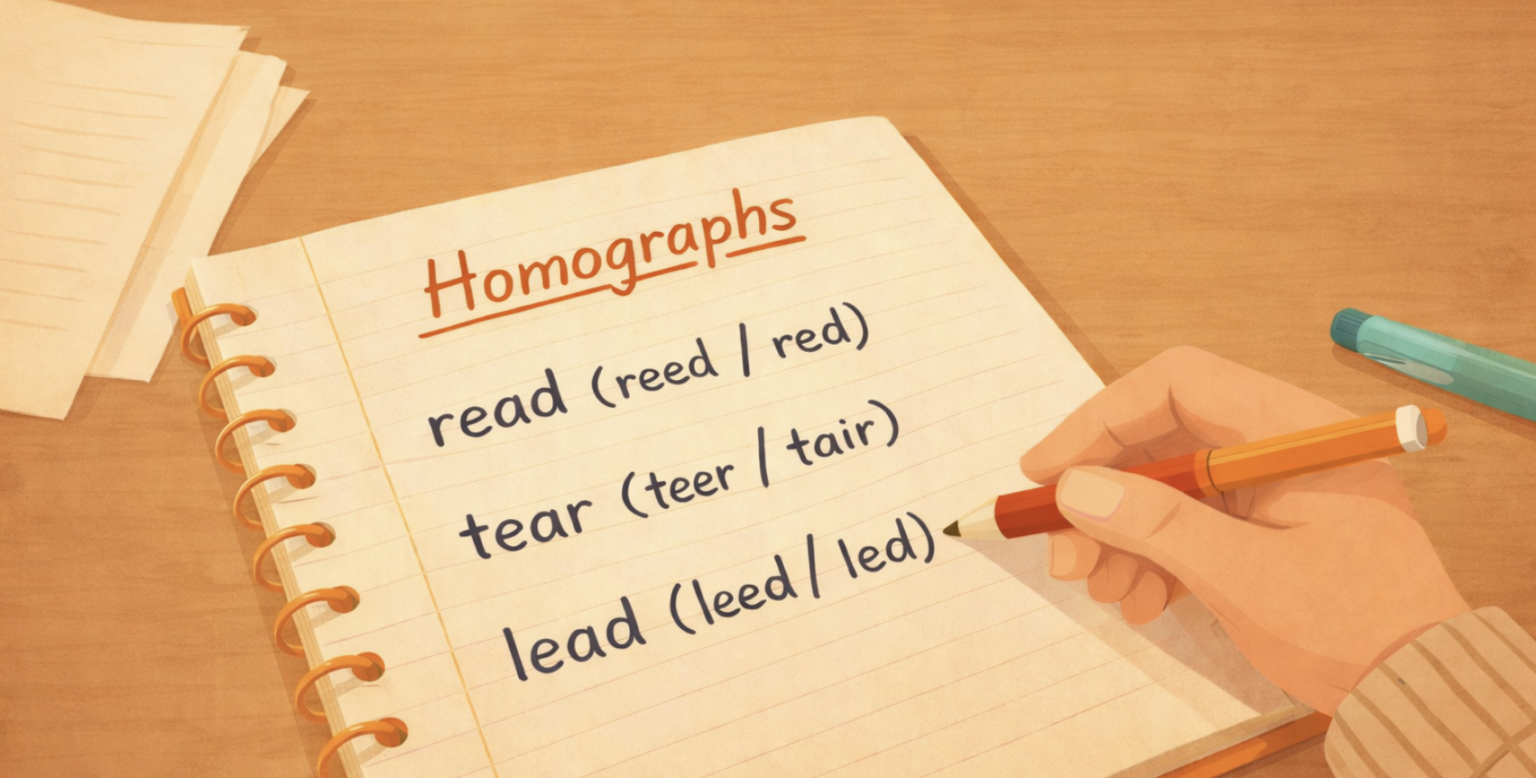
- read (reed / red)
- tear (teer / tair)
- lead (leed / led)
- wind (wind / wynd)
- record (REH-kord / reh-KORD)
- minute (MIN-it / my-NOOT)
Mini tip: if the word changes its stress (REH-kord vs reh-KORD) or flips a vowel sound (wind vs wynd), it’s especially likely to trip readers, particularly when the surrounding sentence is short or ambiguous.
For writers, that stumble matters. A reader stopping to decode a heteronym is a reader stepping out of the scene, even if only for a beat. In fast dialogue, it can break rhythm. In suspense, it can deflate tension.
Homophones and Homographs Examples: Don’t Mix Up the Mix-Ups
When people search for homophones and homographs examples, what they usually want is this: “Which confusing word problem am I dealing with right now?” Totally fair. These two get mixed up all the time, and English does nothing to help.
Here’s the clean definition:
If it sounds the same, think homophones.
their / there / they’re (same sound, different spelling, different jobs in a sentence)
flour / flower (baking ingredient vs something in a vase)
If it’s spelled the same, think homographs.
lead / lead (“I will lead the group” vs “made of lead”)
tear / tear (“Don’t tear the paper” vs “a tear rolled down”)
The Writer’s Toolkit: How to Use Homographs Without Confusing Your Reader
Homographs aren’t the enemy. They’re just the coworkers who need clear instructions. If you want clean, clear language, the goal isn’t to avoid homographs. It’s to make sure your reader never has to stop and translate.
Here’s the toolkit:
- Use context anchors. Put a clear noun or verb nearby that “locks” the meaning. If you write lead, give the reader a hint: lead the team vs lead pipes.
- Avoid stacking ambiguity. One tricky word can be fun. Three in a row is a puzzle. Don’t make your reader solve a riddle unless you’re paying them in prize money.
- Choose clarity over cleverness. Wordplay is great when it’s intentional. If it’s accidental, it reads like a typo wearing a fancy hat.
- Read it aloud (then do the cold reader test). Your brain knows what you meant. A fresh reader doesn’t. If someone pauses, rereads, or asks “Wait… which one?” you’ve found the spot.
- Use punctuation and sentence structure to steer meaning. A small restructure can eliminate the double-take.
Before (confusing): “After the storm, I couldn’t wind down because the wind was loud.”
After (clear): “After the storm, I couldn’t relax because the wind kept rattling the windows.”
Same idea, no speed bumps. Your reader stays in the scene, and your tone stays exactly where you put it.
Quick Practice: Spot the Homograph (Mini Quiz for Writers)
Alright, writer brain: quick warm-up. Read each sentence and decide what the homograph means before you peek at the answers. (No pressure… but your inner editor is definitely watching.)
- “She gave me a minute to think before answering.”
- “Please close the window, it’s freezing.”
- “He played the bass like he was trying to shake the walls.”
- “They sat in the front row and somehow still got lost.”
Answers (no cheating… okay, maybe a tiny bit):
- Minute = 60 seconds
- Close = shut
- Bass = the low sound range
- Row = a line of seats
If you got all four without hesitating, congratulations: your writing will cause fewer accidental plot twists.
Wrap-Up: Clarity Is a Style Choice
Homographs aren’t “bad” words. They’re powerful ones. When you use them on purpose, they add flexibility, rhythm, and even a little spark to your writing. The trouble only starts when they sneak in without enough context and your reader has to stop mid-sentence to play detective.Clean, clear writing isn’t boring. It’s generous. It keeps the story moving, protects your tone, and makes your reader feel confident in your voice, which is exactly what great writing is supposed to do.
FAQs – Homographs Examples
Q1: How do you identify homographs?
Look for a word that’s spelled the same in two different contexts but clearly has different meanings. A quick test is to ask: “Could this word mean something else here?”
Example: close (near) vs close (shut). If the meaning changes without the spelling changing, you’ve found a homograph.
Q2: What is a homograph sentence?
A homograph sentence is simply a sentence that includes a homograph, where the meaning depends on context.
Example: “I will lead the team.” (lead = guide)
Another example: “The pipe contains lead.” (lead = metal)
Q3: What is the difference between a homophone and a homograph?
Homophones sound the same but have different spelling and meaning (like their / there / they’re).
Homographs are spelled the same but have different meanings (like lead / lead).
Rule: if it’s about sound, it’s homophones. If it’s about spelling, it’s homographs.
Q4: What are the most confusing homophones?
Some of the most commonly confused homophones in everyday writing include:
their / there / they’re
your / you’re
to / too / two
its / it’s
then / than
affect / effect (not true homophones for everyone, but constantly mixed up)
These are especially tricky because they’re used constantly and autocorrect doesn’t always save you.
Q5: What is another word for homograph?
A close related term is homonym (but it’s broader). Homonym can refer to words that share spelling or sound, while homograph is specifically “same spelling, different meaning.” If the homograph also changes pronunciation (like record), it’s often called a heteronym.
Q6: What are some easy homographs examples to learn first?
Start with high-frequency homographs you’ll see everywhere:
close (near / shut)
lead (guide / metal)
tear (rip / crying drop)
wind (air / twist)
record (capture / best result)
They’re common, useful, and perfect for training your “context radar” as a writer.