

Every writer hits this question at some point, usually with a deadline sitting a few hours away. A syllabus says 1000 words. A submission guideline says four pages. A word processor says something different than both. None of these numbers agree with each other, and the gap between them is where a lot of last minute panic lives.
The good news is that the math behind it is simple once you separate the word count from the formatting choices sitting on top of it.
The Quick Answer
1000 words is 2 pages single spaced or 4 pages double spaced, using the standard setup: Times New Roman, 12 point font, 1 inch margins.
That standard comes from a simple ratio:
- Double spaced: about 250 words per page
- Single spaced: about 500 words per page
Change the font, the size, or the margins, and both numbers shift. The ratio holds for the format most schools, publishers, and professional documents default to. Everything past this point is what happens when you move away from that default.
Words to Pages, at a Glance
| Word Count | Single Spaced Pages | Double Spaced Pages |
|---|---|---|
| 500 | 1 | 2 |
| 1,000 | 2 | 4 |
| 1,500 | 3 | 6 |
| 2,000 | 4 | 8 |
| 2,500 | 5 | 10 |
| 5,000 | 10 | 20 |
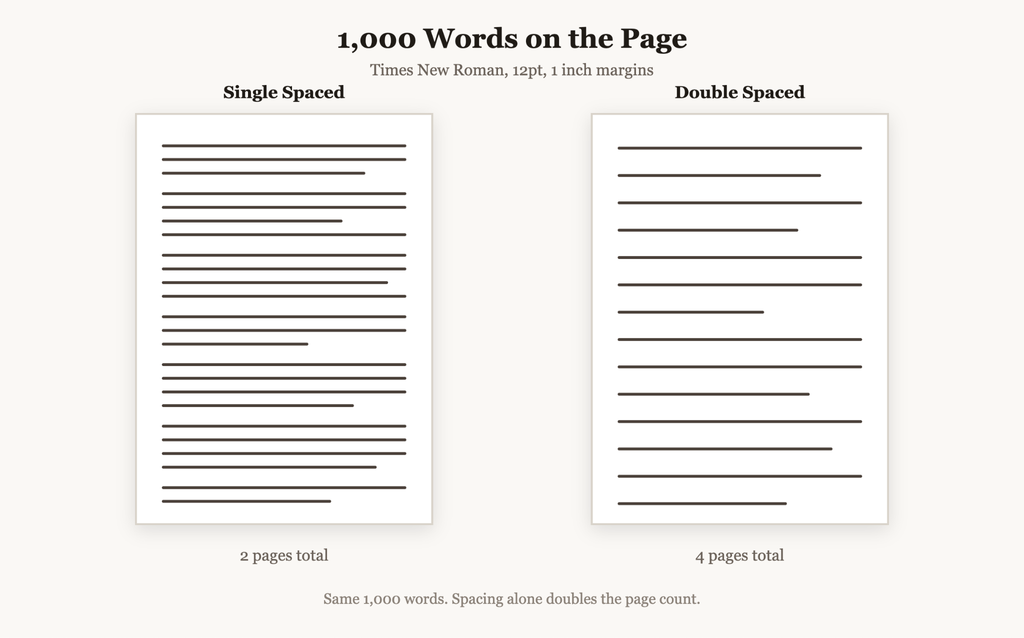
The visual above shows what 1000 words actually occupies on the page at each spacing setting. It is the fastest way to see why the same word count can look like two very different assignments.
How Long Is 1000 Words?
Length shows up in more than page count. At an average reading speed of 200 to 250 words per minute, 1000 words takes about 4 to 5 minutes to read. Writing it takes considerably longer. 1000 words is a manageable sitting. Writing a full-length book is a different kind of commitment entirely, with its own pacing and timeline to plan around. A first draft at a comfortable pace runs 30 to 60 minutes, and that number climbs fast once research, editing, or a topic you’re not confident in enters the picture.
In terms of structure, 1000 words typically breaks down to:
- 5 to 7 paragraphs at a standard length
- 50 to 70 sentences, depending on sentence complexity
- 2 pages single spaced, 4 pages double spaced
That’s the full picture of “how long” 1000 words is: short enough to read on a coffee break, long enough to need a real structure once you sit down to write it.
How Much Is 1000 Words?
“How much” usually means one of two things: how much content that actually is, or how much space it fills. On the content side, 1000 words is roughly the length of a long blog post, a short op-ed, or a college essay assignment. It’s enough room to make one argument well, with supporting examples, but not enough to cover a topic from every angle. Most writers find that 1000 words forces a choice: go deep on one idea, or skim the surface of three.
On the page side, the answer is the same one from above: 2 pages single spaced, 4 pages double spaced, using standard formatting.
What Changes Your Page Count
The word count stays fixed. Everything else is a variable.
Font type and size. Times New Roman at 12 point is the academic default. Arial at the same size runs slightly shorter because the letterforms are narrower. Courier New is monospaced, meaning every character takes up identical width, and it reliably produces the longest page count of the three. Move from 12 point to 11 point and the document shrinks. Move up to 14 point and it grows, sometimes by a full page. These same variables, font, spacing, and margins, are the first things to get right when you’re formatting your manuscript for submission, whether that’s to an agent, a contest, or a print run.
Line spacing. This is the single biggest lever. Single spaced text runs about 500 words per page. Double spaced text runs about 250, which is why the same content nearly doubles in page count. Double spacing exists for a practical reason: it gives an editor or professor room to write comments between the lines.
Margins. A standard page uses 1 inch margins on all sides. Widen them to 1.5 inches and the page count grows. Narrow them to 0.75 inches and it shrinks. This is a common way documents get padded or tightened without touching the actual content. None of this applies once you’re formatting for print. A book’s physical trim size resets the whole equation, since page count there depends on the book’s dimensions, not a standard 8.5 by 11 sheet.
Paragraph breaks and formatting. Frequent paragraph breaks, bullet points, and subheadings all add visual space that a plain block of text wouldn’t use. A blog post formatted for skimmability will run shorter on the page than an academic paper with the same word count, because it’s built for scanning rather than continuous reading.
Two Formats, Same Word Count
Academic essay: Times New Roman, 12 point, double spaced, 1 inch margins. Result: 4 pages. This is the default for coursework and formal writing, and the spacing is there for annotation, not readability.
Blog post: Arial, 11 or 12 point, single spaced, broken up with headings. Result: about 2 pages. Built to be read on a screen in short bursts, not printed and marked up.
Same 1000 words. Different container. The formatting is doing as much work as the writing itself in determining how long the piece looks.
How Software Counts Pages
Microsoft Word calculates page breaks from your exact font, spacing, and margin settings, and its Print Layout view will match what comes out of a printer. Google Docs runs the same math but occasionally displays it a little differently across browsers or devices, since it renders in a web environment rather than a fixed print engine. Export either one to PDF and small shifts can appear again: fonts substitute, spacing rounds differently, and a 4 page Word document can come out as 5 pages in PDF, or compress to 3.
None of these differences change your word count. They only change how that word count is laid out. If a page count matters for a submission, check the actual formatting requirements rather than trusting whatever number your software happens to display.
Getting the Page Count You Need
If a page requirement is fixed and your draft doesn’t match it, the honest fixes are formatting choices already covered above: adjust spacing, use a standard 12 point font, keep margins at 1 inch. Before adjusting margins or font size to hit a target, it’s worth running the draft through a self-editing checklist first. Most page count problems turn out to be content problems. What doesn’t work, and what an editor or professor will notice immediately, is stretching margins past standard, inflating font size, or adding empty paragraph breaks to pad length. Page count is a byproduct of what you’ve written. Treat it as one.
The most reliable way to hit a page target is still to write to the right word count first, using the ratios above, and let the formatting follow naturally.
FAQ: How Many Pages is 1000 Words?
Q: How many pages is 1000 words in MLA format?
MLA format uses double spaced text, 12 point Times New Roman, and 1 inch margins, the same defaults used in the standard word to page ratio. So 1000 words in MLA comes out to about 4 pages. The only extra length MLA adds is the works cited page, which is separate and isn’t counted as part of your 1000 word total.
Q: What do 500 words look like on a page?
500 words fills close to one full single spaced page or two double spaced pages, using standard 12 point font and 1 inch margins. That’s roughly half of a typical 1000 word blog post or essay, enough space for a tight introduction, a couple of supporting paragraphs, and a short conclusion, without much room to spare.
Q: Is 1000 words enough for a book?
1000 words is not enough for a full length book. Most published novels run between 70,000 and 100,000 words. For context, a typical chapter’s word count runs 2,000 to 5,000 words, so 1000 words sits closer to a chapter opener than a chapter in full. Nonfiction and children’s books and some picture books land well under 1000 words total, so the right length depends on the format.
Q: How many pages is 1000 words on college ruled paper?
Handwritten on college ruled paper, 1000 words typically fills 4 to 5 pages, depending on handwriting size and how tightly the lines are filled. Wider handwriting or larger letters push that closer to 6 pages. This is noticeably more than the 2 to 4 pages a typed version takes, since handwriting is naturally less space efficient than a typed font.
Q: How long does it take an author to write 1000 words?
Most authors can draft 1000 words in 30 to 90 minutes once they know what they’re writing, though the range shifts with genre, research needs, and how many revisions happen along the way. The right length for your genre varies widely, so a 1000 word count only tells part of the story until you know what you’re writing toward. Fiction writers working from an outline often move faster than nonfiction writers verifying facts or citations.
Q: How many pages is 1000 words in Google Docs?
In Google Docs, 1000 words comes out to roughly 2 pages single spaced or 4 pages double spaced, matching the same ratio used in Microsoft Word. Google Docs calculates page breaks based on your chosen font, size, and margins, so the count can shift slightly if you’re using a nonstandard font or adjusted margins instead of the default settings.
Q: Is 1000 words a lot for a paper?
1000 words is considered a short to medium length paper, not a long one. It’s enough to develop one clear argument with supporting evidence, but not enough to cover a topic exhaustively. For context, most high school essays run 500 to 1000 words, while college papers often start at 1000 words and go up from there.