

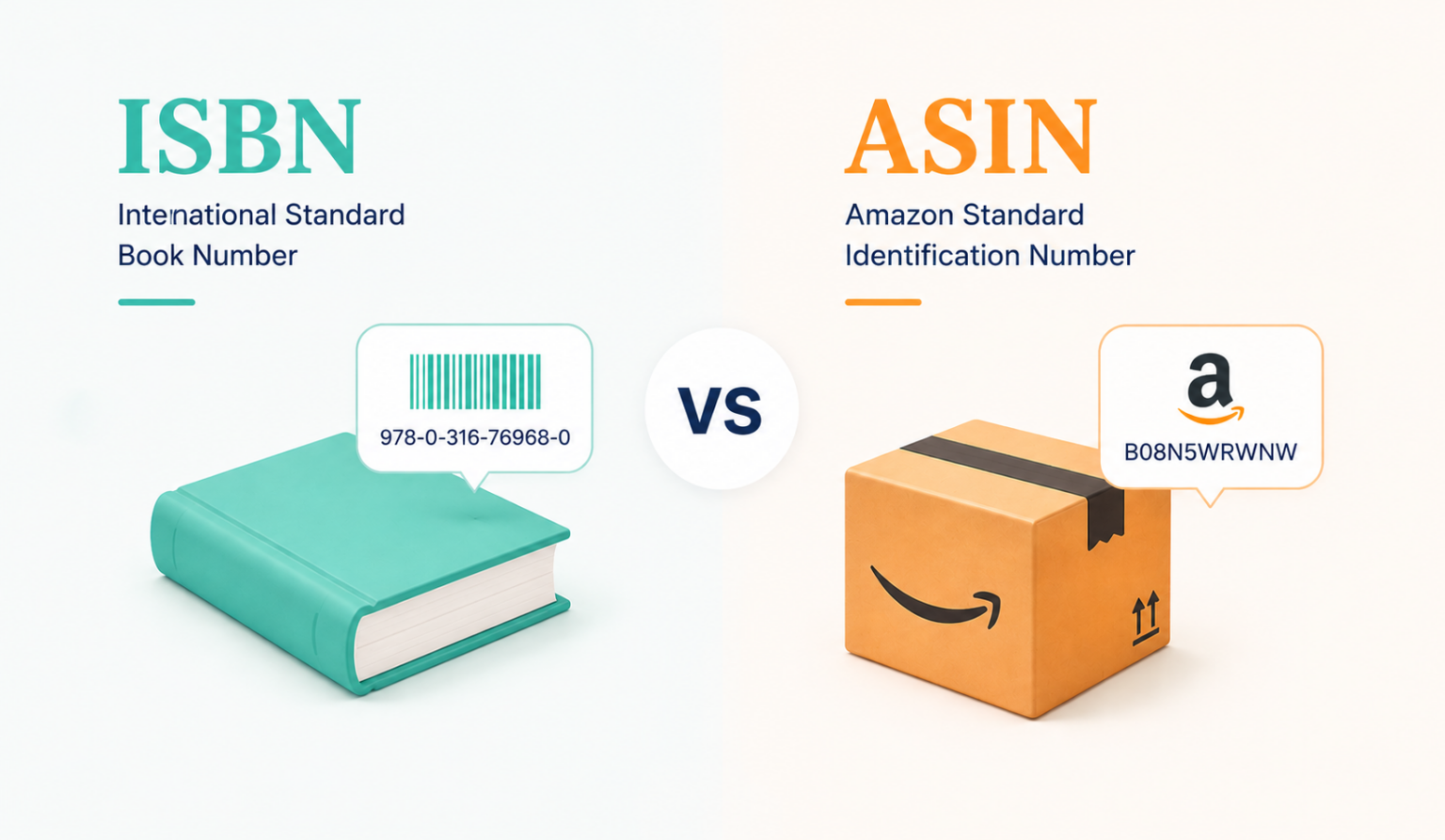
An ISBN and an ASIN solve two different problems, and most authors only discover the difference after their book is already live. An ISBN identifies your book everywhere it’s sold: in bookstores, libraries, and distributor catalogs around the world. An ASIN identifies your book only inside Amazon, and Amazon assigns it automatically the moment your title enters its catalog. You can have one without the other, and knowing which your book actually needs is the difference between a smooth launch and a listing that never quite gets found.
At Spines, this is one of the most common questions we get from authors the day before they upload to KDP. Below is the direct answer, the case for each identifier on its own, and when your book needs both.
Quick Answer: ISBN vs ASIN
An ISBN is a 13-digit number that identifies one specific edition of a book everywhere it’s sold; print, ebook, and audiobook editions each need their own. An ASIN is a 10-character code Amazon assigns automatically to every product in its catalog, including books, and it doesn’t function outside Amazon. If you’re publishing an ebook exclusively through Kindle Direct Publishing, you don’t need an ISBN at all; Amazon assigns an ASIN whether or not one exists. If you’re publishing a paperback, hardcover, or distributing beyond Amazon, you need an ISBN, and Amazon will typically generate a matching ASIN once your book is listed.
What Is an ISBN?
An ISBN is a 13-digit number that identifies one specific edition of a book, and no two editions ever share the same one. Your hardcover, paperback, and ebook each get a separate ISBN, even though they’re the “same” book to a reader. It’s issued by a publisher (or purchased by a self-published author) before the book goes to print, and it’s what libraries, bookstores, and distributors use to order, shelve, and track the title, regardless of who’s selling it or where.
Spines assigns an ISBN to every book we publish, registered with Spines as the publisher of record, which is what makes a title eligible for bookstore and library distribution beyond Amazon. Without one, a book effectively doesn’t exist outside whichever single platform listed it.
What Is an ASIN?
An ASIN is a 10-character code Amazon assigns to every product in its marketplace, including books, and it only functions within Amazon’s own systems. You won’t find it on a library shelf or a distributor order form; it exists purely to let Amazon track inventory, search, and reviews for that specific listing.
If a book already has an ISBN, Amazon typically uses it to generate a matching ASIN when the listing is created, which is why the two numbers often sit side by side on a product page. But plenty of books, especially Kindle-only ebooks, have an ASIN and no ISBN at all, because Amazon doesn’t require one to create the listing.
Do You Need an ISBN to Sell on Amazon?
No. Amazon’s Kindle Direct Publishing program doesn’t require an ISBN for ebooks; an ASIN is assigned automatically the moment your file goes live, whether or not you own an ISBN. Print editions through KDP work a little differently. Amazon will assign a free ISBN to your paperback or hardcover if you don’t provide your own, but that ISBN lists Amazon as the publisher of record and can’t be moved to another printer or retailer later. The ISBN requirements for self-published authors get more specific once you’re distributing outside KDP, since some retailers and library systems have their own registration expectations.
That distinction matters more than most guides mention: if there’s any chance you’ll want your paperback in a bookstore, a library catalog, or on a non-Amazon retailer’s site down the line, you need your own ISBN from the start, not the one KDP offers by default. Publishing directly through KDP comes with its own tradeoffs beyond the free ISBN, worth weighing before you commit your book to Amazon’s system alone. Switching later means a new ISBN and a new listing, not a transfer of the old one.
Can You Convert an ISBN to an ASIN?
No, and there’s no reliable tool that converts one to the other in either direction. An ASIN is generated inside Amazon’s own system; it isn’t calculated from an ISBN, even on books that carry both. When a book already has an ISBN, Amazon uses it to create a matching ASIN at listing time, which is why they often appear together. But books listed without an ISBN, most Kindle ebooks among them, have no ISBN to convert to; the ASIN is the only identifier that exists.
If you have a book’s ASIN and need to find its ISBN, check the product details section of the Amazon listing itself rather than searching for a converter. Most print editions display both numbers there.
ISBN vs ASIN: The Key Differences
- An ISBN identifies a specific edition of a book across every retailer, library, and distributor worldwide. An ASIN identifies a single product listing, and only within Amazon.
- A book keeps its ISBN for its lifetime. Its ASIN can change if a listing is removed and recreated, or if a different seller lists the same book separately.
- ISBNs are assigned by a publisher before a book is printed. ASINs are generated by Amazon automatically the moment a product enters its catalog.
- A single book can carry several ISBNs, one per edition, but only ever needs one ASIN per Amazon listing.
What About UPCs and EANs?
A UPC or EAN identifies a product across retail channels outside the book trade, and neither one typically applies to books themselves. UPCs are standard in North American retail, EANs serve the same role internationally, and both show up far more often on author merchandise (totes, journals, branded mugs) than on the books themselves. Books use ISBNs for identification instead, though a UPC can be generated from an existing ISBN if a retail channel specifically requires a UPC barcode rather than a standard ISBN barcode. Accurate book metadata, not just your ISBN or ASIN, is what actually determines whether readers find your title in search and retailer listings.
Choosing the Right Identifier for Your Book
Most authors need an ISBN. If your book will ever be sold anywhere besides an Amazon Kindle listing, in a bookstore, through a library system, or on another retailer’s site, get one before you publish, not after. Your ASIN takes care of itself once the book is listed. The tradeoffs between exclusive and wide distribution usually decide this for you: staying Amazon-only makes the ASIN sufficient, while going wide makes the ISBN mandatory.
Once you’ve secured your own ISBN, where the barcode needs to sit on your cover becomes the next practical decision before you send the file to print. Spines assigns an ISBN as part of publishing your book and handles the Amazon listing details that come with it, so you’re not troubleshooting a mismatched ASIN or a locked-in KDP ISBN after launch.
FAQ: ISBN vs ASIN
Q: How much does an ISBN cost?
A single ISBN typically costs around $125 when purchased directly from Bowker, the U.S. ISBN agency, though the price drops if you buy in bulk (10 for roughly $295). Some self-publishing platforms include an ISBN as part of a publishing package, which is often more cost-effective than buying one on your own. This price covers registration only, not printing or design, so budget for it separately from your book’s production costs.
Q: Is it better to buy your own ISBN instead of using Amazon’s free one?
Yes, in most cases. Amazon’s free ISBN for KDP print editions lists Amazon as the publisher of record, which limits your book to Amazon’s own distribution and can’t be transferred later if you want to sell through bookstores, libraries, or other retailers. Buying your own ISBN costs more upfront but keeps you listed as publisher and keeps wider distribution open. If you’re staying Amazon-exclusive, the free option works fine.
Q: Why do ISBNs start with 978?
Most ISBNs start with 978 because that prefix identifies the code as belonging to the book industry within the EAN/UPC barcode system used for retail products worldwide. The 978 prefix was assigned to books when ISBNs were adapted into scannable barcodes in the 1970s. A second prefix, 979, was introduced later once the pool of available 978 numbers began running low, so both are valid for books today.
Q: Should I use ISBN-10 or ISBN-13?
Use ISBN-13. It’s been the global standard since 2007, and every new ISBN issued today is 13 digits. ISBN-10 still shows up on older books and in some legacy databases, so you may see it referenced, but you can’t purchase a new 10-digit ISBN anymore. If a system specifically asks for ISBN-10, it can usually be converted from your ISBN-13 with a simple prefix calculation, not a separate number.
Q: Can two books have the same ISBN?
No, two different books should never share the same ISBN, since the entire purpose of the system is making each edition uniquely identifiable. A duplicate you spot is almost always a data entry error, a reused ISBN from an out-of-print title, or a mistake by whoever assigned it. Each format of your book, hardcover, paperback, and ebook, needs its own distinct ISBN, even though the title and content are identical.
Q: What happens if my book doesn’t have an ISBN at all?
Without an ISBN, your book can still be listed and sold, but only within whichever single platform assigned it an identifier, like Amazon’s ASIN system for KDP. It won’t be discoverable through bookstore ordering systems, library catalogs, or most distributors, since all of those rely on ISBNs to track and shelve titles. For authors staying Amazon-exclusive this isn’t a problem, but it becomes a real limitation the moment you want wider distribution.
Q: How do I find my book’s ASIN number?
The fastest way is to check your book’s product page on Amazon. The ASIN appears in the product details section, usually alongside the ISBN if one exists, and it’s also visible in the page URL right after “/dp/”. If you’re the publisher, it’s listed in your KDP dashboard under the title’s details too, so there’s no separate lookup tool required.