
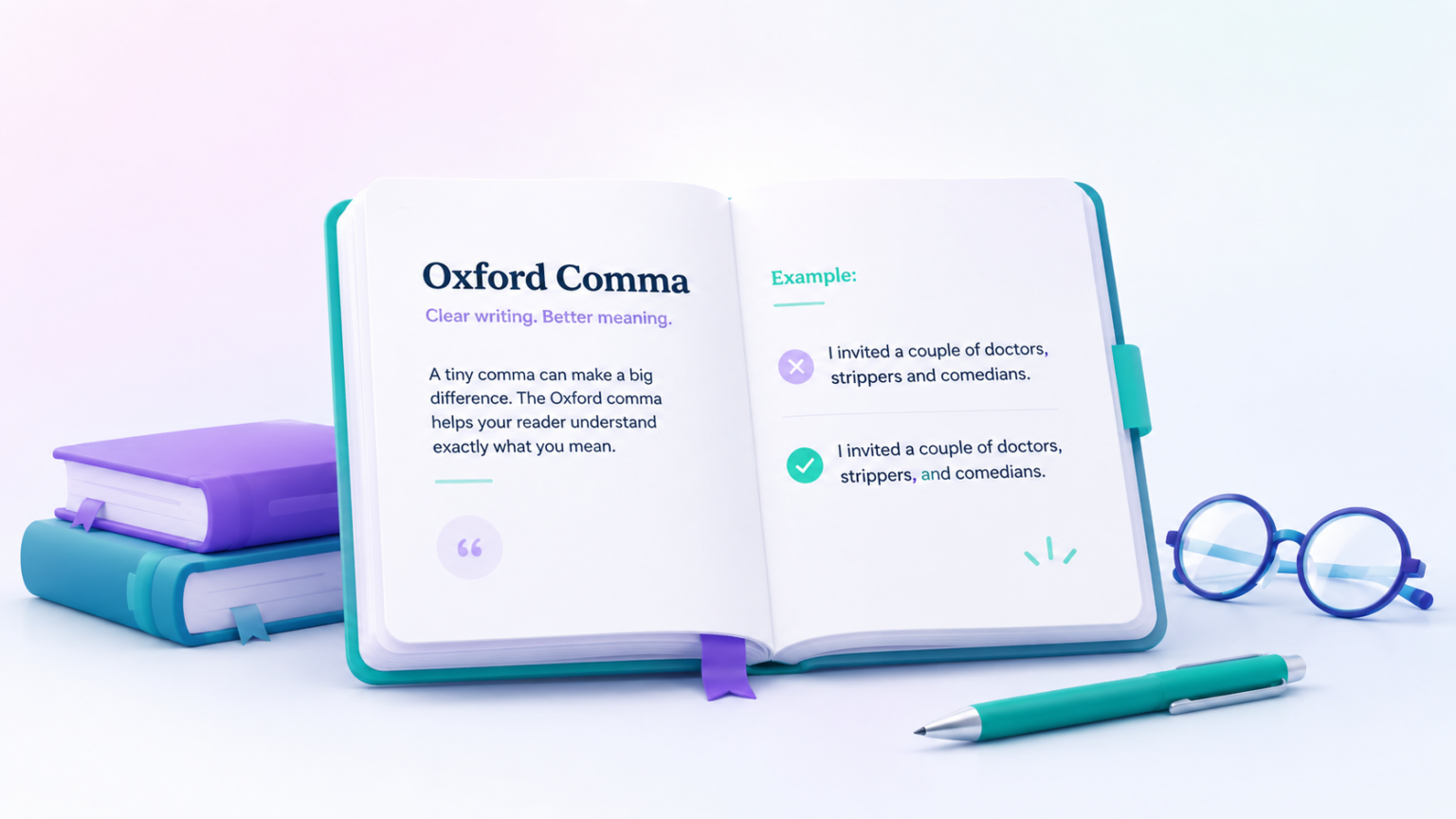
Ever tried to plan a dinner party and accidentally make your guest list sound a little more scandalous than intended? A sentence like: I invited a couple of doctors, strippers and comedians, can create the wrong picture fast. Add one tiny comma, and suddenly the meaning is much clearer: I invited a couple of doctors, strippers, and comedians.
That is the power of the Oxford comma.
Small as it is, this punctuation mark can save your sentence from confusion, accidental comedy, and the occasional awkward misunderstanding. In this guide, we’ll walk through clear and funny Oxford comma examples, explain when to use it, and show why this simple comma can turn a muddled sentence into a masterpiece.
What Is the Oxford Comma?
The Oxford comma, also called the serial comma, is the comma placed before the final conjunction, usually “and” or “or,” in a list of three or more items.
For example:
I bought apples, bananas, and cherries.
In this sentence, the Oxford comma appears before “and.” It may look small, but it can make a big difference in how clearly your sentence is understood.
So, why does the Oxford comma matter? One word: clarity.
Without it, a sentence can become confusing or unintentionally funny. Take this classic example:
I dedicate this book to my parents, Oprah Winfrey and God.
Without the Oxford comma, the sentence can sound like Oprah Winfrey and God are your parents. Add the comma, and the meaning becomes clear:
I dedicate this book to my parents, Oprah Winfrey, and God.
Examples of why the Oxford comma is important often come down to this exact issue: separating items clearly so the reader knows what belongs together and what does not.
That tiny comma helps prevent awkward mix-ups, especially in lists where the final items could be read as one combined idea. Reviewing examples where the Oxford comma is needed can make your writing cleaner, clearer, and much harder to misread.
When to Use the Oxford Comma: Clarity is Key
The Oxford comma is absolutely necessary when listing three or more items to avoid confusion. While it may seem optional in casual writing, in professional or formal contexts, it can make all the difference in ensuring your message is clear. If you’re listing more than two items, that final comma before the conjunction is your friend, helping to keep things neat and tidy.
Examples of when to use an oxford comma can be found all around us. Imagine you’re writing an invitation: “We’re celebrating with cake, music and dancing.” Without the Oxford comma, it’s easy to misread as though “music and dancing” are one combined item, rather than separate activities. Add that Oxford comma, and you get: “We’re celebrating with cake, music, and dancing,” which leaves no room for ambiguity.
Now, let’s look at examples where oxford comma is needed in more complex situations. Take this sentence: “I’d like to thank my parents, Barack Obama and Beyoncé.” Without the Oxford comma, it suggests that Barack Obama and Beyoncé are your parents. But when you include the Oxford comma, “I’d like to thank my parents, Barack Obama, and Beyoncé”, the meaning becomes clear. It’s not about your parents, but about who you’re thanking.
Using the Oxford comma consistently in such cases keeps your writing crisp and easily understood, ensuring that readers won’t get lost in a sea of unclear lists.
Funny Oxford Comma Examples: Why It’s the Comma That Keeps on Giving
The Oxford comma is the punctuation mark that just keeps on giving, especially when it comes to creating hilarious and often awkward situations. In fact, it’s practically the stand-up comedian of the punctuation world. Imagine this: “We invited the strippers, JFK and Stalin.” Without the Oxford comma, it sounds like JFK and Stalin were, quite literally, the strippers! Now, throw in that trusty comma, “We invited the strippers, JFK, and Stalin”, and suddenly the world makes sense again.
Here’s another funny Oxford comma example to chew on: “I love my parents, Prince and Elton John.” Without the comma, it sounds like Prince and Elton John are your parents. Now, we’re not saying that’s impossible (imagine the Thanksgiving dinners!), but it’s probably not what you intended. Add the Oxford comma, “I love my parents, Prince, and Elton John”, and the sentence is back on track.
But wait, there’s more! Consider this list: “I’d like to thank my teachers, my therapist and my dog.” Without the Oxford comma, it sounds like your therapist is your dog. Ouch. With the Oxford comma, “I’d like to thank my teachers, my therapist, and my dog”, it’s much clearer. No confusion, just appreciation.
The Oxford comma might seem like a small thing, but it has a major impact, especially when it’s tasked with saving us from these funny oxford comma examples where hilarity could easily ensue. So, embrace the comma, it’s not just practical, it’s also pretty entertaining!
The Oxford Comma Debate: Love It or Leave It?
Ah, the Oxford comma: beloved by some, loathed by others. It’s the punctuation equivalent of pineapple on pizza: people either swear by it or avoid it like the plague. The ongoing debate about whether to use it rages on, with grammar purists firmly in the “yes” camp, and a significant portion of the writing world arguing that it’s unnecessary. But while both sides have valid points, let’s take a look at why the Oxford comma does have its merits.
Examples of oxford comma users will tell you it’s an essential tool for clarity, especially in professional or formal writing. It keeps your lists tidy and your meanings crystal clear. When you need to communicate with precision, especially in legal, academic, or business contexts, this little comma is your best friend. Take this sentence: “We invited the CEO, a lawyer and a writer.” Without the Oxford comma, it could imply that the lawyer and writer are actually the same person. Add the Oxford comma, “We invited the CEO, a lawyer, and a writer”, and now it’s crystal clear.
But what happens when you don’t use the Oxford comma? Examples where oxford comma is needed often show that omitting it can lead to confusion or misinterpretation. In the case of “We bought eggs, milk and bread,” it’s fine, no ambiguity there. But in more complex lists, that comma is a game-changer. For some, the benefits of avoiding confusion far outweigh the minimal effort of adding one extra comma. So, love it or leave it, the Oxford comma will always have a place in precise writing.
How the Oxford Comma Can Elevate Your Writing
The Oxford comma may seem like a small detail, but its impact on clarity is immense. By adding that extra comma before the conjunction in lists, you prevent confusion and create sentences that are easier to follow. When writing with precision matters, whether in professional, academic, or even creative contexts, the Oxford comma is your secret weapon. It’s the punctuation equivalent of a well-timed pause in a conversation, giving your reader a moment to digest the information clearly and without distraction.
Take, for example, examples of oxford comma in action. Imagine writing a formal report or a speech: “We met with the mayor, the governor and the senator.” Without the Oxford comma, the reader might briefly wonder whether the governor and senator are part of a combined group. Adding the Oxford comma, “We met with the mayor, the governor, and the senator”, removes any doubt and sharpens the message.
In the end, embracing the Oxford comma isn’t just about following grammar rules; it’s about elevating your writing. It helps ensure your message is understood, while also giving you an extra layer of control over how your words are interpreted. So, next time you’re drafting a list, consider adding the Oxford comma: it could be the key to clearer, more effective communication, with a sprinkle of humor!
Comma-tastic Clarity
The Oxford comma may be small, but it does a lot of heavy lifting. It keeps lists clear, prevents awkward misunderstandings, and helps readers understand exactly what you mean.
As the Oxford comma examples in this guide show, one simple punctuation mark can change the entire meaning of a sentence. That matters whether you’re writing a professional report, polishing an essay, editing a book, or putting together a casual blog post.
Next time you write a list, pause before the final “and” or “or.” Adding the Oxford comma could make your sentence cleaner, smoother, and much easier to read. A little punctuation really can go a long way
FAQ: Oxford Comma Examples
Q: Which countries use the Oxford comma?
The Oxford comma is commonly used in countries like the UK, especially in academic, legal, and formal writing. It’s called the “Oxford” comma because of its association with Oxford University Press, which advocates its use. While it’s less common in general American usage, it’s still preferred in professional writing, especially in academia, law, and publishing.
Q: Is it grammatically correct to not use the Oxford comma?
Yes, it is grammatically correct to omit the Oxford comma, but it may lead to ambiguity or confusion in some cases. Whether to use it often depends on the style guide or personal preference. In informal writing or journalism, it’s commonly omitted, but for clarity in formal writing, many experts recommend using it.
Q: What is the opposite of an Oxford comma?
The opposite of an Oxford comma is simply leaving out the comma before the conjunction in a list of three or more items. For example, without the Oxford comma, you would write: I bought apples, bananas and cherries. This is often called the serial comma omission, which can occasionally lead to confusion or ambiguity in more complex lists.
Q: What is the difference between the Oxford comma and the Harvard comma?
The Oxford comma and Harvard comma are essentially the same thing; both refer to the comma used before the conjunction in a list of three or more items. The term Harvard comma is used primarily in American English, while Oxford comma is more commonly used in the UK. They refer to the same punctuation mark and serve the same purpose.