

Commas have a funny reputation. They’re tiny, fussy, and somehow responsible for starting more arguments between writers than plot holes, Oxford commas, and whether “said” is dead combined. But there’s one place where commas quietly wield real, sentence-saving power: right between those rowdy adjective pairs we call coordinate adjectives.
If you’ve ever written a “long winding road” or a “bright cheerful morning” and wondered whether a comma should squeeze between them like a chaperone at a middle-school dance, you’re not alone. Adjectives travel in packs, and sometimes they behave, each describing the noun separately and equally. Other times they cling together like inseparable siblings who refuse to be split up. Knowing the difference matters more than most writers think.
Mastering coordinate adjectives isn’t just about grammar for grammar’s sake. It’s about clarity, rhythm, and writing that sounds confident instead of chaotic. Use these tiny marks correctly, and suddenly your prose feels polished, intentional, and wonderfully easy to read. Tiny commas, giant impact.
Coordinate Adjectives, Explained Like You’re in on the Joke
Coordinate adjectives are the rare moments in grammar where two adjectives stand shoulder-to-shoulder, equally qualified to describe the same noun. Think of them as co-captains of the sentence: no jealousy, no hierarchy, just pure descriptive teamwork. When this happens, they politely request one tiny thing from you: a comma. Or, if you prefer, a quick “and” test to make sure they really deserve it.
For example, if you write a bright, cheerful morning, both bright and cheerful independently describe the morning. Swap them — a cheerful, bright morning — and nothing breaks. Add “and,” and it still makes sense: a bright and cheerful morning. That’s the giveaway. These are coordinate adjectives living their best grammatical life.
But if you try the same trick with three wooden chairs, you’ll see the magic fade immediately. Wooden three chairs? Absolutely not. That’s because those adjectives aren’t coordinate, they’re cumulative, and they march in a fixed order.
Once you spot the difference, the commas practically place themselves.
The “And Test”: Your Secret Weapon for Spotting Coordinate Adjectives
If coordinate adjectives had a superhero cape, it would be the “and test.” This simple trick swoops in to save you from comma confusion, adjective anxiety, and the occasional sentence meltdown. Here’s how it works: if you can insert the word and between two adjectives without making the sentence sound like a malfunctioning robot, you’ve probably found coordinate adjectives.
Try it with this phrase: a grumpy, brilliant detective.
Swap it: a brilliant, grumpy detective. Still smooth.
Add “and”: a grumpy and brilliant detective. No problem.
Conclusion: coordinate adjectives, ready for their comma.
Now let’s experiment with a phrase that fails the test spectacularly: a sleek sports car.
Swap it: a sports sleek car. Immediate chaos.
Add “and”: a sleek and sports car. Even more chaos.
Conclusion: not coordinate and definitely not comma-worthy.
The swap test works the same way. If changing the order of the adjectives sounds natural, you’ve got coordinate adjectives. If the sentence starts sounding like you built it out of spare parts, step away from the comma.
The beauty of these tests is that they’re quick, intuitive, and nearly impossible to forget. Your prose and your readers will thank you.
When Not to Use a Comma: Meet the Cumulative Adjectives
If coordinate adjectives are the easygoing pair who don’t mind switching seats, cumulative adjectives are the strict conga line of the grammar world. They march in a very particular order, they don’t swap places, and they definitely don’t want a comma cutting in. These adjectives stack together to modify a noun as a single, unified idea, no equal billing, no democratic voting.
Take three wooden chairs.
Try swapping: wooden three chairs. Disaster.
Try adding and: three and wooden chairs. Worse.
These adjectives aren’t trying to describe the noun separately. Instead, they’re layering meaning: three chairs → wooden chairs → the actual object in your scene. One depends on the next.
Or try a small country cottage.
Swap it: a country small cottage. No.
Add “and”: a small and country cottage. Also no.
The adjectives work cumulatively, like a recipe: add “small,” then “country,” then “cottage.” You take them in order or the dish collapses.
Cumulative adjectives don’t tolerate commas because they don’t act independently. They cling together to form a single, inseparable description, a bit like those friends who insist on sharing one chair at a party.
Once you spot this conga line, your commas know exactly where not to go.
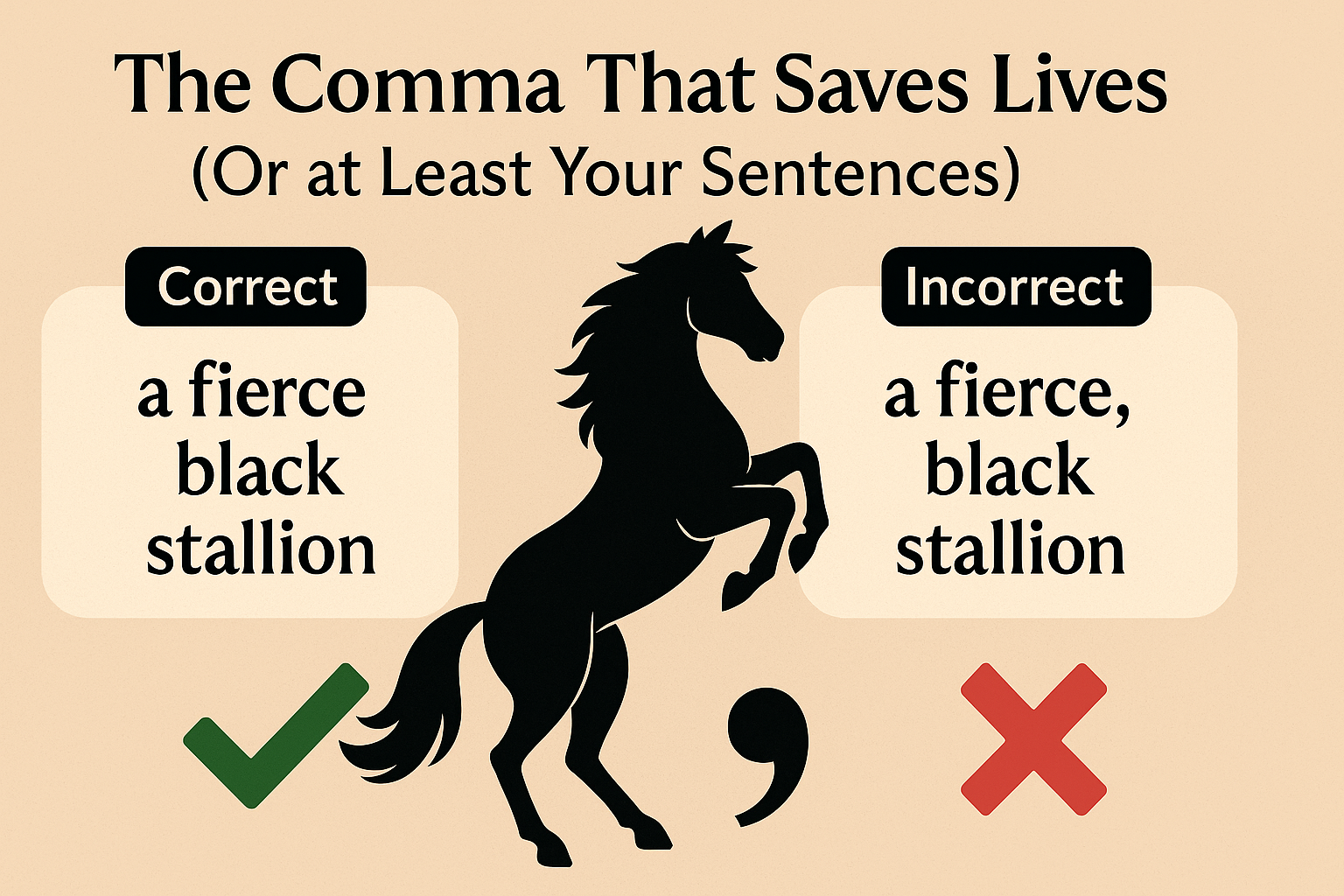
The Comma That Saves Lives (Or at Least Your Sentences)
Commas may be tiny, but misuse one and suddenly your sentence takes on a personality it never signed up for. Place a comma where it doesn’t belong, and the meaning can shift from charming to confusing, or unintentionally hilarious.
Consider this perfectly normal phrase: a charming, eccentric uncle.
He’s delightful. He collects antique radios. He probably wears suspenders.
Now remove the comma: a charming eccentric uncle.
Without that separation, he’s not charming and eccentric; he’s a single, unified brand of eccentricity. Less lovable character, more cautionary tale.
Or flip it and add a comma where you shouldn’t:
Correct: a fierce black stallion.
Incorrect: a fierce, black stallion.
The second version makes it sound like you’re equally describing “fierce” and “black,” instead of the cumulative idea of a particular type of stallion. It shifts tone from dramatic horseback moment to oddly color-focused commentary.
A well-placed comma sharpens meaning, improves rhythm, and keeps your descriptions from veering into accidental comedy. Treat commas with care, and your sentences stay alive, elegant, and blissfully unambiguous.
Creative Writing Glow-Up: Using Coordinate Adjectives to Improve Voice
Coordinate adjectives aren’t just grammar trivia, they’re a secret styling tool for writers who want their prose to feel intentional, musical, and vividly cinematic. When used thoughtfully, they add rhythm and texture to a sentence, giving your descriptions a satisfying little snap instead of a cluttered thud.
Think of them as seasoning. A warm, glowing lantern sounds lyrical and inviting, because each adjective contributes its own distinct flavor. Swap them and you still get a beautiful image. Add “and,” and the flow stays intact. That’s the sign of adjectives working in harmony.
Where writers get into trouble is when they pile adjectives like a Thanksgiving turkey loaded with every herb in the pantry. That’s not voice, that’s chaos. Strategic use of coordinate adjectives, on the other hand, helps you slow down and choose the descriptors that matter most.
Want lush worldbuilding? Clear character cues? Emotional shading? A few well-placed coordinate adjectives can elevate all of it. Use them sparingly, use them smartly, and your storytelling voice will feel sharper, calmer, and infinitely more confident.
Common Mistakes Writers Make (And How to Never Make Them Again)
Even the most seasoned writers occasionally wage war with commas and adjectives. Here are the biggest traps and the easy fixes that keep your sentences crisp instead of chaotic:
1. Overusing commas like confetti
Mistake: Adding commas between adjectives that aren’t coordinate at all.
Example: a fluffy, white, dog bed (Only one comma belongs here, if any.)
Fix: Use the “and” test. If and makes the phrase sound weird, skip the comma.
2. Underusing commas where they’re begging to be included
Mistake: Jamming coordinate adjectives together and hoping no one notices.
Example: a long gloomy hallway.
Fix: If you can swap them and the meaning stays the same, add the comma: a long, gloomy hallway.
3. Confusing cumulative adjectives with coordinate ones
Mistake: Treating every adjective like it deserves equal billing.
Fix: Remember the conga line rule: cumulative adjectives stay in order with no commas.
4. Creating clunky, adjective-stuffed descriptions
Mistake: Using every adjective in the English language at once.
Fix: Pick the two that actually matter. Your prose and your reader will breathe easier.
Quick Diagnostic Checklist for Confident Comma Decisions
Before you panic over another pair of adjectives, run your sentence through this quick, no-nonsense checklist. It works for coordinate adjectives, cumulative adjectives, and everything in between:
Can you add “and” between the adjectives without sounding awkward?
If yes, you’ve got coordinate adjectives, add the comma.Can you swap the adjectives without breaking the flow?
If yes, they’re coordinate. If not, keep them glued together.Do the adjectives build on each other in a fixed order?
That’s the cumulative crew. No commas allowed.Is one adjective describing the overall category while the other adds detail?
Skip the comma, it’s cumulative.Does the sentence still sound intentional and clean?
If it feels clunky or overstuffed, trim the adjectives before worrying about punctuation.
Use this checklist, and your commas stay confident, consistent, and wonderfully drama-free.
Conclusion – Your Commas, Your Voice, Your Power
Mastering coordinate adjectives won’t magically win you a literary award, but it will make your writing clearer, smoother, and far more confident, and that’s a pretty powerful return on a tiny punctuation investment. Once you understand when adjectives work as equals and when they march in order, your sentences suddenly snap into place with satisfying precision.So take these tests, tricks, and conga-line rules into your next chapter. Read your work out loud, spot where a comma adds clarity, and let your voice guide the rhythm. Your sentences and your readers will feel the difference.
FAQ: Coordinate Adjectives
Q1: What are coordinate adjectives in English grammar?
Coordinate adjectives are two or more adjectives that modify the same noun equally. You can usually swap their order or put and between them without changing the meaning (for example, a bright, cheerful room → a cheerful, bright room). When that happens, you typically separate them with a comma.
Q2: How do I know if adjectives are coordinate or not?
Use the two classic tests: the “and” test and the swap test. If you can add and between the adjectives (a long and boring speech) and swap them without it sounding odd (a boring, long speech), they’re coordinate adjectives and need a comma. If either test fails, they’re probably cumulative adjectives and should stay comma-free.
Q3: Do coordinate adjectives always need a comma?
Almost always, yes. If the adjectives are coordinate, standard grammar calls for a comma between them. That said, in very stylized or minimalist writing, some authors bend the rule, but you should know the rule well before you decide to break it.
Q4: What is the difference between coordinate adjectives and cumulative adjectives?
Coordinate adjectives describe the noun independently and equally, like co-leads in a movie: a lazy, sarcastic roommate. Cumulative adjectives build on each other in a fixed order to form one idea, like three old wooden chairs. Coordinate adjectives take commas; cumulative adjectives usually don’t.
Q5: Can coordinate adjectives be used in creative writing without sounding clunky?
Definitely; in fact, they can make your descriptions smoother and more musical. The key is to use only the adjectives that truly earn their place. A phrase like a quiet, persistent doubt feels intentional, while a quiet, small, nagging, persistent doubt starts to sound like you’re stalling instead of storytelling.
Q6: Are coordinate adjectives the same as a list of adjectives?
Not exactly. A random list of adjectives might just be overcrowded description. Coordinate adjectives are a specific type of pairing (or trio) where each adjective has equal weight and passes the “and”/swap tests. If the adjectives don’t behave like equals, they’re not coordinate, and they don’t get that comma.