

A participial phrase example can show you how one small grammar tool can make a sentence feel more vivid, polished, and alive. Instead of adding another full sentence, a participial phrase lets you describe an action, detail, or condition in a smoother way.
For example, in the sentence:
Running late for class, Maya grabbed her backpack and rushed out the door.
The phrase Running late for class tells us more about Maya and what is happening. That is the power of a participial phrase: it adds useful detail without making the sentence feel heavy.
In this guide, we’ll explain what a participial phrase is, show clear examples of participial phrases, and break down how to use them correctly. You’ll also learn how to avoid common mistakes, like dangling participles, so your writing stays clear, natural, and easy to read.
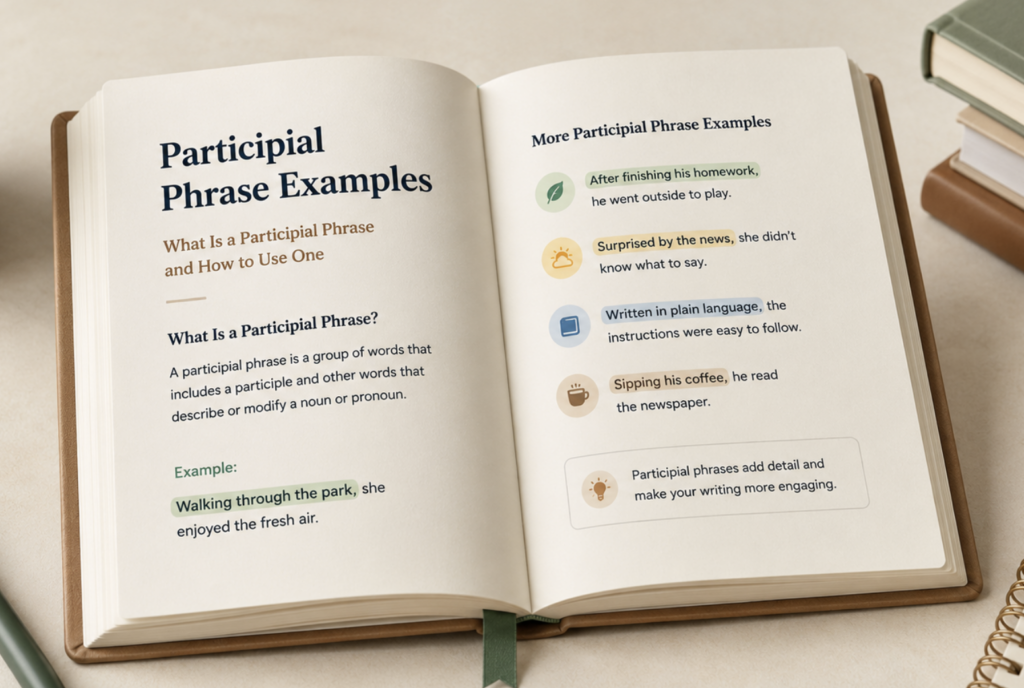
What Is a Participial?
A participial phrase is a group of words built around a participle. A participle is a verb form that works like an adjective, usually ending in -ing for present participles or -ed, -en, -t, or another irregular form for past participles.
In simple terms, a participial phrase describes a noun or pronoun. Instead of writing the cat, you could write the cat snoozing on the windowsill. The phrase snoozing on the windowsill tells us more about the cat and makes the sentence more specific.
Here is a clear participial phrase example:
Exhausted from the hike, Sarah collapsed on the couch.
In this sentence, Exhausted from the hike is the participial phrase. It describes Sarah and explains why she collapsed on the couch. The phrase adds detail without needing a second sentence.
Another example of a participial phrase is:
Carrying a stack of books, Leo hurried into the classroom.
Here, Carrying a stack of books describes Leo. It gives the reader a quick visual and makes the action feel more complete.
Participial phrases are useful because they improve a sentence, making writing more vivid, concise, and natural. Used well, they help sentences flow smoothly while adding description, movement, and context.
Start Your Publishing Journey FOR FREEWhat Is an Example of a Participial Phrase?
A simple participial phrase example is:
Covered in chocolate, the toddler looked suspiciously innocent.
In this sentence, Covered in chocolate is the participial phrase. The participle is covered, and the words in chocolate add more detail. Together, the phrase describes the toddler and helps readers picture the scene immediately.
Here are a few more examples:
- Sitting by the window, the dog barked at every passing car.
- Broken by the storm, the old fence leaned into the garden.
- Smiling at the crowd, the singer stepped onto the stage.
In each example, the participial phrase gives extra information about the noun or pronoun that follows. It helps readers picture the action more clearly without adding a separate sentence. A participial phrase is more than a single word; it’s a mini spotlight that adds drama, humor, or detail to your sentences.
How to Use Participial Phrases Like a Pro
Now that you know the magic and the mischief participial phrases can bring, let’s talk strategy. The secret to using them like a pro is balance. Too many and your prose reads like it’s overdressed for a costume party. Too few and your sentences can feel flat. The goal? Just enough to keep your writing vivid without tripping over itself.
Placement matters. Most participial phrases work best at the beginning or end of a sentence, but sprinkling them in the middle can add rhythm, just make sure they’re hugging the noun they actually describe.
Clarity first. If there’s any chance your phrase could confuse, rewrite.
Here’s a quick checklist to keep handy:
- Is it vivid? (Does it add color or detail?)
- Is it clear? (No accidental comedy?)
- Is it non-dangling? (Firmly attached to its subject?)
Follow those rules and every participial phrase example you write will feel purposeful, polished, and punchy. It’s like giving your sentences a stylist who knows when to add a scarf and when to step away from the sequins.
Why Should You Use Participial Phrases in Writing?
Participial phrases make your writing clearer, smoother, and more vivid. Instead of adding extra clauses or repeating the same sentence structure, you can use a participial phrase to give readers more detail in fewer words.
Compare these two sentences:
She was tired because she had stayed up all night, and she walked slowly down the hall.
Now with a participial phrase:
Tired from staying up all night, she trudged down the hall.
The second sentence is shorter and more visual. The phrase Tired from staying up all night is a clear participial phrase example because it describes she and gives the reader context before the main action.
Here’s another example:
He ate his sandwich and looked out the window.
With a participial phrase:
Eating his sandwich, he stared out the window.
The revised version feels more natural because the participial phrase adds movement and rhythm. Used well, participial phrases help writers create stronger descriptions, avoid wordiness, and make sentences feel less repetitive.
Common Mistakes with Participial Phrases
Participial phrases are useful, but they need to modify the right noun or pronoun. The most common mistake is a dangling participial phrase, also called a dangling modifier. This happens when the phrase does not clearly connect to the subject of the sentence.
Incorrect: Running down the street, the backpack bounced wildly.
This sentence sounds like the backpack is running down the street. The participial phrase Running down the street needs to describe a person, not the backpack.
Correct: Running down the street, Sarah clutched her backpack as it bounced wildly.
Now the phrase clearly describes Sarah.
Another common problem is unclear placement:
Incorrect: Covered in sprinkles, the kids devoured the cupcakes.
This makes it sound like the kids were covered in sprinkles.
Correct: The kids devoured the cupcakes, which were covered in sprinkles.
A simple rule helps: place the participial phrase as close as possible to the noun or pronoun it describes. If the sentence accidentally makes an object perform a human action, or creates a strange image, rewrite it for clarity.
Try It Yourself: Quick Writing Prompts with Participial Phrases
Enough theory; time to play. The best way to master participial phrases is to try them out yourself. Think of this as grammar karaoke: you already know the tune, now just add your own lyrics.
Here are three quick prompts. Your job? Craft a sentence using a participial phrase. Funny, serious, dramatic; it’s all fair game.
- Prompt: A dog at the park.
→ Add a participial phrase to show what the dog is doing. - Prompt: Someone in a coffee shop.
→ Describe them with a phrase that sets the scene. - Prompt: A superhero about to leap into action.
→ Give the moment punch with a vivid phrase.
Once you start spotting and creating these phrases, you’ll realize they’re everywhere. And once you see them, you’ll never unsee them; participial phrases will pop out of novels, headlines, and even your own texts. That’s when you’ll know you’ve leveled up from reader to writer.
FAQ: Participial Phrase Example
Q: What is a participial phrase example in a simple sentence?
A simple participial phrase example is: Running late, he skipped breakfast. In this sentence, running late is the participial phrase. It describes he and explains why he skipped breakfast.
Q: How do I know if I’m using a participial phrase correctly?
A participial phrase is correct when it clearly describes the right noun or pronoun. It should usually sit close to the word it modifies. If the sentence makes it sound like the wrong person or thing is doing the action, the phrase may be dangling.
Q: Can participial phrases be used at the beginning, middle, or end of a sentence?
Yes. Participial phrases can appear in different parts of a sentence:
Covered in glitter, the child walked in.
The child, covered in glitter, walked in.
The child walked in, covered in glitter.
All three are correct. The best placement depends on rhythm and emphasis.
Q: What is the difference between a participial phrase example and a gerund phrase example?
A participial phrase works like an adjective and describes a noun or pronoun. For example: Running down the hall, she tripped. A gerund phrase works like a noun. For example: Running down the hall is exhausting. They may look similar, but they do different jobs in a sentence.
Q: Why should I learn from more than one participial phrase example?
Looking at several participial phrase examples helps you understand how flexible they are. You can use them in casual writing, academic writing, storytelling, and professional content to add detail, improve flow, and make sentences more vivid.