Romance books are my guilty please, so I have read a lot of them! There is nothing quite like getting so completely lost in a love story that the real world goes quiet for a few hours. The right romance book can dissolve a bad week within a couple of chapters.
This guide is organised by section so you can go straight to what you are looking for: the most-loved books in the genre right now, a curated set of picks that go beyond the bestseller lists, and a breakdown by subgenre from dark romance and romantasy to slow burn, contemporary, YA, and the classics that have lasted because they understood something true about longing. If you are writing your own, the guide to self-publishing a romance novel is worth bookmarking, too.
Start Your Publishing Journey FOR FREEMost Loved Romance Books
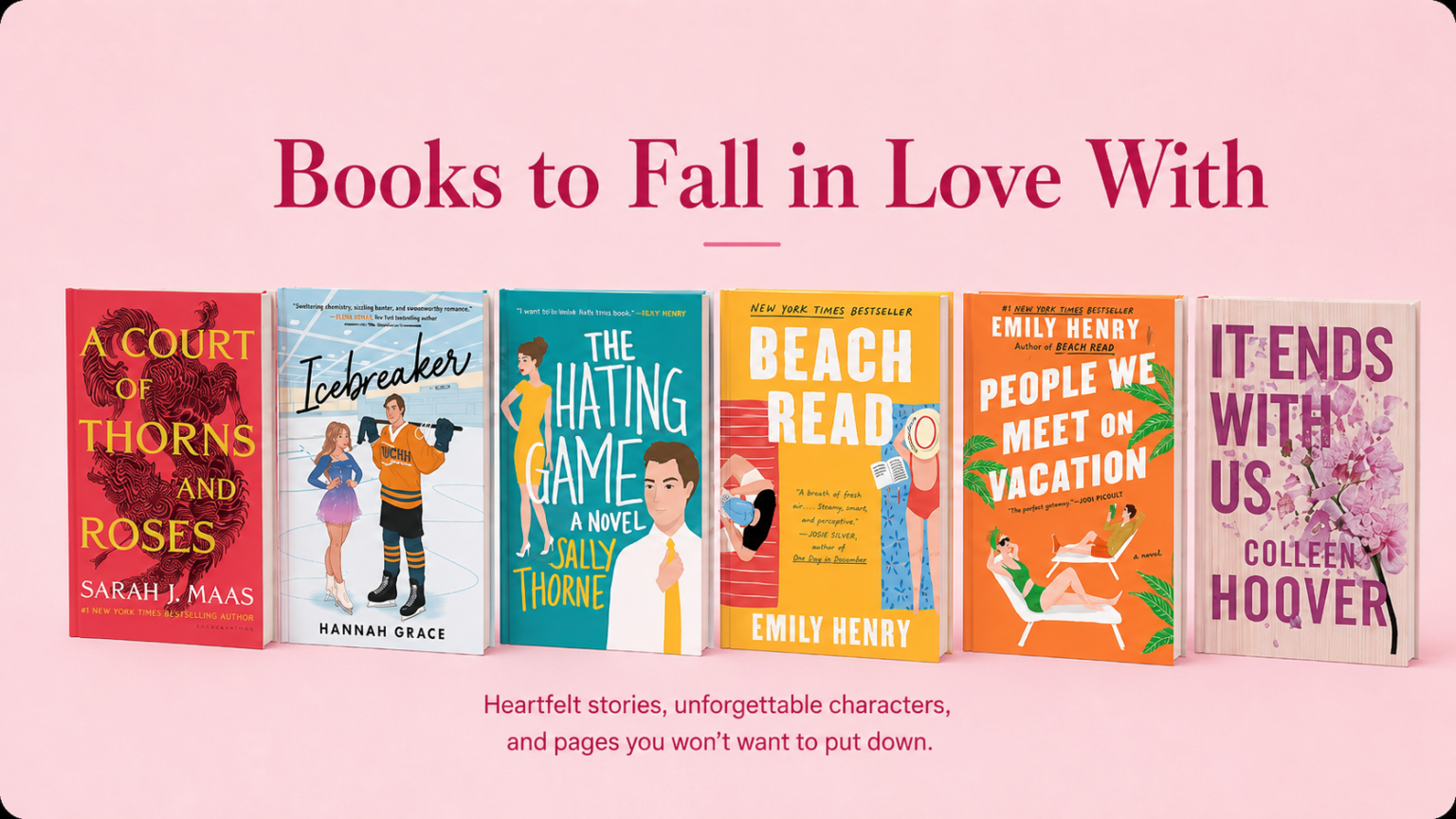
These are the titles readers keep coming back to, the ones dominating BookTok and dominating conversations. If you want to know what the romance genre feels like in 2026, start here.
It Ends with Us by Colleen Hoover
Trope: contemporary romance, emotional drama
The book that turned a generation of readers into Collee n Hoover converts, and for good reason. It follows Lily Bloom navigating love, loyalty, and the painful gap between what we believe about the people we love and what we eventually have to see clearly. This is not a comfortable read. It is a book about the specific courage it takes to leave, and Hoover writes that with more honesty than most romance authors are willing to risk. Over 3 million copies sold. Bring tissues.
Beach Read by Emily Henry
Trope: enemies-to-lovers, slow burn, romantic comedy
Two writers, neighbouring beach houses, and a summer bet to swap genres. Beach Read is sharp, funny, and genuinely moving in a way that sneaks up on you. Emily Henry understands that romantic chemistry lives in conversation, in what two people argue about and what they cannot bring themselves to say. The banter earns the feeling. A perfect entry point into Emily Henry’s work if you have not read her yet.
People We Meet on Vacation by Emily Henry
Trope: friends-to-lovers, slow burn
Two best friends, one summer trip a year, and ten years of something neither of them has named. Henry builds the tension through memory and the accumulating weight of almost, and the payoff lands because the reader has felt every year of waiting alongside the characters. Consistently ranked as one of the best slow burn romance novels published in the last decade.
The Hating Game by Sally Thorne
Trope: enemies-to-lovers, slow burn, romantic comedy
Lucy and Joshua share an office, a deep mutual irritation, and eventually something neither expected. Thorne writes romantic tension with real wit, and the workplace setup creates the kind of forced proximity that enemies-to-lovers readers live for. If you want something fun, fast, and emotionally satisfying without being heavy, this is the book.
Icebreaker by Hannah Grace
Trope: sports romance, forced proximity
A figure skater and a hockey player forced to share ice time. The tension is immediate, the chemistry is undeniable, and both of them resist it for exactly as long as readers want them to. One of the most-read sports romance novels on BookTok, and a reliable choice if you want heat alongside genuine emotional investment.
A Court of Thorns and Roses by Sarah J. Maas
Trope: romantasy, Beauty and the Beast retelling, enemies-to-lovers
The book that launched romantasy as a mainstream reading phenomenon. Feyre is taken to a dangerous faerie realm after killing a wolf in the woods. What follows is part Beauty and the Beast retelling, part high-fantasy romance, and entirely consuming. The series has sold tens of millions of copies across more than 55 countries. Whether or not it is your usual taste, it belongs on this list because it shaped what an entire generation of romance readers is now looking for.
Best Romance Books by Subgenre & Mood: Choose Your Subgenre
The romance genre contains some of the best subgenres! Use the table below to find the section that matches what you are looking for.
| If you want… | Your subgenre | Jump to |
| The most-read books right now | Popular romance | Most-Loved Romance Books |
| Heat, danger, and moral complexity | Dark romance | Best Dark Romance Books |
| Magic, worldbuilding, and high stakes | Fantasy romance | Best Fantasy Romance Books |
| Romance and fantasy in equal measure | Romantasy | Best Romantasy Books |
| Modern love and emotional realism | Contemporary romance | Best Contemporary Romance Books |
| A slow, satisfying emotional build | Slow burn romance | Best Slow Burn Romance Books |
| First love and coming-of-age feeling | YA romance | Best YA Romance Books |
| Timeless longing and elegant prose | Classic romance | Best Romance Books of All Time |
| Curated picks beyond the bestseller lists | Literary romance | Editor’s Picks |
Best Dark Romance Books
If you have never read dark romance before, this is the subgenre that will either completely consume you or confirm it is not for you. There is no middle ground. The love stories here involve power, obsession, moral ambiguity, and characters who do not behave well and are not sorry about it. Readers who love this genre describe it as the most addictive corner of romance fiction. Consider yourself warned.
Haunting Adeline by H.D. Carlton
Trope: dark romance, cat and mouse, obsession.
A writer. A stalker. A love story that has no business working and somehow does. Haunting Adeline is transgressive, deliberately uncomfortable, and one of the best-selling dark romance novels ever written. It does not ask you to feel safe. It asks you to feel everything, and it delivers on that promise from the first chapter.
Corrupt by Penelope Douglas
Trope: dark romance, enemies-to-lovers, second chance.
Set in an elite world of old secrets and older grudges, Corrupt follows Erika and Michael across years and a history that was never fully resolved. Douglas understands something most writers miss: that resentment and desire can occupy exactly the same space in a person, and that tension is what makes this book so hard to put down.
Best Fantasy Romance Books
Fantasy romance takes the emotional stakes of a love story and raises them to impossible heights. When magic, prophecy, and political power are involved, the question is never just whether two people end up together. It is what they are willing to destroy to get there.
The Bridge Kingdom series by Danielle L. Jensen
Trope: enemies-to-lovers, spy romance, political intrigue.
Lara is sent to spy on the king she has just married. What unfolds is one of the most intelligent enemies-to-lovers stories in fantasy romance, built on genuine betrayal, political intrigue, and the specific anguish of falling for someone you were sent to destroy. Jensen writes romantic tension with real craft and does not rush the payoff.
From Blood and Ash by Jennifer L. Armentrout
Trope: forbidden love, fantasy romance, slow burn.
One of the most-read fantasy romance series of recent years, and the sales figures back that up. Poppy has lived her entire life under strict rules she never chose. Hawke is the guard assigned to protect her. Immersive worldbuilding, genuine emotional intensity, and a romance that earns every page of its slow build.
Best Romantasy Books
Romantasy has become the defining reading trend of the mid-2020s, and if you have not tried it yet, this is where to start. These are books where the magic system and the love story are equally essential. Remove either one and the whole thing collapses. That is what separates romantasy from fantasy with a romantic subplot.
A Court of Mist and Fury by Sarah J. Maas
Trope: romantasy, second chance, emotional recovery.
The book that launched romantasy as a mainstream reading phenomenon. The second book in the ACOTAR series and, for most readers, the one that makes the series feel unmissable. Feyre is rebuilding herself after trauma. Rhysand is the High Lord of the Night Court. What develops between them is one of the most discussed romantic relationships in contemporary fantasy, written with genuine emotional intelligence about recovery, power, and what it actually means to choose someone freely rather than out of obligation.
The Cruel Prince by Holly Black
Trope: romantasy, enemies-to-lovers, faerie politics.
Jude is mortal in a faerie world that despises her. Prince Cardan is everything she has been told to distrust. Black writes faerie politics with a sharp, cold elegance, and the romance has the friction of two people who genuinely threaten each other. If enemies-to-lovers tension is what you are here for, this is one of the best executions of that trope in the genre.
Best Contemporary Romance Books
Contemporary romance is the genre at its most human. Real jobs, real insecurities, real miscommunication, and the specific difficulty of choosing to be vulnerable when life has already given you reasons not to be. The best contemporary romance makes love feel like something that requires actual courage, not just chemistry.
The Spanish Love Deception by Elena Armas
Trope: fake dating, slow burn, enemies-to-lovers.
Catalina needs a date for her sister’s wedding in Spain. Her colleague Aaron, who she has spent considerable energy pretending to dislike, volunteers. What follows is a slow-burn fake-dating romance with genuine emotional depth underneath the comedy. Armas writes longing beautifully, the kind that survives being buried under years of denial.
Part of Your World by Abby Jimenez
Trope: contemporary romance, opposites attract, forced apart.
An ER doctor and a small-town handyman who both know from the beginning that their lives do not fit together. Jimenez is one of the strongest writers in contemporary romance because she builds obstacles that are genuinely difficult, not manufactured for plot convenience. This book earns its resolution in a way that makes the ending feel like relief rather than reward.
Best Slow Burn Romance Books
Slow burn readers are a specific kind of person. They do not want the kiss in chapter three. They want the almost-kiss, the loaded glance, the conversation that goes slightly too long, the moment where both characters know and neither says anything. If that sentence made you nod, these are your books.
Attachments by Rainbow Rowell
Trope: slow burn, epistolary romance, workplace romance.
Lincoln is an IT worker whose job requires him to read flagged company emails. Beth and Jennifer are the colleagues he keeps reading about. He falls in love with someone he has never met, through words alone. Rowell writes longing with such quiet precision that by the time anything actually happens, the reader has been waiting for it for a hundred pages and the payoff feels completely earned.
The Kiss Quotient by Helen Hoang
Trope: slow burn, contemporary romance, hired relationship.
Stella is an econometrician who decides to hire an escort to help her understand romantic relationships. What develops between her and Michael is genuinely moving, written with warmth and honesty about neurodivergence, desire, and the quiet difficulty of believing you are worth loving. One of the most emotionally satisfying slow burns in recent romance fiction, and one of the most original premises in the genre.
Best YA Romance Books
YA romance captures something adult romance frequently loses: the feeling that love is the most important thing that has ever happened to you, that everything is at stake, that being rational about someone you care about is completely impossible. The best YA romance does not talk down to its readers. It remembers exactly what first love actually felt like.
The Summer I Turned Pretty by Jenny Han
Trope: love triangle, slow burn, coming of age
Belly has spent every summer of her life at the beach house with her family and the two Fisher brothers, Conrad and Jeremiah. She has loved Conrad for as long as she can remember. Han writes the particular ache of summer love with unusual precision, the way a single season can feel like an entire lifetime when you are sixteen and everything is happening for the first time. The Netflix adaptation introduced a new generation of readers to the series, but the books go deeper, quieter, and hit harder than the show has room to show.
The Sun Is Also a Star by Nicola Yoon
Trope: one day romance, opposites attract, coming of age.
Natasha does not believe in love. Daniel believes in almost everything. They have one day in New York, and Natasha is about to be deported. Yoon writes love stories that move fast because the circumstances demand it, and the speed concentrates the feeling rather than cheapening it. A book that makes a convincing case for love in under 24 hours.
Best Romance Books of All Time
These are the love stories that outlasted the moment they were written in. They are still being read, still being recommended, still being pressed into the hands of people who have not yet read them, because they understood something permanent about longing, pride, and the terror of admitting to another person that you need them.
Pride and Prejudice by Jane Austen
Trope: enemies-to-lovers, slow burn, classic romance.
Elizabeth Bennet and Mr Darcy remain one of the most studied romantic relationships in literary history because Austen understood that real chemistry lives in intellectual friction. These are two people who challenge each other before they choose each other, and over 200 years later, almost every enemies-to-lovers romance written since owes something to what she built here.
The Notebook by Nicholas Sparks
Trope: second chance romance, classic romance, epic love.
A love story built on memory, devotion, and the question of what remains when everything else has been stripped away. Sparks writes with sentiment that does not tip into sentimentality in this one, and the emotional weight of the ending has stayed with readers for decades. A book that asks something of you and earns the right to ask it.
Editor’s Picks: 9 Romance Books Worth Reading Beyond the Bestseller Lists
These are my personal favourites. I love them because they made me think. Not just about the characters, but about desire, about what we hide from the people we want, about the quiet violence of loving someone you cannot keep. I hope you enjoy!
1. Open Water by Caleb Azumah Nelson
Best for: readers who want love as tenderness, attention, music, and being truly seen.
A short, lyrical modern love story about two young Black artists in London. It is romantic, but it is also about masculinity, vulnerability, racism, art, and the fear of being known too deeply. Nelson writes intimacy like a rhythm, full of pauses, glances, songs, photographs, and the fragile relief of being understood.
Why it stays with you:
Because this book understands that love is not only desire. Sometimes love is attention. Sometimes it is witnessing someone clearly enough that they feel real to themselves. It is a book for readers who want romance to feel quiet, physical, political, and deeply human. Nelson writes intimacy like a rhythm, about the fear of being known. Readers who want to understand character motivation in literary fiction will find this illuminating.
Reader mood: lyrical, intimate, tender, aching.
2. Alone With You in the Ether by Olivie Blake
Best for: readers who want obsessive intimacy, mental chaos, and a love story between two restless minds.
This is romance as collision. Strange, talky, vulnerable, and cerebral, it feels less like two people falling in love and more like two private universes recognizing each other. The book is intense, imperfect, and emotionally overloaded in a way that works because the characters themselves feel almost too full to contain.
Why it stays with you:
Because it captures the rare feeling of being recognized by someone whose mind moves at the same dangerous speed as yours. It is not a clean, polished love story. It is obsessive, intimate, unstable, and alive with the fear that being truly understood might also mean being undone.
Reader mood: cerebral, obsessive, strange, intimate.
3. Giovanni’s Room by James Baldwin
Best for: readers who want devastating prose, queer longing, shame, desire, and emotional ruin.
Baldwin writes love as something both saving and unbearable. This is not comforting romance. It is a book about what happens when desire meets fear, denial, and the cost of not becoming yourself. Set in Paris, it follows a man caught between the life he is expected to want and the love he cannot safely admit to himself.
Why it stays with you:
Because Baldwin makes emotional cowardice feel tragic rather than simple. The book is short, but it opens a wound that does not close quickly. It is one of the clearest novels ever written about longing, shame, and the destruction that comes from refusing the truth of your own heart.
Reader mood: devastating, elegant, intimate, haunted.
4. Swimming in the Dark by Tomasz Jędrowski
Best for: readers who want first love, secrecy, politics, and quiet heartbreak.
A tender, restrained queer love story set in communist Poland. The beauty is in how controlled it feels, like every sentence is holding back something it cannot safely say. The romance unfolds under political pressure, personal fear, and the painful knowledge that love alone may not be enough to protect two people from the world around them.
Why it stays with you:
Because it understands the ache of a love that has to hide before it has even had the chance to become ordinary. The book is soft, melancholy, and quietly devastating. It is for readers who want romance shaped by history, silence, and the private grief of what could not be lived openly.
Reader mood: restrained, melancholy, tender, bruised.
5. The Safekeep by Yael van der Wouden
Best for: readers who want sensuality, repression, memory, and desire unfolding inside a house full of secrets.
A sharp, literary novel where romance is tied to history, possession, silence, and the things families refuse to name. It is intimate and tense, with desire emerging through discomfort, suspicion, domestic space, and buried memory. The house itself feels charged, as if every room knows something the characters are not ready to face.
Why it stays with you:
Because the romance does not arrive as decoration. It breaks something open. This is a book about desire, inheritance, historical guilt, and the emotional violence of what gets hidden in families, homes, and national memory. It is sensual, intelligent, and deeply unsettling.
Reader mood: sensual, tense, literary, secretive.
6. In Memoriam by Alice Winn
Best for: readers who want love, war, youth, fear, and tenderness under impossible pressure.
A devastating World War I love story between two young men. It has the ache of romance, the dread of history, and the feeling that love is trying to bloom somewhere it should not survive. The book captures youth with painful clarity: the arrogance, innocence, terror, and tenderness of boys sent into a world that is already destroying them.
Why it stays with you:
Because love here feels almost unbearable against the scale of war. Every moment of tenderness is shadowed by the possibility of loss. It is a book for readers who want romance with historical weight, emotional violence, and the terrible beauty of people finding each other when everything around them is collapsing.
Reader mood: tragic, tender, brutal, unforgettable.
7. These Violent Delights by Micah Nemerever
Best for: readers who want obsession, intellect, danger, and beautiful toxicity.
Dark, feverish, and morally unstable in the best literary way. This is not a healthy-love story. It is about two lonely, brilliant people turning each other into a private religion. Their connection becomes a dangerous alliance, intellectual and emotional in ways that make the intimacy feel thrilling precisely because it should frighten you.
Why it stays with you:Because the book understands how loneliness can distort love into worship, possession, and violence. It is seductive and disturbing, full of beauty and rot. For readers who want romance to feel morally complicated, obsessive, and psychologically sharp, this is one of the strongest picks.
Reader mood: dark, feverish, intellectual, dangerous.
8. Lie With Me by Philippe Besson
Best for: readers who want memory, class, first love, restraint, and quiet devastation.
A slim, elegant novel about a hidden teenage love affair and the grief of looking back at what could not be kept. It does not shout. It leaves a bruise. The story moves through secrecy, desire, class difference, and the kind of first love that becomes larger in memory because it was never allowed to become a life.
Why it stays with you:
Because it captures the ache of remembering someone who changed you before you fully understood yourself. The restraint is what makes it powerful. Nothing feels over-explained, yet the sadness gathers slowly until the book becomes less about the affair itself and more about the person the narrator became afterward.
Reader mood: quiet, elegant, nostalgic, devastating.
9. Written on the Body by Jeanette Winterson
Best for: readers who want desire written as language, body, grief, and obsession.
One of the essential literary love novels. The narrator’s gender is never revealed, which makes the beloved feel less like a plot object and more like a force moving through the body. Winterson writes romance as anatomy, hunger, memory, possession, and loss, with language that often feels closer to poetry than traditional fiction.
Why it stays with you:
Because the book makes love feel physical and metaphysical at the same time. It is about wanting someone so completely that the body becomes a text, a map, a wound, and a prayer. It is a book for readers who want the sentence itself to feel like desire.
Reader mood: poetic, obsessive, sensual, grief-struck.
Why Romance Books Remain So Popular
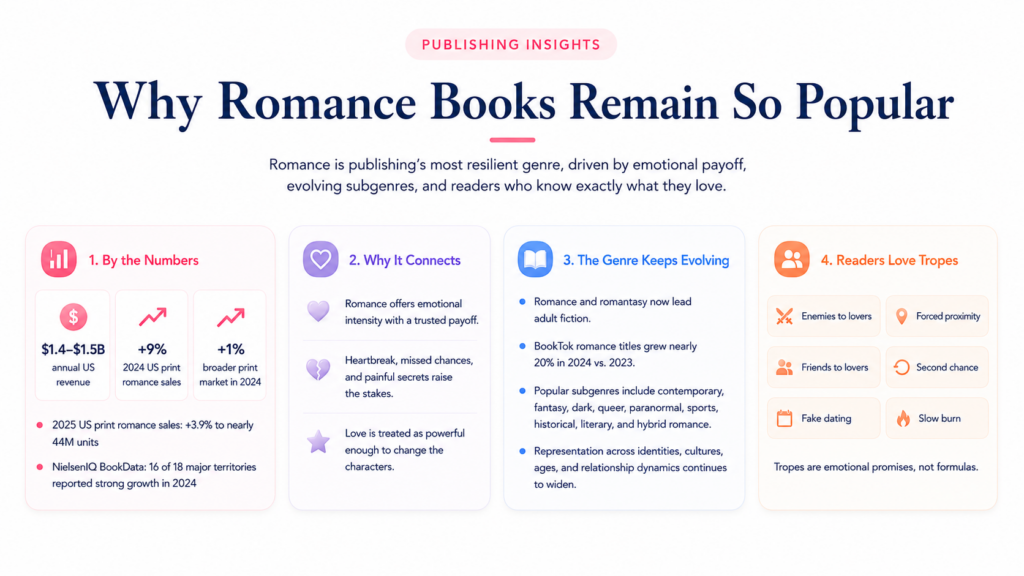
Romance is not just popular. It is the most commercially resilient genre in publishing. Romance generates around $1.4 to $1.5 billion annually in the US alone, and the numbers keep climbing. In 2024, overall US print romance sales rose almost 9%, while the broader print market grew only around 1% that same year. In 2025, romance continued to grow, with US print romance up a further 3.9% to almost 44 million units. According to NielsenIQ BookData, romance was one of the fiction genres with the strongest growth in 2024, with the data covering 16 out of 18 major international territories all reporting significant revenue increases.
The reason is not difficult to understand. A good romance novel lets readers feel deeply while trusting the emotional direction of the story. There may be heartbreak, missed chances, and painful secrets, but love is treated as something powerful enough to change the characters. That combination of intensity and meaning is genuinely rare in fiction.
The Romance Genre Keeps Evolving
Romance and romantasy are now the leading genre groupings in adult fiction, with BookTok titles alone growing nearly 20% in 2024 compared to 2023, marking the fifth consecutive year of growth for that segment. The romantasy subgenre in particular has been on the rise since 2022 and continued strongly through 2024 and into 2025, especially among younger readers aged 13 to 34. Modern romance now spans contemporary romance, fantasy romance, dark romance, queer romance, paranormal romance, sports romance, historical romance, literary romance, and hybrid genres, and representation across identities, cultures, ages, and relationship dynamics has widened significantly across all of them.
Romance Readers Know What They Love
Romance readers tend to know their preferences clearly, and that is one of the genre’s real strengths. Romance tropes like enemies-to-lovers, friends-to-lovers, fake dating, forced proximity, second chance, and slow burn are not formulas. They are emotional promises. A trope tells the reader what kind of tension to expect before they open the book. The pleasure comes from seeing how a writer makes something familiar feel specific and alive.
That is why romance keeps finding new readers. People read for recognition as much as surprise, for longing, desire and for the feeling that a book has put words to something they already knew but had never quite seen clearly.
FAQ: Best Romance Books 2026
Q: What are the best romance books to read right now?
The most-read romance books right now include It Ends with Us by Colleen Hoover, People We Meet on Vacation and Beach Read by Emily Henry, and The Hating Game by Sally Thorne for contemporary romance. For romantasy, A Court of Thorns and Roses and A Court of Mist and Fury by Sarah J. Maas and The Cruel Prince by Holly Black are the titles readers keep returning to. Haunting Adeline by H.D. Carlton leads dark romance. For something more literary, Open Water by Caleb Azumah Nelson and In Memoriam by Alice Winn are among the most emotionally lasting love stories published in recent years.
Q: What romance books are coming out in 2026?
Highly anticipated 2026 romance releases include new titles from Lucy Score, Abby Jimenez, Liz Tomforde, and Kate Clayborn. B.K. Borison’s And Now, Back to You and Liz Tomforde’s In Her Own League are among the most followed upcoming releases. The Roman Holiday Rule by Andra Loy and Like in Love with You by Emma R. Alban are drawing attention in travel romance and sapphic historical fiction respectively. This guide covers both new 2026 releases and older books still worth reading this year, because the best romance book for a given moment is not always the newest one.
Q: What is the most popular romance book right now?
In 2026, Colleen Hoover remains the most-read romance author globally, with It Ends with Us and November 9 consistently ranking among the most borrowed and purchased titles. In romantasy, the A Court of Thorns and Roses series by Sarah J. Maas and the From Blood and Ash series by Jennifer L. Armentrout continue to dominate. Icebreaker by Hannah Grace and The Love Hypothesis by Ali Hazelwood lead sports romance and academic romance respectively on BookTok, while Haunting Adeline by H.D. Carlton remains the most discussed title in dark romance.
Q: What is the most romantic book ever written?
By most measurable standards, Pride and Prejudice by Jane Austen is the closest thing to a consensus answer. It has never gone out of print since 1813, has sold an estimated 20 million copies, and consistently tops reader polls for the most beloved love story ever written. On Goodreads it holds over 4 million ratings. The relationship between Elizabeth Bennet and Mr Darcy remains the template that almost every enemies-to-lovers romance written since has borrowed from in some way. For contemporary readers, The Song of Achilles by Madeline Miller and It Ends with Us by Colleen Hoover are the titles most frequently named as the books that hit hardest emotionally. But if the question is which single love story has meant the most to the most people across the longest period of time, the data points to Austen.
Q: What does FF mean in romance books?
FF in romance books means a female-female romance, where the central relationship is between two women. Well-known FF romance titles include In a Holidaze by Christina Lauren, Cemetery Boys by Aiden Thomas on the MM side, and The Price of Salt by Patricia Highsmith as a classic FF literary romance. Related labels include MM for male-male romance, MF for male-female romance, and queer romance as a broader term covering LGBTQ+ love stories.
Q: What are the best romance books for beginners?
The best entry points into romance depend on the subgenre. For contemporary romance, Beach Read by Emily Henry and The Hating Game by Sally Thorne are widely recommended first reads. For romantasy, A Court of Thorns and Roses by Sarah J. Maas is the standard starting point. For dark romance, Corrupt by Penelope Douglas is more accessible than Haunting Adeline for new readers. For slow burn, Attachments by Rainbow Rowell and The Kiss Quotient by Helen Hoang are both emotionally satisfying without being overwhelming.
Q: What are the best romance books for writers to study?
The best romance books for writers are the ones that show how desire, tension, and intimacy work at the sentence level. Giovanni’s Room by James Baldwin, Written on the Body by Jeanette Winterson, and Open Water by Caleb Azumah Nelson are essential for studying longing, restraint, and voice. These Violent Delights by Micah Nemerever shows how obsession and psychological complexity can drive romantic tension. The Kiss Quotient by Helen Hoang is worth studying for emotional interiority and how to write desire with real vulnerability.
Q: What does HEA mean in romance?
HEA stands for Happily Ever After, the traditional ending expectation in romance fiction where the central couple ends up together. Colleen Hoover’s It Ends with Us and Emily Henry’s People We Meet on Vacation both deliver HEA resolutions after significant emotional difficulty. A related term is HFN, meaning Happy For Now, used for romances that end positively but without a permanent commitment. Giovanni’s Room and In Memoriam are examples of romance novels that deliberately avoid both, which is part of what makes them feel so different from genre romance