
Most lists of the best books of all time are written for people deciding what to read next. This one is written for people who want to understand how these books were built.
The best books of all time survive because later writers keep borrowing from them, often without noticing. Read them once and you get a great story. Read them as a writer and you get a working manual for character, voice, structure, and the exact moment a reader decides to care.
Below are 25 of them, each with the one thing it can teach you about writing. If you want recommendations sorted by mood and genre instead of craft, our best books to read has a curated list of 100 books to read in 2026. This page is about the mechanics.
At a Glance: The 25 Best Books of All Time
Below is a curated list of 25 books that are considered classics that everyone should read. We also highlighted what a writer can learn from reading each of these books.
- Pride and Prejudice by Jane Austen (1813): How a character’s misjudgment can drive an entire plot.
- The Great Gatsby by F. Scott Fitzgerald (1925): How a narrator standing slightly outside the story makes the longing land harder.
- To Kill a Mockingbird by Harper Lee (1960): How a child narrator turns moral complexity into something a reader feels before they analyze it.
- 1984 by George Orwell (1949): How invented vocabulary can carry ideology so the author never has to lecture.
- Brave New World by Aldous Huxley (1932): How to build dread out of comfort instead of threat.
- The Grapes of Wrath by John Steinbeck (1939): How to alternate one family’s story with the wider world so a single household carries an era.
- Beloved by Toni Morrison (1987): How withholding information makes the reader assemble the horror themselves.
- The Kite Runner by Khaled Hosseini (2003): How one childhood act can be engineered to pay off decades later.
- Slaughterhouse-Five by Kurt Vonnegut (1969): How fractured chronology can write trauma more honestly than a straight timeline.
- Little Women by Louisa May Alcott (1868): How to write four characters distinctly enough that readers argue over which one they are.
- The Catcher in the Rye by J.D. Salinger (1951): How a single voice can become the entire book.
- Don Quixote by Miguel de Cervantes (1605): How a story can be aware of itself and still move you.
- Jane Eyre by Charlotte Brontë (1847): How first-person conviction pulls a reader onto the narrator’s side.
- The Picture of Dorian Gray by Oscar Wilde (1890): How one supernatural device can make an internal theme visible on the page.
- The Diary of a Young Girl by Anne Frank (1947): How the absence of hindsight makes a story unbearable and true.
- All Quiet on the Western Front by Erich Maria Remarque (1929): How to tell a war through the body rather than the politics.
- The Book Thief by Markus Zusak (2005): How an unexpected narrator reframes everything and controls the reader’s distance from grief.
- A Tree Grows in Brooklyn by Betty Smith (1943): How small, exact domestic detail builds a life a reader believes in.
- Man’s Search for Meaning by Viktor Frankl (1946): How lived testimony can earn a philosophical argument.
- Atomic Habits by James Clear (2018): How one idea per chapter, tied to a concrete example, makes nonfiction stick.
- The 7 Habits of Highly Effective People by Stephen R. Covey (1989): How a framework a reader can hold in their head becomes memorable.
- The Artist’s Way by Julia Cameron (1992): How to turn a book into a practice the reader actually does.
- In Cold Blood by Truman Capote (1966): How novelistic scene-building can be applied to real events.
- I’ll Be Gone in the Dark by Michelle McNamara (2018): How the writer’s own obsession can become part of the story.
- Midnight in the Garden of Good and Evil by John Berendt (1994): How a place can hold a book together more firmly than its plot.
What Makes a Book One of the Best Books of All Time?
Some books endure because they capture universal human experiences, offering insights that remain relevant across generations. Whether a single tale or an expansive trilogy, the best books create immersive worlds and enduring stories.
Lasting Influence
Books change the way we think about literature and life, pushing boundaries and altering how future novels are written, read, or discussed.
Don Quixote, for example, gave birth to modern fiction, influencing storytelling for generations. Pride and Prejudice shaped how we view social class, relationships, and wit in literature.
The Great Gatsby continues to define the American Dream, making readers question its attainability and meaning. 1984 and Brave New World revolutionized dystopian fiction, leaving readers with chilling warnings about totalitarianism and social control.
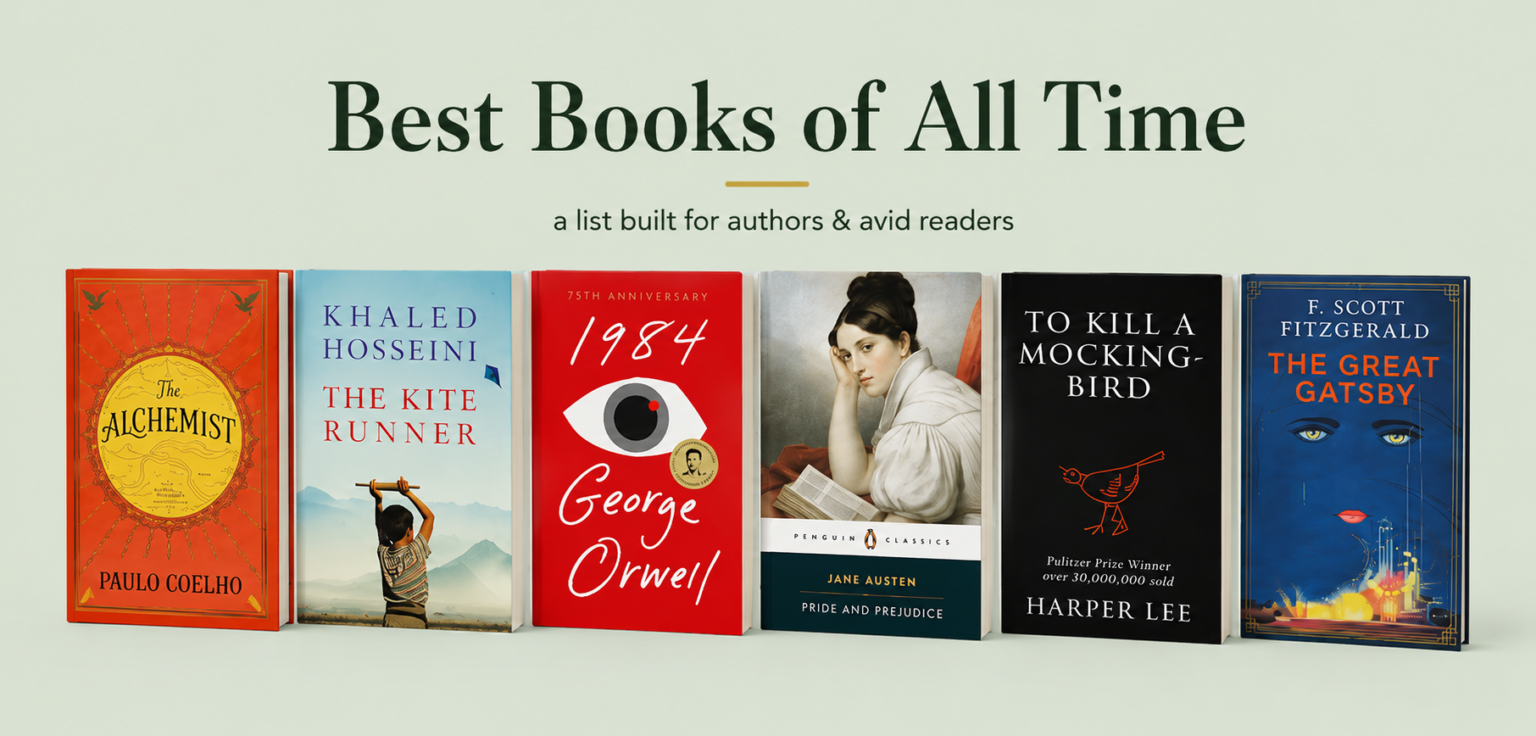
These works stand the test of time not just because of their themes, but because they have shaped the course of literature itself. Also, the book covers play a very important role to the lasting influence of these books.
Memorable Characters
Iconic characters are at the heart of the best books. Elizabeth Bennet, from Pride and Prejudice, offers a sharp, independent voice that readers remember long after finishing the book.
The Joad family in The Grapes of Wrath reflects resilience and struggle during the Great Depression, embodying the power of survival.
And, of course, mysterious millionaire Jay Gatsby continues to captivate readers, symbolizing the pursuit of the American Dream and its consequences.
These characters are unforgettable because they feel real, flawed, and deeply human. Rich characterization in literature involves creating complex and relatable characters across generations.
Deep Humanity
The best books explore the core of what it means to be human. They dive into grief, love, survival, ambition, family, and even injustice. Beloved captures the lasting trauma of slavery, while To Kill a Mockingbird paints a powerful picture of childhood innocence confronting racial injustice.
The novel explores these themes through the perspective of children, highlighting their innocence and moral development. To Kill a Mockingbird by Harper Lee addresses racial injustice and moral growth through the eyes of a young girl in the racially charged South during the Depression.
The Kite Runner brings the reader into the struggles of friendship and guilt, wrapped in a larger context of war and redemption.
These books resonate because they explore emotions and experiences everyone can relate to, offering profound insights into the human heart.
Literary Greatness Without Being Inaccessible
Great literature doesn’t always have to be difficult to read. Some of the best books are deeply emotional, funny, strange, or incredibly entertaining. Little Women, for example, balances warmth, humor, and family dynamics while discussing complex issues like ambition and identity.
Even though these works are beloved for their depth, they remain accessible to a wide range of readers.
Being great doesn’t always mean being complex, but it means resonating deeply and staying relevant over time.
What Makes a Book Worth Studying
A book earns a place in the canon when writers who came after it cannot stop stealing from it. Don Quixote taught novelists that a story could comment on itself. 1984 gave every later dystopia its vocabulary of surveillance. Pride and Prejudice set the template for the romance where two people are kept apart by their own worst assumptions. Influence is the most reliable sign that a book solved a problem other writers were still struggling with.
The characters we remember all want something badly and contradict themselves while chasing it. Elizabeth Bennet prizes her own judgment and is wrong about the two men who matter most. Gatsby builds an empire to win back a version of a person who no longer exists. A character becomes unforgettable at the point where their desire and their flaw are the same trait viewed from two angles.
These books also name feelings readers were already carrying. The Catcher in the Rye put words to the specific loneliness of sensing that everyone around you is performing. Man’s Search for Meaning gave language to the search for purpose inside suffering. Readers return to books that articulate something they felt but had never managed to say.
And difficulty is not a requirement. Little Women is warm and funny and still handles ambition, poverty, and grief with real weight. A book can go deep without becoming hard to read. Some of the most studied books in the world are also the most immediately enjoyable.
The 25 Best Books of All Time
1. Pride and Prejudice by Jane Austen (1813)
Austen runs almost the entire novel on one engine: Elizabeth Bennet’s confidence in her own read of people, and how often that read is wrong. The technique underneath it is free indirect speech, which lets the narration sit inside Elizabeth’s head while quietly showing the reader what she is missing. Study this book for how a limited point of view can generate plot on its own. It is also a foundational text for the modern love story, which is why it still anchors so many romance reading lists.
2. The Great Gatsby by F. Scott Fitzgerald (1925)
Nick Carraway is inside the story and outside it at the same time, close enough to feel Gatsby’s hope and far enough to see it fail. That distance is the whole trick. Study Gatsby for narrator placement, and for how a book about wanting something too much becomes a book about the reader’s own wanting.
3. To Kill a Mockingbird by Harper Lee (1960)
Scout narrates a story about racial injustice she is too young to fully understand, and her partial understanding is exactly what makes it land. The reader sees more than the narrator does, and the gap does the emotional work. Study this for how a child’s perspective can carry adult moral weight without ever stating the lesson.
4. 1984 by George Orwell (1949)
Orwell builds his world through language: Newspeak, doublethink, thoughtcrime. The invented vocabulary carries the ideology so he rarely has to explain the regime directly. 1984 gets more disturbing with age because readers slowly recognize how easily people trade truth for comfort. Study it for worldbuilding through words.
5. Brave New World by Aldous Huxley (1932)
Huxley engineers a dystopia where nothing looks wrong. Everyone is content, medicated, entertained, and hollow. The horror comes from comfort, which is harder to write than menace. Study this for how to make a reader uneasy about a world that appears to be working.
6. The Grapes of Wrath by John Steinbeck (1939)
Steinbeck alternates chapters about the Joad family with wide chapters about the whole migration, so one household comes to stand for a generation. A cornerstone of American literature, it turns economic collapse into something personal enough to grieve. Study it for structure, specifically how to move between the intimate and the epic without losing either.
7. Beloved by Toni Morrison (1987)
Morrison releases the central event of the novel in fragments, circling it, withholding it, letting the reader assemble the full horror only near the end. The trauma feels heavier because you built it yourself. Study Beloved for the power of what a writer chooses not to say yet.
8. The Kite Runner by Khaled Hosseini (2003)
One act of childhood cowardice sets up a payoff that arrives decades later. Hosseini plants guilt early and lets it compound, so the emotional interest accrues across the whole book. Study this for how a single early scene can be built to detonate at the end.
9. Slaughterhouse-Five by Kurt Vonnegut (1969)
The time-jumping structure is the argument. A mind broken by war does not experience events in order, so Vonnegut refuses to tell them in order. The phrase “so it goes” absorbs each death and moves on, which is its own comment on trauma. Study this for how form can mirror a character’s psychology.
10. Little Women by Louisa May Alcott (1868)
Jo, Meg, Beth, and Amy are written so distinctly that readers still fight about which sister they are. Alcott gives each one a separate want and a separate weakness, which is why the family feels real rather than symbolic. Study it for writing an ensemble where everyone is individual.
11. The Catcher in the Rye by J.D. Salinger (1951)
Holden Caulfield’s voice is the book. His repetitions, his slang, his contradictions all tell you more about his grief than any description could. Study Catcher for how diction alone can build a fully realized person, and for how much a narrator reveals by what they refuse to talk about.
12. Don Quixote by Miguel de Cervantes (1605)
Often called the first modern novel, Don Quixote already knows it is a novel. It plays with its own storytelling, mocks the books that inspired its hero, and finds real feeling inside the comedy. Study it for the origins of metafiction, and for how absurdity and tenderness can share a page.
13. Jane Eyre by Charlotte Brontë (1847)
Jane speaks directly to the reader and insists on her own worth in a world built to deny it. That first-person conviction is what makes readers side with her completely. Study this for how a narrator’s moral certainty becomes the reader’s.
14. The Picture of Dorian Gray by Oscar Wilde (1890)
Wilde takes an internal process, moral corruption, and makes it physical through the portrait that ages in Dorian’s place. One clean supernatural device carries the entire theme. Study Dorian Gray for how a single well-chosen image can externalize something invisible.
15. The Diary of a Young Girl by Anne Frank (1947)
The diary form gives the book its unbearable power. Anne writes without knowing how the story ends, so there is no hindsight softening it, only a girl planning a future she will not get. Study this for what immediacy does that retrospective narration cannot.
16. All Quiet on the Western Front by Erich Maria Remarque (1929)
Remarque writes the First World War through the senses: mud, hunger, sound, the body under fire. The politics stay offstage while the physical experience stays close. Study it for how sensory precision makes an abstract subject impossible to look away from.
17. The Book Thief by Markus Zusak (2005)
Death narrates, which sounds like a gimmick until you notice how it controls the reader’s distance from every loss. Zusak can foreshadow, comment, and grieve in a register no human narrator could reach. Study The Book Thief for how narrator choice shapes tone and emotional access.
18. A Tree Grows in Brooklyn by Betty Smith (1943)
Smith builds Francie Nolan’s life out of tiny, exact domestic details, and the accumulation is what convinces you she is real. Nothing spectacular happens, and that is the point of the craft. Study this for how specificity in the small moments creates a believable whole.
19. Man’s Search for Meaning by Viktor Frankl (1946)
Frankl earns his philosophy by living it first. The book moves from concentration-camp testimony to an argument about purpose, and the argument holds because the experience came before it. Study this for how to fuse personal account with a larger idea.
20. Atomic Habits by James Clear (2018)
Clear structures the whole book around one idea per chapter, each attached to a concrete, memorable example. That discipline is why readers can actually apply it. Study Atomic Habits for how nonfiction earns retention. It sits near the top of most self-help reading lists for the same reason.
21. The 7 Habits of Highly Effective People by Stephen R. Covey (1989)
Covey gives readers a framework simple enough to carry in their heads and repeat to others. The structure is the reason it spread. Study this for how packaging an idea well can matter as much as the idea itself.
22. The Artist’s Way by Julia Cameron (1992)
Cameron turns her book into a practice through devices like morning pages, so the reader does the work rather than only reading about it. Study The Artist’s Way for how interactive structure changes a book from information into experience.
23. In Cold Blood by Truman Capote (1966)
Capote applied the tools of the novel, scene, character interiority, suspense, to a real murder, and more or less invented modern true crime in the process. Study it for how reporting and narrative technique combine, and for how much tension you can build when the reader already knows the outcome.
24. I’ll Be Gone in the Dark by Michelle McNamara (2018)
McNamara writes herself into the hunt for the Golden State Killer, and her obsession becomes part of the book’s subject. The investigation and the investigator are inseparable. Study this for how a writer’s presence can deepen nonfiction rather than distract from it.
25. Midnight in the Garden of Good and Evil by John Berendt (1994)
Savannah is the real protagonist. Berendt lets the city, its eccentrics, and its atmosphere carry the book while the crime almost drifts to the background. Study this for setting as character, and for how place can become the thing a reader remembers.
How to Build Your Own Must-Read List as a Writer
As a writer, creating your own must-read list is about more than just discovering great stories. It’s about exposing yourself to diverse voices, themes, and techniques that will help you improve your own writing.
Read Across Genres
To become a well-rounded writer, read widely. Fiction, nonfiction, memoir, self-help, true crime, poetry, and classics each offer something unique.
Fiction teaches you storytelling and character development, while nonfiction sharpens your understanding of real-world concepts. Memoir reveals emotional truths, and self-help provides insight into personal growth. Each genre gives you new tools to enrich your writing.
Study What Each Book Does Well
Every great book has something it excels at. Study these elements to understand what makes them work:
- For character development, look at Pride and Prejudice and how Elizabeth Bennet’s growth shapes the entire novel.
- For atmosphere, The Great Gatsby immerses readers in the opulent yet empty world of 1920s New York.
- For the theme, 1984 presents a chilling exploration of power and truth through Winston’s journey.
- For structure, Slaughterhouse-Five uses time travel to mirror the emotional trauma of war.
- For emotional truth, The Kite Runner shows how personal choices affect relationships and guilt.
- For nonfiction pacing, In Cold Blood is a masterclass in building tension and intrigue.
Keep a Writer’s Reading Journal
A writer’s reading journal is a valuable tool for tracking what works in the books you read. Jot down observations like:
- Opening lines that grab your attention.
- Chapter structure and how it affects pacing.
- Character arcs and how they evolve.
- Dialogue and how it reveals character traits.
- Emotional turning points and how they impact the reader.
- Themes that emerge naturally through the story.
- Endings and whether they resonate emotionally or thematically.
By keeping a journal, you’ll start recognizing patterns in storytelling and develop a deeper understanding of what makes each book effective.
Reading widely and analyzing what you read can greatly improve your own writing. Build your list of must-read books by focusing on works that teach you valuable lessons about character, structure, voice, and themes.
What Writers Can Learn from the Best Books of All Time
By the end of the first chapter, a strong book has told you what you are going to feel: the longing in Pride and Prejudice, the unease in 1984, the ache in The Catcher in the Rye. That promise is what keeps a reader turning pages. Decide early what emotional experience you are offering, then deliver it.
→ Great books make an emotional promise early
Elizabeth Bennet, Gatsby, Jane Eyre, and Holden Caulfield all want something specific and undercut themselves while reaching for it. A character built only from good qualities stays flat. Give them a want strong enough to drive decisions and a flaw that keeps getting in the way. If you want a map of the roles characters tend to play, the guide to character types is a useful reference.
→ Characters come alive through desire and contradiction
1984 never pauses to explain that freedom matters. It shows Winston losing his. The Grapes of Wrath argues about poverty and dignity entirely through what happens to the Joads. Theme lands when the story shows the cost of an idea rather than announcing it. Pick one central theme and let the plot pay it off in consequences.
→ Theme arrives through consequence, not statement
Slaughterhouse-Five scrambles time to mirror a broken mind. The Diary of a Young Girl uses the diary form to strip away hindsight. How a story is told changes what it means, which is why structure deserves as much attention as plot. Choose a shape that reinforces your subject instead of fighting it.
→ Structure is meaning
People remember Nick Carraway’s reflective calm and Holden Caulfield’s restless slang long after the plots blur. Voice comes from word choice, rhythm, and the specific literary devices a writer leans on. It usually announces itself in the first lines, so your opening is where voice does its heaviest work.
The Best Books of All Time Are Also Great Teachers
Great books teach us how to build unforgettable characters, how to structure a compelling narrative, and how to explore powerful themes. They show us the importance of voice and the emotional truths that resonate with readers. By analyzing these works, we can sharpen our instincts and improve our craft.
How to Read Like a Writer
Read across genres: Fiction teaches character and scene. Nonfiction like In Cold Blood teaches pacing and research turned into narrative. Memoir teaches emotional honesty. Self-help teaches clarity and structure. Reading widely gives you more tools than reading deeply in one lane ever will.
Study one thing per book: Trying to absorb everything at once absorbs nothing. Read Pride and Prejudice for character. Read The Great Gatsby for atmosphere. Read Slaughterhouse-Five for structure. Read In Cold Blood for suspense. One focus per book turns reading into training.
Keep a reading journal: Note the openings that grabbed you, the chapter breaks that changed the pace, the moments a character surprised you, and the endings that landed. Patterns start to appear across books, and those patterns become instincts in your own drafts. If you want a starting stack organized by mood and genre, the reading list is a good place to build from.
From Reader to Published Author
Studying the best books of all time sharpens the instincts you will need for your own. When you are ready to move from reading to writing, the step-by-step guide to starting a book walks through the first draft, and Spines helps authors take a finished manuscript through publishing and distribution.
FAQ: Best Books of All Time
Q: Which best books of all time should a writer read first?
Start with the ones that match the skill you most want to build. Read Pride and Prejudice for character, The Great Gatsby for narration, Slaughterhouse-Five for structure, and In Cold Blood for turning research into a gripping narrative.
Q: What makes a book last across generations?
Endurance comes from a mix of influence on later writers, characters readers cannot forget, and emotional truths that stay relevant as the world changes. Books like 1984 and The Great Gatsby survive because their insights into power, longing, and illusion still describe present-day life.
Q: Which classic best teaches character development?
Pride and Prejudice. Almost the entire plot runs on Elizabeth Bennet’s flawed judgment, which shows how a character’s inner limitation can generate an entire story.
Q: Which book should a writer study for voice?
The Catcher in the Rye. Holden Caulfield’s diction, rhythm, and evasions build a complete person, which is a masterclass in how voice alone can carry a novel.
Q: Do you have to read the classics to become a good writer?
No single book is required, but reading widely and closely is one of the most reliable ways to improve. The classics stay on study lists because they solved craft problems so well that later writers keep learning from them.
Q: How do the best books explore themes without lecturing?
They show the consequences of an idea instead of stating it. 1984 dramatizes the loss of freedom, and The Grapes of Wrath dramatizes the cost of poverty, so the reader arrives at the theme through the story rather than being told it.