
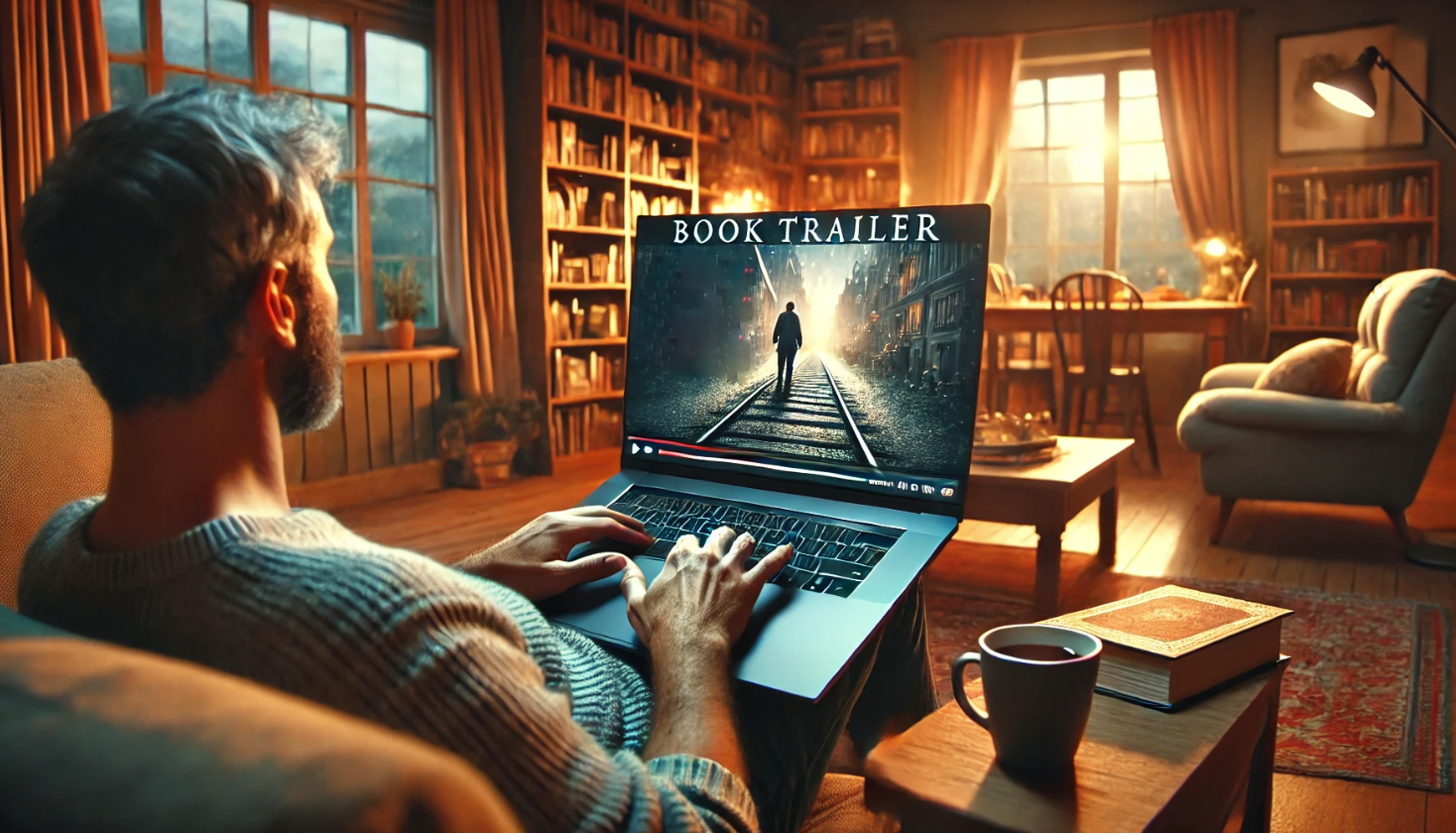
Book trailer marketing is creating a short promotional video, usually 30 to 90 seconds, built to do one specific job: make a stranger stop scrolling long enough to care about a book they’ve never heard of. It borrows the language of a movie trailer, a hook, a tone, a handful of images, but it’s built for readers instead of ticket buyers.
Most debut authors discover the hard truth after the manuscript is finished: writing the book was the controllable part. Getting noticed in a market flooded with new releases wasn’t. A book trailer won’t fix a weak book, but it gives a good one a fighting chance to be seen before it’s judged by a cover thumbnail alone.
What Is a Book Trailer?
A book trailer is a short video that previews a book’s plot, characters, or mood using visuals, music, and text, the same way a movie trailer sells a film before anyone buys a ticket. It isn’t a summary. The strongest ones tease a single scene, a character, or a feeling, and leave the rest for the reader to discover by actually opening the book.
Video content reportedly gets retained at a much higher rate than plain text, which is part of why it converts attention into curiosity so efficiently. Viewers retain 95% of a message via video, compared to 10% via text. A mystery trailer might tease a cryptic clue instead of naming the killer. A children’s book trailer leans on color and rhythm more than plot. A memoir trailer usually needs just one honest moment, not a highlight reel of an entire life.
Done well, a book trailer doesn’t just inform a viewer that a book exists. It gives them a reason to want it.
Why a Book Trailer Matters for a Debut Novel
A book trailer matters most for a debut because it does the one thing a new author’s name can’t do yet: create instant trust through emotion instead of reputation. More than four million books are published every year, and a first-time author has no backlist, no existing readership, and no name recognition to lean on. A trailer gives a stranger a reason to care in under a minute, before they’ve made any judgment about who wrote it.
This matters more for some genres than others. A children’s book trailer convinces a parent as much as it excites a kid, so the tone has to work on two audiences at once. A mystery or thriller trailer can lean entirely on atmosphere and withhold almost everything else. Either way, the trailer is doing a job the query letter and the back-cover copy can’t: it’s showing, not describing.
How to Make a Book Trailer: A Step-by-Step Guide
Making a book trailer doesn’t require a production budget or a film degree. It requires one clear idea, executed without trying to cram the whole book into it.
Step 1: Develop Your Concept
Pick one element to build the entire trailer around: a character, a scene, or the emotional core of the book. A trailer that tries to represent every subplot ends up representing none of them well. If the book follows a boy on a magical journey, show one glimpse of that world, not a tour of the whole map.
Step 2: Write a Script
The script has 30 to 90 seconds to do its job, so every line has to earn its place. Open with something that grabs attention immediately, a question, an image, a line of dialogue. Use the middle to tease stakes or character without resolving them. Close with a direct call to action: “Available now,” or “Pre-order today.”
Step 3: Visuals and Audio
Match the visuals and music to the book’s actual tone rather than a generic “trailer” aesthetic. A mystery benefits from dark, moody footage and tense music. A children’s book wants color, motion, and something playful in the soundtrack. Small sound details, a creaking door, a burst of laughter, do more to set mood than most authors expect.
Step 4: Editing and Final Touches
Free tools like iMovie, Windows Video Editor, or Canva’s video editor are enough for a clean, professional-looking result. Add text overlays for the title, author name, and social handles, and end on a clear closing frame with a call to action and a link. Sixty seconds is a safe target length for most genres; shorter works better as a teaser.
Step 5: Publishing and Sharing
Upload first to YouTube, and optimize the title, description, and tags around the book’s genre and title, since YouTube functions as a search engine for readers actively looking for something to watch and read next. From there, share it across social platforms, embed it on the author website, and send it directly to reviewers and bloggers instead of waiting for them to find it.
Engaging Readers Through Story, Not Summary
The best book trailers work because they withhold more than they reveal. A trailer that tries to explain the whole plot in 60 seconds reads like a synopsis with music behind it, and synopses don’t make anyone curious.
Focus on the single moment that captures what the book actually feels like to read. A mystery trailer works by leaving the central question unanswered: who did it, and why. A children’s book trailer works by capturing a sense of adventure, not explaining the plot mechanics. A memoir trailer works by showing one honest, specific moment instead of summarizing a life. The goal isn’t to tell the viewer what happens. It’s to make them need to find out.
Tools and Resources for Making a Book Trailer
A professional-looking trailer doesn’t require a professional budget. Free tools cover most of what a first-time trailer needs: iMovie or Windows Video Editor for editing, Pexels, Unsplash, and Pixabay for stock footage, and Bensound or FreeSound for royalty-free music and sound effects.
For authors who want a more polished result, Adobe Premiere Pro, Final Cut Pro, and DaVinci Resolve offer more control, and Shutterstock or Storyblocks provide premium stock media. For scripting or voiceover help, AI tools can draft a starting point, and freelance voiceover artists on Fiverr or Voices.com can record something more polished. Authors who’d rather hand off the whole process can find editors and animators on Upwork or Fiverr, or work with a specialist trailer production service. There’s no single right budget here. A $0 trailer built with free tools and a clear concept usually outperforms a $2,000 trailer with no concept at all.
Promoting a Book Trailer
A trailer only works if people actually see it, so promotion isn’t optional once it’s made. Upload it to YouTube first and optimize the title, description, and tags around the book’s genre and title, since YouTube functions as a search engine for readers actively looking for something to watch and read next.
From there, cut it into shorter clips for Instagram, TikTok, and Facebook, embed it on the author website with a clear “Buy Now” or “Pre-order” link nearby, and send it directly to the email list instead of hoping subscribers stumble onto it. Reaching out to bloggers and influencers in the book’s genre, often in exchange for a free copy, extends the trailer’s reach further than any single post will on its own. Paid ads on YouTube or Meta are worth testing only after the organic version has already proven the concept works.
Book Trailer Examples Worth Studying
The trailers that work best share one habit: none of them open with the book’s title. They open with a feeling, and the title comes after the hook has already landed.
The Hunger Games by Suzanne Collins uses fast cuts and cinematic tension to feel like a movie preview rather than a book ad, which fits a fast-paced, high-stakes plot. Watch the trailer.
Miss Peregrine’s Home for Peculiar Children by Ransom Riggs leans entirely on atmosphere, using the novel’s own vintage photographs to create unease before a single plot point is revealed. Watch the trailer.
Impyriym by Henry H. Neff uses hand-drawn animation and a narrator’s voice to make the trailer feel like an extension of the book’s world-building rather than a separate ad for it. Watch the trailer.
Opposite of Always by Justin A. Reynolds uses bright color and a warm, conversational voiceover to signal the book’s tone before revealing anything about the story, which matters more for contemporary YA than plot details do. Watch the trailer.
The pattern across all four: the trailer sells a feeling first and the plot second, if at all.
Take the Marketing One Step Further
A book trailer is a short investment with a long payoff: a well-made one keeps working across YouTube, social platforms, and a website long after the manuscript itself is finished. It doesn’t need a large budget or professional crew to do its job. It needs one clear idea, executed without trying to say everything at once.
FAQ: Book Marketing Trailer
Q: How much does a book trailer cost?
A book trailer typically costs between $100 and $500 for a simple DIY version, and $1,000 to $5,000 or more for a cinematic, professionally produced one. Price depends mainly on animation, professional voiceover work, and music licensing. A trailer built with free editing tools and stock footage can still work well for under $200.
Q: Are book trailers worth it?
Book trailers are worth it for most authors because video consistently draws more engagement on social media and YouTube than text or static images do, and a finished trailer can be reused across every promotional channel for the life of the book. The return depends more on having one clear concept than on budget, since a free, well scripted trailer can outperform an expensive one with no hook.
Q: What should a book trailer include?
A book trailer should include four core elements: a strong opening image or line, one narrative hook rather than a full plot summary, music or sound that matches the book’s tone, and a clear call to action at the end. Trailers that try to cover everything about the story usually hold viewer attention the least, so restraint matters more than completeness.
Q: What is a good length for a book trailer?
A good length for a book trailer is between 30 and 90 seconds, with 60 seconds working as a safe default for most genres. A shorter cut works best as a teaser or social clip, while a story with several characters or a more complex plot can justify pushing closer to 90 seconds without losing viewer attention.
Q: Where is the best place to post a book trailer?
YouTube is the strongest primary platform for a book trailer, since it doubles as the second largest search engine after Google. From there, the trailer should also live on the author’s website and Amazon Author Central, and get cut into shorter clips for Instagram, TikTok, and Facebook to reach readers who aren’t already looking for the author.
Q: What is the purpose of a book trailer?
A book trailer’s purpose is to create emotional interest in a book before someone decides whether to buy it, the same job a movie trailer does for a film. It works by previewing tone, character, or a single compelling scene instead of summarizing the plot, then closing with a direct call to action such as a pre-order link.
Q: What are the benefits of a book trailer?
A book trailer helps a title stand out in a market where millions of new books are published every year, mainly by giving readers an emotional reason to care before they read a single page. It also works as shareable content for social media and YouTube, where video consistently outperforms plain text or static image posts.