

A novelist spends months agonising over a single word to title their book, then hands the reader a page that doesn’t give much away.
Meanwhile a freshman is burning the midnight oil trying to format a title page for an APA paper that’s due right away, muttering to themselves about rules that seem downright arbitrary, until they take a step back and notice they are actually not as random as they appear.
Both are staring at the same empty page. Neither of them are really ‘writing’ yet: they’re figuring out how to introduce the reader to their work before they even get to the first sentence.
That title page might look like a tiny thing, but it does more heavy lifting than it lets on. It’s the page that names the work, gives the author credit, and, nice and quietly, tells the reader what kind of attention they should be giving this document from the off.
A novel’s title page has a gentle charm to it, while an APA paper’s one is bluntly formal, but it’s all the same idea: just done up for a different kind of occasion.
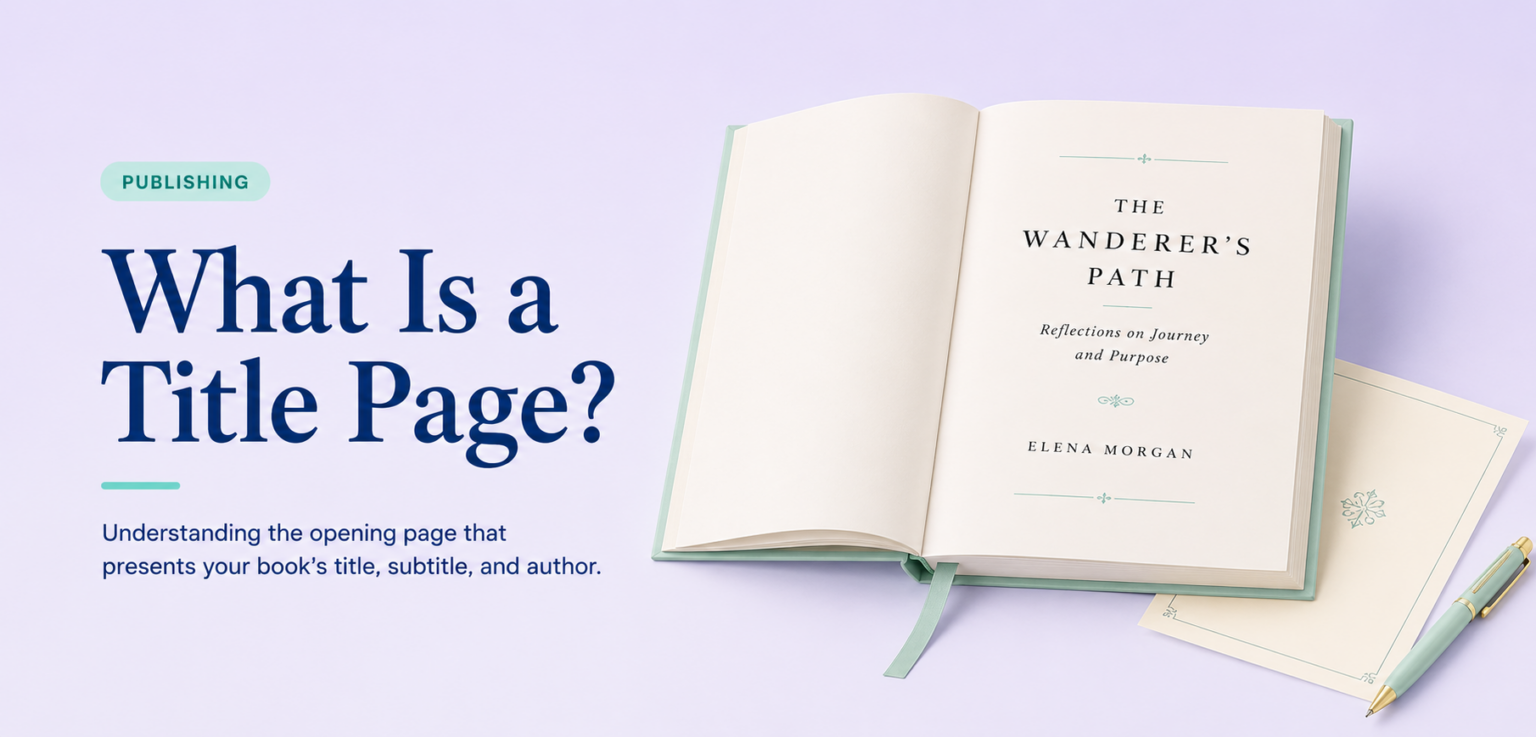
A title page is how you introduce written work to the reader. You give them the title, the author and the key details before they dive into the good stuff. With some books it’s all part of the package – coming right after the cover.
But for essays and formal papers, more often than not the title page stands on its own as the very first page and in some circles gets referred to as an APA cover page when the work is in APA format.
What a Title Page Actually Does
First off let a title page just do one job in every conceivable scenario: its one single function is to let the reader, librarian, professor or citation database know exactly what they’ve got in their hands and who made it.
A book cover is where you sell the story , the title page on the other hand just authenticates it, much like a signature on a cheque proves it’s yours. On it youll find the title, the author’s name and often the publisher or imprint, copyright details and the year of publication.
Now an essay’s title page has to be a bit more low key because let’s face it a professor grading a hundred papers isn’t really looking for any kind of flair in your title page, all they need is your name, course number quick sharp.
Now the APA title page takes it even further by adding a running head and page number to the mix, because let’s put this another way APA was as much about making things easy to retrieve as it was about making things look easy on the eye.
Here’s how the same underlying idea shifts across the three most common formats.
| Format | What It Includes | Style |
| Book | Title, author’s name, publisher or imprint, copyright information | Reflects the tone of the book, more design freedom |
| Essay | Title, your name, instructor’s name, course name, submission date | Plain, centered, no design flourish |
| APA | Title, author’s name, institutional affiliation, running head, page number | Structured, standardized, precision over personality |
The Title Page of a Book
A book’s title page is the formal introduction that sits behind the cover, the page that libraries catalog, that other authors cite, and that carries the legal weight of the work.
Its core elements are the book’s title, the author’s name, the publisher’s name or your own imprint, and the copyright details, usually the symbol, the name, and the year. In many printed books that copyright detail actually lives on the reverse of the title page, on a separate copyright page.
Getting this page right matters more than most authors expect. The work of choosing the right title for your book happens before this page exists, and it deserves its own attention.
Once the title is settled, the title page is where it becomes official. If you are self-publishing, this is also where you list your imprint, a small detail that readers absorb as a signal of professionalism.
Handle your copyright information here too, so the work is properly attributed and protected from the start.
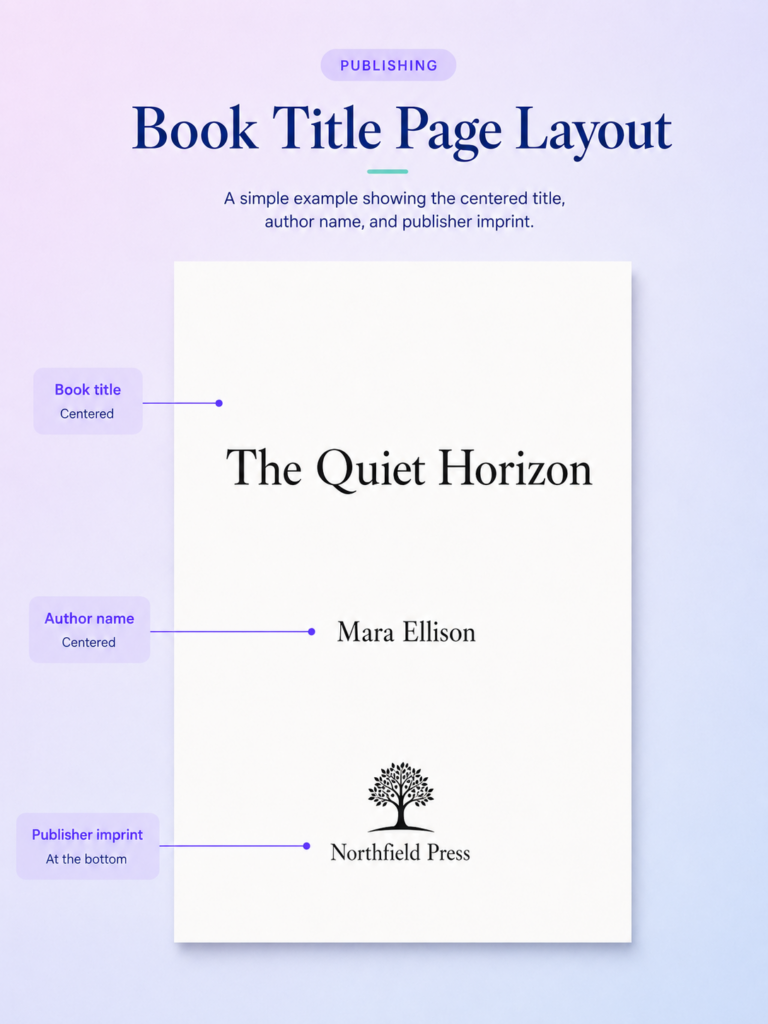
A book cover uses color and imagery to catch a browsing eye, while the title page works as the quiet, formal handshake underneath. Where a book cover reflects a designer’s craft, the title page carries the book’s authority in plain type. It rarely gets a redesign after publication, so what goes on it now is close to permanent.
The Title Page in an Essay
An essay’s title page is a bit of a formality, but it still serves a very real purpose, helping a grader to quickly tell whose work is in their hands, when scanning through a whole stack of essay submissions.
The requirements themselves are pretty straightforward, just the title of the essay, right in the middle of the page, in big and clear letters. Then comes your name, the instructor’s name, the course name or number, and the date you submitted it.
A lot of students tend to underestimate just how important formatting is in this case. You want to make sure the font is easy to read, usually that means sticking with something like Times New Roman at 12 points and that the writing is double spaced with one inch margins all the way around.
The APA Title Page (APA Cover Page)
An APA title page, also called an APA cover page, is the standardized first page of a paper written in APA style.
It carries the paper’s title, the author’s name, the author’s affiliation, and a page number, all formatted to rules set by the American Psychological Association. People search for this page as both “APA title page” and “APA cover page,” and both terms describe the same required first page.
APA 7th edition uses two versions of this page, and knowing which one applies is where most formatting mistakes start.
Student APA title page (the version most assignments require):
- Page number in the top right corner, starting on page 1
- Paper title in bold, centered, placed in the upper half of the page
- Author’s name, centered, below the title
- Affiliation (your department and university), centered
- Course number and name
- Instructor’s name
- Due date
Student papers do not use a running head. That single point trips up a lot of writers, because older APA guidance required one.
Professional APA title page (for work submitted for publication):
- Page number in the top right corner
- Running head, a shortened title in all capitals, flush left in the header
- Paper title, author name, and affiliation, centered
- An author note at the bottom of the page
Font and spacing stay consistent with the rest of the paper: Times New Roman at 12 points, one-inch margins, and double spacing throughout.
Because the APA format title page is so precise, a labeled example is worth more than any description. Here is the structure of a student title page, top to bottom.
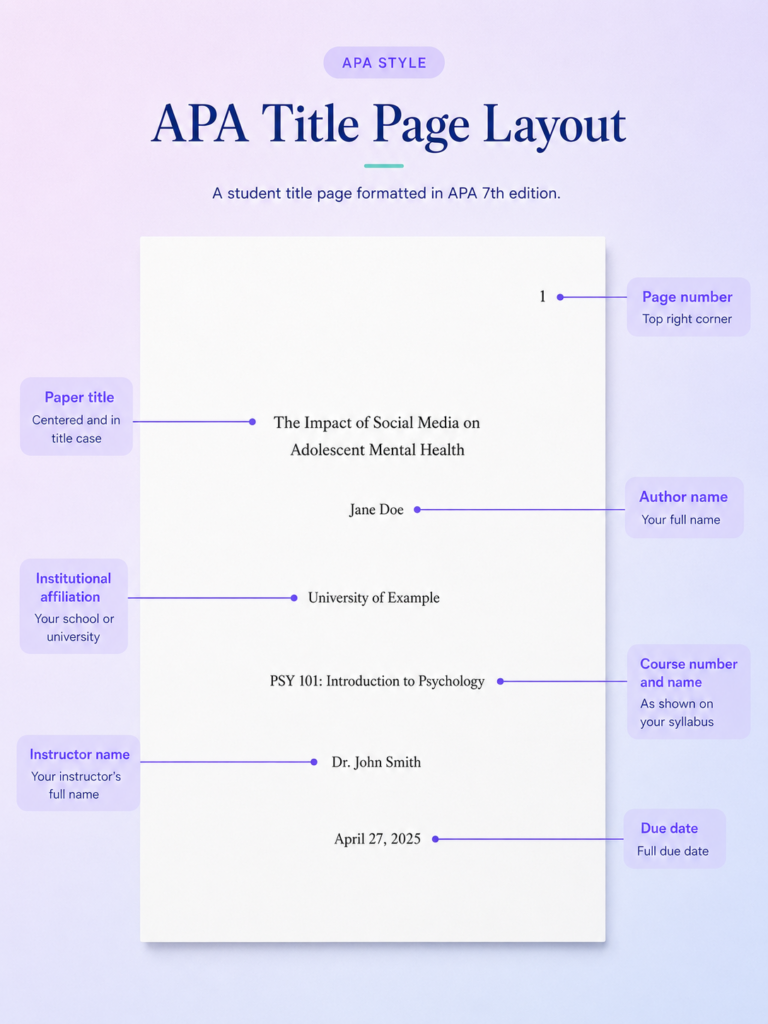
APA is this particular for a reason. The format exists so that academic work stays findable, citable, and comparable across a huge body of research, and a standardized cover page makes that manageable at scale.
If your work is heading toward formal submission, our guide to academic publishing covers what comes after the title page.
The Half Title Page: A Detail Most Guides Skip
Most explanations of book title pages stop at the main title page and miss a smaller, older convention still used in traditionally printed books, the half title page.
It’s a page containing only the book’s title, no author name, no publisher, no copyright details, positioned before the full title page rather than instead of it.
Its origin is largely practical. Early printed books used it to protect the more detailed title page from wear during binding, and the convention stuck around long after the practical need faded.
Today it shows up mostly in traditionally published hardcovers and literary fiction, giving the reader a quiet, decorative pause before the fuller introduction arrives.
Self-published authors can include one as a stylistic choice, though it isn’t required, and plenty of successful self-published books skip it entirely without losing any credibility.
MLA, Dissertations, and Other Formats
Two other formats come up often enough to be worth a mention.
MLA usually skips a separate title page. Instead, the title, your name, the instructor’s name, and the course details go in the upper left corner of the first page. When an instructor does ask for a standalone MLA title page, it centers the same information without the running head or first-page numbering that APA requires.
Dissertations and theses use the most detailed title page of all. Alongside the title and author, they typically state the degree being awarded, the institution, the date of submission, and sometimes approval lines for a committee. These pages follow strict institutional templates, so the school’s own guidelines take priority over any general rule. For longer academic work heading toward publication, our academic publishing resources walk through the wider process.
Where Book, Essay, and APA Title Pages Diverge
All three formats solve the same problem. Identify the work, and identify the author. What changes is how much personality that identification is allowed to carry.
A book’s title page has the most freedom, since authors and publishers can adjust font, spacing, and placement to match the tone of the book, whether that reads as playful, literary, or severe.
An essay title page favors a clean, businesslike layout that stays out of the grader’s way. An APA cover page sits between the two, borrowing the essay’s plainness and adding the page number, and on professional papers the running head, that make academic retrieval possible.
Match the format to the document, and the most common mistake takes care of itself. A book’s design freedom suits a novel, while an APA paper stays uniform by design, and mixing the instincts from one context into the other is what reads as carelessness.
Formatting a Title Page
A few formatting decisions carry more weight than they seem to, because a reader spots a problem on this page before reading a word of the actual work.
Follow the guidelines that match the document. APA, MLA, Chicago, and standard book formatting each have their own rules, and keeping them consistent signals care from the first glance. Keep the design focused on readable fonts rather than decorative ones, especially for essays and academic papers, and lean on tested book formatting tools to keep spacing and margins clean.
Proofread this page specifically, because a typo in the title or a misspelled name here damages trust faster than almost anything else. Give margins and white space the same attention, since loose formatting on the first page makes the rest of the document look less carefully made by association.
FAQ: What Is a Title Page
Q: What does a title page look like in a book?
A book’s title page is a clean, formal layout built around the title, usually centered and set in a larger font than the rest of the page. The author’s name follows below it, often in a smaller size. In a traditionally published book, the publisher’s name sits near the bottom, alongside copyright details and the publication year.
Q: How do you properly title a page?
The title should reflect the content clearly and stay concise and easy to read. For a book, that often means naming the central theme of the story in a way readers remember. Placement depends on the format: book title pages center the title near the top, while essays and academic papers center it in the middle of the page with the author’s name and other details below.
Q: How do you make an APA title page?
For a student paper, add a page number in the top right, then center the title in bold in the upper half of the page. Below it, center your name, your affiliation, the course number and name, the instructor’s name, and the due date, all double-spaced in 12-point Times New Roman. A professional paper adds a running head in the header and an author note at the bottom, and drops the course and instructor details.
Q: Does a student APA paper need a running head?
No. Under APA 7th edition, only professional papers use a running head. Student papers show just the page number in the header, starting on the title page.
Q: What is the primary purpose of a title page?
Its main purpose is identification. It tells the reader the title, the author, and often extra context such as a course number or publisher, while making a professional first impression before the content begins.
Q: Do you need a title page for an assignment?
Most academic assignments require one, since it organizes submissions and gives instructors the context they need at a glance. A typical assignment title page includes the title, the student’s name, the instructor’s name, the course name or number, and the submission date. Check the assignment guidelines to confirm the specific requirement.
Q: What is the difference between MLA and APA title pages?
MLA usually skips a separate title page and places the title, writer’s name, instructor’s name, and course details in the upper left of the first page. APA requires a dedicated title page, sometimes called an APA cover page, with the paper’s title, the author’s name, the affiliation, and a page number, plus a running head on professional papers.
Q: Is an APA cover page the same as an APA title page?
Yes. Both terms describe the same required first page in an APA paper. APA’s own style guide uses title page, while many students and search engines default to cover page.