
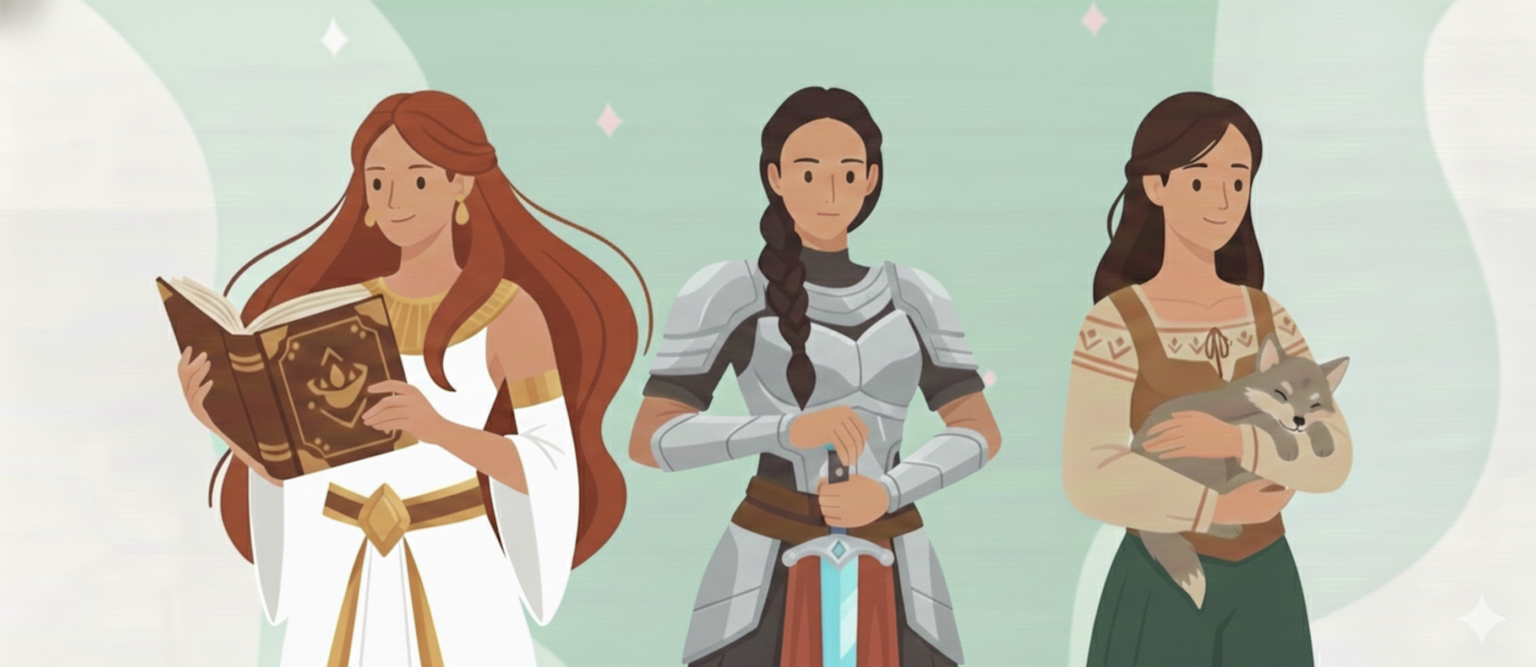
You’ve met them before. The fierce protector who turns “no” into a full time personality. The wise woman who somehow knows everyone’s secrets before they’re even secrets. The chaos queen who shows up late, says something unhinged, and accidentally changes your life.
That’s the pull of female archetypes. They’re familiar enough to recognize in seconds, but they’re not personality prisons or outdated “types of women.” They’re story blueprints, and modern storytelling has gotten good at remixing them.
This piece breaks down what these archetypes actually are, why every list online seems to count them differently, and how they’ve evolved from flat symbols into something closer to real people.
What Are Female Archetypes, Exactly?
Female archetypes are recurring character patterns that show up across stories, cultures, and centuries. Think of an archetype as a character’s default settings: the values she protects, the fears that push her buttons, the motivation that drives her forward, the moves she makes when life gets messy. This pattern recognition is exactly what makes archetypal characters in literature so durable across centuries of storytelling.
An archetype is a starting structure. It gives a character shape before the finer details of voice and backstory get added. A stereotype is something else entirely: flat, predictable, stuck repeating the same traits with zero room to grow.
Readers feel like they understand a character within seconds. Writers get a foundation to build from instead of starting blank. And archetypes work as narrative shortcuts, but only when they’re used with intention instead of laziness.
How Many Female Archetypes Are There?
Search this question and every list claims to be the definitive one. One source says six. Another says seven. Someone else shows up with twelve, thirteen, or insists it’s infinite.
The number shifts because archetypes were never a fixed scientific inventory. Mythology focuses on roles and symbols. Psychology leans into inner drives and transformation. Storytelling frameworks care about function and conflict. Branding translates the same patterns into identity. Each system is answering a slightly different question, even though they’re circling the same handful of human patterns.
The honest answer is that it depends on the lens you’re using and what you’re trying to build with it, whether that’s a novel, a screenplay, or a brand voice.
The Archetypes You’ll See Everywhere
This is a starter set, not a complete list. You’ll spot these in myths, novels, rom coms, prestige TV, and the “about me” section of half the internet.
The Maiden / Ingénue: She wants discovery and belonging, the wide eyed energy of a first time. Left unchecked, that openness curdles into naivety and a habit of outsourcing her choices to whoever is loudest in the room. The version worth writing now is the curious beginner who keeps her own agency. She learns fast, asks better questions, and chooses her own coming of age instead of waiting for someone to hand it to her.
The Mother / Caregiver: Martyrdom is the trap here. So is control dressed up as love, and the “I’m fine” said through gritted teeth. What she actually wants is simpler: protect, nourish, hold the world together. The modern version has learned boundaries. She builds chosen family and community care, and she helps without disappearing into the helping.
The Queen / Ruler: Picture her making the call nobody else wanted to make, then living with it. Her desire is order, standards, leadership that actually holds. Her shadow is rigidity, image obsession, mistaking perfection for safety. Today’s version leads from values instead of fear. She’s not difficult, she’s effective, and she knows exactly what she stands for.
The Lover / Muse: Connection, beauty, pleasure, aliveness. That’s what she’s chasing. The shadow side is people pleasing and a hunger for validation that gets mistaken for intimacy. The modern Lover wants desire with self respect intact. She’s a creative force in her own right, not someone else’s sparkly side quest.
The Warrior / Amazon: Justice. Achievement. The kind of courage that shows up even while she’s scared. Her shadow is emotional shutdown, the instinct to do it all alone, treating vulnerability like something suspicious. What makes a Warrior worth reading is the thing she’s hiding and the soft spot she’d rather die than admit exists. She can fight. She can also feel. Both at once, no contradiction required.
The Sage / Mystic: Truth, insight, the meaning underneath the mess. That’s her territory. Her shadow is detachment, a superiority complex disguised as wisdom, disappearing into insight to avoid real life chaos. A good Sage stays useful. She’s spiritual, but she’s also grounded in something lived, not just recited.
The Trickster / Rebel: Freedom. Disruption. Exposing the rules nobody agreed to but everyone follows anyway. Her shadow is self sabotage and cynicism, burning bridges before checking whether there was a door. The version worth writing is the rule breaker with an actual cause. She’s not just stirring the pot. She’s trying to make something better out of what’s left.
Quick note: these aren’t personality types assigned to real women. They’re story energies, and any character, or any person, can move through more than one, shift between them, or blend them into something new entirely.
How Female Archetypes Are Changing
The old version of these archetypes treated women like symbols with legs. Pure or tempting. Nurturing or wicked. The prize, the warning sign, the emotional support system for someone else’s hero journey. Clean labels. Simple functions. Almost no interior life.
Modern storytelling is finally letting women be full humans without leaning on stereotypes. Contradictory. Powerful. Funny. Ambitious. Occasionally a disaster in sweatpants at 2am. Believable, in other words.
Three shifts are driving that change. The plot doesn’t just happen to her anymore. Things happen because of her choices, even the bad ones, because growth needs consequences to mean anything. Flaws stopped being a moral punishment and became part of the arc, the friction that makes real change possible. And characters started blending archetypes the way people actually do: a Warrior Mother, a Rebel Queen, a Sage Lover. The mashups are where the interesting stuff lives.
The “strong female character” who was only ever strong at scowling is retiring. Strength looks like tenderness now too. Humor. Saying “I need help” without falling apart over it.
Writing an Archetype Without Writing a Cardboard Cutout
Treat an archetype as a jumping-off point, not a character generator. Nobody needs “The Queen” as a finished product. What works is a person who happens to carry that energy at the start of her story.
When you are crafting timeless characters from an archetype, start with what she wants more than anything, then find what she’s terrified it will cost her. That single tension does more work than a leather jacket and a sharp one-liner ever will.
Add something that doesn’t fit the mold. A Warrior who loves romance novels. A Caregiver who hates being needed. A Sage who’s petty in group chats. Contradiction is what makes an archetype feel like a person instead of a costume.
Figure out her relationship to power, love, and belonging. Does she chase power or avoid it? Does love feel safe to her, or does it feel like a risk she’s still deciding whether to take? Give her a personal code, something she won’t do even under pressure, because that’s where drama actually comes from. And let her be a different person by the end than she was on page one. Growth is the entire point of putting her on the page.
If a character’s whole vibe reads as competent and untouchable, add mess. Add softness. Let her be wrong sometimes.
Pick an Archetype, Then Break It Beautifully
Crafting memorable characters in women’s fiction was never meant to work like assigning name tags at a networking event. They’re a way to understand what drives a character before you get to the finer details of voice and choices.
Start with an archetype. Then make it yours. Blend two of them together. Flip the expectation. Give the Queen a soft spot. Let the Maiden be ruthless. Turn the Rebel into the one who protects everyone else.
Whether you’re writing, revising, or picking apart your favorite stories, use this as a lens meant to deepen your characters, not box them in. The archetypes worth remembering never stay tidy.
FAQ: Female Archetypes
Q: What are the 12 universal archetypes?
The 12 universal archetypes come from Carl Jung’s work on the collective unconscious: the Innocent, Everyman, Hero, Outlaw, Explorer, Creator, Ruler, Magician, Lover, Caregiver, Jester, and Sage. Female archetypes overlap heavily with this list but adapt it for storytelling, often merging categories like Ruler and Hero into blended roles such as the Warrior Queen. Writers use the framework as a starting map, not a rulebook.
Q: What are the 7 archetypes of Jung?
Jung’s original framework is usually condensed into 7 archetypes: the Self, the Shadow, the Anima/Animus, the Persona, the Hero, the Mother, and the Wise Old Man. These are psychological categories rather than character templates, which is why storytelling versions of female archetypes borrow the ideas but reshape them into more specific, narrative-friendly roles like the Mother, the Warrior, and the Sage.
Q: What are the 4 main feminine archetypes?
The 4 main feminine archetypes most often cited are the Maiden, the Mother, the Queen, and the Crone (sometimes reframed as the Sage). This is the simplest version of the female archetypes framework, tracking a woman’s arc across life stages rather than personality traits. Writers use this smaller set when they want a clean structure for a character’s transformation over time.
Q: What are the 5 female archetypes?
There’s no single agreed-upon list of 5 female archetypes, since the number depends on which framework is being used. A common version narrows the full set down to the Maiden, Mother, Queen, Warrior, and Sage, cutting the Lover and Trickster to keep things simple. Writers looking for a compact model often start here before expanding into more nuanced categories.
Q: What are the 13 feminine archetypes?
The 13 feminine archetypes framework expands the classic list to include more specific roles like the Seductress, the Mystic, the Huntress, and the Wanderer alongside the familiar Mother, Queen, and Warrior. It’s popular in tarot and goddess archetype systems, offering writers a wider palette when a story needs a character who doesn’t fit neatly into one of the more common categories.
Q: What archetype is Angelina Jolie?
Angelina Jolie is most often read as a blend of the Warrior and the Rebel, with traces of the Sage in her later public persona. Her early career leaned into fierce, unconventional roles that read as Rebel energy, while her humanitarian work and shift toward directing added a Sage-like depth. It’s a useful example of how real people, like characters, rarely sit in just one archetype.
Q: What is a good girl archetype?
The good girl archetype is a version of the Maiden defined by likability, obedience, and a fear of disappointing others. She avoids conflict, seeks approval, and often struggles to want things for herself. In modern storytelling, the most interesting versions of this archetype let her break the pattern, discovering that being liked and being honest aren’t always the same thing.