
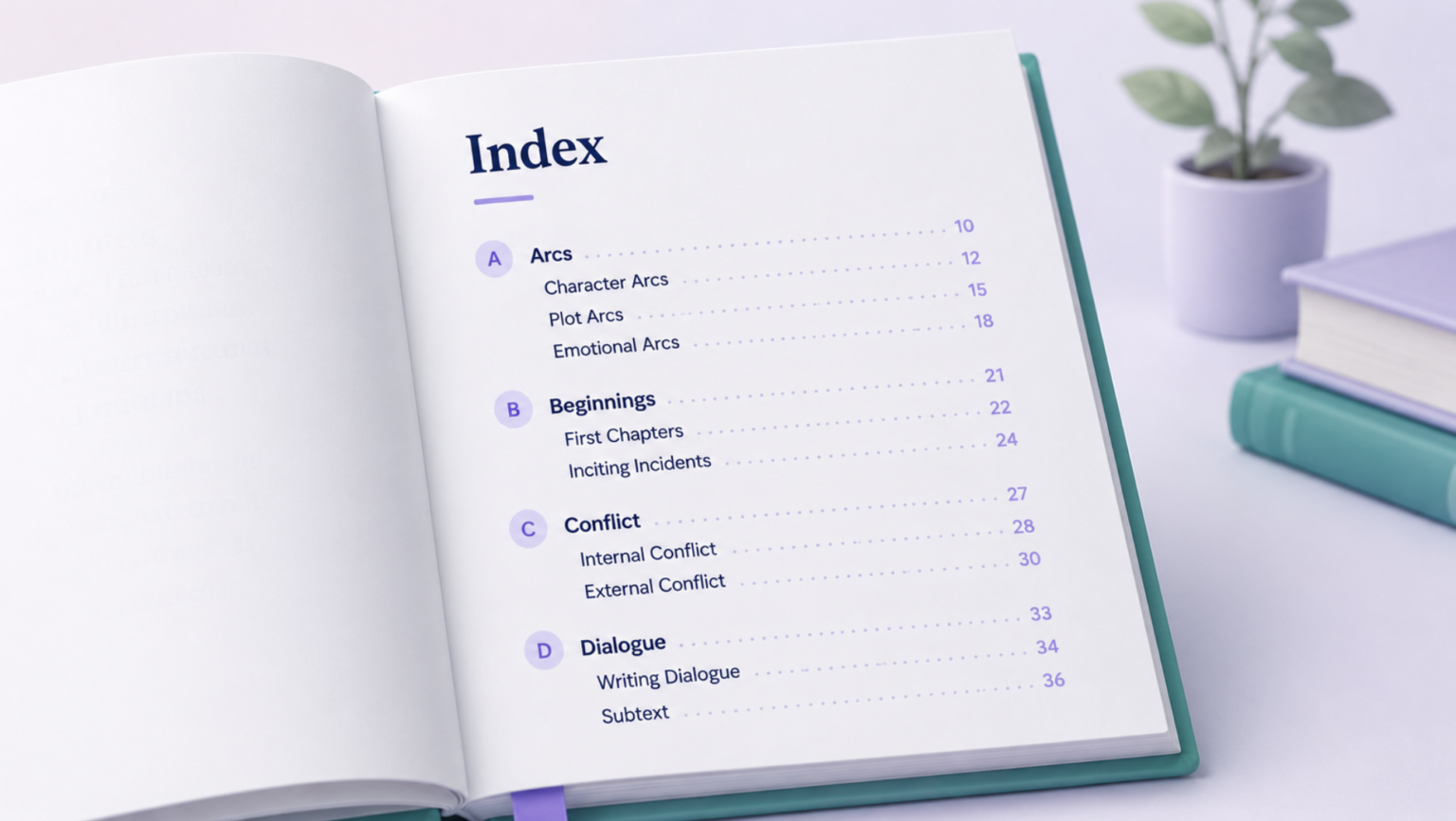
An index in a book is the organized list of names, topics, terms, and concepts that usually appears at the end of a nonfiction book. It helps readers find specific information quickly without flipping through every chapter or relying on memory alone.
Think of the book index page as the book’s built-in search tool. Need to find a person, place, idea, event, or technical term? The index points you to the exact page numbers where that subject appears. For readers, researchers, students, and curious skimmers, it can turn a 300-page hunt into a 10-second lookup.
But the index of a book is more than a convenience. A good index shows how the content is organized, highlights the book’s main ideas, and makes the reading experience easier to navigate. In a world of infinite scroll and instant search bars, the index page in a book still does something beautifully practical: it gives readers a clear roadmap to the information they actually came for.
What Is an Index in a Book?
So, what is an index in a book? An index is an alphabetical list of important names, topics, terms, places, and subjects mentioned throughout the book, usually placed at the end of a non-fiction book. Each entry includes page numbers that show readers exactly where that topic appears.
Think of the index of a book as its built-in navigation system. The table of contents shows the main chapters and sections, while the index helps you find specific details inside those chapters. Need to locate a person, concept, event, or keyword? The book index page points you there without the painful page-by-page search.
Each entry is followed by the page numbers where that topic appears. Sub-entries dive deeper, breaking complex subjects into more specific parts. For example, an entry might look like:
A simple index entry might look like this:
Dragons
etiquette, 57
fire-breathing technique, 103–105
in modern real estate law, 202
The main entry is the broad topic, while the smaller lines beneath it are subentries. These help break larger subjects into more specific ideas, making the page easier to scan and more useful for readers.
A well-made index is especially common in nonfiction, textbooks, academic books, manuals, biographies, history books, and reference guides. But it is not only for students or researchers. Anyone who wants to find information quickly can benefit from a clear, organized index.
Shortcut to Sanity: Why Readers (And Writers) Should Love the Index
The index page in a book is the literary equivalent of a GPS system, except it doesn’t yell at you when you miss a turn. It offers clarity in chaos, a beacon in the informational fog, and, let’s be honest, a little peace of mind when you’re pressed for time.
But it’s not just readers who should send thank-you notes to the humble index. Writers, especially of nonfiction, cookbooks, and memoirs, use the index as both a roadmap and a mirror. It helps them reflect on the structure of their work: Are topics covered consistently? Are the themes clear? Is the dragon etiquette section, perhaps, overkill?
A solid back-of-the-book reference also boosts credibility. It shows the author respects the reader’s time and intellect.
Anatomy of a Book Index Page
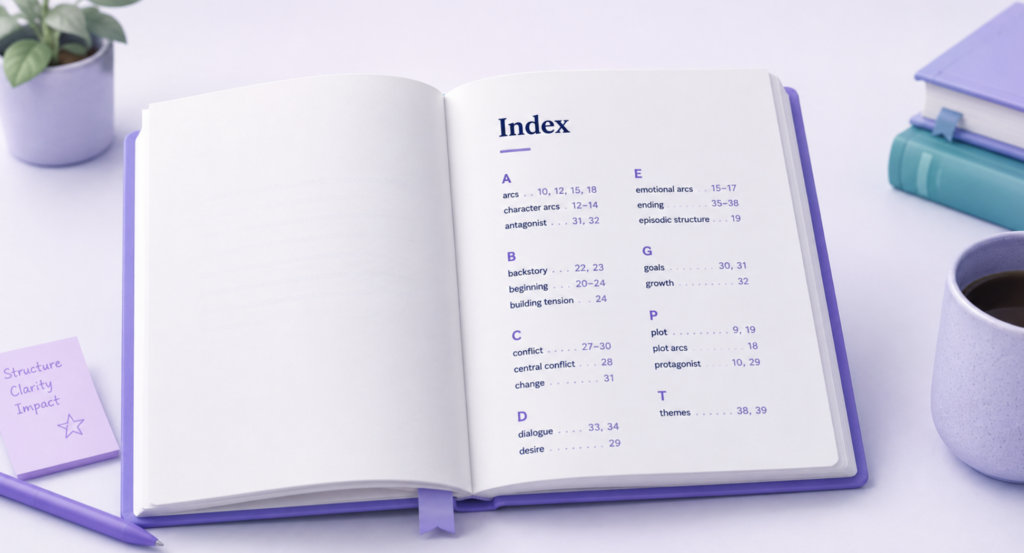
A book index page may look like a simple alphabetical list, but it is actually one of the most useful parts of a nonfiction book. It is built to help readers find specific information quickly, especially when they are looking for a name, topic, term, place, event, or theme of the book.
Most indexes include three main parts:
- Main entries: the primary topics listed in alphabetical order
- Subentries: more specific details related to each main topic
- Page references: the page numbers where each topic appears
For example, an index entry might look like this:
Publishing
book cover design, 42
editing process, 58–61
marketing plan, 109
see also self-publishing
In this example, “Publishing” is the main entry, the lines beneath it are subentries, and the numbers point readers to the exact pages where each subject is discussed. A “see also” note guides readers toward related topics, making the index page in a book even more helpful.
A strong index is not created by accident. Professional indexers review the manuscript and decide which subjects readers are most likely to search for. They organize those terms in a way that feels logical, clear, and easy to scan.
So while the index may sit quietly at the back of the book, it does important work. It turns a long nonfiction book into a searchable, reader-friendly resource.
The Art of Organized Obsession
Creating the index of a book isn’t some afterthought slapped on in a rush. It’s a precise, often painstaking craft handled by a rare breed: the professional indexer. These folks are part detective, part editor, and part obsessive-compulsive superhero. Many are freelancers, hired specifically to decode a manuscript and turn its contents into a crystal-clear roadmap.
Indexing is a mix of tools and touch. Yes, there’s software that can help, tagging terms, generating rough lists, but no algorithm can replace the human eye for nuance. Only a person can tell when “bats” refers to flying mammals, baseball gear, or someone’s questionable ex.
Think of indexing as literary cartography: mapping out a book’s ideas the way explorers chart coastlines. Each entry is a landmark, each subentry a footnote in the terrain of the text. The result? A topic mapping system that guides readers across intellectual landscapes.
Technology is streamlining some parts of the job, but the final polish still depends on human judgment, knowing what readers will look for, and how they’ll think. That’s what turns basic content sorting into an art form.
So the next time you consult an index, remember: someone obsessively organized all that chaos just so you could find “dragon fire regulations” in two seconds flat.
Indexing Done Right (and Hilariously Wrong)
The index isn’t always a dry roll call of topics; it can be a playground for creativity, wit, and even mischief. Some authors and indexers use this clever back matter to sneak in jokes, build character, or add an extra layer of delight to the reading experience.
Take Douglas Adams, who famously indexed The Hitchhiker’s Guide to the Galaxy with gems like:
“Universe, the: extant status of, disputed.”
Or Terry Pratchett, who used the index of his Discworld books to continue world-building with entries that were mini-comedies in themselves.
Even cookbooks get in on the fun. The Joy of Cooking has entries like:
“Eggs, how to poach, 103; how not to poach, 104.”
That’s not just helpful, it’s hilarious.
These moments of creative indexing aren’t just clever; they deepen reader engagement. A well-crafted index of a book can surprise you, make you laugh, and remind you that every part of a book, even the back, is a chance for storytelling.
FAQ: What Is an Index in a Book?
Q: Why is it called an index?
The word index comes from the Latin indicare, meaning “to point out” or “indicate.” That’s exactly what an index does: it points readers to where information lives in a book. It’s like the finger that helps you navigate through a sea of pages, directing you to the right spots quickly and efficiently.
Q: Are glossary and index the same?
A glossary and index are not the same. A glossary defines terms used in the book, like a mini dictionary. An index, on the other hand, tells you where to find those terms (and other topics) throughout the book. Think of the glossary as a list of meanings, and the index as a list of locations.
Q: What are the benefits of an index at the end of a text?
An index boosts usability. It helps readers find specific content fast, improves comprehension by organizing concepts, and even enhances the professional polish of a book. Whether you’re studying, researching, or skimming for fun facts, an index turns the hunt into a hop.
Q: Do you need an index in a book?
You definitely need an index If the book is nonfiction, dense, or reference-heavy. An index adds major value by making content searchable and accessible. For fiction, it’s not typically needed (unless you’re George R.R. Martin and your readers need a roadmap for all those noble houses).
Q: What goes on an index page?
The index page contains an alphabetized list of key names, topics, terms, and sometimes quirky references found throughout the book. Each entry includes the page number(s) where it appears. Subentries offer more detail, and cross-references may guide readers to related topics.
Q: What is an example of an index?
Here’s a fun fictional example from a book titled Dragons: A Survival Guide:
Dragons
— behavior in captivity, 43–45
— diet preferences, 88–91
— flame types, 12, 33, 102
— treaties with elves, 149
Each line tells you where to find that topic, saving you from flipping through every chapter hoping for a scaly clue.