
A plot is the sequence of events; it is what happens in the book. A story is the emotional experience behind those events; what the characters want, fear, learn, and overcome. And the narrative is the way the book delivers both of those things to the reader, the voice, perspective, and style that shape how the reader experiences the plot and story.
These terms are often used interchangeably, but they don’t mean the same thing.
A manuscript can have a clear plot and still feel empty. The scenes may be in the right order, and the structure probably works well, but if the reader does not feel or deeply understand why those events matter, the book will feel hollow. The plot needs to have the story and narrative to go with it.
Plot vs Story vs Narrative Quick Overview
| Element | Definition | Key Focus | Example |
|---|---|---|---|
| Plot | Sequence of events in a story | Cause & effect, structure, actions | The Hunger Games: Katniss volunteers, fights to survive, defies the system |
| Story | Why events matter | Emotional journey, character change, meaning | Lost in Translation: Two strangers connect emotionally despite minimal events |
| Narrative | How the story is told | Voice, tone, pacing, perspective | Gone Girl: Manipulative, unreliable narrator across multiple timelines |
What is The Plot?
Plot is the structure of events. It is what happens in the book, in order, with cause and effect connecting each moment.
A character arrives in town. She meets someone. Something goes wrong. She has to make a choice. That choice creates a consequence.
The plot is the skeleton of the book. It answers one basic question: What happened?
E.M. Forster drew the line cleanly in Aspects of the Novel. “The king died and then the queen died” is a story, a sequence arranged by time. “The king died, and then the queen died of grief” is a the plot of a story, because grief is the causal thread that turns one event into the reason for the next. That single word of causality is the whole distinction in miniature.
What Is The Story?
The story is the emotional experience the reader moves through. It’s the interior life underneath the events, what they mean to a person, and therefore what they mean to the reader watching that person.
A strong story answers a different question: What did it feel like to live through this?
Two characters lose their jobs on the same afternoon. On the page, identical events. One of them has been quietly relieved for months, too afraid to quit, and this is the exit she could never give herself. The other mortgaged his apartment last week to send his daughter to university. Same event. The story lives in the specific weight the event lands on, and those two weights have almost nothing in common.
This is what readers are actually chasing when they open a novel. They already know from the back cover roughly what will happen. What they want to know is how it will feel to be inside it.
How Does Narrative Fit In?
Narrative is the voice that decides how both get told. It’s the angle of vision.
The choice of where to start, what to linger on, and what to skip. Two writers could take identical plot events and an identical emotional core and produce completely different reading experiences based solely on narrative choices.
Think of Lolita. The plot is monstrous. The story, underneath it, is about a man who destroys a child while convincing himself he loves her. Nabokov’s unreliable narrator, that seductive, self-justifying prose voice, is what makes the novel one of the most psychologically disturbing books ever written. The horror lives in the gap between what the narrator tells you and what you understand is actually happening.
Narrative is what controls that gap. It’s the intelligence behind the telling.
If you understand all three terms, you can start asking yourself: who is telling this, from where, and what does that perspective make visible or invisible?
Story vs Narrative vs Plot
| – | Plot | Story | Narrative |
| What it is | The sequence of events with cause and effect | The emotional experience those events produce | The voice and perspective shaping how events are told |
| The question it answers | What happened? | What did it feel like? | Who is telling this, and from where? |
| Lives in | Structure and scene order | Character interiority and consequence | Point of view, tone, and distance |
| When it fails | Events feel disconnected or arbitrary | Readers follow along but feel nothing | The telling feels wrong even when plot and story are solid |
| Classic example | The husband dies; the wife inherits his debt | The wife realizes she never knew the man she married | The story is told years later, by someone who loved her and watched it happen |
Imagine you’ve got a dramatic breakup. The story is: They fell in love, grew apart, and realized too late what they’d lost. The plot is the meet-cute, the first fight, the tearful airport scene. The narrative is how you tell it; maybe it’s in flashbacks, from alternating perspectives, or with a cynical narrator who undercuts the drama with snark.
Story is what happens and why it matters.
Plot is how those events are structured.
Narrative is how the story is told; the voice, the tone, the pacing, the point of view.
Advice From Your Editor
There’s a single question that separates writers who understand this distinction from writers who are still learning it. It’s a small shift in wording with significant consequences for the whole draft.
Instead of: what happens in this scene?
Try asking: what does this scene do to this person?
If you can answer the second question with something specific, something that couldn’t apply to any other character in any other novel, you’re writing a story. If you can only answer the first, you’re working with a plot that hasn’t found its emotional purpose yet.
Character-driven stories and plot-driven stories get talked about as though they’re opposites. They’re better understood as two different entry points into the same territory. A character-driven story puts the internal experience at the center and lets external events grow from it. A plot-driven story starts with external events and works inward to find the human cost. Both can produce powerful fiction. Writers get into trouble when they commit to one and forget the other exists entirely.
A Practical Way to Read the Difference
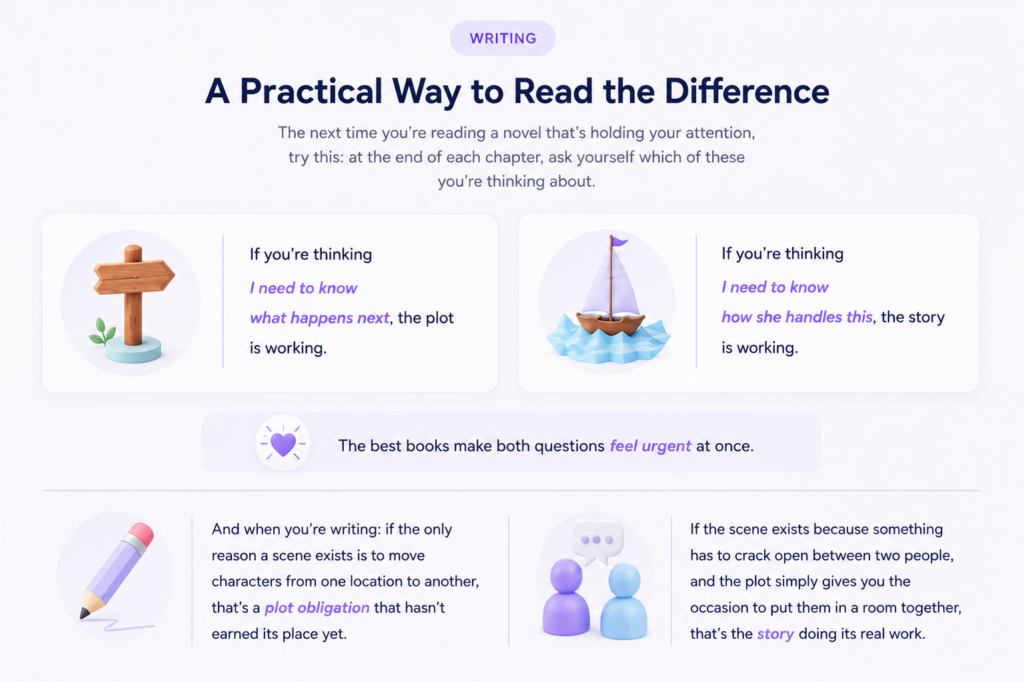
The next time you’re reading a novel that’s holding your attention, try this: at the end of each chapter, ask yourself which of these you’re thinking about.
If you’re thinking I need to know what happens next, the plot is working.
If you’re thinking I need to know how she handles this, the story is working.
The best books make both questions feel urgent at once.
And when you’re writing: if the only reason a scene exists is to move characters from one location to another, that’s a plot obligation that hasn’t earned its place yet. If the scene exists because something has to crack open between two people, and the plot simply gives you the occasion to put them in a room together, that’s the story doing its real work.
Character-Driven vs Plot-Driven
Character driven and plot driven get talked about as opposites, as if a writer has to pick a team. In fact, they’re closer to two entry points into the same territory
A plot-driven story is all about what happens. Bombs go off. Clues are found. Doors get kicked in. Characters react to the whirlwind around them. Think The Da Vinci Code, Robert Langdon’s just trying to keep up with the next ancient secret that could blow the Vatican wide open. These stories are fast, external, and action-packed. They move like freight trains fueled by caffeine and conspiracy.
A character-driven story is powered by who the character is and how they change. It’s about choices, growth, flaws, and internal conflict. Gatsby throws wild parties, sure, but the real drama in The Great Gatsby is in Gatsby’s delusion, Daisy’s indecision, and Nick’s existential unease. These stories stroll through the park like they’re pondering life while sipping a flat white.
But don’t get too binary. Most great narratives live somewhere on the spectrum. Breaking Bad is a masterclass in both: external plot twists (meth labs, cartel shootouts) powered by an intense internal transformation (Walter White’s descent from chemistry teacher to drug kingpin).
The character-driven story vs plot-driven debate isn’t about picking sides, it’s about knowing which engine you’re using, and making sure it’s firing on all cylinders. Whether your story sprints or saunters, make sure someone’s actually driving the damn thing.
Examples of Plot vs Story That Show the Difference Clearly
Abstract definitions only go so far. These examples make the gap concrete.
The Remains of the Day by Kazuo Ishiguro.
Plot: A butler takes a road trip across England to visit a former colleague.
Story: a man slowly realizes, over the course of a few days, that he sacrificed every meaningful thing in his life for a professional ideal that wasn’t worth it, and the realization has come too late to change anything.
The Road by Cormac McCarthy.
Plot: a father and son walk south through a post-apocalyptic landscape, trying to survive.
Story: a man discovers that love is the only thing that makes survival worth the cost, and that protecting someone you love means watching them inherit a world you couldn’t save.
Gone Girl by Gillian Flynn.
Plot: A woman disappears on her wedding anniversary and her husband becomes the prime suspect.
Story: a portrait of a marriage where both people performed versions of themselves until the performance became the only thing left, and what happens when someone finally decides to stop.
In each case, you could summarize the plot in a sentence and it would sound thin, even absurd. The story is why the book exists.
What Happens When You Confuse Plot & Story?
A plot-heavy manuscript reads like a summary of events. Things happen, characters react, more things happen. The reader processes it all without being moved by any of it. They finish and feel vaguely unsatisfied, the way you feel after eating a meal that was nutritionally complete but had no flavor.
A story without plot produces a different kind of failure: It’s emotionally rich but narratively shapeless because the reader cares about the character but grows frustrated that nothing is moving. Internal life without external events becomes a kind of beautiful stasis.
What actually works is when plot and story are inseparable. When every external event is chosen because of what it will do to a specific character’s interior. When the scene isn’t just “what happens next” but “what will break this person open in the most revealing possible way.”
The novels that stay with readers for years are the ones where you can’t separate the events from the feelings they produce. Normal People by Sally Rooney is a useful example. Plot-wise, not much happens: two people meet, they date, they break up, they reunite.
But the story is about the particular shame that comes from wanting someone more than you’re willing to admit, and Rooney builds every scene to press on that exact nerve. The plot serves the story so precisely that readers feel like the events couldn’t have happened any other way.
Why Does This Matter for Your Own Writing
If you’re feeling stuck on a draft, you’re probably experiencing a plot-story confusion without realizing it.
The answer, almost always, is that you’re writing toward events instead of toward what those events reveal. The question driving your draft is what comes next, when the more generative question is what does this cost, and what does that cost teach the character about who they actually are.
This is also at the heart of character development, because you need to understand your characters deeply enough to know which events will genuinely break them open, and which ones will just move them around the page.
Plot is something you can outline in an afternoon. The story takes longer because you have to understand your characters well enough to know what will truly affect them, and what will simply move the plot forward.
The manuscripts that get remembered, the ones readers press into other people’s hands, are the ones where the writer understood that plot gives the book its shape and the story is what gives it weight.
Learn more about plot holes and discover how to create a plot that feels complete, believable, and engaging.
FAQ: Plot vs Story
Q: What is the best definition of plot vs story?
Plot is the sequence of events in a narrative, connected by cause and effect. Story is the emotional experience those events create for a specific character and, by extension, for the reader. A plot tells you what happened. A story tells you what it meant to live through it. Both are necessary, but they do different work in a piece of fiction.
Q: What are the 5 elements of plot?
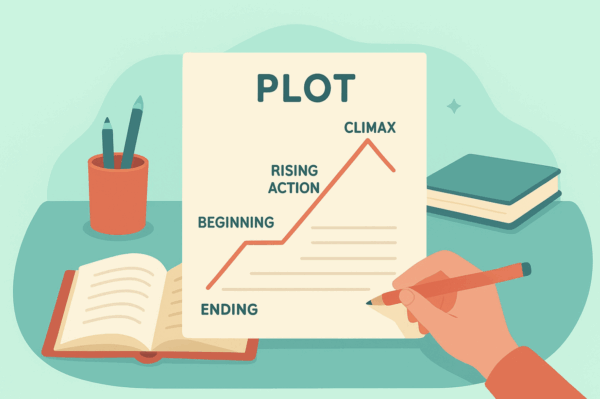
The five core elements of plot are exposition, rising action, climax, falling action, and resolution. These form the structural spine of a narrative. They tell you where the story is going. What they don’t tell you is how the character feels at each stage, which is where story lives. Understanding plot structure matters most when you use it to serve your characters, not just to sequence your scenes.
Q: What is the difference between plot and storyline?
A storyline and a plot are often used as synonyms, and in casual conversation that’s fine. More precisely, the storyline is the chain of events as they unfold in sequence. Plot adds causality to that chain: one event produces the next. Neither term captures the emotional interior of the narrative, which belongs to story. If your storyline is clear but your reader feels nothing, the story hasn’t been written yet.
Q: What is Forster’s distinction between plot and story?
E.M. Forster defined story as a sequence of events arranged by time, and plot as events arranged by causality. His famous example: “The king died and then the queen died” is story. “The king died, and then the queen died of grief” is plot. The grief is what transforms one into the other. Forster’s insight is still the clearest starting point for understanding how plot vs story function differently in fiction.
Q: Is the plot the same as the theme of a story?
No. Plot is what happens. Theme is what the story is ultimately about at the level of meaning. A plot might follow a man who loses his job and rebuilds his life. The theme might be that identity built entirely around work is too fragile to survive real loss. Theme tends to emerge from the story, not the plot. It’s the idea that the whole narrative is quietly making an argument for.
Q: Are plot and summary the same thing?
A summary describes the plot, but they aren’t the same thing. Plot is the actual architecture of a narrative with its causal logic intact. A summary is a compressed version of that architecture, stripped of texture, pacing, and consequence. When a plot summary makes a novel sound thin or uninteresting, it usually means the real power of that book lived in the story, which summaries almost always lose.
Q: What comes after plot in storytelling?
After you have a working plot, the next layer is story: the emotional reality underneath each event. Then comes narrative: the decisions about voice, point of view, pacing, and perspective that determine how the plot and story get told. Most writers draft in plot, revise toward story, and refine through narrative. The best manuscripts show evidence of all three layers working together.