
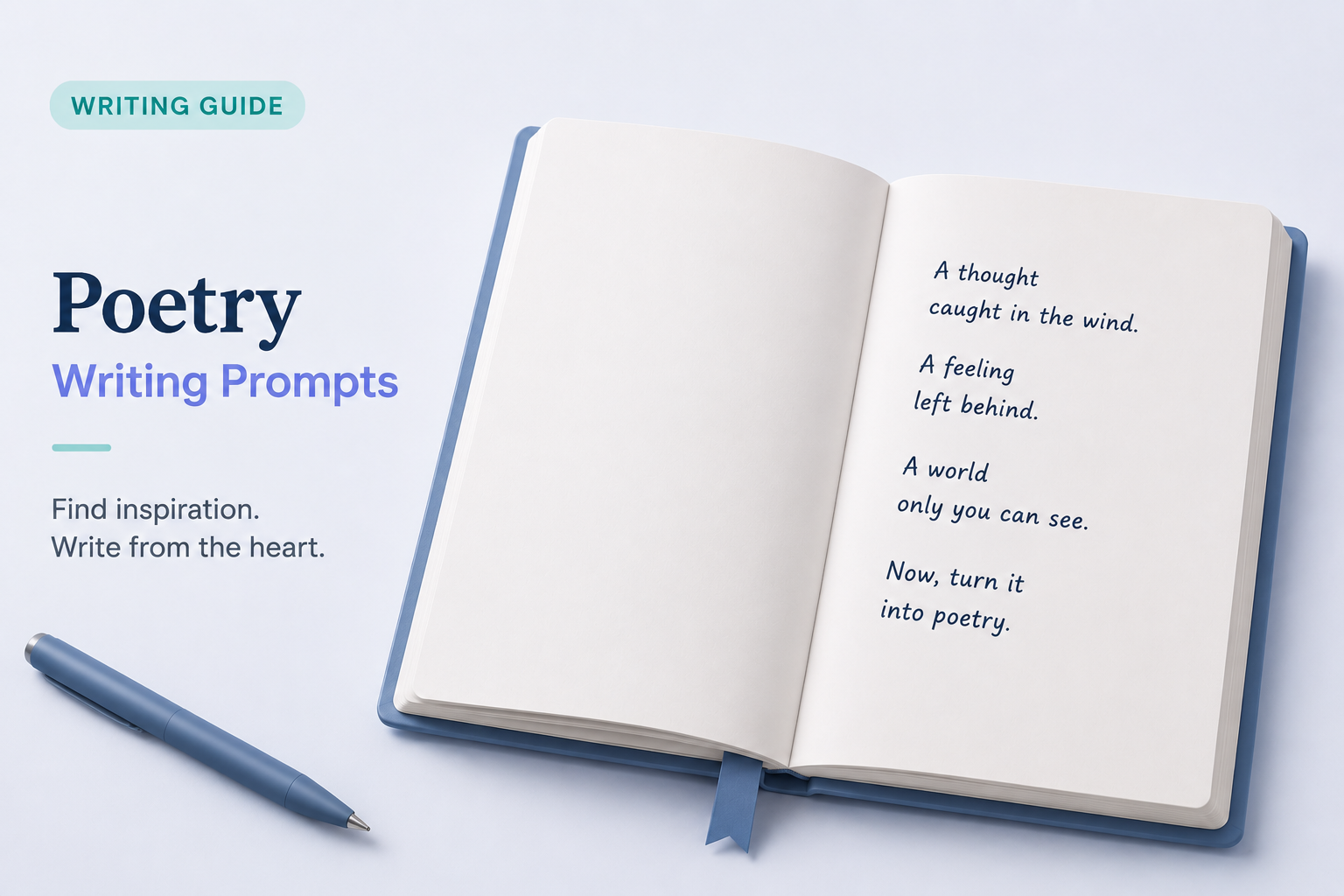
A blank page can make even the most creative person forget every thought they have ever had.
A good poetry prompt gives you a doorway into the poem itself, but when you find yourself just staring at the blankness of a page and only funny cat reels come to mind, “prompting” an idea can help you enter the artist-mode quickly.
Poetry writing prompts are short, specific starting points, an image, a feeling, a memory, a question, or a single first line that give you somewhere to begin when the blank page feels impossible.
Below you’ll find poetry prompts sorted by mood, theme, and poem style, from beginner-friendly poetry starters and short poem ideas to prompts designed to push your imagery, voice, and perspective further.
How Poetry Prompts Help You Start Writing
When you are dealing with writer’s block, it’s hard to even know where to begin. Starting with a prompt gives your mind something specific to respond to. That small shift can make it easier to write the first line, follow an image, or discover what the poem is really about as you go.
For beginners, a prompt can make the first line feel less like a test. For experienced poets, it can interrupt familiar habits and push the poem toward a new voice, form, or direction. Sometimes a prompt becomes a finished poem. Sometimes it only gives you one line worth keeping. Both outcomes are useful.
That is why poetry prompts work: they turn a broad writing task into a clear creative starting point. A prompt might begin with a memory, an object, a question, a first line, a scene, or a point of view. Instead of asking you to invent a finished poem from nothing, it gives you one place to begin.
Why a Prompt Is More Useful Than a Topic
A poem idea gives you the subject. A prompt gives you a way into it. Childhood is a topic. Write about a childhood room as if it still remembers you is a full prompt.
A poetry starter goes one step further. It gives you the first few words, such as: I still remember the sound of… or No one noticed when… From there, your job is simply to keep the sentence moving.
A few examples of the difference:
| Poem Idea | Poetry Prompt |
|---|---|
| Childhood | Write about a childhood room as if it still remembers you. |
| Love | Write a poem about love using only images from a kitchen. |
| Nature | Describe a storm without using the words rain, wind, or sky. |
| Regret | Write about an apology that stayed in your mouth too long. |
How to Use Poetry Prompts Without Feeling Boxed In
Poetry prompts work best when you treat them as invitations, not instructions. You can start with one image, feeling, or question, then let the poem move somewhere unexpected as you write.
Give yourself permission to write badly at first. Set a timer for 5 to 10 minutes, follow the line that feels most alive, and remember that one prompt can become a short poem, a free verse piece, a narrative poem, or just one strong line worth saving.
A simple way to begin:
- Choose a prompt that gives you a strong image or feeling.
- Write the first line before you have time to judge it.
- Keep writing for 5 minutes.
- Circle the phrase that feels most alive.
- Use that phrase as the real beginning of the poem.
Poetry Prompts for Beginners
Beginner poetry prompts work best when they give you a clear, specific starting point instead of making the blank page feel bigger. You do not need the whole poem at the start, but an image, object, feeling, or moment can give the first lines somewhere to land.
Start with one of these:
- Write about your morning using only what you saw, heard, smelled, tasted, or touched.
- Write about your favorite object without explaining why you kept it.
- Describe a place you know well, but never tell the reader where they are.
- Write about a color as if it has moods, habits, and secrets.
- Begin with “Today, I noticed…” and let the smallest detail lead the poem.
Build Your First Lines
A poem can start to move when you combine three small things: something you can picture, something you can feel, and something that shifts.
Choose one row from the table and write a few lines before your inner editor has time to interrupt.
| Start With | Add | End With |
|---|---|---|
| A place | A feeling | A surprising detail |
| A memory | A sensory image | A question |
| An object | A person connected to it | What has changed |
Poetry Prompts by Theme and Mood
| Theme | Poetry Prompt |
|---|---|
| Memory | Write about a memory that feels clear in one detail but blurry everywhere else. |
| Love | Write a love poem without using the word love. |
| Grief | Write about something small that feels heavier than it should. |
| Nature | Describe a season as if it were a person visiting your home. |
| Identity | Write a poem about a name, nickname, or title you have carried. |
| Change | Write about the moment before something ends. |
| Hope | Write a poem about a tiny sign that things might get better. |
| Fear | Describe fear as a place you once entered. |
A prompt should help you enter the poem, not trap you inside one idea. Follow what feels true, change direction when the writing asks for it, and keep the lines that surprise you.
55 Poetry Prompts by Style, Subject, and Mood
Here is the main collection, 55 poetry prompts grouped by what you’re in the mood for. Sometimes the problem is not the idea, it’s the shape the idea needs: a loose thought might want the room of free verse, while a sharp image works best as a short poem, a narrative poem, or an image-based opening. Start anywhere.
Free Verse Poetry Prompts
- Write a poem where the line lengths match the feeling: short and clipped, long and wandering, or uneven and restless.
- Write about a conversation where everyone talks around the one thing that matters.
- Describe a city street using only sounds: footsteps, traffic, voices, doors, music, sirens, silence.
- Write a poem that refuses to use a single full stop until the very last word.
- Let one long sentence wander across the whole page, then end with three short ones.
- Write about waiting, and let the line breaks do the waiting for you.
Short Poem Ideas
- Write a three-line poem about a goodbye without explaining who left.
- Describe a feeling in one image, without naming the feeling.
- Write a poem that fits inside a single breath.
- Write a two-line poem where the second line undoes the first.
- Capture an entire season in four lines or fewer.
- Write a poem small enough to fit on a luggage tag.
Narrative Poem Prompts
- Write about an arrival that happens just after it matters.
- Tell the story of a family object that means something different to each person who keeps it.
- Write about a journey remembered only through small things seen along the way.
- Tell the story of an ordinary day that quietly became the last of something.
- Follow a single letter from the moment it is written to the moment it is read.
- Narrate a photograph as if the moment kept going after the shutter closed.
Imagery-Based Poetry Starters
- Start with “The light fell across…”
- Start with “No one noticed the…”
- Start with “In the corner of the room…”
- Start with “By morning, the kitchen still smelled of…”
- Start with “Years later, I would remember the…”
Quick Poetry Prompts (5 Minutes or Less)
Set a timer for five minutes, pick one, and write without stopping or editing.
- Write down the last thing that made you pause today, then turn it into three lines.
- Describe the room you are in using only what you can hear.
- Write a poem that begins and ends with the same word.
- Capture this exact moment as if it were the only one you will remember.
- Write about the weather as if it matched your mood — without naming the mood.
- Finish this line and keep going: “Right now, I am…”
- Write a poem using only words you would say out loud to a stranger.
Things to Write About for a Poem
When you don’t need a prompt so much as a subject, start with one of these and let a single detail pull you in.
- The oldest object you own.
- A door you were afraid to open.
- The last text you never sent.
- A meal someone made for you once.
- The view from a window you no longer look out of.
- A scar and the story it stopped telling.
- The sound your house makes at night.
- A stranger you think about more than you should.
- The first time you felt older than you were.
- A song that belongs to one specific person.
- Something you lost that was never really yours.
- The space between deciding to leave and actually leaving.
Funny and Playful Poetry Prompts
Not every poem has to ache — humor and absurdity are their own kind of craft.
- Write an apology poem from your phone to your thumbs.
- Give a houseplant an inner monologue.
- Write an ode to the most useless object in your kitchen drawer.
- Describe Monday as if it owed you money.
- Write a breakup poem between you and a bad habit.
- Let an animal review your life choices in verse.
A 7-Day Poetry Prompt Challenge
Writing one poem is good; writing one a day builds the muscle. Take one of these per day for a week, with no pressure to make any of them perfect.
- Write about the place you slept as a child.
- Write a poem made entirely of questions.
- Describe a color to someone who has never seen it.
- Write about an ending without saying what ended.
- Borrow the first line of a song and then walk away from it.
- Write a poem in the voice of someone you miss.
- Reread your week and write one poem stitched from your favorite lines.
Editor’s note: My personal favorite way is to have a conversation as if the chatbot were a person. Talking about feelings is a great way to start, but if you’re uncomfortable with that, ask for poetry from a specific author or even something totally unrelated. Once I saw the name “Dada” and went on to search for its meaning, turns out the name came from “Dadaism,” an anti-artistic movement that happened in the first quarter of the 20th century. From there I was able to find a rebellious voice for a piece. In other words: play around a little!
How to Build a Leaner Chatbot Poetry Writing Prompts
AI can help you create poetry writing prompts, but it works best when you do not ask it for “a beautiful poem idea” and hope for magic.
A common mistake is treating AI like a vending machine for inspiration: ask for a sad poem, a romantic poem, or a deep poem, then accept the first polished answer. The result often feels smooth but predictable, because the chatbot leans toward familiar emotions, obvious metaphors, and safe poetic language.
A better approach is to ask for poetry prompts that create conditions, not finished feelings. Instead of asking for “a prompt about grief,” ask for a prompt where grief appears through objects, silence, routine, or something the speaker refuses to mention. That gives the poem room to become emotional without announcing the emotion too early.
Before asking a chatbot for poetry writing prompts, decide:
- What subject or feeling do you want to explore?
- What should the prompt avoid saying directly?
- Should the poem be short, narrative, free verse, or image-based?
- What kind of image, object, place, or memory should anchor the poem?
- What constraint would make the writing less obvious?
- Should the prompt leave the ending open instead of resolving the emotion?
A good AI-generated poetry prompt should give you one clear image, tension, constraint, or point of view that you can develop in your own voice.
| Instead of Asking AI For | Ask For a Prompt That Creates |
| A sad poem idea | An emotion shown through objects, habits, or silence |
| A love poem prompt | A relationship revealed through small actions, not direct confession |
| A poem about loneliness | A speaker who never says they are lonely, but keeps missing ordinary connections |
| A nature poem | A natural scene that reflects a change without explaining it |
| A deep poetry prompt | A contradiction, image, or question the poem cannot fully resolve |
That kind of request gives the chatbot enough structure to avoid generic ideas, while leaving you enough space to make the poem yours.
A simple rule: if the AI prompt asks for an emotion, make it more specific. If it asks for a topic, give it a constraint. If it asks for a finished poem, pull it back into a starting point.
Most weak AI poetry prompts can fail because they give the chatbot too much freedom in the wrong places. The better path is to use fewer, sharper instructions: one subject, one constraint, one image system, and one thing the poem is not allowed to say outright.
Editor’s Tip: More Poem Ideas to Try Today
Sometimes the best poems are those small, unfinished things that stay in your mind because they still have something to say. Or not! The idea is to find a middle ground for both.
Here are a few ideas to get you started:
- A letter you never sent, and the one sentence you would remove if you wrote it today.
- A sound from your childhood that returns before the memory does.
- The weather before important news, when the world looked ordinary but was not.
- A room after everyone has left, described through what was touched, moved, or forgotten.
- Something you inherited, and what it asks of you without speaking.
- A place you only visited once but still measure other places against.
- A promise you kept or broke, told through the moment just before the choice.
- A dream that stayed with you because it felt less like fiction than warning.
- A photo you cannot stop looking at, and the detail that keeps changing in your mind.
- A small object with emotional weight, described without explaining why it matters.
- A conversation you wish went differently, written through everything said around the truth.
- A version of yourself you have outgrown, meeting you in an ordinary place.
FAQ: Poetry Writing Prompts
Q: What are some good poetry prompts?
Good poetry prompts give you a specific image, feeling, or situation to begin with. Try prompts like: write about a room after everyone has left, describe a memory through one object, or write a love poem without using the word love. The best poetry prompts leave enough space for your own voice to take over.
Q: How do you write poetry when you have no ideas?
Start with one small detail instead of trying to find a whole poem. Choose an object, sound, memory, photo, place, or sentence fragment, then write a few lines without judging them. Poetry writing prompts help because they give your mind something concrete to respond to when the blank page feels too open.
Q: What are good prompts to write about?
Good prompts to write about include memories, relationships, ordinary objects, childhood sounds, weather before important news, dreams, inherited things, and conversations that stayed with you. Strong poem ideas usually have emotional tension, sensory detail, or an unanswered question that gives the poem room to grow.
Q: How do you make your poetry stand out?
Make your poetry stand out by being specific, not dramatic. Instead of naming the emotion directly, show it through images, actions, objects, silence, or contrast. A poem about grief, for example, can feel stronger when it focuses on a chair left untouched or a shirt still hanging in the closet.
Q: What are common poem themes?
Common poem themes include love, memory, grief, identity, nature, change, hope, fear, family, time, and belonging. These themes work well because they connect to experiences many readers recognize. To make them feel original, approach the theme through a specific image, moment, voice, or unusual point of view.
Q: How do I write a catchy poem?
A catchy poem usually begins with a strong first line, a clear image, or a surprising turn. Focus on rhythm, sound, and one memorable detail. You do not need to make every line clever. A poem often becomes more powerful when it has one phrase the reader wants to return to.
Q: What are short poem ideas?
Short poem ideas work best when they focus on one image, moment, or feeling. Write a three-line poem about a goodbye, describe a feeling without naming it, or write a poem that can be read in one breath. Short poems do not need to explain everything. They often work through suggestions.
Q: What are the best topics for poetry?
The best topics for poetry are the ones that still feel unresolved in your mind. A place you left, a person you miss, a promise you kept, a photo you keep returning to, or a version of yourself you have outgrown can all become strong poem ideas when written with detail and honesty.