
What makes a story good? Is it the heart-pounding suspense of a mystery novel, the boundless imagination of a fantasy world, or the emotional depth of a love story? A great story stays with us long after we’ve turned the last page.
When writing a story, whether you’re writing novels, writing short stories, or experimenting with short fiction, it’s a specific set of elements, applied deliberately, that create that lasting impact, along with knowing how those elements shift depending on genre.
This guide breaks down what makes a good story stand out, whether you’re crafting a thrilling whodunit, an epic adventure, or a heartwarming love story, and addresses a debate most writing resources skip entirely: whether plot or character actually matters more, and why that might be the wrong question to ask in the first place.
The Foundation of a Good Story
A compelling story doesn’t just happen, it’s built with intentional choices that keep readers engaged. When writing a story, whether it’s novel writing, non fiction, or creative writing more broadly, what makes a good short story or novel is the careful use of key elements that draw readers in and hold their attention.
It’s just a matter of applying them deliberately rather than hoping talent alone carries a new story from first page to last.
A good beginning
A good beginning hooks the reader by introducing the main character, setting, and conflict, setting the tone for the rest of the narrative. Starting in medias res, amid the action, creates urgency and pulls readers directly into the story without a lengthy introduction. Introducing the main character in a way that makes the reader care about them, showcasing their thoughts, feelings, and motivations, builds connection from the first page.
Compelling characters
Readers connect with characters who feel real, flawed, complex, and driven by goals. Whether it’s a detective solving a case, a wizard learning magic, or a lover navigating heartbreak, characters need depth. Their choices, growth, and relationships with other characters shape the story’s emotional core.
An engaging plot
A plot should move the story forward with purpose. A story that lacks direction falls flat, losing the reader’s interest. Whether it’s a mystery with unexpected twists, a fantasy quest with rising action, or a romance with emotional stakes, every scene should serve the overall narrative.
Real conflict and stakes
Nothing drives a story forward like genuine conflict, something the protagonist wants and something standing in the way. Stakes make that conflict matter, what does the character stand to lose if they fail? Without clear stakes, even well-written conflict can feel like motion without consequence.
A vivid setting
Setting isn’t just a backdrop, it shapes the characters and events. Fantasy and science fiction stories transport readers to new worlds, while mysteries often rely on eerie atmospheres or urban landscapes. The more immersive the setting, the stronger the reader’s connection to the story.
Narrative voice and writing style
The way a story is told matters. First-person narration brings readers inside a character’s mind, while third-person gives a broader view of the world. Writing style, from lyrical prose to snappy dialogue, sets the tone and keeps readers engaged.
Universal themes
Great stories explore themes that resonate with readers, love, identity, justice, adventure. Whether it’s coming-of-age lessons or philosophical questions, themes add depth and meaning beneath the surface plot.
Strong narrative structure
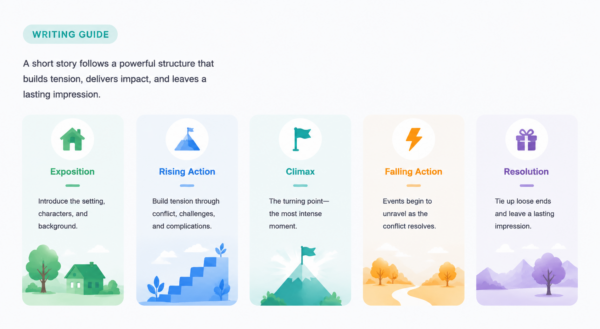
A strong narrative structure is the backbone of a compelling story, encompassing the plot, characters, setting, and themes in a clear beginning, middle, and end. The three-act structure, setup, confrontation, resolution, remains effective in both short stories and novels. Pacing and tension are critical here too, balancing high-tension moments with periods of release keeps readers engaged without exhausting them.

Starting the Writing Process (and Getting Past Writer’s Block)
Understanding what makes a good story is one thing. Actually sitting down to start writing it is another, and it’s worth addressing directly rather than assuming the two are the same skill.
For new writers especially, the hardest part is rarely knowing the theory, it’s just getting a first draft down, finishing writing the thing before worrying about whether it’s good.
A common piece of writing wisdom, sometimes attributed loosely to various working novelists, holds that a writer needs to produce roughly a million words before their work consistently reads as accomplished.
Whether or not that exact number holds up, the underlying point does: writing fiction requires practice, not just knowledge of story structure, and many writers only really begin writing with confidence after finishing several complete first drafts, good, bad, or somewhere in between.
As a story progresses from first draft to final version, that early practice tends to show less problem solving on the page, more sense of where the story is actually headed.
A scene as small as a love interest telling the protagonist she’s leaving can carry an entire chapter’s worth of emotional weight once a writer has enough practice to trust a single moment to do that work.
Writer’s block deserves a direct, honest mention too, since it affects new writers and long-published ones alike. It often isn’t a lack of ideas so much as a fear that the current sentence isn’t good enough yet, sometimes bordering on sheer rage at a scene that refuses to work.
Writing prompts can help restart momentum when a story stalls, as can simply lowering the bar for a first draft entirely, permission to write badly now and revise later is one of the more reliable ways past a stuck scene.
If a single scene or even a single sentence is the sticking point, skipping ahead to a scene that feels more interesting to write right now, then circling back, often unsticks the whole project.
Whether the goal is traditional publishing or self-publishing, most stories go through this same messy middle before becoming something worth showing to loved ones, let alone a wider readership, and there’s nothing wrong with that being the case.
For writers drawn to shorter forms specifically, a microfiction story or a piece of flash fiction can be a genuinely useful way to practice the core elements covered here, character, conflict, a central question, and resolution, at a scale small enough to finish in a single sitting.
Many writing contests built around these shorter forms also publish their submission guidelines publicly, and reading what a contest judge is actually looking for is a fast, concrete way to understand which elements of a short piece are pulling their weight and which aren’t.
The Plot vs. Character Debate (and Why It’s the Wrong Question)
This is one of the most persistent, genuinely unresolved debates in serious writing communities, and most guides to “what makes a good story” sidestep it entirely by simply listing plot and character as two separate checklist items. It deserves real treatment.
The debate itself is old and, honestly, a little tired: which matters more, plot or character? Writers who lean toward plot argue that events and structure are what keep pages turning.
Writers who lean toward character argue that readers stay invested in people, not events, and that a fascinating character can carry a thin plot far further than a brilliant plot can carry flat characters. Both camps have real, credible examples to point to.
The more useful framing, and the one most experienced writers eventually land on, is that this is a false binary. Plot is what a character does.
You cannot have a plot without a character to enact it, and you cannot have a character whose depth means anything without a plot to reveal it through. An unknown planet hurtling toward
Earth isn’t a story, it’s a news item, until specific characters start reacting to it, making choices, and living with the consequences.
The two build each other in a continuous cycle: character creates plot, plot reveals character, and that revelation creates the next turn in the plot, shaping the character arcs that make a story feel like it’s actually going somewhere rather than just happening.
It also helps to separate two terms that get used interchangeably but aren’t quite the same thing.
Plot is the structured sequence of events, what happens, in what order, and why.
Story is the larger whole, plot plus characters plus setting plus theme plus the specific way it’s told. Treating “plot” as a stand-in for the entire story is a common, quiet source of craft problems, since a writer can nail the sequence of events perfectly and still have a story that doesn’t work, because the events aren’t landing through a character worth caring about.
A practical diagnostic worth using during revision: can your story have too much plot and not enough character? Yes, easily, this shows up as a book that’s eventful but oddly hollow, where readers can summarize what happened but struggle to say who the protagonist actually is underneath the events.
Can it have too much character and not enough plot? Also yes, though it’s rarer, this shows up as a story that sits inside a character’s head indefinitely without anything actually happening to test or reveal them.
Worth naming too: some writers deliberately build stories through character alone, without a pre-planned plot at all, often called discovery writing or “pantsing.” A character is dropped into a situation, real life pressures and all, and the writer follows their reactions scene by scene rather than working from an outline.
This is a legitimate process, not a lesser one, plenty of great novels and good novels alike get written this way. The key difference between this working and not working usually comes down to whether the character’s reactions are consistent and specific enough to generate real plot momentum on their own, which is really just the same plot-character cycle described above, approached from the character side first instead of the outline side.
Start Your Publishing Journey FOR FREEWhat Changes by Genre
Before going deeper into each genre, here’s how the core elements above shift depending on what you’re writing.
| Mystery | Fantasy | Love Story | |
| Core question | Who did it, and why? | What are the rules of this world, and what’s at stake in it? | Will they end up together, and what do they overcome to get there? |
| Central engine | Clues and red herrings | World-building and a consistent magic system | Emotional conflict and growth |
| Reader’s role | Piecing together the truth alongside the protagonist | Being transported into an unfamiliar world | Rooting for two specific people |
| Common pitfall | A reveal that isn’t earned by earlier clues | Magic with no real limits or cost | Romance that overshadows the rest of the plot |
What Makes a Good Mystery Story?
Mystery stories keep readers hooked by posing a question: Who did it? Why did it happen? How will the protagonist uncover the truth? What makes a good mystery story is its ability to maintain suspense, intrigue, and clever storytelling that keeps readers on the edge of their seats.
The inciting incident
Every mystery starts with a disruption, a crime, a disappearance, or a hidden secret. This event propels the protagonist into action, compelling them to seek answers.
Rising action and clues
A mystery unfolds through layers of tension. Clues are scattered throughout, leading readers closer to the truth while keeping them guessing. The best mysteries challenge readers to piece things together.
A protagonist who overcomes challenges
A detective, journalist, or amateur sleuth must navigate obstacles, misleading clues, reluctant witnesses, or personal dilemmas, to solve the mystery. Their determination and intellect keep the story compelling.
Foreshadowing and red herrings
Great mystery writers, like Agatha Christie, masterfully mislead readers while planting subtle hints. Foreshadowing builds suspense, while red herrings keep readers from solving the puzzle too soon.
A satisfying resolution
The final reveal should feel earned, not forced. A great mystery ties up loose ends while delivering an unexpected, yet logical, conclusion.
Great example: the Sherlock Holmes stories by Arthur Conan Doyle.
What Makes a Good Fantasy Story?
Fantasy stories transport readers to extraordinary worlds, blending imagination with universal human struggles. What makes a good fantasy story is how it combines a richly built world with compelling characters and high stakes, whether it’s high fantasy or urban fantasy.
An immersive world
World-building is crucial. Whether it’s a medieval kingdom or a futuristic society, the setting should feel real, with its own rules, history, and cultures.
A magic system and its rules
If magic exists, it should have limitations and consequences. A structured magic system with real limits feels believable within its world in a way that limitless magic rarely does.
Characters who react to the world
A great fantasy story isn’t just about world-building, it’s about how characters navigate that world. Their challenges, conflicts, and relationships drive the story forward.
Conflict and high stakes
Fantasy thrives on epic conflicts, good vs. evil, rebellion against tyranny, personal redemption. Stakes should feel meaningful, making readers invested in the protagonist’s journey.
Universal themes and symbolism
Like all great stories, fantasy explores deeper themes, power, destiny, love, and sacrifice. A compelling sci-fi or fantasy novel makes readers reflect on real-world issues through a magical or speculative lens, whether the world in question is entirely new or grounded in something closer to home.
Great example: the Harry Potter series by J.K. Rowling.
What Makes a Good Love Story?
Romance stories resonate because they tap into the human experience of love, heartbreak, and personal growth. What makes a good love story is its ability to explore these emotions deeply, creating characters whose journeys feel real and relatable.
Characters with depth
A love story is only as strong as its characters. A romantic lead should have flaws, dreams, and agency, someone readers want to root for.
Emotional conflict and growth
Great romance isn’t just about falling in love, it’s about overcoming obstacles. Whether it’s external conflict (family, distance) or internal struggles (fear, self-doubt), characters must grow throughout the story.
Body language and dialogue
Romance isn’t just about grand declarations, it’s in the small moments. Subtle body language, tension-filled conversations, and unspoken emotions make relationships feel authentic.
Balancing love and plot
Romance should enhance the story, not overshadow it. The best love stories weave romance into the larger narrative rather than making it the sole focus.
A satisfying resolution
Whether the ending is happy, bittersweet, or open-ended, it should feel meaningful. A satisfying resolution leaves readers emotionally fulfilled.
Great example: The Fault in Our Stars by John Green.

HHow to Make Your Story Stand Out
Even with strong characters and a solid plot, writing a story requires a unique touch to truly shine.
Avoid clichés
Fresh perspectives keep stories original, and familiar plot devices used without variation make a story feel predictable rather than comfortingly familiar.
Pacing matters
Short stories and novels require different rhythms. A story that moves too slowly becomes boring, while one that rushes can overwhelm the reader, striking the right balance keeps the narrative moving without feeling dragged out.
Supporting characters shape the protagonist
Side characters add depth and contrast, revealing the protagonist through relationship rather than exposition alone.
Weak characters remain a frequent problem even in otherwise well-plotted stories. Characters need distinct thoughts, feelings, and motivations, and they need to be active participants driving the plot forward, not merely observing events as they happen around them.
By avoiding these pitfalls, clichés, poor pacing, and weak characters, what makes a good short story becomes clearer, making it much easier to write your own story, one that captivates and holds the reader’s attention from beginning to end.
With so many books competing for a reader’s time, a new story needs every one of these elements pulling in the same direction, and there’s no substitute for actually finishing one scene, then the next, until the main conflict resolves. It should still be fun, and if it stops being fun entirely, that’s usually worth paying attention to as well, not just pushing through in silence.
Talking through a stuck story with other writers, rather than working in total isolation, often surfaces the fix faster than staring at the page alone, and it’s worth strongly recommending it to any writer who’s never tried it.
Whatever the outcome, finishing a story is itself a real accomplishment worth some hope and pride, regardless of how the final draft compares to the one in your head when you started.
FAQ: What Makes a Good Story
Q: What makes a story so powerful?
A powerful story leaves a lasting emotional or intellectual impact, drawing readers into its world through relatable characters, emotional depth, and universal themes like love, loss, justice, or redemption. More than entertainment, it provokes thought and reflection.
Q: How do you define a good story?
A good story captures the reader’s attention, keeps them engaged, and leaves a lasting impression. It has a clear structure with a well-defined beginning, middle, and end, strong character development, real conflict, and a resolution that feels satisfying, whether happy, bittersweet, or open-ended.
Q: Is plot or character more important in a story?
Neither, and treating them as competing priorities is usually the wrong frame. Plot is what a character does, and character depth is revealed through plot. The two build each other continuously, which is why the strongest stories rarely sacrifice one for the other.
Q: What makes writing good, beyond just plot and character?
Clarity, so sentences flow naturally, engagement that keeps a reader hooked from the first line, and authenticity, a genuine, specific voice rather than a generic one. Good writing lets a reader experience the story rather than just being told what happened.
Q: What are the 5 most important elements of a short story?
A single focus, since short stories revolve around one key theme or event rather than many. Strong characters, even within a limited page count. A concise, purposeful plot where every sentence contributes. Atmosphere and setting, even briefly sketched. And a powerful ending, whether a twist, an emotional beat, or a deliberately open question.
Q: What makes a great story idea?
A great idea has depth, emotional weight, and built-in conflict, not just novelty. Asking a genuine “what if” question is a reliable way to generate one, and a fresh angle on a familiar theme often produces a stronger idea than an entirely unfamiliar premise.
Q: Can a story be too plot-heavy or too character-heavy?
Yes, both are real problems, and the full diagnostic above covers how to spot each one during revision. The short version: too much plot reads as busy but hollow, too much character reads as static, nothing actually testing who they are.