If you’ve ever written “he said” so many times your document started echoing, you’re not alone. Dialogue tags are those little signposts that tell readers who is speaking in a conversation: she whispered, they shouted, he asked, and so on. They may look small, but they’re the unsung heroes of fiction, quietly keeping your characters from turning into a confusing chorus of disembodied voices.
So, what are dialogue tags in writing really? Think of them as your story’s conversational GPS: they guide readers through exchanges, add tone and rhythm, and reveal emotion without hijacking the scene. A well-placed tag keeps dialogue smooth and natural, while a clumsy one can trip up even the most gripping exchange.
In this article, you’ll discover what dialogue tags are, how to use them like a pro, which ones to avoid (yes, even he exclaimed dramatically!), and a handy dialogue tags list packed with dialogue tags examples that’ll keep your writing sharp, engaging, and delightfully human.
Start Your Publishing Journey FOR FREEDefinition Time: What Are Dialogue Tags, Really?
Dialogue tags are the little anchors that keep your conversations from drifting into chaos. In simple terms, they’re phrases that tell the reader who’s speaking and how they’re saying it. For example: “I’m not scared,” she whispered. Here, she whispered is the tag, which identifies the speaker and gives the line a specific tone. Without it, readers would be left guessing who said what.
But don’t confuse dialogue tags with action beats. In “I’m not scared.” She crossed her arms. The second sentence isn’t a tag; it’s an action that shows attitude instead of saying it outright. Great writers often mix both to keep dialogue dynamic and natural.
Tags can appear before (She whispered, “I’m not scared.”), in the middle (“I,” she whispered, “am not scared.”), or after the dialogue. Used wisely, they control pacing, shape rhythm, and give emotion its voice. In short, what are dialogue tags? The subtle glue that holds your conversations together.
Say What? How to Use Dialogue Tags Without Driving Readers Crazy
Using dialogue tags is like seasoning food: too little and your readers get lost, too much and they choke on it. The trick is balance. Every line of dialogue doesn’t need a tag waving its hand and shouting for attention. When done right, tags make your writing feel natural and easy to follow. When overused, they start sounding like a roll call at drama camp.
Here’s the golden rule: “said” and “asked” are your invisible heroes. Readers glide right past them without even noticing, which is exactly what you want. Tags like “he grumbled resentfully” or “she articulated proudly” stick out like bad karaoke: they distract instead of enhance.
Correct: “I told you not to touch it,” she said.
Incorrect: “I told you not to touch it.” She said. (That period should be a comma!)
Remember: the comma goes inside the quotation marks, the tag stays lowercase (unless it’s a name), and question marks or exclamation points replace the comma when needed.
The Rule of the Invisible Said: When in doubt, let “said” do the heavy lifting.
Learning how to use dialogue tags well means mastering clarity, rhythm, and restraint, all while keeping your readers blissfully unaware you’re pulling the strings.
The Handy Dialogue Tags List You’ll Actually Use (With Examples)
There are more ways to say something than your thesaurus wants you to believe. But before you go wild with “he articulated” and “she vocalized,” let’s get practical. A good dialogue tags list isn’t about showing off; it’s about clarity, rhythm, and emotion. Below is a list of dialogue tags examples you’ll actually use (and your readers will thank you for).
Neutral Dialogue Tags
These are your bread and butter. They keep conversations flowing without drawing attention.
- said
- asked
- replied
- answered
- added
Example: “I’ll handle it,” she said. / “Really?” he asked.
Emotional Dialogue Tags
Perfect for hinting at feelings, but sprinkle lightly.
- shouted
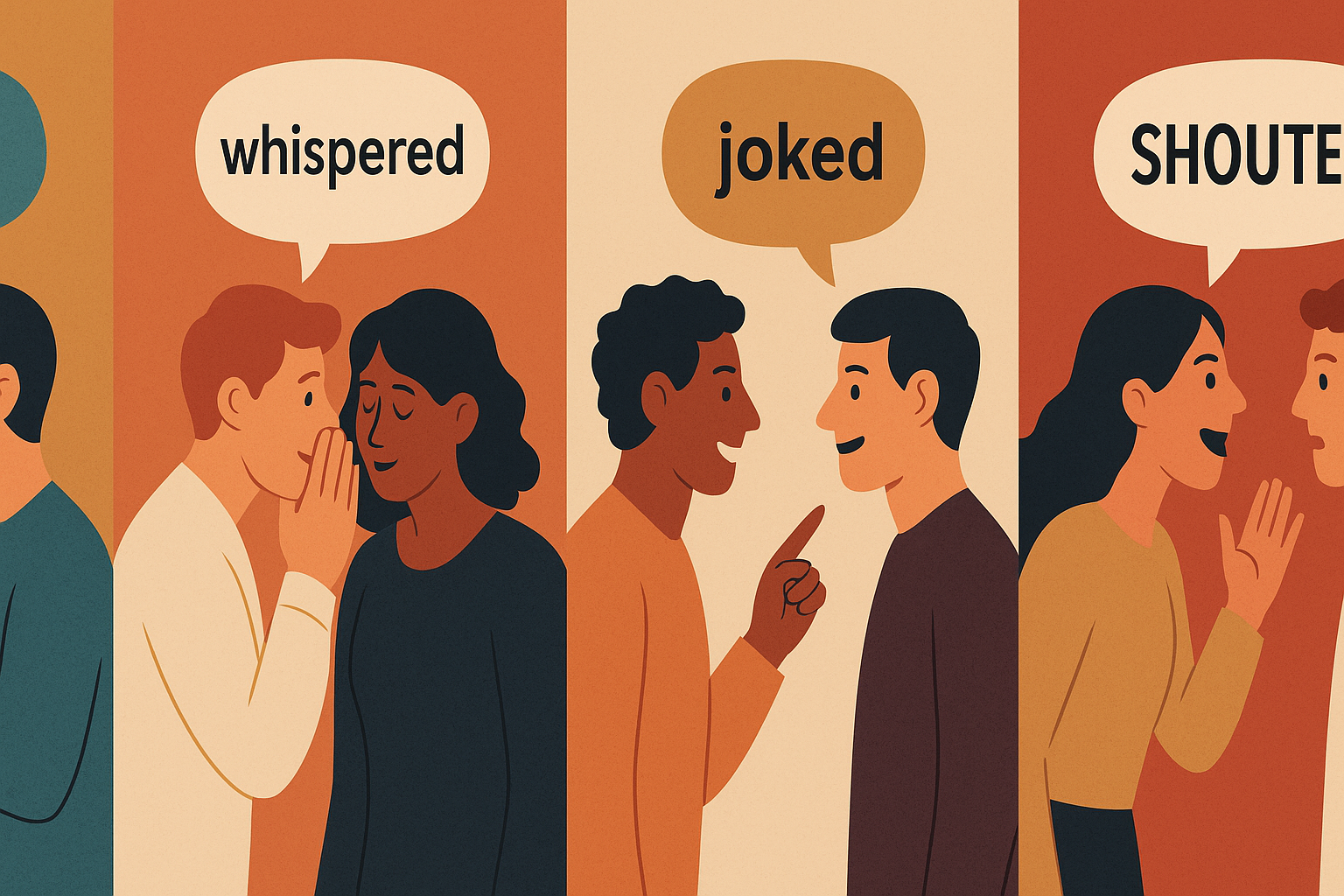
- whispered
- muttered
- sighed
- cried
Example: “I can’t believe it,” she whispered. / “Finally!” he shouted.
Tone-Based Dialogue Tags
Ideal for revealing attitude or personality.
- joked
- demanded
- teased
- confessed
- argued
Example: “You never listen,” she argued. / “I might have eaten the last cookie,” he confessed.
Volume & Intensity Tags
Use to convey energy, urgency, or mood shifts.
- bellowed
- murmured
- exclaimed
- yelled
- snapped
Example: “Get down!” he bellowed. / “It’s fine,” she murmured.
Creative (But Risky) Dialogue Tags
Fun to experiment with, but overuse them and your writing starts sounding like a cartoon.
- cautioned
- hissed
- groaned
- moaned
- stammered
Example: “Don’t move,” she cautioned. / “I can’t… believe… this,” he stammered.
A well-crafted dialogue tags list isn’t about replacing said; it’s about variety, subtlety, and storytelling flair. Use these dialogue tags examples as seasoning, not sauce.
The Art of Subtlety: When (and When Not) to Use Dialogue Tags
Like salt in a recipe, dialogue tags should enhance flavor, not overwhelm it. If every line of dialogue ends with a dramatic flourish: “he declared,” “she snapped,” “they retorted furiously”, your story starts reading like a soap opera on caffeine. Subtlety is what keeps dialogue believable.
Over-tagged:
“I’m done with this,” she shouted angrily. “You never listen,” he growled back. “Maybe I wouldn’t have to,” she retorted bitterly.
Smoother alternative:
“I’m done with this.” Her voice rose.
“You never listen.”
“Maybe I wouldn’t have to if you did.”
See the difference? The emotion stays, but the writing breathes. Instead of cluttering every line with tags, mix in action beats: gestures, expressions, or movements that reveal tone. For example, skip “‘I hate you,’ she spat” and write She slammed the door. “I hate you.” The message lands harder and cleaner.
Quick Tips:
- Use tags to clarify, not decorate.
- Vary rhythm, don’t tag every line.
- Trust your readers to pick up emotional cues.
- When in doubt, let “said” quietly do its job.
Because if every line screams, readers stop listening. Mastering how to use dialogue tags means knowing when to speak and when to stay silent.
Common Dialogue Tag Mistakes to Avoid
Even the best dialogue can fall flat if your tags trip over themselves. Here are the most common pitfalls and how to sidestep them with style.
1. The Adverb Overload
If every tag ends in -ly, your dialogue starts sounding like it’s on autopilot.
Before: “It’s fine,” she said softly.
After: “It’s fine.” Her voice barely rose above a whisper.
2. The Thesaurus Trap
You don’t need to prove you own a dictionary. Tags like he articulated or she vocalized feel stiff.
Before: “I agree,” he articulated.
After: “I agree,” he said.
3. The Punctuation Problem
A period before a tag breaks the flow.
Before: “Let’s go.” He said.
After: “Let’s go,” he said.
4. The Overexplainer
Don’t describe what’s already obvious from the dialogue itself.
Before: “I hate you!” she shouted angrily.
After: “I hate you!” she shouted. (We got the anger, thanks.)
Learning how to use dialogue tags well means trusting your dialogue to carry emotion. Subtlety wins always.
Dialogue Tags in Action: Famous Examples That Nail It
If you want to see dialogue tags in action, look no further than the masters. J.K. Rowling, for instance, treats them like quiet stage directions: useful, clear, and never overdone. In Harry Potter, she mixes simple tags like said and asked with occasional emotional ones: whispered, muttered, snapped, to match the scene’s energy. It’s a balanced approach: just enough flair to keep Hogwarts buzzing with personality.
Ernest Hemingway, on the other hand, took the minimalist route. In The Sun Also Rises, nearly every tag is said, and it works. His crisp style lets the dialogue speak for itself. The rhythm feels natural, conversational, and unpretentious.
Then there’s Jane Austen, who used tags as part of her wit. She often paired them with action or irony, like “said Elizabeth, with a smile,” letting personality shine through without a single adverb in sight.
The lesson? There’s no single right way. Whether you prefer Rowling’s variety, Hemingway’s restraint, or Austen’s charm, find your rhythm. Great dialogue isn’t about showing off, it’s about sounding real.
Dialogue tags aren’t just technical tools; they’re the soundtrack of your story’s conversations.
Wrap-Up: Your Turn to Talk
And now it’s your turn to talk—literally. We’ve covered what dialogue tags are, how to use dialogue tags effectively, and the sneaky mistakes that can turn good dialogue into a grammatical circus. The secret is balance: let your characters speak freely while your tags quietly steer the conversation.
Experiment, mix in action beats, play with rhythm, and listen to how your dialogue sounds out loud. If it flows naturally, your tags are doing their job. And if not? Well, you’ve got a handy dialogue tags list to guide you back.Because sometimes, “he said” says it all.
FAQs – Dialogue Tags
Q1: What are dialogue tags used for?
Dialogue tags are used to identify who’s speaking and how they’re saying it. They guide readers through conversations, keeping exchanges clear and natural. Without them, your story risks turning into a guessing game of “who said what.” Think of tags as the traffic signals of dialogue: they direct flow and prevent literary pileups.
Q2: What are the incorrect dialogue tags?
Incorrect dialogue tags are ones that distract or confuse readers. Examples include over-the-top or illogical verbs like “he laughed” as a tag (you can’t literally laugh words). Overusing adverbs (“she said softly”) or weird synonyms (“he articulated”) also count as offenders. The best tags are simple, logical, and natural.
Q3: Why do writers use dialogue tags?
Writers use dialogue tags to give conversations clarity, tone, and rhythm. Tags help readers understand emotion and pacing without interrupting the flow. They can show who’s speaking, hint at mood, and keep multi-character scenes from sounding like chaos at a dinner party.
Q4: What are the seven rules of dialogue?
Each new speaker gets a new paragraph.
Punctuation goes inside quotation marks.
Keep tags lowercase after the quote (“…,” he said).
Avoid excessive adverbs.
Mix in action beats for variety.
Don’t over-tag every line.
Read your dialogue aloud—it should sound real.
Q5: Can you write dialogue without dialogue tags?
Absolutely. Skilled writers often drop tags when context or character voice makes it clear who’s speaking. Using action beats like gestures or reactions can replace tags beautifully. Just don’t go overboard; sometimes a simple “she said” is all you need to stay grounded.
Q6: What is the main purpose of a dialogue?
The main purpose of dialogue is to reveal character, move the story forward, and make readers feel like they’re eavesdropping on real life. Dialogue brings your world to life; it’s where emotion, tension, and personality collide on the page.