
You can become a freelance writer without formal experience by choosing a writing service, creating a few strong samples, building a simple portfolio, and reaching out to beginner-friendly clients. You do not need a degree or published work to start, but you do need to show that you can write clearly, follow a brief, and create useful content for a specific audience.
If you enjoy writing, freelance writing can be a realistic way to turn that skill into paid work. The challenge is knowing where to begin. Freelance writers create many types of content, including blog posts, website copy, email newsletters, product descriptions, author bios, book descriptions, and ghostwritten articles.
This guide will show you how to become a freelance writer with no experience in a practical way, from choosing your first services to building a portfolio, finding writing jobs, setting beginner rates, and following a simple 30-day plan.
What Does a Freelance Writer Do?
A freelance writer creates written content for clients on a project, contract, or ongoing basis. Their clients may include businesses, publications, authors, marketing agencies, nonprofits, startups, or individuals who need clear, useful, and audience-focused writing.
Freelance writers are usually hired to help with a specific goal. A company may need blog posts to attract search traffic, an author may need a stronger book description, or an agency may need website copy for a client. The writer’s job is to understand the assignment, research the topic, write in the right voice, and deliver polished content that serves the client’s purpose.
Common freelance writing tasks
Freelance writing can cover many types of content. Some writers specialize in one format, while others offer a few related services.
Common freelance writing tasks include:
- Blog posts that educate readers, answer search questions, or support a company’s content strategy
- Website copy for homepages, service pages, about pages, and landing pages
- Email newsletters that keep subscribers informed, engaged, or ready to take action
- Product descriptions that explain features, benefits, and use cases clearly
- Social media captions for brands, creators, authors, or small businesses
- Case studies that show how a product, service, or customer success story worked in practice
- Ghostwritten articles credited to a founder, executive, author, or subject-matter expert
- Book-related content, such as author bios, book descriptions, press releases, and promotional copy
- SEO articles designed to answer search intent and help pages appear in Google results
For beginners learning how to become a freelance writer, blog posts, SEO articles, email newsletters, and simple website copy are often practical starting points because they are widely needed and easier to turn into portfolio samples.
Freelance writing vs. writing for yourself
Writing for yourself is usually driven by your own ideas, voice, and creative goals. Freelance writing is different because it is client-focused. You still need strong writing skills, but the work must also solve a real problem for someone else.
That problem might be attracting readers from search engines, explaining a service clearly, selling a product, building trust with an audience, or helping a professional sound more polished online. A good freelance writer does more than write nicely. They ask what the content needs to achieve, who it is for, where it will appear, and what the reader should understand or do next.
Step-by-Step Roadmap: How to Become a Freelance Writer
The simplest way to become a freelance writer is to choose what you want to write, create proof that you can do it, and start reaching out to clients who need that type of content. You do not need to figure out your entire career path at once, but you do need a clear first offer, a few strong samples, and a repeatable way to find work.
Step 1: Choose the type of writing you want to offer
Begin by choosing a few writing services you can realistically provide. You can start broad while you learn, but “I write anything” is usually too vague for clients. A clearer offer helps people understand what they can hire you for.
Beginner-friendly writing services include:
- SEO blog writing
- Website copy
- Email writing
- Book descriptions
- Author bios
- Thought leadership articles
For example, instead of saying, “I’m a freelance writer,” you might say, “I write blog posts and website copy for small businesses,” or “I help authors with book descriptions, bios, and promotional content.” This gives your freelance writing work a practical shape.
Step 2: Pick a beginner-friendly niche
A niche is the area or type of client you want to write for. It does not have to limit you forever. It simply helps clients understand where your writing fits best.
Beginner-friendly niches include:
- Books and publishing
- Health and wellness
- Finance
- Education
- Lifestyle
- Technology
- Small business
Choose a niche based on your interests, background, or topics you are willing to research. If you enjoy books, publishing, and author branding, you might start with book-related content. If you have experience in education, you might write blog posts for tutoring companies, online courses, or learning platforms.
The goal is not to pick the perfect niche on day one. The goal is to make it easier to create samples, find relevant clients, and write pitches that feel specific.
Step 3: Learn the basics of SEO writing
Many freelance writing jobs involve online content, so basic SEO knowledge is useful even for beginners. You do not need to become a technical SEO expert, but you should understand how search-friendly content works.
Start with these basics:
- Search intent: what the reader is trying to learn, solve, or compare
- Keywords: the words and phrases people use when searching
- Headings: clear H2s and H3s that organize the article
- Internal links: links to related pages on the same website
- Clear structure: sections that answer one idea at a time
- Helpful answers: direct, useful explanations rather than vague advice
- Readability: short paragraphs, natural language, and logical flow
This matters for Google Search, AI Overviews, and answer engines because clear, well-structured content is easier to understand, summarize, and cite. A good freelance writer does not just include keywords. They help readers find the answer quickly and understand what to do next.
Step 4: Create writing samples
You do not need a client’s permission to prove you can write. If you do not have paid work yet, create your own samples. These are practice pieces that show your style, structure, research ability, and understanding of a specific content format.
A simple beginner portfolio can start with:
- One blog post
- One landing page sample
- One email newsletter
- One niche-specific article
Make each sample feel realistic. For example, if you want to write for authors, create a sample author bio, a book description, or a blog post about book marketing. If you want to write for small businesses, write a sample service page or a local SEO article.
Treat these samples like client work. Give them clear titles, edit them carefully, and format them so they are easy to read.
Step 5: Build a simple portfolio
Your portfolio does not need to be fancy. It only needs to make it easy for a potential client to see what you write and how to contact you.
You can build a portfolio using:
- A Google Doc
- A Notion page
- A simple personal website
- A PDF portfolio
Include the basics:
- A short introduction
- The writing services you offer
- 3 to 5 writing samples
- Your contact information
- A short niche description, if relevant
For example, your intro could say, “I write clear blog posts, website copy, and email content for small businesses and authors.” Keep it simple. Clients should not have to guess what you do.
Step 6: Find your first freelance writing jobs
Once you have a few samples, start looking for beginner-friendly opportunities. Your first goal is not to land the perfect client. It is to get real practice pitching, speaking with clients, and completing paid writing work.
Places to find first freelance writing jobs include:
- Upwork
- ProBlogger
- Freelance Writing Jobs
- Facebook groups
- Cold email
- Local businesses
- Agencies
- Author service companies
- Content marketing agencies
Use a mix of methods. Job boards can help you understand what clients are asking for. LinkedIn can help you build visibility. Cold email can help you reach businesses that may need content but have not posted a job.
Track where you apply, who responds, and which samples you send. This helps you improve your outreach instead of guessing.
Step 7: Pitch clients clearly
A beginner pitch should be short, specific, and focused on the client’s needs. Avoid long messages about your passion for writing. Clients usually want to know what you noticed, how you can help, and whether you can show relevant work.
A simple pitch structure looks like this:
- Who you are
- What you noticed about their content, website, brand, or audience
- How you can help
- A relevant writing sample
- A simple call to action
For example, you might say that you noticed a company has helpful services but no recent blog content, then offer to write a search-friendly article that answers a common customer question. The more specific your pitch is, the easier it is for the client to understand the value.
Step 8: Set beginner freelance writing rates
Freelance writing rates vary by niche, experience, project complexity, turnaround time, and client type. As a beginner, your rate should reflect the full work involved, not just the time spent typing.
Common beginner pricing models include:
- Per article: one fixed price for a blog post or article
- Per word: a rate based on word count
- Per project: one price for a complete deliverable, such as a landing page or email sequence
- Hourly: payment based on time spent
Project-based pricing is often easier for clients to understand because it ties the price to a clear outcome. For example, “one 1,000-word blog post with research, SEO structure, and one revision” is easier to discuss than an open-ended hourly estimate.
Before setting a rate, consider the research, writing, editing, revisions, client communication, and deadline. Your first rates may change as you gain experience, but they should still be clear and agreed on before the work begins.
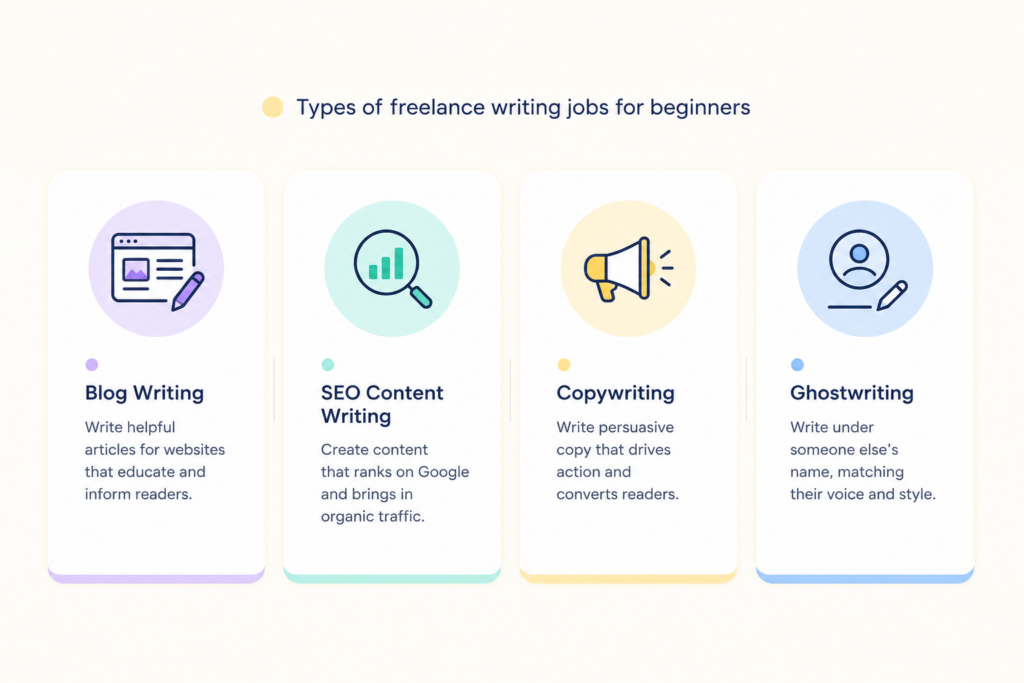
Types of Freelance Writing Jobs for Beginners
Beginner freelance writers can start with several types of writing jobs, depending on their interests, skills, and the kind of clients they want to serve. Some writing formats are easier to practice and turn into portfolio samples, while others may require more subject knowledge or persuasive writing experience.
Blog writing
Blog writing is one of the most common starting points for new freelance writers because many businesses, creators, and agencies need regular articles for their websites. Blog posts are usually meant to educate readers, answer questions, support SEO goals, or explain a topic in a helpful way.
For beginners, blog writing is useful because it teaches important skills: research, structure, headlines, introductions, examples, and clear explanations. A strong blog sample can also show clients that you know how to organize information for online readers.
SEO content writing
SEO content writing focuses on creating articles and pages that match what people are searching for online. Businesses need search-friendly content because it can help them answer customer questions, explain their services, and attract relevant traffic from Google and other search engines.
A beginner SEO writer should understand search intent, keywords, headings, readability, internal links, and direct answers. The goal is not to force keywords into every paragraph. The goal is to create useful content that helps readers find what they came for.
Copywriting
Copywriting is more focused on persuasion and action. While blog writing often educates, copywriting is usually written to encourage a reader to click, subscribe, book a call, buy a product, or take another specific step.
Common beginner copywriting projects include:
- Landing pages
- Website service pages
- Sales emails
- Ad copy
- Product descriptions
- Homepage copy
Copywriting can be a strong path for writers who enjoy strategy, psychology, and concise messaging. It may take more practice than basic blog writing because every sentence needs to support a clear goal.
Ghostwriting
Ghostwriting means writing content that is published under someone else’s name. The client provides the ideas, expertise, or direction, and the writer turns that information into polished content.
Ghostwriters may write for:
- Executives
- Founders
- Authors
- Coaches
- Consultants
- Public figures
- Subject-matter experts
For beginners, ghostwriting can include LinkedIn posts, blog articles, newsletters, or thought leadership pieces. The main skill is adapting to the client’s voice while keeping the content clear and credible.
Technical or niche writing
Technical or niche writing focuses on specialized topics. This could include finance, healthcare, software, education, law, engineering, real estate, or any field where the writer needs to understand specific terms, processes, or audiences.
Writers with professional experience, academic background, or strong research skills may find this path especially useful. Over time, specialized knowledge can make a writer more valuable because clients often need someone who can explain complex information accurately and clearly.
Book and publishing-related writing
Book and publishing-related writing is a natural fit for writers who enjoy working with authors, stories, and the self-publishing process. This type of freelance writing can support authors before, during, and after a book launch.
Examples include:
- Book descriptions
- Author bios
- Press releases
- Blog content for authors
- Promotional copy
- Book marketing emails
- Social media captions for book launches
- Website copy for author pages
This can be a good niche for beginners who understand books and reader expectations. It also allows writers to practice both informational and promotional writing, from explaining an author’s message to helping a book appeal to the right audience.
How to Build a Freelance Writing Portfolio Before You Have Clients
You can build a freelance writing portfolio before you have clients by creating realistic sample pieces that show the kind of work you want to be hired for. A beginner portfolio does not need paid projects. It needs clear, polished examples that prove you can write for a specific audience, format, and purpose.
Write sample pieces for imaginary clients
Self-created samples are a practical way to show your skills when you are just starting. The key is to make them look like real assignments, not random writing exercises.
For example, you could create:
- A blog post for a wellness brand, such as “How to Build a Simple Evening Routine That Supports Better Sleep”
- A book description for a fictional novel, including a short hook, genre cues, and reader appeal
- A landing page for a small business, such as a local bakery, fitness coach, or interior designer
- An email newsletter for an author announcing a new book, event, or reader update
Choose samples that match the type of freelance writing jobs you want. If you want to write SEO articles, create a search-friendly blog post with clear headings. If you want to write for authors, include book-related samples like author bios, book descriptions, and promotional emails.
Rewrite weak content as a practice sample
Another useful option is to improve existing public content and present it as a practice project. For example, you might find a confusing service page, a weak product description, or a cluttered blog introduction, then rewrite it to make the message clearer and easier to read.
Be transparent when you do this. Label the piece as a “practice rewrite” or “sample project,” and do not imply that the business hired you. You can include a short note explaining what you improved, such as clarity, structure, tone, calls to action, or SEO readability.
This type of sample can be especially helpful for copywriting because it shows how you think, not just how you write.
Publish on your own blog or LinkedIn
Publishing your writing publicly can help build credibility, especially when you do not have client work yet. A personal blog, LinkedIn article, or simple portfolio page gives potential clients a place to see your voice, consistency, and topic knowledge.
You do not need to publish every week to benefit from this. A few thoughtful posts can be enough to show that you understand a niche. For example, a beginner writer interested in publishing could post about book marketing basics, author websites, writing routines, or how to write a stronger book description.
Public writing also gives you links you can include in pitches, applications, and your portfolio.
Keep your portfolio focused
A strong beginner portfolio is not about having as many samples as possible. It is about showing the right samples for the work you want.
Three polished pieces are better than ten rushed ones. Aim for a small, focused portfolio that includes different formats or topics within your chosen direction. For example, a writer targeting authors might include one book description, one author bio, one blog post about publishing, and one promotional email.
Before sharing your portfolio, check that each sample has a clear purpose, clean formatting, strong grammar, and a logical structure. Clients should be able to understand what you write, who you write for, and why your work could help them.
Where to Find Your First Freelance Writing Clients
You can find your first freelance writing clients through job boards, freelance platforms, LinkedIn, cold pitching, and your existing network. The best approach is to use more than one channel, then track which types of outreach lead to responses, calls, or paid projects.
Job boards: Job boards are competitive, but they are useful for beginners because they show what real clients are asking for. Even if you do not land a job right away, you can study the listings to understand common project types, required skills, rates, niches, and client language.
Freelance platforms: Platforms like Upwork and Fiverr can help new writers find clients without needing a personal website or a large network. They also make it easier to see what services other writers offer, how they describe their work, and how clients structure projects. The downside is that these platforms can be crowded, and beginner writers may feel pressure to compete on price.
LinkedIn outreach: LinkedIn can be a strong place to find freelance writing clients because many business owners, marketers, founders, editors, and agency leads are already active there. Before reaching out, make sure your profile clearly says what you do. Update your headline, About section, and featured links so people can quickly understand your writing services.
Cold pitching: Cold pitching means contacting potential clients directly, even if they have not posted a job. It works best when the message is personal, relevant, and tied to a real need.
A weak cold pitch says, “I am a writer. Do you need content?” A stronger pitch mentions something specific, such as an outdated blog, unclear service page, missing email newsletter, or opportunity to answer common customer questions. Keep the message short, include one relevant sample, and make the next step simple.
How Much Should Beginner Freelance Writers Charge?
Beginner freelance writers should charge based on the full scope of the project, not just the number of words. There is no single correct starting rate because pricing depends on the type of writing, the niche, the amount of research, the deadline, the client’s expectations, and the writer’s current skill level.
Common beginner pricing models
Most freelance writers use one of four pricing models. Each has benefits and drawbacks, especially when you are just starting.
| Pricing model | How it works | Best for |
|---|---|---|
| Per word | You charge based on the final word count | Blog posts, SEO articles, simple content assignments |
| Per article | You charge a fixed price for one article | Blog writing, thought leadership articles, guest posts |
| Per hour | You charge for the time spent working | Research-heavy tasks, editing, consulting, unclear project scopes |
| Monthly retainer | A client pays a recurring monthly fee for ongoing work | Regular blog posts, newsletters, social captions, content support |
Per-word pricing is common, but it can make writers focus too much on length instead of value. Per-article or per-project pricing is often easier to explain because the client knows what they will receive and what it will cost. Hourly pricing can work when the scope is uncertain, but it may be harder to estimate as a beginner. Retainers are usually better once you have a client who needs ongoing content.
Why the cheapest rate is not always the best strategy
Charging very low rates may seem like an easy way to get your first freelance writing jobs, but it can create problems. Extremely low rates often make the work unsustainable because writing includes research, planning, editing, revisions, emails, and client communication, not just drafting.
Low rates can also attract clients who value speed over quality or expect unlimited changes for a small fee. That does not mean beginners should charge premium rates immediately. It means your rate should be realistic enough to let you do careful work and still respect your time.
A better beginner strategy is to start with clear, modest pricing and a defined scope. For example, instead of offering “a blog post for any price,” offer one specific deliverable, such as a 1,000-word blog post with basic keyword use, one round of revisions, and delivery within an agreed timeline.
A simple beginner rate-setting method
To set a beginner freelance writing rate, estimate the total work involved before giving a price. A short article can still take several hours if it requires research, SEO planning, examples, editing, and revisions.
Consider:
- Research time: How much background reading or fact-checking is needed?
- Writing time: How long will it take to draft the piece properly?
- Revisions: How many rounds of edits are included?
- Client communication: Will there be calls, emails, briefs, or feedback discussions?
- Project complexity: Is this a simple blog post, a sales page, a technical article, or a brand-sensitive piece?
Once you understand the scope, choose the pricing model that fits best. For many beginners, project-based pricing is the simplest option because it connects the fee to a clear deliverable. It also helps prevent confusion about what is included, especially if you write the scope in advance.
A Simple 30-Day Plan to Start Freelance Writing
You can start freelance writing in 30 days by choosing a service, creating a few focused samples, building a simple portfolio, and reaching out to potential clients consistently. The goal of this plan is not to master everything at once. It is to move from interest to action with a clear, realistic process.
Week 1: Choose your services and niche
Use the first week to decide what kind of writing you want to offer and who you want to write for. Keep this simple. You can adjust later as you learn what you enjoy and what clients need.
By the end of week one, aim to choose:
- 1 to 2 writing services, such as blog writing, email writing, website copy, or book descriptions
- 1 to 2 beginner-friendly niches, such as small business, books and publishing, wellness, education, or technology
- 5 examples of strong content in your chosen niche to study for structure, tone, and topic ideas
For example, if you want to write for authors, review author websites, book descriptions, newsletters, and publishing blogs. Notice how they introduce books, speak to readers, and explain value clearly.
Week 2: Create your first writing samples
Use the second week to create proof of skill. These samples do not need to come from paid clients. They only need to show that you can write useful, organized content for a specific audience.
Create 2 to 3 samples, such as:
- One blog post that answers a clear reader question
- One landing page or service page sample
- One email newsletter or promotional email
- One niche-specific sample, such as an author bio or book description
Edit each sample carefully. Check the headline, introduction, structure, grammar, readability, and call to action. Treat each piece as if a client will judge your ability from it, because they probably will.
Week 3: Build your portfolio and profile
Use the third week to make your writing easy to review. A simple portfolio is enough at this stage. You can use a Google Doc, Notion page, PDF, or basic website.
Your portfolio should include:
- A short introduction explaining what you write
- Your main writing services
- 3 to 5 writing samples
- Your preferred contact method
- A short note about your niche, if relevant
Also update your LinkedIn profile or another professional profile so it clearly reflects your freelance writing services. A simple headline like “Freelance blog writer for small businesses and authors” is more useful than a vague title like “Aspiring writer.”
Week 4: Start pitching and applying
Use the final week to begin outreach. This is where many beginners hesitate, but outreach is how freelance writing becomes real client work.
Set a practical weekly goal, such as:
- Send 5 to 10 personalized pitches
- Apply to several beginner-friendly writing jobs
- Contact local businesses, authors, agencies, or creators who may need content
- Track each message, response, and follow-up in a simple spreadsheet
Keep each pitch short and relevant. Mention who you are, what you noticed, how you can help, and include one relevant sample. If you do not get replies right away, use that information to improve your offer, samples, or pitch.
By the end of 30 days, you should have a clear writing service, a small portfolio, a basic online presence, and your first outreach attempts completed. That is a much stronger starting point than simply wondering how to become a freelance writer with no experience.
FAQ: How to Become a Freelance Writer
Q: Can you become a freelance writer with no experience?
Yes. You can start freelance writing without paid experience by choosing one or two services, creating a few sample pieces, and pitching beginner-friendly clients. Clients care more about clear, useful writing that fits a brief than about a formal work history, so self-made samples can stand in for past client work when you begin.
Q: How much do beginner freelance writers make in 2026?
Freelance writing rates for beginners in 2026 typically fall between $0.05 and $0.10 per word, or $50 to $100 for a 1,000-word article. On an hourly basis, most beginners fall in the $15 to $25 range. Rates rise once you specialize in a niche and build a focused portfolio. Blockerry
Q: Do you need a degree to become a freelance writer?
No. A degree is not required to become a freelance writer. Most clients hire based on writing samples, niche knowledge, and reliability rather than formal qualifications. A background in a specific field can help you win work in that niche, though a strong portfolio matters more than any credential.
Q: Is freelance writing still worth it in 2026 with AI tools?
Yes, though the market has shifted. AI tools have increased competition for generic, low-value content, which puts pressure on the cheapest end of the market. Demand stays steady for writers who bring research, niche expertise, a clear voice, and content built to earn citations in search and AI Overviews. Specializing is the most reliable way to stay in demand.
Q: How long does it take to start earning as a freelance writer?
Many beginners land their first paid work within one to three months of consistent effort. A focused 30-day plan can get you a clear service offer, a small portfolio, and your first pitches sent. How quickly paid work follows depends on your niche, your outreach volume, and the quality of your samples.
Q: What skills do you need to become a freelance writer?
Core skills include clear writing, research, following a brief, editing, and basic SEO. Communication and reliability matter just as much, since clients rehire writers who meet deadlines and respond well to feedback. You can build these skills through practice samples before you have paying clients.
Q: Do freelance writers need to know SEO?
Basic SEO knowledge helps, since much freelance writing is online content. You should understand search intent, keywords, headings, internal links, and readable structure. In 2026, writing that is clear and well organized is also easier for AI Overviews and answers.