

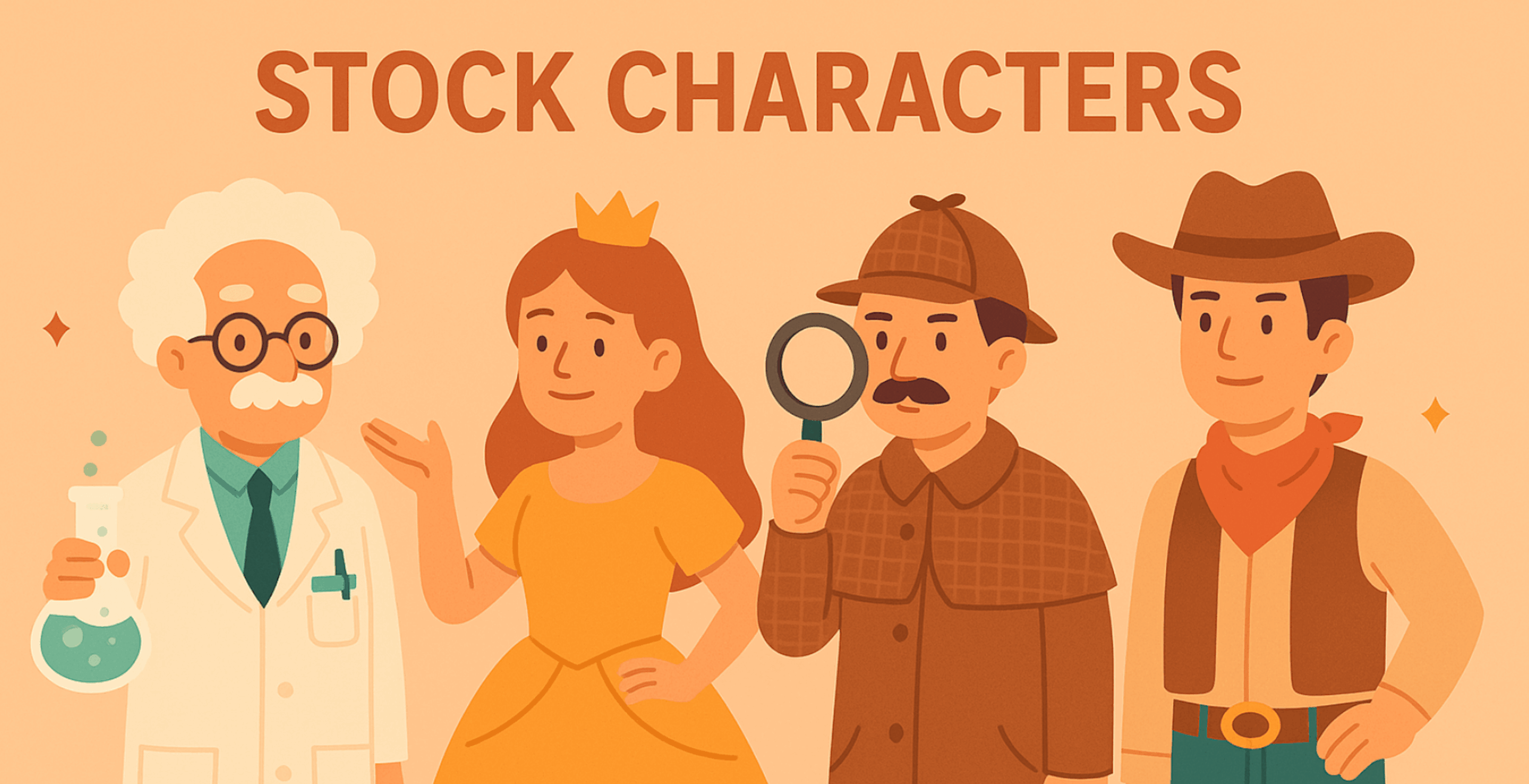
A stock character is a role a reader recognizes before the writer finishes describing it: the mentor who won’t survive the third act, the sidekick who exists to say what the hero is thinking, the villain who talks too much because menace bores him. These figures move through Shakespeare, Marvel films, and the query letters editors read every week, unchanged in function even when the costume changes.
That repetition works because it’s structural. A stock character lets a writer skip the introduction and move straight into plot, and it lets a reader settle into a story almost immediately. The real skill is knowing how much weight one of these figures can carry before it slides into stereotype.
Below: the definition, where these roles came from, the six types worth knowing, and how to use them so they read as choices instead of defaults.
What Is a Stock Character?
A stock character is a recognizable figure in literature, theater, or film built from a fixed set of traits: the clever trickster, the nagging parent, the noble hero. Because the traits are familiar, a reader identifies the character’s role almost immediately, without needing a chapter of backstory.
Writers sometimes call these figures archetypes or literary staples, and the terms get used loosely enough that the distinctions blur. A cliché, a trope, and a stock character get treated as interchangeable, though they aren’t quite the same thing. A cliché is a tired, uninspired use of language or character type. A trope is a broader storytelling device. A stock character is a specific recurring figure, and depending on execution, it can be either brilliant or forgettable.
That’s the mechanical description. What makes a stock character worth studying is what happens when a writer decides to break the pattern instead of filling it, which is the part most explanations of the term skip entirely.
A Brief History of Stock Characters
Stock characters date back to ancient Greek theater, where actors wore exaggerated masks to signal roles the audience would recognize instantly: the braggart soldier, the nagging wife, the lovestruck youth. The mask wasn’t a costume choice. It was a narrative signpost, doing in one glance what modern writers still do in a paragraph of introduction.
The pattern carried forward. By the 16th century, Commedia dell’arte troupes in Italy performed with a rotating cast of stock figures, like the greedy Pantalone or the sly Harlequin, and audiences knew exactly who was who the moment a character stepped on stage. Shakespeare borrowed liberally from this tradition, filling his plays with fools, star-crossed lovers, and scheming villains. The same patterns carried into novels, vaudeville, and eventually Hollywood, where the wise mentor, the comic relief, and the hardboiled detective became industry fixtures.
Writers have been reusing these figures since long before reboot culture existed, and the tradition shows no sign of slowing down.
Six Stock Characters You Already Know
Six stock character types recur across genres more than any others: the wise mentor, the comic relief, the star-crossed lovers, the villain audiences love to hate, the quirky best friend, and the reluctant hero.
| Type | What They Do | Classic Example | Modern Example |
|---|---|---|---|
| The Wise Mentor | Hands the protagonist a skill, a secret, or a weapon, then often exits before the plot resolves | Merlin | Dumbledore, Obi-Wan Kenobi |
| The Comic Relief | Lightens the mood and cracks a joke at the wrong moment, keeping the story from drowning in its own drama | Shakespeare’s fools | Ant-Man, Joey from Friends |
| The Star-Crossed Lovers | Fall for each other despite fate, family, or their own bad decisions | Romeo and Juliet | any tear-soaked romance novel lead pair |
| The Villain Everyone Loves to Hate | Makes treachery entertaining instead of just menacing | Iago | Disney’s Scar |
| The Quirky Best Friend | Delivers better lines than the protagonist and exists mainly to say “you’ve got this” | the confidante in Restoration comedy | Jess from New Girl |
| The Reluctant Hero | Resists the call to action, complains through most of the story, then carries it anyway | Achilles | Frodo, Katniss |
Editors who work with debut self-published manuscripts see two of these six far more than the rest: the wise mentor and the reluctant hero. Both show up because they feel safer to write than an original supporting cast. A new author trusts a recognizable mentor to explain the plot’s rules more than they trust their own worldbuilding to do it, and a reluctant hero lets a writer delay a character’s growth without having to justify the delay. Neither choice is wrong on its own. These types also get sharper when they’re written against a proper foil, which is why a chaotic sidekick makes a wise mentor’s steadiness land harder. The manuscripts that stand out are the ones where the writer notices the pattern and bends it on purpose, rather than reaching for it by default.
Why Writers and Readers Both Rely on Them
Writers use stock characters because they work like shorthand. The moment a mentor limps onto the page with a staff, a reader already knows the role, which frees the writer to spend the saved pages on plot, worldbuilding, or the twist that actually needed the space.
Readers get something out of the arrangement too. A stock character acts as an emotional anchor: the bumbling sidekick signals comic relief, the scheming villain tells a reader where to direct their outrage, and the reluctant hero gives a reader someone to root for who’s exactly as scared as they are. These figures work as storytelling glue, keeping an audience oriented even inside a complicated plot.
A stock character functions as scaffolding rather than a finished draft. It hands a writer a frame and a reader an instant way in, and everything that happens after that depends on what the writer builds on top of it.
When a Stock Character Becomes a Stereotype
A stock character turns into a stereotype the moment predictability replaces personality, when a reader can guess a character’s next line before finishing the last one. The wise mentor who only dispenses cryptic advice, the comic relief reduced to tripping over chairs, the villain whose entire personality is stroking a cat: these versions feel stale fast because there’s nothing left to discover.
Audiences want depth and surprise even inside a familiar role. Giving the archetype a contradiction, an unexpected motivation, or a quirk that goes beyond the label keeps a sturdy storytelling tool from turning into dead weight. The same trap catches writers reaching for a stock role on any underrepresented character, which is exactly why you should avoid writing strong female characters without falling into stereotypes.
How to Reinvent a Stock Character
The fix for a flat stock character is to give it one contradiction the trope doesn’t predict: an unreliable mentor, a villain whose morality outperforms the hero’s, a sidekick who quietly resents being funny. Readers already know the pattern, so the story gets interesting the moment a writer bends what they expect.
Blending two stock types into a hybrid works the same way. A reluctant hero who also plays the comic relief, or a star-crossed lover who doubles as the story’s trickster, keeps an audience on its toes and helps a character stand out in a crowded genre.
Specific, unexpected detail does more to fix a flat character than removing the archetype ever could. A brooding detective who knits socks in his downtime, or a quirky best friend who’s secretly terrible at giving advice, turns a label into a person. A stock character is a starting point, not a finish line, and handled with one deliberate detail, it becomes memorable instead of forgettable.
The Bottom Line on Stock Characters
A stock character earns its place in a story the same way a supporting beam earns its place in a building: it holds weight so the rest of the structure can take shape. Used well, it creates instant recognition and a fast emotional connection. Used carelessly, it collapses into the exact stereotype it was supposed to prevent.
The difference between the two outcomes is rarely the archetype itself. It’s the one specific, human detail a writer is willing to add on top of it.
FAQ: Stock Character
Q: What is a synonym for a stock character?
The closest synonyms are archetype, literary type, and recurring character. Archetype leans psychological and mythic. Stock character is narrower, tied specifically to recurring figures in drama, film, and fiction rather than universal symbols.
Q: What is an example of a stock character?
A classic example is the wise mentor, the figure who hands the protagonist a skill, a secret, or a weapon and then often exits before the plot resolves. Obi-Wan Kenobi, Dumbledore, and Mr. Miyagi all fill this exact role across three different genres.
Q: What best describes a stock character?
The description that fits best is a recurring figure defined by a fixed, easily recognizable set of traits that a writer can deploy without building an individual backstory. That’s what separates it from a fully developed character, whose behavior can’t be predicted just from the role they’re playing.
Q: What are the five stock characters?
There’s no single official list, but the five stock characters cited most often across dramatic theory are the hero, the mentor, the sidekick, the villain, and the love interest. Every genre builds its own variation on top of these five: fantasy turns the mentor into a wizard, romance turns the love interest into a rival, and horror turns the sidekick into the first casualty.
Q: How do you avoid writing flat stock characters?
The most reliable way is to add one contradiction the reader doesn’t expect, like an unreliable mentor or a villain with a moral code sharper than the hero’s. Specific, unexpected detail is what turns a flat stock character into a memorable one.
Q: What is the difference between a stock character and an archetype?
An archetype is a universal symbol, like the Hero or the Trickster, rooted in psychology and myth. A stock character is more specific, tied to recurring figures in literature or entertainment, like the nagging in-law or the hardboiled detective.
Q: Are stock characters stereotypical?
No, not inherently. A stock character is a neutral template, and it only turns into a stereotype when a writer skips the nuance and leans on the label alone.
Q: How are stock characters used today?
Stock characters show up everywhere in film, television, and YA fiction today, though writers increasingly use them as a base to subvert rather than a role to fill straight.
Q: Do different genres have different stock characters?
Yes, each genre leans on its own lineup. Romance relies on the brooding love interest, fantasy leans on the chosen one and the mentor, and horror depends on the final girl and the doomed skeptic.