


Read these two phrases carefully:
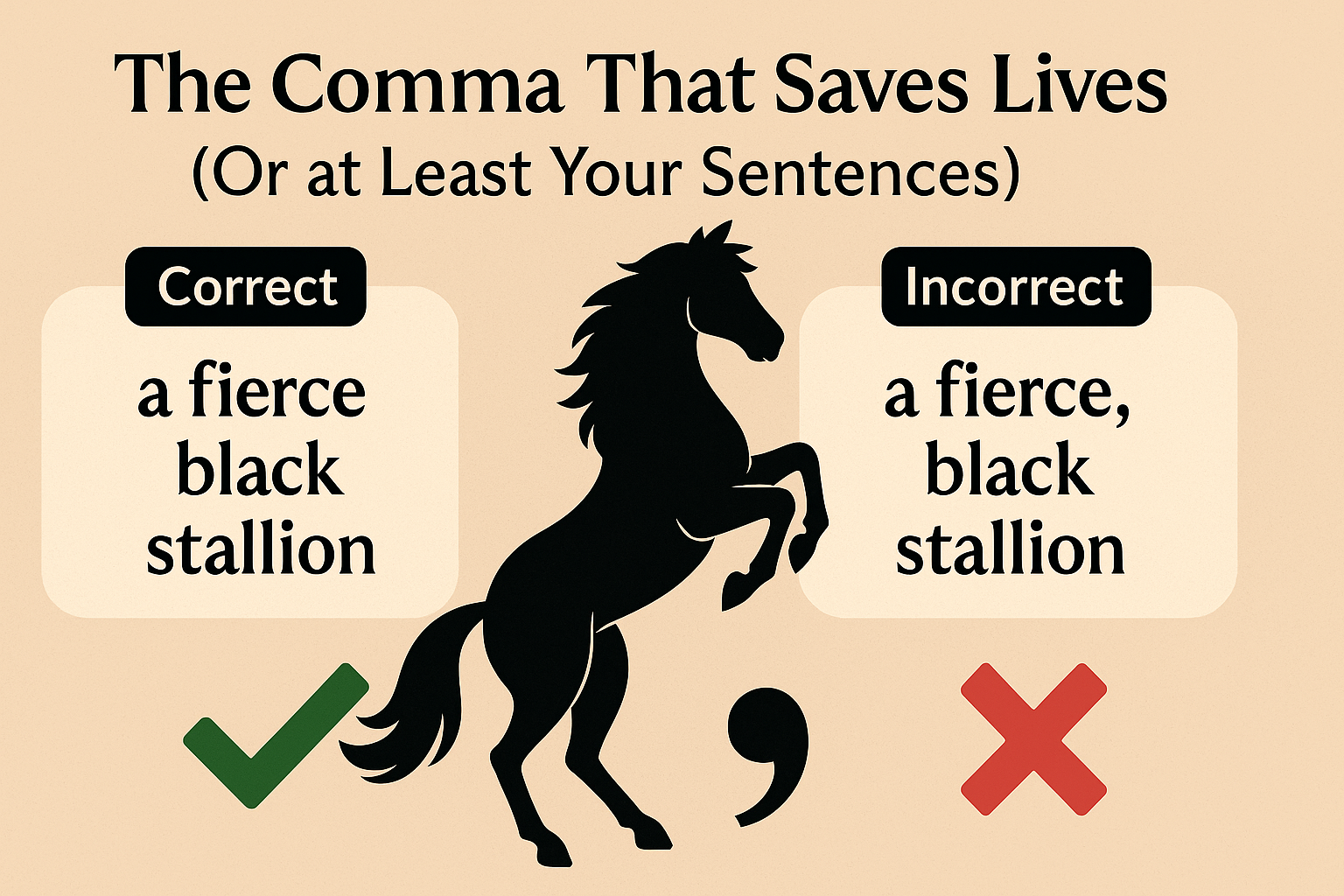
“A fierce black stallion.” “A fierce, black stallion.”
They look almost identical, but one comma separates them. They are not saying the same thing. In the first, “fierce” and “black” stack together to describe a particular kind of stallion, while in the second, the comma signals that each adjective is doing its own independent work, that the horse is fierce and separately, equally, black. The comma changes the relationship between the words, and therefore changes what the sentence actually means.
That is what coordinate adjectives are about. The grammar rule exists because the meaning requires it. Let’s dive in.
What are coordinate adjectives
Coordinate adjectives are two or more adjectives that independently and equally modify the same noun. Each adjective contributes its own distinct meaning without depending on the other to make sense, together, they describe the noun from separate angles, and because they carry equal weight, a comma sits between them to signal that equality.
The word “coordinate” here means what it means in geometry: existing on equal terms, at the same level, without one subordinate to the other.
“A bright, cheerful morning.” Both adjectives describe the morning independently. Now, remove one and the other still works. They are standing alongside each other and that equality is what earns the comma.
How to identify coordinate adjectives: the two tests
Two practical tests will tell you whether adjectives are coordinated or cumulative almost every time.
The “and” test. Insert the word “and” between the two adjectives. If the phrase still sounds natural, the adjectives are likely coordinated and need a comma. If it sounds forced or broken, they are probably cumulative and the comma does not belong.
A warm, sunny afternoon → a warm and sunny afternoon. Natural and coordinate. Use the comma.
A little old cottage → a little and old cottage. Broken, cumulative. Skip the comma.
The swap test: reverse the order of the adjectives. If the phrase still reads smoothly, they are coordinated, now If the reversal sounds wrong, they are cumulative.
A quiet, empty street → an empty, quiet street. Both work. Coordinate.
A large ceramic bowl → a ceramic large bowl. Wrong, cumulative. The order is fixed.
Both tests tend to produce the same result: If one test flags cumulative and the other flags coordinate, read the phrase again slowly. The version that sounds natural when spoken aloud is usually right.
Coordinate adjectives vs cumulative adjectives
Cumulative adjectives also appear before a noun in a sequence, but they work differently. Each adjective modifies not just the noun but the combination of everything that follows it. They build in a fixed order, with each one narrowing the description further, and they do not carry equal weight. Swapping them produces nonsense and, adding “and” between them produces something worse.
Three wooden chairs. “Three” modifies “wooden chairs” as a unit. “Wooden” modifies “chairs.” The order cannot move, no comma belongs here.
The distinction matters for meaning, not just correctness. A comma between cumulative adjectives tells the reader to weigh each adjective separately, which misrepresents how they are actually working in the sentence.
| Phrase | Type | Comma? | Why |
| a bright, cheerful room | Coordinate | Yes | Each adjective describes the room independently |
| a long, winding road | Coordinate | Yes | Both pass the “and” test and swap test |
| a small country cottage | Cumulative | No | Order is fixed; “and” test fails |
| three wooden chairs | Cumulative | No | Each adjective narrows the next; not equal |
| a tired, hungry traveler | Coordinate | Yes | Both describe the traveler independently |
| a large ceramic bowl | Cumulative | No | “Ceramic large bowl” does not work |
| a dark, stormy night | Coordinate | Yes | Swap test and “and” test both pass |
| a little old lady | Cumulative | No | Fixed order; changing it sounds wrong |
| a quiet, empty street | Coordinate | Yes | Both adjectives stand on their own |
| a beautiful French novel | Cumulative | No | “French” narrows the category; not equal |
Coordinate adjectives examples
These phrases all contain coordinate adjectives. Each pair passes both tests.
A warm, generous mentor. A cold, calculating rival. A long, difficult conversation. A clear, confident voice. A soft, worn armchair. A sharp, precise observation. A slow, deliberate walk. A raw, honest memoir. A dense, humid forest. A short, brutal chapter. A young, ambitious editor. A dark, cluttered study. A light, airy kitchen. A deep, quiet grief. A wide, empty street.
Each of these works because both adjectives independently describe the noun. Remove either one and the other still stands. Reverse them and the meaning holds. Add “and” and the phrase survives.
When the comma changes what you mean
This is the part that matters most to writers who care about precision.
Consider: “a charming eccentric uncle.”
Without a comma, “charming” and “eccentric” are pressed together into a single descriptor. The uncle is a particular type of eccentric, a charming one. The adjectives are working cumulatively, each refining the next.
Add the comma: “a charming, eccentric uncle.”
Now both adjectives stand on equal ground. The uncle is charming. He is also eccentric. The reader weighs both qualities separately, giving each its full due. The character feels more dimensional because the sentence is treating his qualities as distinct rather than fused.
The same shift happens in reverse: place a comma between cumulative adjectives and the sentence signals a separation that the meaning does not support. “A small, country cottage” implies that small and country are equally independent qualities of the cottage, which is not quite how the phrase works. The comma creates a small but real distortion.
For writers, this is not primarily a grammar question, it is a question of what the sentence is actually saying, and whether the punctuation reflects that accurately.
Creative Writing Glow-Up: Using Coordinate Adjectives to Improve Voice
Coordinate adjectives aren’t just grammar trivia, they’re a secret styling tool for writers who want their prose to feel intentional, musical, and vividly cinematic. When used thoughtfully, they add rhythm and texture to a sentence, giving your descriptions a satisfying little snap instead of a cluttered thud.
Think of them as seasoning. A warm, glowing lantern sounds lyrical and inviting, because each adjective contributes its own distinct flavor. Swap them and you still get a beautiful image. Add “and,” and the flow stays intact. That’s the sign of adjectives working in harmony.
Where writers get into trouble is when they pile adjectives like a Thanksgiving turkey loaded with every herb in the pantry. That’s not voice, that’s chaos. Strategic use of coordinate adjectives, on the other hand, helps you slow down and choose the descriptors that matter most.
Want lush worldbuilding? Clear character cues? Emotional shading? A few well-placed coordinate adjectives can elevate all of it. Use them sparingly, use them smartly, and your storytelling voice will feel sharper, calmer, and infinitely more confident.
Common mistakes and how to fix them
Adding commas between cumulative adjectives. The most common error usually comes from a general instinct that multiple adjectives need commas between them.
Incorrect: a tall, dark, wooden bookcase. Correct: a tall dark wooden bookcase.
The adjectives are cumulative. Each one narrows the description further. Run the swap test: “a wooden dark tall bookcase” is immediately wrong, no commas belong here.
Omitting commas between coordinate adjectives. Less common but equally disruptive, it fuses adjectives that the reader needs to register separately.
Incorrect: a long gloomy corridor. Correct: a long, gloomy corridor.
Both “long” and “gloomy” describe the corridor independently. The swap test works: “a gloomy, long corridor” reads fine. The comma belongs.
Piling in too many adjectives. Three or more adjectives in sequence is a signal to pause. Some will be coordinated, some cumulative, and the sentence is probably carrying more descriptive weight than it needs to.
Cluttered: a small, dark, damp, narrow, winding staircase. Cleaner: a narrow, winding staircase.
Pick the two adjectives that do the most specific work. The others are usually already implied.
Your Commas, Your Voice, Your Power
Mastering coordinate adjectives won’t magically win you a literary award, but it will make your writing clearer, smoother, and far more confident, and that’s a pretty powerful return on a tiny punctuation investment.
Once you understand when adjectives work as equals and when they march in order, your sentences suddenly snap into place with satisfying precision.
So take these tests, tricks, and conga-line rules into your next chapter. Read your work out loud, spot where a comma adds clarity, and let your voice guide the rhythm. Your sentences and your readers will feel the difference.
FAQ: Coordinate Adjectives
Q: What are coordinate adjectives?
Coordinate adjectives are two or more adjectives that each independently and equally modify the same noun. They describe the noun from separate angles without one depending on the other. Because they carry equal weight, a comma is placed between them. The classic tests are the “and” test (inserting “and” between the adjectives should sound natural) and the swap test (reversing their order should still make sense).
Q: Do coordinate adjectives always need a comma?
In standard usage, yes. When two adjectives independently and equally modify a noun, a comma separates them. The exception is stylistic writing where a writer deliberately omits the comma for rhythm or effect, but that is a choice made after understanding the rule, not before.
Q: What is the difference between coordinate and cumulative adjectives?
Coordinate adjectives each describe the noun independently and can be swapped or joined with “and” without breaking the phrase. Cumulative adjectives build on each other in a fixed order, with each one narrowing what follows. Coordinate adjectives take a comma. Cumulative adjectives do not. “A bright, cheerful room” is coordinate. “A small country cottage” is cumulative.
Q: How do you identify coordinate adjectives?
Use the “and” test and the swap test. If you can insert “and” between the adjectives and the phrase still sounds natural, and if you can reverse their order without producing nonsense, they are likely coordinate. If either test fails, the adjectives are probably cumulative and the comma does not belong.
Q: Can you have three coordinate adjectives in a row?
Yes, though it is worth asking whether all three are necessary. If three adjectives each independently describe the noun and all pass both tests, commas go between each pair. In practice, three coordinate adjectives in sequence often signals that the sentence is carrying more description than it needs, and trimming to the two most precise adjectives usually produces cleaner prose.
Q: Why does the comma between adjectives change the meaning?
Because a comma signals to the reader that each adjective should be weighted separately. Without the comma, adjectives press together and the reader processes them as a unit. “A charming eccentric uncle” and “a charming, eccentric uncle” are slightly different people. The first presents a particular type of eccentric. The second presents someone who is both charming and eccentric as distinct qualities. The comma is doing real semantic work.