Starting a book comes down to one decision: beginning before you feel ready. Every author who has finished a book started without knowing exactly how it would turn out. What separates the writers who finish from the ones who don’t is rarely talent. It’s having a clear process and following it one step at a time.
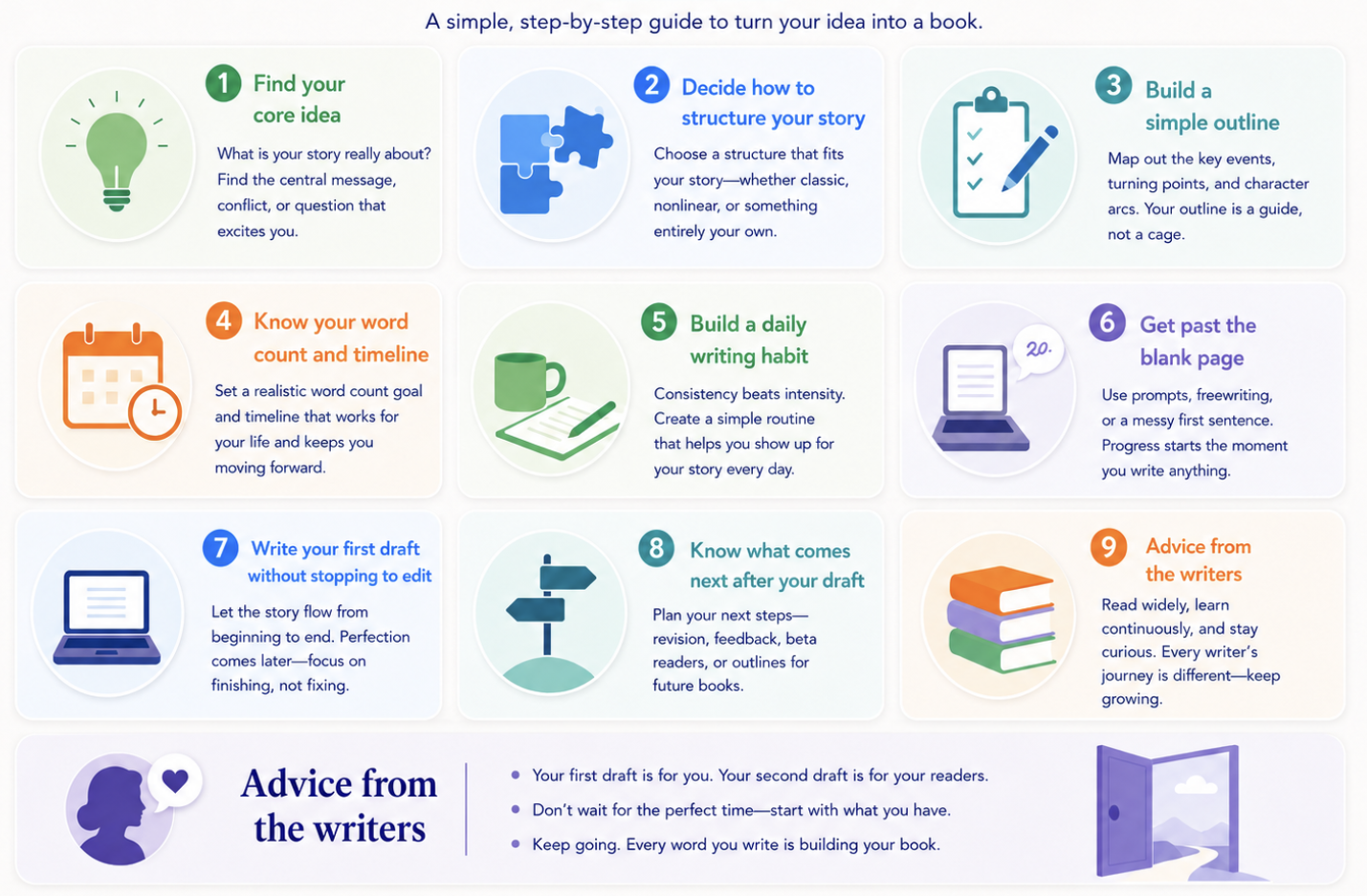
Here’s how to start writing a book:
- Find your core idea
- Decide how to structure your story
- Build a simple outline
- Know your word count and timeline
- Build a daily writing habit
- Get past the blank page
- Write your first draft without stopping to edit
- Know what comes next after your draft
- Advice from the writers
This guide walks you through how to build a writing habit that holds, how to structure your idea, how to get past the particular fear that comes with writing your first book, and begin the journey of writing your book.
Find the Idea Worth Staying With
The question isn’t whether you have an idea. Most aspiring writers have dozens. The question is which one you’re willing to sit with for months, possibly years, through slow drafts and the creeping suspicion that someone else could tell it better.
That’s your real starting point: not the most impressive idea, but the one you can’t quite leave alone.
Start by writing down everything that keeps returning to you. Is there a literary theme that keeps popping up in your mind, or half-formed characters, a situation you’ve turned over in your head more times than you can count? Don’t evaluate yet. Just get them out of your mind and onto a page where you can actually look at them.
J.K. Rowling’s starting point for Harry Potter was a boy who didn’t know he was a wizard. Suzanne Collins built The Hunger Games from a single, disturbing premise: a televised fight to the death as entertainment. Neither idea arrived fully formed. What made them work was that the author stayed with them long enough to find out what they were really about.
The same applies to your idea. It doesn’t need to be original in every detail, but it should be something you are passionate about writing about. Passion for your subject carries you through the days when the writing is hard, and there will be plenty of those days.
If you’re finding it hard to commit to one concept, try writing a paragraph about each of your strongest ideas as if you were already explaining the finished book to a reader. The one that feels most alive when you describe it is usually the one worth starting. Once you’ve landed on it, the next step is deciding how much structure you want around it before you begin writing.
If nothing is coming, these writing prompts can help shake something loose, and this guide on how to find inspiration for your book is worth reading before you commit to an idea.
Plotting vs Pantsing: Decide How Much Structure You Need
One of the first practical decisions you’ll face when starting a book is whether to outline or not. Writers call this the plotter versus pantser divide. Plotters plan everything before they write. Pantsers write by the seat of their pants, letting the story lead them. Most of the debate about which is better misses the point entirely.
Neither approach is superior. What matters is understanding which one matches the way your brain works, and being willing to experiment until you find out. A detailed planning guide for your book can help you figure out where you naturally sit on that spectrum before you invest weeks going the wrong direction.
Plotting means building your story’s architecture before you write a word of it. You know your beginning, your ending, and the major beats in between. This gives you a roadmap, which is genuinely useful when momentum drops and you can’t remember why you started. The risk is that some writers lose interest in a story once they feel like they already know it. If discovery is what excites you about writing, a detailed outline can quietly drain the energy out of the project before the first chapter is finished.
Pantsing preserves the feeling of discovery. Characters surprise you. Plot turns arrive unexpectedly. The process feels alive. But it also means you can write yourself into corners, spend weeks on scenes that don’t belong, or reach 40,000 words and realise you don’t know what your story is actually about. That kind of structural confusion is painful and time-consuming to fix in revision.
Most experienced writers land somewhere between the two. They use a loose structure that defines the shape of the story without locking down every detail. You know where you’re going. You just don’t know exactly how you’ll get there. This is sometimes called being a “plantser,” and it works well for writers who need creative freedom but also need a safety net.
For a deeper look at different approaches, the story outlining guide on the Spines blog breaks down several methods and helps you match one to your working style.
How to Write a Basic Book Outline
Start with direction. A minimum viable outline gives you just enough structure to move forward with confidence, while leaving space for the discovery that makes writing exciting in the first place.
1. Your opening situation
Where does your story begin? Who is your main character and what is their world before everything changes? One or two sentences is enough. You’re not writing the chapter yet, just anchoring the starting point.
2. The inciting incident
What happens that sets the story in motion? This is the moment your character’s normal world is disrupted. In Harry Potter, it’s the letter from Hogwarts. In The Hunger Games, it’s Katniss volunteering as a tribute. Every story has one. Knowing yours before you start writing keeps your opening chapters focused. For more on how this works, the inciting incident guide explains its role in story structure in detail.
3. Three major turning points
These are the moments that force your character to change direction. Something is revealed, lost, won, or broken that makes going back impossible. You don’t need to know exactly how you’ll get to each one. You just need to know they exist and roughly what they are.
4. The midpoint shift
Something changes at the halfway point that raises the stakes. Your character either gains something that gives them false confidence or loses something that forces them deeper into the conflict. This is the structural hinge of your story.
5. Your ending
You don’t need to know every detail of how your story ends. But you need a destination. Without one, you’ll write in circles. Even a rough sense of how things resolve gives your drafting process direction.
Once you have these five elements, you have a working outline. It fits on a single page. It leaves room for discovery. And it gives you something to return to when you lose your way.
You can also explore the Snowflake Method directly if you want a systematic way to build your story from a single sentence outward.
How Many Words Should Your Book Be?
Word count varies significantly by genre. Here’s a straightforward breakdown:
| Genre | Typical Word Count |
| Novel (general fiction) | 80,000 to 100,000 words |
| Literary fiction | 70,000 to 110,000 words |
| Mystery / Thriller | 70,000 to 90,000 words |
| Science fiction / Fantasy | 90,000 to 120,000 words |
| Romance | 50,000 to 100,000 words |
| Young Adult (YA) | 55,000 to 80,000 words |
| Middle Grade | 20,000 to 55,000 words |
| Memoir | 55,000 to 80,000 words |
| Nonfiction | 50,000 to 80,000 words |
| Novella | 20,000 to 40,000 words |
| Children’s picture book | 500 to 1,000 words |
A few things worth knowing about these numbers:
They are targets, not rules. A debut novel that comes in at 120,000 words is a harder sell to a publisher than one at 90,000, simply because longer books cost more to produce and represent a higher risk on an unknown author. If you’re self-publishing, you have more flexibility, but readers still have expectations by genre.
Your first draft will probably be shorter than you expect. Most first-time writers finish their draft and discover it runs 20,000 to 30,000 words short of their target. This is normal. First drafts are skeletons. Revision is where you add flesh. The goal of the first draft is to get the story down, not to hit a word count.
Shorter books are legitimate books. A novella between 20,000 and 40,000 words is a complete, publishable work. If your story is told at 45,000 words, it doesn’t need padding to become a novel.
For more on how word count works by format, the guide to finding the right length for your genre goes deeper on this, and the breakdown of how many words in a chapter is useful if you want to work backwards from a total target into a per-chapter writing goal.
How Long Does It Take to Write a Book?
How long it takes to write a book depends on two simple things: how much you write each day and how long the finished book needs to be. Most writers underestimate the timeline at first. Getting a realistic picture before you begin helps you plan better, stay motivated, and avoid feeling behind before you’ve even had a fair chance to build momentum.
Here’s a simple breakdown based on daily word count targets:
| Daily Word Count | 50,000 word book | 80,000 word book | 100,000 word book |
| 250 words/day | 200 days (~7 months) | 320 days (~11 months) | 400 days (~13 months) |
| 500 words/day | 100 days (~3 months) | 160 days (~5 months) | 200 days (~7 months) |
| 1,000 words/day | 50 days (~2 months) | 80 days (~3 months) | 100 days (~3.5 months) |
| 2,000 words/day | 25 days (~1 month) | 40 days (~6 weeks) | 50 days (~2 months) |
What these numbers actually mean in practice:
250 words a day is more achievable than it sounds. It’s roughly half a page. Most people can write 250 words in fifteen to twenty minutes. At that pace a 80,000 word novel takes just under a year, which is exactly how long many debut novelists take to finish their first draft.
500 words a day is the sweet spot for most writers. It’s ambitious enough to build real momentum but sustainable enough to maintain alongside a full-time job and other responsibilities. At 500 words a day, a standard novel takes roughly five months of first draft writing.
1,000 words a day is achievable in focused sessions. Writers like Stephen King famously write 2,000 words a day, but he’s been doing it for fifty years. If you can hit 1,000 words consistently, you’re doing well.
These numbers are for first drafts only. They don’t account for revision, editing, or the days when life gets in the way. A realistic total timeline from blank page to polished manuscript is typically one to three years for a first-time author, depending on how much time you can dedicate to the project.
For a more detailed breakdown of the full writing timeline including revision and editing stages, the Spines guide on how long it takes to write a book covers the entire process from first word to finished manuscript.
How to Build a Writing Habit That Sticks
Writing a book takes longer than most people expect. Over that time, motivation will fluctuate. There will be weeks when the work feels effortless and weeks when sitting down to write feels like a minor form of self-punishment. A habit carries you through the second kind of week. Motivation doesn’t.
Start smaller than feels necessary
The most common mistake new writers make is setting an ambitious daily goal and abandoning it within two weeks. Three hundred words a day feels almost embarrassingly modest. It’s also roughly 110,000 words in a year, which is a complete novel. Start with a target you could hit on your worst day. You’ll often exceed it. On the hard days, hitting a small target builds the habit rather than breaking it.
Protect a specific time
Vague intentions to write “when I have time” produce vague results. Pick a specific window and treat it as fixed. Early morning before the rest of your household wakes up. Thirty minutes on your lunch break. After the kids are in bed. The best writing time is the one that actually exists in your life, not the ideal one you’re waiting for. For practical strategies on protecting your writing time, the guide on time management tips for writers covers this in detail.
Track your progress visibly
Word counts on a calendar, a simple spreadsheet, a sticky note on your desk. Anything that shows you the work accumulating. Progress is motivating in a way that intention never is. Seeing a streak of writing days builds momentum and makes you reluctant to break it.
Separate writing from editing
One of the most destructive habits a new writer can develop is editing yesterday’s work before writing today’s. It feels productive. It isn’t. It keeps you perpetually polishing the opening chapters while the rest of the book stays unwritten. When you sit down to write, write forward. Editing comes later. For more on building a sustainable writing practice, the full guide to building a writing routine that works for you is worth reading alongside this one, and the book writing tips guide covers the broader habits that separate writers who finish from those who don’t.
Give yourself permission to write badly
A writing habit only works if you actually sit down and write, and you’ll only do that consistently if you’ve made peace with imperfect output. The first draft is not the place for beautiful sentences. It’s the place for getting the story down. Everything else comes later.
How to Get Past the Blank Page
Writer’s block is usually perfectionism wearing a different name. The blank page feels paralyzing because some part of your brain has decided that what you write must be good, and it doesn’t yet trust that you can make that happen. The solution isn’t to wait for confidence. It’s to lower the stakes until starting feels possible.
Understand what the blank page actually is
The blank page isn’t a test. It’s an invitation. Nothing you write on it is permanent, irreversible, or being judged by anyone. The words you put down today can be deleted, rewritten, or ignored entirely tomorrow. The only thing the blank page requires is that you put something on it, and the moment you do, it stops being blank and starts being a draft. That shift matters more than the quality of the first sentence. For strategies specifically designed to break through creative paralysis, the guide on overcoming writer’s block covers the most effective approaches in detail.
Practical techniques that actually work
Start in the middle. You don’t have to begin at the beginning. If you know a scene that happens later in the book, write that first. Many writers find it easier to write their way into a story from a scene they’re already excited about rather than forcing themselves through an opening they haven’t figured out yet.
Use freewriting to warm up. Set a timer for ten minutes and write without stopping, without editing, without reading back what you’ve written. Don’t aim for the book. Just aim for words. It breaks the paralysis and reminds you that you’re capable of producing sentences even when you don’t feel like it. The writing exercises guide has structured warm-up exercises worth trying if freewriting alone isn’t enough.
Write the worst possible version first. Give yourself explicit permission to write the scene as badly as it can be written. Terrible dialogue, clunky description, placeholder names. Get the shape of it down and move on. A bad scene can be fixed. A blank page cannot. This is one of the core principles behind the first draft writing guide, which covers the full process of getting from blank page to completed draft.
Start with dialogue. If you’re stuck on how to open a scene, skip description and exposition entirely and start with two characters talking. Dialogue is often easier to write than prose, it creates immediate momentum, and it pulls you into the scene naturally. Before long you’ll have words on the page and the paralysis will have passed.
Lower your daily target temporarily. If the blank page is stopping you completely, drop your daily word count goal to fifty words. Anyone can write fifty words. The goal isn’t output. It’s momentum. Once you’re writing, even badly, the resistance drops and the real work begins. The guide on how to overcome writer’s block and keep writing has more targeted strategies for writers who are stuck mid-book rather than at the start.
The blank page loses most of its power the moment you put something on it. Even something imperfect. Even something you’ll delete tomorrow. The act of writing, however faltering, is what turns a blank page into a draft, and a draft into a book.
How to Write a First Draft Without Stopping to Edit
The first draft has one job: to exist. Not to be good, not to impress anyone, not to resemble the finished book you have in your head. Just to exist on the page in a form you can work with. Every author who has ever published a book produced a messy, imperfect first draft before they produced anything worth reading. The first draft is not the book. It’s the raw material the book is made from.
What a first draft actually is
A first draft is your story told to yourself. It’s the version where you find out what happens, who your characters really are, and what your book is actually about. Many writers discover that the book they thought they were writing in chapter one is not the book they’re writing by chapter ten. That’s not a problem. That’s the process working. Understanding what a completed manuscript looks like before you begin helps set realistic expectations for what you’re working toward.
The one rule that matters most
Write forward. Always forward. The most destructive habit a first-time writer can develop is going back to revise yesterday’s work before writing today’s. It feels productive. It produces a polished opening chapter and nothing else. Every time you feel the urge to fix something you’ve already written, make a note in brackets and keep moving. You can fix it in revision. Right now your only job is to reach the end.
How to handle the messy middle
Most first drafts hit a wall somewhere between the 30,000 and 50,000 word mark. The initial excitement has worn off, the ending still feels far away, and the story has become complicated in ways you didn’t anticipate. This is where most unfinished manuscripts live permanently. A few things that help:
Go back to your outline. If you built one using the framework in the outline section above, return to it now. Remind yourself where you’re going and what the next major turning point is. You don’t need to see the whole path. You just need to see the next step.
Write the scene you’re most excited about. If you’re dreading the scene you’re supposed to write next, skip it temporarily and write one you’re looking forward to. Momentum matters more than sequence at this stage. You can fill in the gaps later.
Lower your expectations for this section deliberately. The messy middle of a first draft is almost always rewritten heavily in revision anyway. Getting through it is the goal, not getting it right. The full first draft writing guide covers strategies for each stage of the drafting process in more detail, and the guide on how to write a book fast has practical strategies for increasing daily output without sacrificing the quality of the raw material.
Progress tracking keeps you honest
Keep a simple word count log. A spreadsheet, a notebook, a calendar with daily totals marked on it. Seeing the numbers accumulate does something important: it makes the book feel real before it’s finished. It also makes it harder to stop, because stopping means watching a streak end.
When you reach the end
Finishing a first draft is one of the most disorienting experiences in writing. The book exists, but it doesn’t feel finished. It feels broken in places, thin in others, and nothing like what you imagined. This is completely normal. What you have is not a finished book. It’s a complete first draft, which is something most people who want to write a book never produce. That matters enormously. Everything that comes next is revision, and revision is a different skill entirely from drafting. The story writing checklist is a useful tool for assessing what your first draft has and what it still needs before you move into editing.
What Comes After Your First Draft
Finishing a first draft is a genuine achievement. Most people who want to write a book never get there. But the draft is the beginning of the second phase of writing, not the end of the whole process. Knowing what comes next before you get there means you won’t stall when the drafting stops.
Step away before you revise
The single most useful thing you can do immediately after finishing a first draft is nothing. Put the manuscript away for at least two weeks, ideally a month. The distance gives you the ability to read what you actually wrote rather than what you intended to write. Writers who revise immediately after drafting are too close to the work to see its real problems. When you come back to it fresh, the structural issues, the thin scenes, and the sections that don’t earn their place become visible in a way they weren’t during drafting.
Revise before you edit
Revision and editing are different processes and they happen in a specific order for a reason.
Revision comes first. This is the big-picture work: does the structure hold? Does the story make sense? Are the characters consistent? Are there scenes that slow everything down or subplots that go nowhere? Revision is where you add, cut, and restructure. It happens before anyone looks at sentences, because there’s no point polishing prose that might be cut. The editing guide covers the full revision and editing process in detail.
Editing comes second. Once the structure is sound, you work at the sentence and paragraph level: clarity, rhythm, word choice, consistency. This is also where continuity errors, repetitions, and awkward phrasing get fixed.
Proofreading comes last. This is the final pass for spelling, punctuation, and formatting before the manuscript goes anywhere.
Get outside eyes on it
Every manuscript benefits from readers who are not the author. Beta readers are unpublished readers who give feedback on the reading experience: what confused them, where they lost interest, what they wanted more of. They are not editors, but their responses tell you things no amount of self-editing can. The guide on how to find beta readers covers where to find them and how to brief them effectively.
A professional editor goes further. A developmental editor works on structure and story. A copy editor works on language and consistency. Most authors need at least one round of professional editing before their manuscript is ready to publish, regardless of how strong a writer they are. For guidance on finding the right editor for your manuscript, the guide on how to find an editor for your book is the right starting point.
Decide how you want to publish
Once your manuscript has been through revision and editing, you face the most significant decision of the publishing process: how to bring it to readers.
Traditional publishing involves submitting to literary agents, who represent your manuscript to publishers. It offers prestige, editorial support, and retail distribution, but it is competitive and slow. Most debut authors wait one to three years between finishing a manuscript and seeing it in bookstores through the traditional route. The guide on how to find a literary agent covers the submission process in full.
Self-publishing gives you complete control over your book, a significantly higher royalty rate, and a much faster path to publication. The tradeoff is that you are responsible for funding and managing editing, cover design, formatting, and marketing yourself, or finding a platform that handles those elements for you. For a complete walkthrough of the self-publishing process, the how to self-publish a book guide covers every stage from finished manuscript to published book.
Where Spines fits in
Spines is a self-publishing platform built specifically for authors who want professional results without navigating the process alone. It handles editing, cover design, formatting, distribution, and marketing support in one place, so you can focus on the writing while the publishing infrastructure is taken care of. If you’ve finished your first draft and want to understand what the path to publication looks like, the Spines platform is the logical next step.
The draft is done. The book is closer than it’s ever been. Everything from here is about getting it into the shape it needs to be in before it reaches the readers it was written for.
Advice From the Writers
The best writing advice doesn’t come from people who theorise about books. It comes from authors who have sat down, faced the same blank page you’re facing, and found a way through it. Here is what three of the most widely read writing teachers actually say about starting and finishing a book, stripped of the parts that get quoted everywhere and focused on what’s genuinely useful.
Anne Lamott: Write The Version Nobody Will See
Anne Lamott’s Bird by Bird is one of the most recommended books on writing for good reason. Her most practical insight is also her most counterintuitive: the first draft should be written as if no one will ever read it. Lamott calls it the “down draft,” the version where you get everything down without judgment. She describes first drafts as “the child’s draft, where you let it all pour out and then let it romp all over the place, knowing that no one is going to see it and that you can shape it later.”
What most people miss when they quote this is the second part. Lamott isn’t just giving permission to write badly. She’s describing a deliberate strategy: by removing the audience from the first draft entirely, you remove the self-censorship that kills momentum. The writers who never finish their first books are almost always the ones writing for an imagined reader before the story exists.
Her other piece of advice that rarely gets quoted: take on only what’s in front of you. The title Bird by Bird comes from advice her father gave her brother when he was overwhelmed by a school project on birds. He told him: just take it bird by bird. Applied to writing a book, it means don’t think about the whole manuscript. Think about the next scene. Then the one after that.
Stephen King: Show Up Every Day and Close The Door
Stephen King writes 2,000 words a day, every day, including his birthday and holidays. He has been doing this for over fifty years. In On Writing, he is direct about what he thinks of writers who wait for inspiration: “Your job is to make sure the muse knows where you’re going to be every day from nine ’til noon. If he does know, I assure you that sooner or later he’ll start showing up.”
The practical implication is that the habit comes before the inspiration, not after it. King doesn’t sit down because he feels like writing. He sits down because it’s the time he writes. The feeling follows the action.
His advice on first drafts is equally specific: write the first draft with the door closed, meaning for yourself only, and the second draft with the door open, meaning for your reader. This is the same principle as Lamott’s down draft, arrived at independently. When two authors as different as King and Lamott reach the same conclusion through different paths, it’s worth taking seriously.
King also says something that first-time writers need to hear plainly: “Stopping a piece of work just because it’s hard, either emotionally or imaginatively, is a bad idea. Sometimes you have to go on when you don’t feel like it, and sometimes you’re doing good work when it feels like all you’re managing is to shovel s**t from a sitting position.”
What both of them agree on
Lamott and King have almost nothing in common as writers. Lamott writes memoir and literary fiction. King writes horror and thrillers. Their processes are different, their voices are different, their careers look nothing alike.
But on the question of how to start writing a book and actually finish it, they say the same thing: lower your standards for the first draft, show up on a schedule, and write forward. The writers who finish are not the most talented. They are the ones who treat writing as work rather than waiting for it to feel like art.
Writing Your First Book: What Beginners Need to Know
Writing your first book is a different kind of hard. The technical challenges of plotting and pacing are real but learnable. What catches most first-time writers off guard is the psychological side: the self-doubt, the fear of commitment, and the gap between the book you imagined and the one you’re actually writing.
Here is what to expect and how to handle it.
1. The commitment problem
What happens: You pick an idea and two weeks in, a better one appears. Or the excitement fades and you wonder if you chose wrong.
What to do: Stick with it. Commitment to an imperfect idea, followed through completely, teaches you more about writing than a dozen abandoned starts. The better idea will still be there when this book is done. Your first book is not your masterpiece. It’s your education.
Useful reading: Beginner’s guide to writing your first book
2. Imposter syndrome
What happens: Somewhere in your first draft you’ll think: who am I to be writing this? It arrives disguised as self-awareness. It functions as self-sabotage.
What to do: Write through it rather than wait for it to pass, because it doesn’t pass. Every published author you admire has felt exactly this. The difference is they kept going anyway.
Useful reading: Overcoming imposter syndrome as a writer
3. The gap between what you imagined and what you’re writing
What happens: The book you pictured at the start doesn’t match the one appearing on the page. Characters behave differently from what was planned. Scenes you were excited about fall flat.
What to do: Accept it as part of the process. The book that surprises you during writing is almost always more interesting than the one you planned in advance. Deviation from your original vision is not failure. It’s the story finding its shape.
4. Writing with no experience
What happens: You worry that without formal training or a writing background, you’re not qualified to write a book.
What to do: Start anyway. Experience in writing comes from writing, not from preparing to write. Read widely in the genre you’re working in, write consistently, and give yourself permission to produce a rough first draft.
Useful reading: Writing a book with no experience and beginner’s tips for writing a first book
5. What your first book is actually for
Most writing guides won’t tell you this directly: your first book is primarily for you. It’s where you learn how stories work by building one. It’s where you find your voice by using it under pressure. It’s where you discover what kind of writer you are.
Some first books get published. Many don’t. Both outcomes produce a writer who knows things they couldn’t have learned any other way.
FAQ: How to Start Writing a Book
Q: How do you start writing a book with no experience?
You start by writing, not by waiting until you feel qualified. Experience in writing comes from writing, not from preparing to write. Begin with a small daily goal, read widely in the genre you want to write in, and give yourself permission to produce a rough first draft. Most published authors wrote badly before they wrote well. The guide to writing a book with no experience covers exactly where to begin if you’ve never written anything longer than a few pages.
Q: How many words should a first book be?
It depends on your genre. A standard novel runs between 80,000 and 100,000 words. Young Adult fiction typically falls between 55,000 and 80,000 words. Memoirs and narrative nonfiction usually land between 55,000 and 80,000 words. A novella is complete at 20,000 to 40,000 words. Your first draft will almost certainly come in shorter than your target, which is normal. Revision is where you build out what’s thin. The full breakdown by genre is in the word count and length guide.
Q: How long does it take to write a first book?
At 500 words a day, a standard 80,000 word novel takes roughly five months of drafting. At 250 words a day, the same book takes closer to eleven months. Most first-time authors take one to two years from blank page to a draft they’re happy with, accounting for life, revision, and the inevitable slow periods. The realistic timeline for writing a book covers the full journey from first draft through to finished manuscript.
Q: How do I stay motivated when writing a book?
Motivation is unreliable over the length of a book. Habit is what carries you through. Writers who finish books don’t wait to feel motivated before sitting down. They show up at a set time, hit a modest daily target, and build momentum through consistency rather than inspiration. Tracking your word count visibly, setting small weekly goals, and connecting with other writers all help. The guide on staying focused on your writing goals covers the practical side of maintaining momentum across a long project.
Q: What makes a good opening line?
A strong opening line creates a question the reader needs answered. It doesn’t have to be dramatic. It has to be specific enough to feel real and open enough to feel unresolved. The best opening lines make the second sentence feel necessary. They drop the reader into a world mid-motion, before they’ve had time to decide whether they’re interested. Read more about how to start writing a story.
Q: What is the best way to outline a book?
The most effective approach for most writers is a minimum viable outline: a clear beginning, a defined ending, and three to five major turning points in between. This gives you enough structure to stay on track without removing the discovery that makes writing rewarding. More detailed methods like the Snowflake Method work well for writers who need tighter structure before they feel comfortable starting. The full book outline guide covers several approaches and helps you choose the one that matches your working style.
Q: Can anyone write a book?
Yes. Writing a book requires no formal qualifications, no prior publishing experience, and no particular background. It requires time, consistency, and a willingness to finish something imperfect. The barriers to writing a book are almost entirely psychological rather than practical. Self-publishing has also removed the gatekeeping that once made publishing feel inaccessible. The guide to how to self-publish a book covers what happens after you finish your manuscript if you want to understand the full journey from idea to published book.
Q: How do I get my book published after I finish writing it?
You have two main paths. Traditional publishing involves finding a literary agent who submits your manuscript to publishers. It is competitive and slow but offers editorial support and retail distribution. Self-publishing gives you full control, a higher royalty rate, and a faster path to readers. The guide to getting your first book published covers both routes, and the self-publishing guide walks through the self-publishing process step by step.